He was promoting his novel, The Season of the Witch, and I was on the publicity tour arranged by Random House for the Vintage Books edition of Living on the Earth (the second edition – the first was published the previous year by The BookWorks, in Berkeley.)
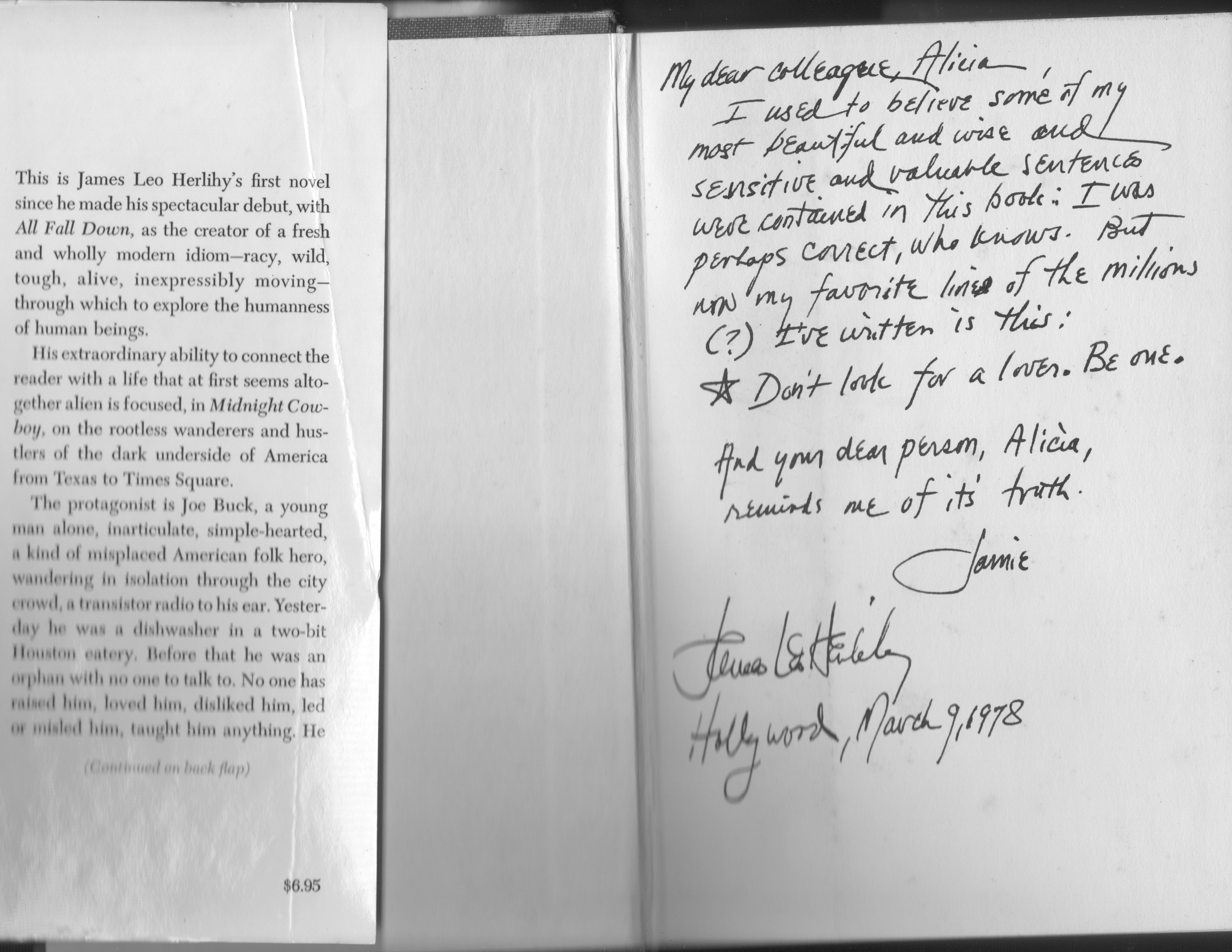
A mutual friend reconnected us in 1977, and, after that, I was a frequent guest in his home in the Silver Lake district of Los Angeles. It was during those happy times that he gifted me with his book, The Midnight Cowboy, with this sweet inscription. I gifted him with a drawing of his face as a huge photo on the wall of a living room, with Marlene Dietrich admiring it from the sofa. He had a movie screen-sized photo of her face on one wall of his living room. “That’s the size I’m accustomed to seeing her,” he told me.
Jamie had been Anais Nin‘s confidante, and told me this story: In her forties, Anais told him that she wanted to die at fifty, so she would be “always the ingenue, never the dowager.” When he reminded her of this as she lay dying at seventy-two, she replied, “How could I have known that my best years would come after?”
In 1980, Jamie’s long time partner, Bill Lord, was one of the first gay men to perish from AIDS. After that, Jamie’s life centered on hospicing and eulogizing many of his beloved friends. In 1991, when it became clear that he, too, was succumbing to the virus, he took his own life. I was devastated. Only one year later, a three-drug therapy came into use that could have saved him.
My mother, Verna Lebow Norman, a sculptor and painter, taught me and my siblings to blow eggshells and paint them when we were in elementary school.
My method: I use a thick hand sewing needle to pierce one end of the shell and to chip off tiny pieces until there is a hole about 1/4 across. Using the same method, I make a bigger hole at the other end. Then I use the needle to break up the yolk. I blow through the small hole, so the raw egg goes into a bowl through the bigger hole. (If it’s very hard to blow out the egg, make bigger holes, and scramble the egg more thoroughly.) Then I let the egg shell dry for a day or two, so the remaining raw egg white seals and hardens the inside of the shell. I don’t cook with the raw eggs that are blown out of the shells, because they have shell fragments in them. Once the shells are completely dry inside and out, I like to seal up the holes by gluing circles of colored tissue paper over them. By gluing on a loop of ribbon or cord at the narrower top of the shell, the decorated eggs can be displayed by hanging them from a horizontally suspended, slender tree branch. This allows each eggshell to be viewed on all of its curving surfaces.
Most of these painted eggshells are from a decade of my life inwhich each spring I would prepare blown eggs for myself and some children I knew, and we would paint them together, using enamel paints and nail polish, and sometimes glue things onto them. Mine were mostly “wish eggs” – visualizations of experiences I wanted to materialize.
I will also share here a couple of eggshells that I prepared and decorated around the age of 10.
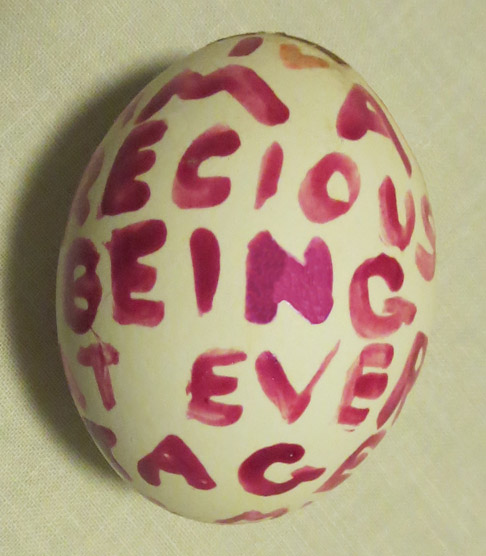
I painted this eggshell (with nail polish) shortly before I turned 40. It says: “I am a precious being at every stage of my life.” Yes, we all are.
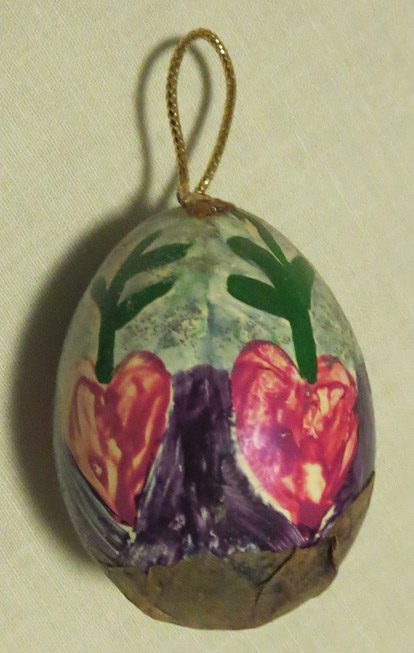
Here are three views of an egg I painted a few years later, in celebration of vegetable gardening. I painted asparagus, rutabaga, radishes, crookneck squash, scallions and tat soi.
Here’s an eggshell with the opening line of Paul Desmond’s jazz classic, “Take Five,” a song I learned to sing and to play on guitar.
This egg is a wish from my 25 years based on Maui, to make friends with a whale in the ocean.
This one depicts a lop-eared rabbit of my acquaintance, contemplating a carrot patch after a long night of hiding Easter eggs.
This one reminds me of the last line of Amanda McBroom’s song, “The Rose.”
“Just remember in the winter, far beneath the bitter snows,
Lies the seed, that, with the sun’s love, in the spring, becomes the rose.”
A (purple!) guitar and a colorful stream of musical notes: a wish egg for joyful song.
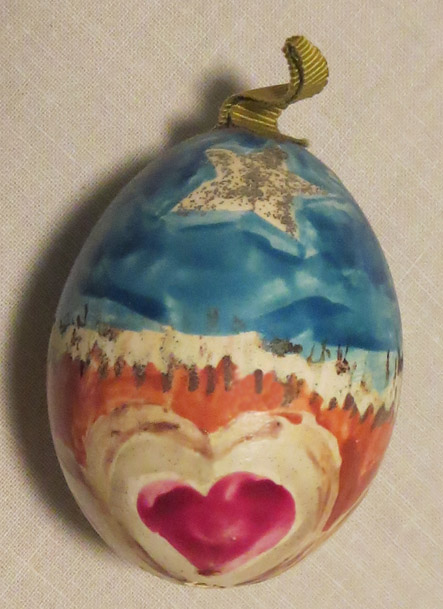
Here is a wish egg for romance! It came true, too.
Here are a couple of the eggs I decorated when I was about ten years old:
“The Girl in the Pink Turban,” and “The Lady in the Lace Mantilla.”
Sophia Rose, very creative herbalist, writer, photographer, designer, life artist, and my good friend, assembled this video collage of art from my books and photographs of me and my communal friends in the early 1970s in Northern California, to a fragment of my autobiographical jazz waltz, “1966.” You can savor Sophia Rose’s divine herbal and artistic offerings at La Abeja Herbs.
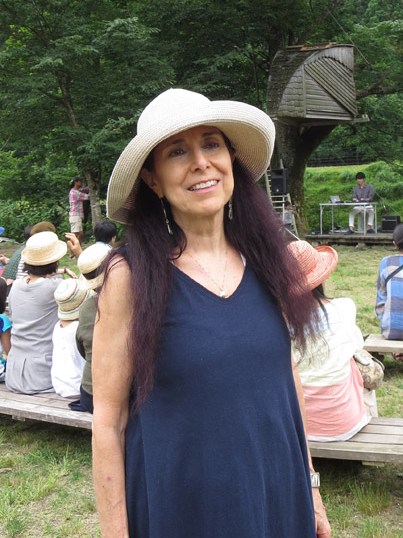
Kaorico Ago Wada’s portrait of Alicia Bay Laurel at Cafe Millet, near Kyoto, on June 13, 2015.
Here‘s a link to Hikaru-san’s article and photos in the magazine he founded in the 1970s and has edited since then.
Here‘s a link to a video he made of my performance at Art Cafe Naksha in Awajishima of a famous old peace song, “Last Night I Had the Strangest Dream,” on July 11, 2015. I tell the story of the song (at some length) before I sing, but, once I begin singing, people join me, and, in the instrumental break, and to the end of the song, everyone gets up and dances in a circle, echoing the lyrics: “…and the people in the streets below were dancing ’round and ’round…”
Here is a link to a video he made of my performance at Modern Ark Pharm Cafe in Kobe of my song Beautiful, Beautiful, June 28, 2015.
Here is a link to a video he made of my performance at Modern Ark Pharm Cafe in Kobe of my song Paisley Days, June 28, 2015.
The very last performance of the Amana Band (Hiromi Kondo on African percussion, Sachiho Kojima on electric bass, and Yoko Nema on harmonium – and we all sang) was on July 4, 2015. We were all modeling purple clothes for the Little Eagle fashion show at Tenkuu No Cyaya in Tamagusuku, Okinawa.
Schedule as of July 13, 2015
06/05 Naot (shoe shop), in Kuramae, Tokyo, book signing for Mille Books’ “Welcome to the World” by Yuko Hirose and illustrated by Alicia Bay Laurel, live talk and art show, start at 19:00 http://naot.jp
06/06 Café Slow in Kokubunji, Tokyo, live music, featuring the great traditional Japanese singer Ikue Asazaki, plus Little Eagle fashion exhibition and fashion show, start at 19:00, phone 042-401-8505 http://event.cafeslow.com/?eid=1080760
06/13 Café Millet in Takao, Kyoto, live music, Little Eagle fashion exhibition and fashion show start at 14:00, phone 075-741-3303, http://blog.cafemillet.jp/
06/14 Cacao Magic in Kyoto, live music and Little Eagle fashion exhibition, start at 15:00, phone 075-757-8914, http://www.cacaomagic.com/
06/20 Café Jisouan in Sue, Gifu, live music and Little Eagle fashion exhibition, start at 14:00, phone 0572-65-2010, http://jisouan.blog.fc2.com/
06/21 NAOT Shoe Shop in Nara, live music and gallery show of original drawings from Living on the Earth. Start at 18:00, phone 074-220-6887, http://www.kazenosumika.com/
06/27 (Nepal fundraiser) at Little Eagle Atelier in Nishio, Aichi, live music and fashion exhibition, start at 15:30, phone 0563-53-3393, http://www.little-eagle.net/
07/03 Café Unizon in Ginowan, Okinawa, live music with vocalist/multi-instrumentalist Takuji, and Little Eagle fashion exhibition. Start 19:00 phone 098-896-1060, http://www.cafe-unizon.jp/
07/04 Tenkuu No Cyaya in Tamagusuku, Okinawa, live music with Sachiho Kojima, Yoko Nema and Hiromi Kondo (the Amana band), plus Little Eagle fashion show and fashion exhibition. Start 17:00, phone 098-948-1227, http://www.ten.hamabenocyaya.com/
07/08 Mana Natural Café, Naha, Okinawa, live music event with Sachiho Kojima. Start 19:00.
07/11 Art Café Nafsha in Awaji-shima, live music and Little Eagle fashion exhibition, start at 19:00, phone 0799-64-1121, https://www.facebook.com/cafenafsha
07/12 Art & Craft Village in Misaki, Okayama, live music and Little Eagle fashion exhibition, start at 18:00, phone 0867-27-3733, http://arts-craftsvillage.com/
07/16 Manos Garden in Hiroshima, live music and Little Eagle fashion exhibition, start at 18:30, phone 082-294-5660, http://www.manosgarden.com/
07/17 Urban Research/DOORS in Osaka, live music event. Start 19:30, TALK : 19:30, LIVE : 20:00. Phone 06-6120-3270, http://www.urdoors.com
07/19 Bagus in Wakayama live music, Little Eagle fashion exhibition and fashion show, start at 19:00, 073-444-2559, http://www.wakanoura.com/bagus/
07/24 Kagure in Omotesando, Shibuya, live music and talk, CANCELLED.
07/25 Surfers’ in Zushi live music and hula show with Miho Ogura and her halau (hula troupe), and the Inoue Ohana Band Start at 16:00, end at 20:00, phone 046-870-3307, http://surfers.jp/
07/26 Chikyu-ya (“Earth Café”) in Kunitachi, Tokyo, with the Inoue Ohana Band, plus Miho Ogura and her hula halau. Hawaiian music and dance! Starting at 20:00. Also featuring the band Little Tempo. Phone 042-572-5851, http://chikyuya.info/ CANCELLED
07/29 Live music with dinner in Gifu for Murmur Magazine, at Smoke House Warawazu, with Millet Hattori and friends. 18:00 open, 19:00 dinner, 20:00 live music. http://warawazu.yu-yake.com CANCELLED
08/01 Susu (Furniture and furnishings shop) in Setagaya, Tokyo, book signing for Mille Books’ “Welcome to the World” by Yuko Hirose and illustrated by Alicia Bay Laurel, live talk and art show, start at 19:00 http://www.susu.co.jp CANCELLED
08/02 Gallery Kan in Fukushima live music and Little Eagle fashion exhibition, start at 18:30, phone 024-932-8756, http://www.gallery-kan.com/ CANCELLED
08/04 Under The Light Yoga Studio in Yoyogi, Tokyo. “Instant Book” art workshop at 13:30 and live music event at 18:00. Organized by Rie Kuwahara of RieTreat. Mail@rietreat.com, http://www.rietreat.com/ CANCELLED
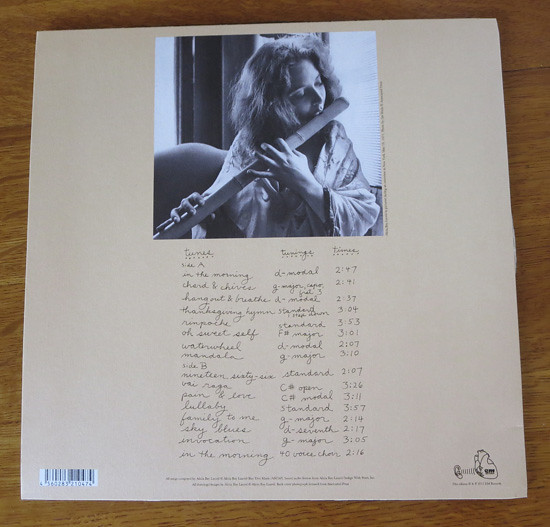
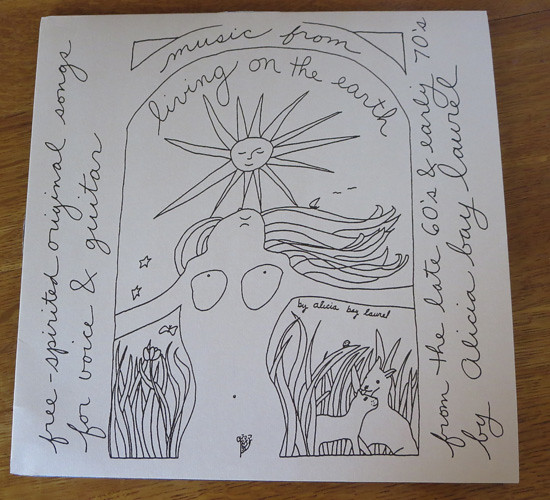
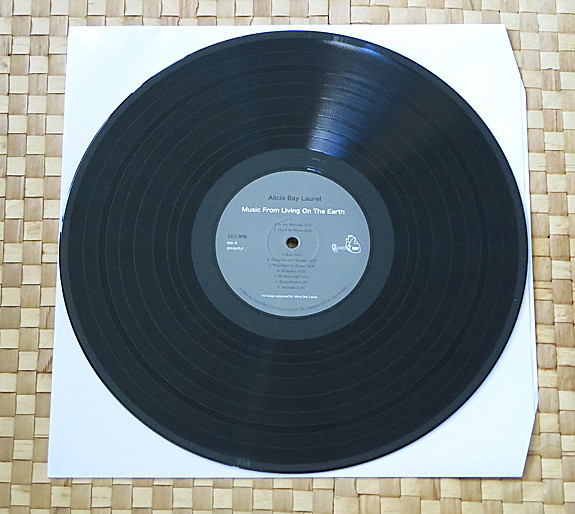
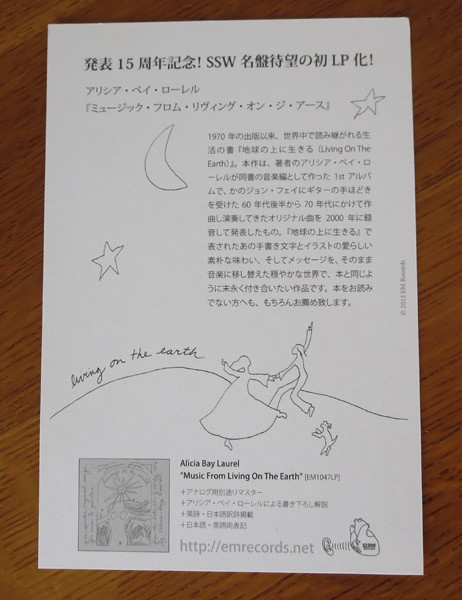
“Music From Living on the Earth,” my first ever vinyl LP arrived today – 5 copies. EM Records, in Osaka, made the LP from my first CD, the one I released in 2000 for my self-made eight-month national tour promoting the 30th anniverary Villard/Random House edition of Living on the Earth. On the back cover is a photo that was taken in 1971 during a New York City book tour for the Vintage/Random House second edition of Living on the Earth. EM Records licensed it from the Associated Press.
I somehow never imagined my music would be recorded on vinyl. During the years that 33 1/3 albums were the standard presentation of singer/songwriters, I was writing lots of songs, but I was not at a professional level as a musician. By the time I felt ready to record, at age 50, the technology had blessedly changed. I could produce my own CDs, instead of hoping to be discovered by a record company. So, I did. I’ve made eight of them, so far.
However, I actually WAS discovered by a record company. Koki Emura, the owner/producer of EM Records, saw my first two CDs when I posted them at the CD Baby online indie record store, where he was browsing for new releases. He knew my book, and he knew it was popular in Japan. He bought copies of the two CDs, listened and liked them, and offered license them both for distribution in Japan with Japanese language covers and liner notes. They were released in Japan in 2005. The following year I began doing concert tours in Japan, and I sold plenty of them for him.
In 2014, Koki Emura proposed that “Music From Living on the Earth” be released as a vinyl LP. Of course, I agreed. So here it is. A thousand thanks to you, Emura-san!
Review of the LP, Music from Living on the Earth, on soundohm.com:
“Alicia Bay Laurel is well known as the writer and illustrator of one of the classic books of the back-to-the-earth movement, the 1970 hand-written guide to living the good life, Living On the Earth. She is also an accomplished singer, songwriter, and guitarist, the latter skill honed by studying with John Fahey. The songs on Music from Living On the Earth were composed concurrently with the writing of the book, permeated by the sun and soil of the commune life. Bright and earthy paeans to the natural world, featuring ABL’s pure, strong, and uplifting voice atop her fluid, confident, and deft steel-string acoustic guitar fingerpicking, her style showing that she learned well from Fahey. She also collaborated with San Francisco Tape Music Center co-founder Ramón Sender Barayón, who contributes the 40-voice choral arrangement for the closing track. Although these songs were written as the ’60s became the ’70s, Music from Living On the Earth was actually recorded in 2000, first issued as a self-produced CD, and reissued on CD by EM Records in 2006 (EM 1047CD). This 2015 15th anniversary edition is its first appearance on vinyl, and includes liner notes by the artist as well as English and Japanese lyrics, allowing listeners to again hear ABL’s blues, jazz, and Indian music influences meld with folk roots to glorious effect.”
Here’s how an antimacassar (a lace doily, often affixed to the arms and backs of overstuffed chairs, in bygone eras) can be made into a lace ornament for a Christmas tree. At a crafts store, buy a bottle of stiffening agent. Lay some waxed paper on a table, put the antimacassar on top, and paint the stiffening agent on both sides of it. Let it dry on the waxed paper (and wash the stiffening agent out of your brush!) When it’s dry, it will hang perfectly flat. A small paperclip, unbended into an S shape, makes a good hanger for it.
My friend Randy Carnefix explained how these doilies got their peculiar name. A century ago, many men used an oily hair dressing made in Makassar, Indonesia, from coconut or palm fruit oil, perfumed with essential oil of frangipani (plumeria) blossoms. In an effort to protect their appolstered chairs from the greasy heads and fingers of men thus groomed, housekeepers began placing lace or embroidered pieces of cloth on the backs and arms of their chairs. When styles changed, the antimacassars began to show up in thrift shops. That’s where I found the ones hanging on my tree.
I wrote this essay at the request of curator Neil Kramer, with whom I co-founded the (now defunct) online Hippie Museum. I still find it posted on various sites around the Internet – evidently it struck a chord with other people who lived in those times.
What Did The Hippies Want?
by Alicia Bay Laurel
November 19, 2001
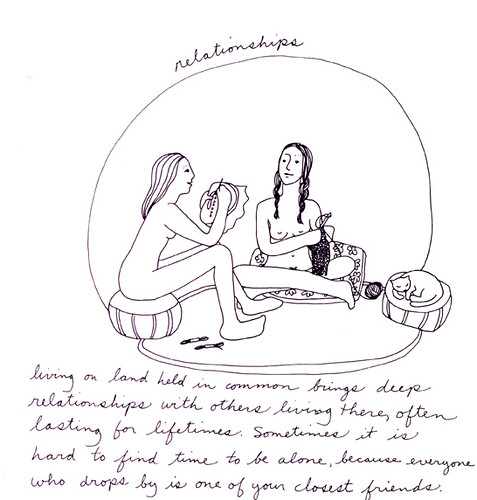
We wanted intimacy– not a neighborhood where you didn’t know anyone on the block, or you competed, kept up with the Joneses.
A hunter-gatherer or early agricultural community meant that people lived, worked and sought deeper contact with the holy spirit as a group, and they all knew one another, from cradle to grave.
I used to call my hippie friendships “a horizontal extended family,” as opposed to the ancient tribal extended family, which was multi-generational, and therefore, vertical.
We wanted a culture which acknowledged the human body, not just for sex, but to hug each other, to be naked without shame, to revere the body with natural foods, beneficial exercise, herbs, baths, massage, deep understanding. This was not part of the culture from which we came. We wanted a culture that thrived on gift-giving. We hitchhiked, shared our food and drugs, gave away our possessions. People who could afford to buy land invited others who could not to live there.
We opened free stores, free clinics, free kitchens, not just in the Haight, but everywhere we went. We wanted be living proof that God(dess) was taking care of us and therefore there was no need to hoard.
We wanted to live without the constraints of time. We wanted to wake up each day and decide what would be the most fun to do that day-–or just find out as it went along. We wanted to go with the flow, follow our bliss, be here now.
This was in complete opposition to the culture from which we came.
We wanted new ways to value one another, rather than by wealth, status, looks, achievements, machismo, as our culture of origin had taught us, and continues to teach us through the media. We wanted to value one another for being lovable and real.
We valued spiritual depth, which we referred to as “heavy.” We admired one another for being happy. We admired those who offered selfless service or peaceful resolution of conflict. We wanted a spirituality that actually caused you to grow as a person, not one in which people attended religious gatherings for social status. We wanted to be guided by our own Inner Spirits, rather than by priests.
We thirsted for the spiritual awareness and grace we experienced on psychedelics, without psychedelics, or in addition to them. Many hippies would spend their last cent on a weekend workshop that promised to “change your life forever.” That was how so many gurus found followers in those days.
We wanted to live in harmony with the earth, the plants and animals, the indigenous peoples of the earth, with each other, with ourselves. We were the fuel behind the rapid expansion of the environmental movement. We experimented with living arrangements that we thought would harmonize with nature. We sought out indigenous tribal elders as our teachers.
We wanted to make the things we wore and used with our hands, grow our food and medicine, feel all kinds of weather – all the experiences our modern urban lives had excluded in the name of convenience and comfort. We wanted to live on the road, have adventures, build things that hadn’t been built before, and live in them.
We wanted to live our mythic selves, give ourselves names that resonated with our souls, dress in costumes that expressed our dreams, do daring deeds, dance as if no one was looking, decorate our homes with magical things, listen to music that took us out of ordinary reality into altered states of awareness.
We wanted to see life without violence. We wanted media that contained truth. Some of us risked our lives to find out what the government was doing and let the underground press know. We wanted to talk about things in print that we were not allowed to discuss in our culture of origin.
We wanted to live without stupid, arbitrary rules, either for ourselves or for our children. Some of our children, as adults today, say they wish we had been more protective of them, or offered more structure. We only knew what we endured, being as culturally different from our culture of origin as Chinese are from Italians, and punished for it, and wished to spare our children these experiences. However, some portion of kids raised by hippie parents grew up to be hippies themselves. At that point, one can say, a new culture was born and continues.
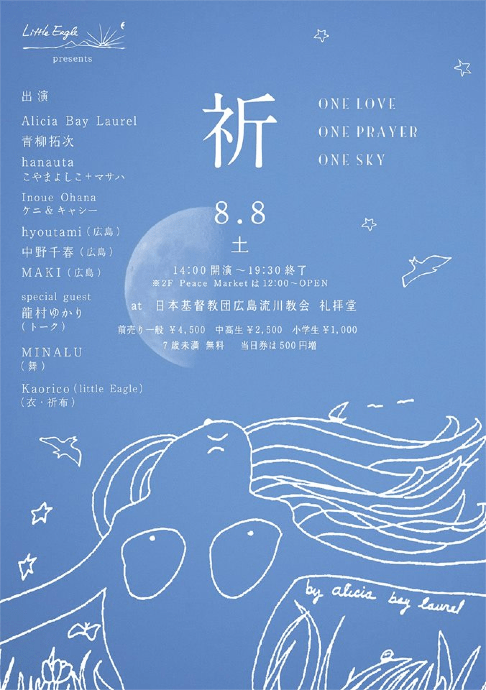
The entire cast and the audience of the all-day peace concert at Nagaregawa Church, at ground zero in Hiroshima, during the 70th anniversaries of the atomic bombings of Hiroshima and Nagasaki, on August 8, 2015, stood in a circle around the circumference of the church , surrounded by a garland of 1,000 folded cranes (in memory of those that perished in these attacks), singing together “Last Night I Had the Strangest Dream” in both Japanese and English.
“Last Night I Had the Strangest Dream” is a visionary peace song written by the late folksinger and peace activist Ed McCurdy in response to the atomic bombing of Hiroshima and Nagasaki, and copyrighted in 1950. I first heard it as a child on Pacifica Radio, the pacifist radio network created by the US peace movement during WWII, and which is still broadcasting from many cities around the United States.
I sang it at Nagaregawa Church, at ground zero in Hiroshima, two days after the 70th memorial of the atomic bombing of Hiroshima, on August 8, 2015. I would like as many people as possible, all over the world to sing it, in many languages. I read that it has been recorded in 76 languages, so I can safely assume that world peace is a very much beloved idea. At Hiroshima, I sang it in English and Japanese, so I am offering the words here in both languages.
Here are the lyrics in English:
Last night I had the strangest dream I never dreamed before I dreamed the world had all agreed To put an end to war.
I dreamed I saw a mighty room The room was full of men And the paper they were signing said They’d never fight again.
And when the paper all was signed And a million copies made They all joined hands and bowed their heads And grateful prayers were prayed.
And the people in the streets below Were dancing ‘round and ‘round And swords and guns and uniforms Were scattered on the ground.
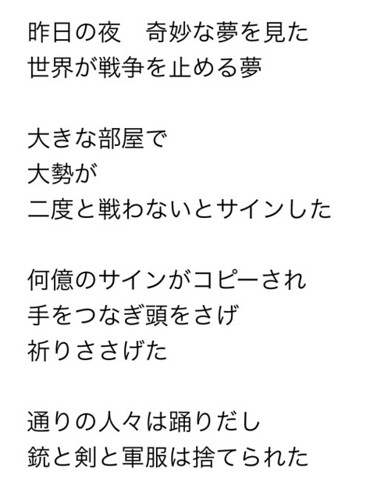
Here is a translation of the lyrics into Japanese created by the wonderful singer/songwriter Maiko Kodama in 2013.
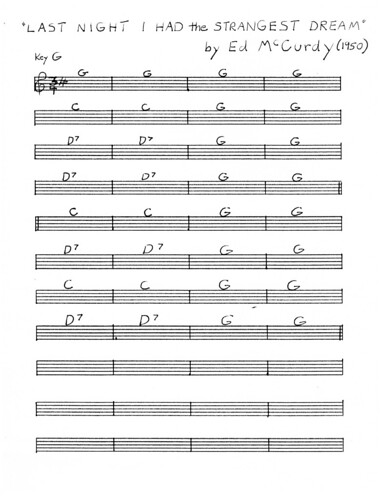
Here is a guitar chart in the key of G, the key in which I sing this song.
If you are an English-speaking person, and want to learn Maiko’s Japanese lyrics phonetically, here is how they go:
Kee noh yoh roo kee myo oh nah
Last night I had the strangest dream
Yoo mei woo oh mee tah
I ev – er dreamed be fore
Sei kah ee gah seh nn soh oh
I dreamed the world had all agreed
Woh yah mei roo oo yoo mei
To put an end to war
Oh oh kee nah heh yah deh
I dreamed I saw a mighty room
Oo oh zei gah
The room was filled with men
Nee doh toh tah tah kah wah nai
And the paper they were signing said
Toh sah ee nee ee shee tah
They’d never fight again
Nah nn woh koo noh sah ee nn
And when the papers all were signed
Gah koh pee ee ee sah rei
And a million copies made
Tei woh tzu neh gee ah tah mah woh sah geh
They all joined hands and bowed their heads
Ee noh ree sah sah geh tah
And grateful prayers were prayed
Too oh ree noh hee toh bee toh
And the people in the streets below
Wah oh doh ree dah shee
Were dancing round and round
Jyoo toh ken toh goon poo koo
And guns and swords and uniforms
Wah soo tei rah rei tah
Were scattered on the ground
Kee noh yoh roo kee myo oh nah
Last night I had the strangest dream
Yoo mei woo oh mee tah
I ev – er dreamed be fore
Sei kah ee gah seh nn soh oh
I dreamed the world had all agreed
Woh yah mei roo oo yoo mei
To put an end to war
Here is the concert poster for the peace concert at Nagaregawa Church in Hiroshima, a combination of the cover illustration from Living on the Earth, and a graphic layout by Kaoriko Ago Wada, the fashion designer and owner of the Little Eagle organic fiber, fair trade clothing company, who coordinated the event.













 Alicia Bay Laurel
You must be logged in to post a comment.