Living in Hawaii Style: Production Notes, Liner Notes and Lyrics


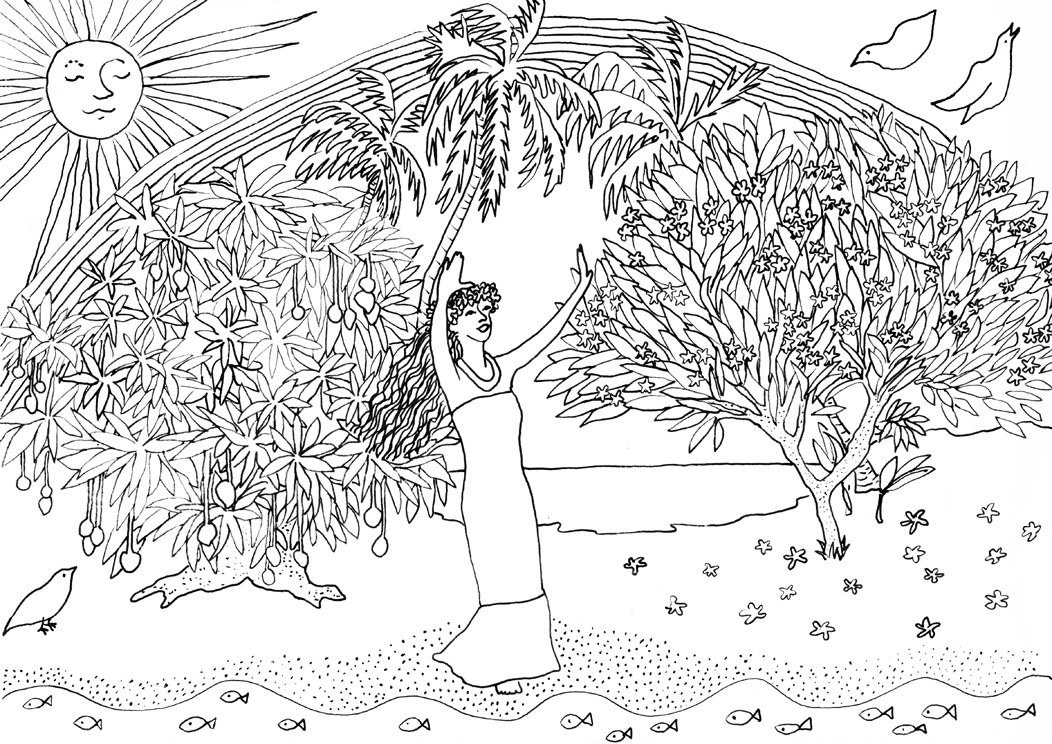
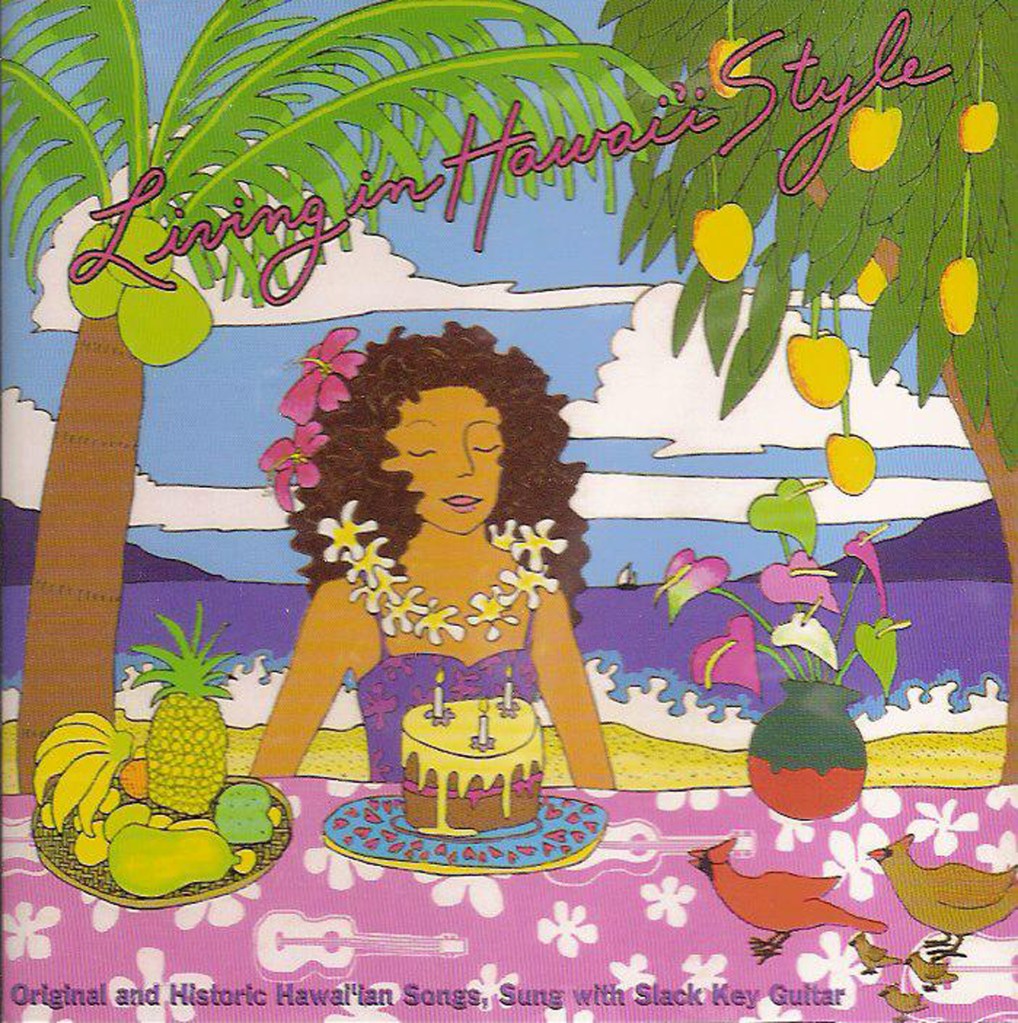
Alicia’s cover for her CD, Living in Hawaii Style, expresses the dazzling colors, sounds, fragrances and tastes of the Hawaiian islands, and the feelings of peace and well-being they engender.

After an eight-month self-coordinated national USA road tour in 2000, promoting the Villard/Random House 30th anniversary edition of Living on the Earth, and Alicia’s first (self-produced) CD, Music from Living on the Earth, with 75 performances of Alicia’s original one-woman two-act comedy/storytelling/original music show, Living on the Earth: The Musical, Alicia returned to Rick Asher Keefer’s Sea-West Studios in Pahoa, Hawaii, and began recording her second CD, Living in Hawaii Style.

For these tracks, a combination of historic Hawaiian songs and Alicia’s original Hawaiian-style songs, Alicia called upon two great Hawaiian musicians:

Lei’ohu Ryder: A spiritualist, composer, performer, recording artist and educator, with deep roots in Hawai’ian culture, Lei’ohu raises her superb voice in song and Hawai’ian chants, which she can compose on the spot (there’s one on this CD.) Her psychic abilities yielded the discovery of the Kukuipuka heiau (temple ruins), which she and others are restoring. She had recently performed with Alicia’s partner, avant-garde jazz musician Joe Gallivan’s ensemble at the 2000 Bell-Atlantic Jazz Festival in New York City when Alicia invited her to collaborate on this album. 

Sam Ahia: Widely respected throughout the state of Hawai’i (and elsewhere) as a great jazz guitarist/vocalist, Sam has appeared on dozens of recordings, including his own, including the all-original Ukumehame, and Sam Ahia, a collection of Hawai’ian favorites. Alicia studied guitar with Sam Ahia for two years.

The album opens with Alicia’s Hawaiian happy birthday song, Hau’oli La Hanau, the only existing recording on which Alicia plays an ukulele.  Rick Asher Keefer joined her on ukulele and Hawaiian percussion, and invited some of the children in the neighborhood to join her in singing the second verse.  This, the least sophisticated song on the album, or maybe on all of her albums, became, far and away, Alicia’s most downloaded song. 

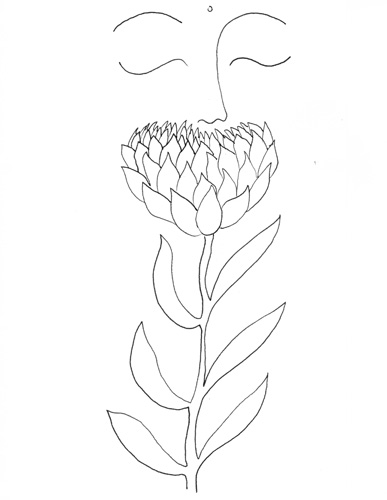
The cover of the album began as an ink line drawing on an invitation to a beach party Alicia held on her 35th birthday, in 1984.  While working on the album, in 2001, Alicia had just begun learning Adobe PhotoShop, and used it to color the drawing for the cover art of the album.

Alicia also scanned a letter she received in 1986 from the legendary slack key guitarist, Auntie Alice Namakelua, a musician who had serenaded Hawaii’s last monarch, Queen Liliuokalani, and for whom Alicia had written a song of praise after hearing her in concert on Maui in the early 1970s.  In 1986, Alicia managed to send a cassette tape of her song to the great lady, and Auntie Alice responded graciously with a handwritten note of thanks.  This letter appears inside the front cover of the CD.

Here is a Christmas card I received from her caregiver, after Auntie Alice sent me the letter displayed in the album liner.  The deep warmth of Hawaiian family is palpable in this short missive.


For the many who only buy downloads instead of CDs, here are the complete liner notes and lyrics:

About the songs

Apologia: To those of you already rich in Hawai’ian language and lore, please excuse the vocabulary, geology, sociology and history in these notes, which I gathered for those not as fortunate as you are.

All songs are copyright (c) 2001 by Alicia Bay Laurel and published by Bay Tree Music (ASCAP), except where otherwise noted. Total running time of CD:  53:38

1.  Hau’oli La Hanau (Happy Birthday)

Music and lyrics by Alicia Bay Laurel (Key D) Time: 01:36

Lead vocal, finger-picked ukulele and rhythm guitar: Alicia Bay Laurel

Three strummed koa ukuleles, ipu (gourd drum), pu’ili (bamboo rattles): Rick Keefer

Chorus of celebrants:  Rick Keefer, Smitty Smith, Camille Thomas, Sarah Runnells, Rainbow, Moonstar

A birthday song I created for one friend and now sing for many of them.  “Hau’oli” means happy, “la” means day, and “hanau” means birth.  “Aloha nui loa”: “Nui” means big, “aloha” means love and spiritual presence, “loa” means long or forever.  “Auntie Liliko’i” is just a name with the right set of syllables to fit the song—you can put in anyone’s name you want.  Many Hawai’ians call people they love “auntie” and “uncle”, or “tita” (sister) and “brada” (brother) regardless of actual blood relationship.   A liliko’i is a passionfruit or granadilla.

Hau’oli la hanau, aloha nui loa.

Hau’oli la hanau, Auntie Liliko’i!

Lucky live Hawai’i, Hawai’i lucky, too.

Seashore to da mountain, plenny love for you!

2.  Kanikau O Hawai’i

Music and lyrics by Ginni Clemmons (self-published) (Key D) Time: 03:28

Lead vocal: Lei’ohu Ryder

Harmony vocal: Alicia Bay Laurel

Steel string and nylon string guitars: Sam Ahia

An environmental anthem written by Maui singer/songwriter Ginni Clemmons in 1988.  The first ten times I listened to it on Lei’ohu Ryder’s wonderful CD, Waiha, I wept profusely.  Profound thanks to Lei’ohu and to Ginni for sharing this song with me. “Kanikau” means “a mournful cry.”

Oh Hawai’i, you’ve lost your innocence

How can we get it back?

Have we claimed you?  Have we shamed you?

Have we spoiled the prize we’ve won?

By taking you against your will, as all greedy lovers do.

Oh Hawai’i…oh Hawai’i, we’re sorry

Those who care are crying tears of shame

But with your gentle kindness you wash our tears away

With your never-ending streams

Come reach us; come teach us your gentle simple ways

Teach us the ways of nature, so that peace can end this war

Oh Hawai’i…oh Hawai’i, we’re sorry

Those who care are crying tears of shame

But with your gentle kindness you wash our tears away

With your never-ending streams

Come reach us; come teach us your gentle simple ways

Teach us the ways of nature, so that peace can end this war

Oh Hawai’i…oh Hawai’i, we love you

Hawai’i, aloha nou, Hawai’i

3.  From Hawai’i To You

Music and lyrics by Lani Sang, Criterion Music (Key C) Time: 03:51

Vocals: Alicia Bay Laurel and Sam Ahia

Steel string and nylon string guitars: Sam Ahia

A classic from the mid-‘fifties, this graceful ballad was written by Lani Sang, of the famed Waikiki Serenaders.  I learned it from Sam Ahia when I studied guitar with him in the mid-‘eighties.  “Aloha wau ia ‘oe” means “I love you.”

I’ll weave a lei, a beautiful lei, of stars,

To greet you the Hawai’ian way,

Straight from Hawai’i to you.

I’ll take a kiss and blend it into a lei

Of fragrance so sweet and so rare,

Straight from Hawai’i to you.

Just vision, lazy days beside the sea

Underneath the coco tree;

This my love conveys to you.

So take a kiss and blend it into a lei

Of fragrance so sweet and so rare.

Aloha wau ia oe;

Straight from Hawai’i to you.

4.  Nanakuli Blues/Nanakuli/Vale of Feathers

Nanakuli Blues: Music and lyrics by Liko Martin and Thor E. Wold (American Pride Music/BMI) (Key G) Time: 04:11 (total of medley)

Nanakuli: Traditional, from the 1890’s

Vale of Feathers: Music by Liko Martin and Thor E. Wold (American Pride Music/BMI), lyrics by Alicia Bay Laurel (Bay Tree Music/ASCAP)

Lead and harmony vocals, lead and harmony guitars:  Alicia Bay Laurel

The a capella opening verse is from a hit protest song from the early 1970’s, recorded as Waimanalo Blues by the band Country Comfort. It galvanized a feeling that took shape as the Hawai’ian sovereignty movement by the centennial of the 1893 overthrow of the Hawai’ian monarchy.  The second song is an nineteenth century Hawai’ian song about Nanakuli, a seacoast town west of Honolulu. The third song consists of lyrics that I wrote soon after hearing the first two. In 1981, Liko Martin showed up at a recording session I was doing in California. I sang my lyrics for him; he insisted that I should record them, and, Liko, twenty years later, you got your wish.

Nanakuli Blues  (verse 2)

Tired and worn, I woke up this morn’,

Found that I was confused.

Spun right around and found I had lost

The things that I could not lose

The beaches they sell to build their hotels,

The old Hawai’ian families knew.

The birds all along the sunlight at dawn

Singing Nanakuli Blues.

Nanakuli

O ka leo o ka manu

E ho’i mai e pili

Keiki o ka aina i ka pono a o Nanakuli e a

E ho’i mai e pili

Translation:
The voice of the bird,
Come close.
The children of the land Nanakuli are righteous;
Come close.

Vale of Feathers 

In the vale of feathers, morning dawns

Like a lovely woman coming on.

Oh, pool of tears, wash over me;

Take my sorrows down to the sea.

‘Cause when I look back at what I lacked,

I miss the high times when they come by.

Treat the people and the islands kind;

You know it’s not about the bottom line.

In the gardens of the bountiful,

We  will wander through a meadow to a pool.

Oh, mother island, plenteous,

You feed us from your flowing breast.

‘Cause when we look back at all we lacked,

We  miss the high times when they come by.

Treat the people and the islands kind;

You know it’s not about the bottom line.

In the vale of feathers, land of song.

The cardinal, the mynah, and the dove.

Oh kona wind, please carry this song

To the ears of the ones that I love.

When you look back at what you lacked

You’ll miss the high times when they come by.

Treat the people and the islands kind;

You know it’s not about the bottom line.

5.  Waikaloa

Music and Lyrics by Alicia Bay Laurel (Key A) Time: 04:25

Vocal and slack key guitars: Alicia Bay Laurel

My first Hawai’ian music teacher, Clara Tolentino, and her husband, Joe, raised their children in a house without electricity or telephone at the end of the road in Waikaloa, and I would visit them there in the 1970’s.  Vocabulary: “Pele” is the volcano goddess. “A’a” is sharp, jagged lava.  “Laupaho’eho’e” is smooth, ropy lava. “Heiau” is an ancient Hawaiian temple, or the ruins of it.  “Ki ho’alu” is slack key, or open-tuned guitar picking. “Koa” is a tropical hardwood used for making furniture—and the best ukuleles. Bamboo is used to make pu’ili rattles. “Pahu” is a wooden drum played with hula kahiko (ancient style hula) and chanting.  “Ipu” is a gourd drum. “Pu” is a large conch shell used as a wind instrument.  “Waikaloa” literally means “fresh water that is endless.”

Waikaloa, beautiful newborn land,

From the mountains you came,

From the smoke and the flame,

From a wave of Pele’s hand.

Waikaloa, rainforest by the sea,

With your lava rock walls,

And your trees green and tall,

Here the ancient ones live on in dreams.

I’m walking slow in Waikaloa

Come play some music with my friends,

Over a’a and laupaho’eho’e,

An old steel string guitar held in my hands.

Waikaloa, north shore of Hana Bay,

Where the heiau once stood,

Where the fishing’s still good,

Where the old ki ho’alu still plays.

We sang all night in Waikaloa;

The sun rose from the sea when we were through.

Our sounds of bamboo and of koa,

The pahu, the ipu and the pu.

Waikaloa, mystery is your song.

You’re the wrinkle in time

Where the past and present rhyme;

You’re the waters that flow ever long.

6.  Ukulele Hula

Music and lyrics by Alicia Bay Laurel (Key G)  Time: 04:15

Lead and harmony vocals, slack key guitar: Alicia Bay Laurel

Ukuleles: Rick Keefer

On my first night in Hana, in the spring of 1974, I was camping in the jungle behind a friend’s house, and, next door, a wedding reception was in full swing.  In true Hana style, the celebrants took turns making music, performing hula and telling funny stories until dawn, while I was falling asleep and awakening, absorbing it all.  In the morning, this song rolled out of my head.

I’m dreaming to the sound of ukuleles

Playing all night long for a wedding of our family.

In paradise, everybody is lover,

And the more you let go, the more that comes back to you.

So, surrender to the beautiful island,

And she’ll give you everything that you need.

Feasting on a sun-ripened papaya,

Playing all day in the waves along the sand,

Breezy afternoon and a sunset on the ocean,

Sailing away on a song of Bali Hai.

Let me make you feel good; that’s what we’re here for:

For ecstasy, delight and bliss.

It’s so balmy, such a balmy evening,

To melt in love in a tropical paradise.

Let’s swing and sway to the sound of ukuleles

Like the gentle green fronds of the lovely coconut tree.

Surrender to the beautiful island

And she’ll give you everything that you need.

I’m dreaming to the sound of ukuleles

Playing all night long for a wedding of our family.

In paradise everybody is a lover,

And the more you let go, the more that comes back to you.

7.   Holua, Kapalaoa and Paliku

Music and lyrics by Matthew Kalalau (self-published) (Key F) Time: 03:22

Opening chant composed and performed by Lei’ohu Ryder (she accompanies herself with ti leaf rattles)

Lead and harmony vocals, melody slack key guitar: Alicia Bay Laurel

Harmony guitar: Sam Ahia

Written by Clara Kalalau Tolentino’s brother, Matthew Kalalau, about the three camping sites in the volcanic valley surrounded by the summit of Haleakala (“house of the sun”).   Clara taught me the song in 1976, when we spent three days hiking in Haleakala.  She choreographed this song, and sang it in her heavenly voice with ukulele, soon after our trek, at a fundraiser for the Hui Aloha Church, with five of her young female relatives dancing, each wearing a maile lei made from maile we had picked on our way down the Kaupo Gap from the mountain, and each in a holoku (Victorian gown) of a different color, one of which I sewed.  

Lei’ohu’s Opening Chant:

Eia la wahipana la
E ola e ola e ola la
Eia papa hele mu
E ala e ola e ola Haleakala

Lei’ohu’s translation of her chant:


Here it is sacred–
Life, life, life…
Moving forward with the people
To awaken life, Haleakala.

Uncle Matthew’s song:

I ke ia makou ka nani a o Holua

Amena pali ki’e ki’e a o Hale Mau’u

I ke ia makou a o Kapalaoa

Amena pu’u kaulana a o Pu’u Maile

I ke ia makou ka nani a o Paliku

Amena pali ha uli uli; he nani po ina ‘ole

E o nei makou mele ka nani a o Holua

Kapalaoa amena Paliku

Translation:

We came and saw the beauty of Holua (“wooden sled”– used on cinder hills)

With its misty cliffs of Hale Mau’u (name of the trail, literally: “grass house”)

We came and saw Kapalaoa (“the whale tooth”)

With its famous cinder cone, Pu’u Maile

(“Pu’u” means hill, “maile” is a fragrant vine used to make an open-ended leaf lei)

We came and saw the beauty of Paliku (“vertical cliff”)

With its verdant cliffs, its beauty can never be forgotten

This, now, is our song about the beauty of Holua,

Kapalaoa and Paliku.

8.  Sassy/Manuela Boy/Livin’ On Easy

Slack key guitar: Alicia Bay Laurel (Key G) Time: 03:15

Three drinking songs, each about one hundred years old.   Sassy was written by Kokolia, circa 1890, and describes the “saucy” girls (hookers) sashaying about Honolulu.  Manuela Boy was a hit for the singer Hilo Hattie in the 1930’s.  Livin’ On Easy inspired hundreds of humorous verses over its long history as the quintessential party song.  Even Clara Tolentino sang me a verse she made up.

9.  Moonlight and Shadows/Blue Lei

Music and Lyrics: Moonlight and Shadows by Leo Robin and Friedrich Hollaender, Paramount Music/ASCAP; Blue Lei by R. Alex Anderson and Milton Beamer, Universal Polygram/ASCAP. (Keys Bb and C) total time: 04:04

Vocals: Alicia Bay Laurel and Sam Ahia

Steel string and nylon string guitars: Sam Ahia

This medley is another of my favorites from Sam’s repertoire which I learned in the course of studying guitar with him. This genre of swing tunes with tropical lyrics is known in the islands as “hapa ha’ole”, meaning half-foreign.

 Moonlight and shadows and you in my arms,

And a melody in a bamboo tree, my sweet.

Even in shadows, I feel no alarm

As you held me tight in the pale moonlight, my sweet.

Close to my heart you always will be,

Never, never to part from me.

Moonlight and shadows and you in my arms,

I belong to you; you belong to me, my sweet.

You were wearing a blue lei

The day that I first met you,

As we walked along the sand

By the blue, blue sea.

Without a cloud in the sky to caress us,

Not a tear have you or I to suppress us.

I will always remember

The moment when I kissed you,

And the smile upon your lips was so heavenly sweet.

When your blue eyes looked in to mine,

It was then the sun began to shine,

That day in May you wore a blue, blue lei.

10.  Kawailehua‘a‘alakahonua

Music and lyrics by Frank K. Hewett, Mountain Apple Music (Key G) Time: 03:04

Slack key guitars, lead and higher harmony vocal: Alicia Bay Laurel

Lower harmony vocal: Lei’ohu Ryder

Composed by the great kumu hula (teacher, choreographer) and Hawai’ian cultural healer, Frank Kawaikapuokalani (“the sacred waters of heaven”) K. Hewett.  The title means “the lehua waters that give fragrance to the earth”, and it is the name he gave to his niece, in whose honor the song was composed. Below is his own translation of the lyrics:

Ke iho la ka ua

Halihali na lehua o luna

Helele‘i pua i ke kai

Hula le‘a na lehua i ka moana

He kupa la ka ua i ke kai

Ke ho’i hou e aloha mai

He mele nou e ku‘u lani

Kawailehua‘a‘alakahonua

The rains are falling

Like red lehua blossoms falling from the sky.

Strewn over the surface of the sea,

They dance playfully amid the waters.

The waters of the sky are well acquainted to the waters of the ocean.

It returns from the sky once more and their relationship is imbued with love.

A song for you, my heavenly one,

Kawailehua‘a‘alakahonua.

11.  Auntie Clara

Music and lyrics by Alicia Bay Laurel (Key G) Time: 03:36

Lead and harmony vocals, melody slack key guitar:  Alicia Bay Laurel

Harmony guitar: Sam Ahia

 I wrote this song in 1975, when I was living in Hana, Maui, to honor Clara Keanu Kalalau Tolentino, the town kumu hula (choreographer and teacher of the local hula halau [dance troupe], plus fountain of Hawai’ian arts and culture to the community) and matriarch of a musical dynasty that includes recording artists G-girl Keli’iho’omalu (her oldest daughter, Philomena) and Princess Keli’iho’omalu (G-girl’s daughter).  “Clara won every hula contest she entered,” remembered her sister-in-law, Mary Kalalau, “The famous kumu hula Emma Sharpe said that Clara’s choreography was divinely inspired.”   Clara taught me to sing in Hawai’ian, and introduced me to her son-in-law, Jerome Smith, who taught me to play ki ho’alu (open-tuned guitar, Hawai’ian style).  This song was an instant hit, winning me first place at the talent show of the 1975 Ho’olaulea o Hana (the annual community festival, also known as Aloha Week), a spirited event held at Hana Bay Beach Park after sunset. 

On Aloha Week in old Hana town,

I saw her ride by in a satin gown:

A goddess of flowers, a Hawai’ian queen

That everyone calls Auntie Clara.

Descended from a line of ancient kings,

She plays ukulele and dances and sings,

And what makes her happy is to hear people laugh,

Which is easy around Auntie Clara.

She lives by the sea with the man that she loves,

And they raised eleven sisters and brothers.

And now their grandchildren number forty-two;

And soon, I bet, there will be others.

And she’s taught them all to sing and to dance,

To work real hard and to love romance,

Just by the way that she spends her days,

Being happy being Auntie Clara.

She’s delivered babies and planted trees,

And walked through volcanoes; she smiles with ease.

To me, she’s the essence of old Hana town,

Besides being dear Auntie Clara.

God bless you, my dear Auntie Clara!

12.  Living In Hawai’i Style

Music and lyrics by Alicia Bay Laurel (Key A) Time: 02:43

Lead and harmony vocals, slack key guitar: Alicia Bay Laurel

“Awapuhi” means fragrant ginger (the w is pronounced v). “Ulu” means breadfruit, in this case, the great breadfruit trees of the rainforest, although it can also mean “growth”. “Kukui” is the silvery-leafed candlenut tree. “O’o” is an indigenous and endangered species of songbird. “Hula ‘auwana” (literally hula that meanders, like a stream) is the more modern form of hula, performed to melodic songs. It is the only ethnic dance in which the dancers must smile.  “’Olapa” is the ancient form of hula, serious, sacred and vigorous, performed with chanting, drums and other percussion instruments.  “Aloha” is usually translated as “love”, “hello” or “goodbye”, but literally means “the Presence (of the holy spirit) (alo) is the breath (ha).”  “Wahine” (vah-hee-nay) means “woman”, and “kanaka” means “man.”

Moving slow, laughing long, smiling the aloha smile,

Everybody loves living in Hawai’i style la la.

Down to the sea as the day is dawning,

Lavender and golden is the morning.

Snorkeling along the coral reef

Is beautiful beyond belief, oh la la.

Fragrance of the roadside awapuhi

Underneath the ulu and kukui,

Mountain apple booms; the o’o calls;

I’m swimming under waterfalls, oh la la.

The spirit of the land is the ancient chants,

The taro growing farms and the fishing camps,

Sweet hula ‘auwana, bold ‘olapa,

Aloha of wahine and kanaka.

Moving slow, laughing long, smiling the aloha smile,

Everybody loves living in Hawai’i style la la.

13.  Maui Chimes

Slack key guitar: Alicia Bay Laurel (Key G) Time: 01:57

Written by Sam Kapu in 1899, this was the first slack key piece taught to me by Clara Tolentino’s son-in-law, Jerome Smith.

14.  Kaupo

Music, lyrics and poetry by Alicia Bay Laurel (Key F) Time: 03:37

Sung and spoken vocal, slack key guitars: Alicia Bay Laurel

Kaupo literally means “arrive by night”, perhaps alluding to its remote location on the coast of the fierce Alenuihaha Channel.  “Alelelele” is the name of a stream that descends from the mountain in a series of waterfall pools, each in a box canyon.  Maunawainui: “Mauna” means mountain, “wai” means fresh water, “nui” means great.  “Nuu” means height, perhaps referring to the steep ascent to Haleakala’s summit from this coastline. “Hui” means union or gathering.

Kaupo, Kaupo, where the wild winds blow,

The shadow of your evening thrills me now.

Kaupo, the moon upon your brow

Rides high upon the desert mountain skies.

The spirits of the warrior kings

Alight upon the seashores of Kaupo.

Arrive by night, awaken to the sight

Of light caressing hillsides of Kaupo.

Oh lonely Lualailua Hills

Knowing only the sea, the sky and the mountain!

Oh mighty Maunawainui Canyon

Gathering the storm waters and flooding deeply!

Oh majestic cliffs of the Kaupo Valley

Ascending to sacred Mount Haleakala!

Oh ruthless Alenuihaha Channel!

Oh sea of engulfing waves!

Oh growling black stones of Nuu

Ever turning in the tide!

Oh waterfall upon waterfall

Singing Alelelele!

Oh Hui Aloha Church alone beside the sea

Where, in the wild winds, we gather in love!

Oh millions of stars by night!

Oh snow-capped Mauna Kea by day!

Kaupo, Kaupo, where the wild winds blow,

The shadow of your evening thrills me now.

Kaupo, the moon upon your brow

Rides high upon the desert mountain skies.

15.   Auntie Alice

Music and Lyrics by Alicia Bay Laurel (Key G) Time: 02:24

Vocal and slack key guitars: Alicia Bay Laurel

 In 1975, I attended a slack key festival in Lahaina, Maui, where Alice Namakelua, court musician to Queen Lili’uokalani during her years of house arrest at Iolani Palace after the 1893 overthrow of the monarchy, performed in her own tuning.  I was totally enchanted. That night I learned her tuning and composed this piece, what Hawai’ians call a mele inoa, a song honoring a person’s name. 

In 1986, I had a job playing music on one of two horse-drawn wagons at an agricultural theme park on Maui.  The musician on the other wagon was a young Hawai’ian named Kawika who played wonderful slack key guitar. I asked him to teach me something new.  He began by demonstrating wahine tuning, and I said, “Oh, that’s Auntie Alice Namakelua’s tuning!”  He told me that his girlfriend’s aunt was Auntie Alice’s nurse.  I asked if he would send a cassette to his girlfriend’s aunt, and he agreed.  I rushed home, recorded this song, and, sure enough, received a note of appreciation from the great lady herself, only months before she passed into the spirit realm. Her letter is reproduced in these liner notes.

Vocabulary: “Wahine (vah-hee-nay) tuning” means a woman’s tuning, in this case, Auntie Alice’s tuning.  “Holoku” (literally “walk straight”) is a Victorian style gown.  “Colors of the isle” refers to the traditional colors associated with each island.  On this night, she wore a pink holuku to honor the island of Maui.  “Iolani (ee-oh-lah-nee) Palace” was the seat of the Hawai’ian monarchy, which still stands in Honolulu.  “Aloha ke akua” means “God is love.”

I heard Auntie Alice play

Slack key guitar tuned this way

(It’s called wahine tuning)

To her gentle crooning.

Her holoku was glistening;

Everyone was listening.

She wore the colors of the isle,

Made the people smile.

She was only seventeen

Playing guitar for the Queen.

Pretty Auntie Alice

At Iolani Palace.

She hears the songs the spirits sing,

Sees the light in everything,

Alice Namakelua;

Aloha ke akua.

16.  Kipahulu  

Music and lyrics by Alicia Bay Laurel (Key F) Time: 03:10

Vocal and slack key guitar: Alicia Bay Laurel

Harmony guitar: Sam Ahia

The Kipahulu valley lies southeast of Hana town, on Maui.  I lived there and composed this song in 1976. 

Haleakala (“House of the Sun”) is the 10,000-foot volcano that comprises eastern Maui.  Mauna Kea (“White Mountain”) is the 14,000-foot volcano that comprises most of northern Hawaii island.  Kaupo Gap is the amphitheater-headed valley that comprises the eastern half of Haleakala’s “crater”, opening southward to the seacoast at Kaupo.  The original caldera and summit of the volcano eroded away long ago, but two enormous amphitheater-headed valleys—the other is the Ko’olau Gap, opening to the north side of the island—were united by volcanic eruptions that decimated the wall between them, creating cinder cones and other formations within the summit walls, and the illusion of a caldera.

If you want to call on me, this is where I stay:

In a meadow, by a mango, Mau’ulili Bay.

Life is simple in the shadow of Haleakala;

Moon and raindrops for my crystal candelabra.

Let your feet dance down the boulders to the rushing stream,

Floating chilly, willy-nilly, to ancestral dreams.

Hear the spirits of the valley sing in soft guitars;

Mark the passage through the heavens: wind and cloud and stars.

Hear the cattle call as the evening falls.

Bamboo canyon walls, silver waterfalls,

Birds of ancient lineage, brilliant in their plumage,

Hidden by the foliage down from Paliku.
If you come to call on me, this is how I live:

Contemplating God’s creation, learning how to give.

Kipahulu Valley people work the livelong day;

Then you’ll see us in the evening, coming out to play.

Sudden rain may slice the sunlight, disappearing down.

Floating on the sea’s horizon, Mauna Kea’s crown.

Kaupo Gap, oh gate of heaven, clouds advance, retreat.

Verdant pasture, sleepy rapture, sky and mountain meet.

Hear the cattle call as the evening falls.

Bamboo canyon walls, silver waterfalls,

Birds of ancient lineage, brilliant in their plumage,

Hidden by the foliage down from Paliku.
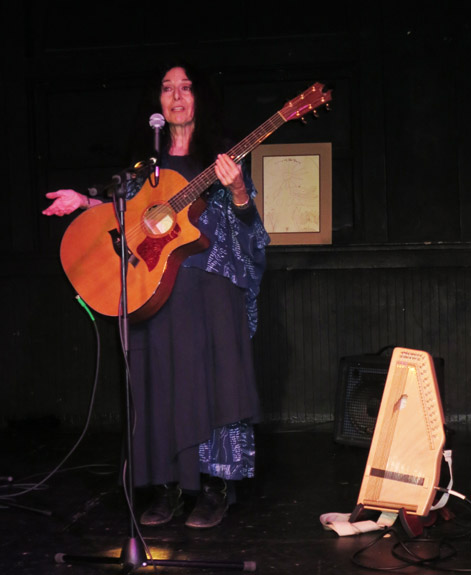
Living on the Earth: The Musical (live stage performance) – history and audience response

Telling the stories at Beyond Baroque Literary Arts Center in Venice Beach, California, November 5, 2016

The print material in my garment is white organic cotton printed with pages of the book Living on the Earth with natural indigo dye.

This fabric and ensemble were designed and produced by Kaoriko Ago Wada for her organic fiber, fair trade fashion company, Little Eagle.


Living on the Earth: The Musical, is an original one-woman, two-act show of quirky, edgy stories about the birth and aftermath of the book, Living on the Earth, plus some of the songs I wrote during these times.

During the year 2000, I performed the show 75 times during a twice-cross-country road tour plus five shows in Hawaii. I performed the show occasionally in succeeding years as well, including three shows in California and Arizona in 2016.

No two shows have been entirely identical, since I chose which of the stories to tell while on stage and interacting with the audience. And, as I accrued additional life experiences, I added a few new stories to the end.


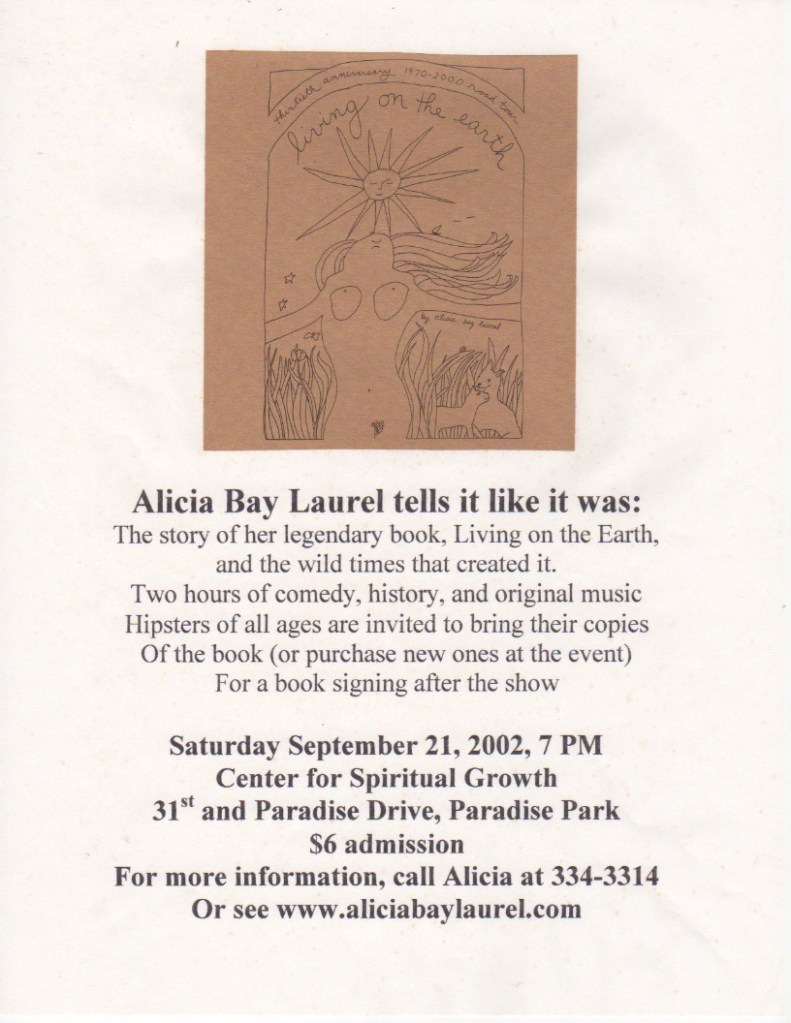
Poster for a performance in Kea’au, Hawaii in 2002


Following are comments from audience members, emailed to me after seeing the show:


“Great performance by our legendary friend Alicia this afternoon in Venice, California. It was amazing!”
Pauline Adamek, Theatre Critic, Los Angeles, California


“Alicia Bay Laurel is a wealth of storytelling! What an amazing trip she’s taking us on….”
Gwendolyn Sanford, Film Composer and Singer/Songwriter, Los Angeles, California


“My Beautiful Alicia, Thank you for a fabulous evening! We all loved it and you are Beyond Brilliant…your show was so much fun and filled with so much love, it was a happening and wonderful to behold.”
Brenda Lowy, Legal Secretary and my beloved cousin, who brought her entire household to the show
Los Angeles, California


“I am so glad that I went to hear Alicia Bay Laurel’s show tonight. The songs were great, but the story telling was amazing. She shared the life journey that led to her writing Living on the Earth and beyond. It was a fascinating history lesson and a peek at what my parents were doing just before I was born.”
Amanda Timbermoon, teacher, mother and community leader
Occidental, California


“I was so glad to be there and hear Alicia perform. No wonder the Japanese are such fans!”
Erin Sheffield, co-curator of the open land commune exhibition, “The Hippies,” presented by the Sonoma County Historical Society at the West County Museum
Sebastopol, California


“It was such a special, intimate event! An honor to be there, especially as it is the last of the kind! Alicia, your guitar playing, storytelling, songwriting and singing are authentic,uplifting, humorous,and enchanting. For me, it was a real validation of my/our/ the counter-cultural collective/ choices, experiences, and commitment to natural living, in the many forms that takes. And to see the on-going creativity, insights, and awareness you embody is very inspiring! Within minutes I was drawing again! Thank you!”
Andrea McShane Radoccia, bed and breakfast owner and natural gardener
Clarkdale, Arizona


“Dearest Alicia your musical words moved me beyond measure. I had tears in my eyes while listening to some of the lovely lyrics that you wrote. Thank you for sharing your heartfelt heartstrings last evening, it was positively divine!”
Mardy Bee, antique collector and scholar
Prescott, Arizona


“I am so grateful for being able to attend an intimate home concert with beautiful music created by Alicia Bay Laurel. Her music has different sounding elements, from hippie folk style to Hawaiian to bluesy sounding magic. I love her hippie stuff – Oh Sweet Self and Mandala are two of my favorite songs. I am smiling and spinning around my home this morning getting all my chores done. Feeling so blessed.”
Jennifer Price, Artist
Sedona, Arizona


“Alicia, we loved your concert! You should write a memoir! Seriously! Thank you for coming to Sedona and sharing your clear presence with us– come back soon! My daughters will love their t-shirts and cds, as will my husband and I. We remember those ‘Paisley Days’!”
Elizabeth Oakes, Writer and Professor Emeritus of Literature
Sedona, Arizona


Ramón Sender Barayón and Alicia Bay Laurel after singing Ramón’s sunset chant.

November 13, 2016 at the Arlene Francis Center in Santa Rosa, California.

Similar, but different, performance costume, also designed and produced by Kaoriko Ago Wada.


In 2021, I collaborated with Spanish filmmaker Luis Olano on the movie version of “Living on the Earth: The Musical,” which he filmed on November 13, 2016 while gathering footage for Sender Barayón – Viaje Hace la Luz, a documentary about the life and work of Ramón Sender Barayón, who made a guest appearance in the show. 

Video: Living on the Earth 50th Anniversary Edition

Published in February 2021 by Echo Point Books & Media of Brattleboro, Vermont. Available in our online store.

“This video looks great, and captures the feeling of your wonderful book. My sister and I adored the 1st edition of Living on the Earth, and you definitely influenced our views on the right way to live. I can’t believe it is now 50 years later!”

Mark Chickering | Project Development

ECHO POINT BOOKS & MEDIA, LLC

No-bake Vegan, Gluten-free Mango (or Peach) Pie, Maybe á la Mode

08-15-20-Panama-home-raw mango pie

Joe Gallivan’s birthday was on August 9th. I usually make a mango pie for that occasion, since it coincides with the height of mango season, but, this year, even though I had all the ingredients and equipment assembled, the mangos were green, and hard as rocks.

So, we waited another six days, until they turned golden and issued their unmistakeable fragrance.

If you live somewhere that has snow in the winter, fear not. Sliced, raw, ripe peaches can be used instead of mangos.

No need to light an oven in mid-August to make this pie.

Crust: Grind in a food processor, first a cup of cashews (neither toasted nor salted), then a cup of shelled walnuts, then, finally, half a cup of de-seeded and coarsely chopped deglet dates. Combine all three in a big bowl with a big spoon, until well blended. (Substitutions: unsalted macadamia nuts for cashews, pecans for walnuts).

Form the dough into a ball (or two), and then press the dough into the shape of a piecrust into a glass piepan or a ceramic bowl. (Or you could make tiny pies in custard cups.) Press the dough into an even thickness covering the bottom and sides of the container. Don’t place it over the lip of the piepan; it will just break off when you are trying to serve it.

Filling: Cut up the mangos inside a bowl, because, if they are ripe, they will exude a lot of juice, which you will want to capture and use. Place the bite size pieces of mango inside the prepared crusts, and measure the juice into heavy pot or a double boiler. Add more liquid, if necessary, to make a total of two cups – coconut milk, juice of another fruit, or purified water will all work. Add two droppers full of stevia liquid (or a commensurate amount of another sweetener, if you prefer), and two tablespoons of agar-agar (kanten) flakes.

Bring to a boil, and then simmer for five to ten minutes – stirring gently – until the agar-agar is completely dissolved.

Then pour the hot liquid over the mango pieces to within 1/2″ of the top of the pie shell.

Place the pies into the refrigerator, covering each one with an inverted ceramic plate, and let them chill for at least an hour.  Overnight works, too.

If you want to serve with ice cream on top, plate the pie slices first, then blend frozen peeled bananas and smooth cashew butter in your food processor and scoop out the ice cream immediately onto the pie slices and serve.

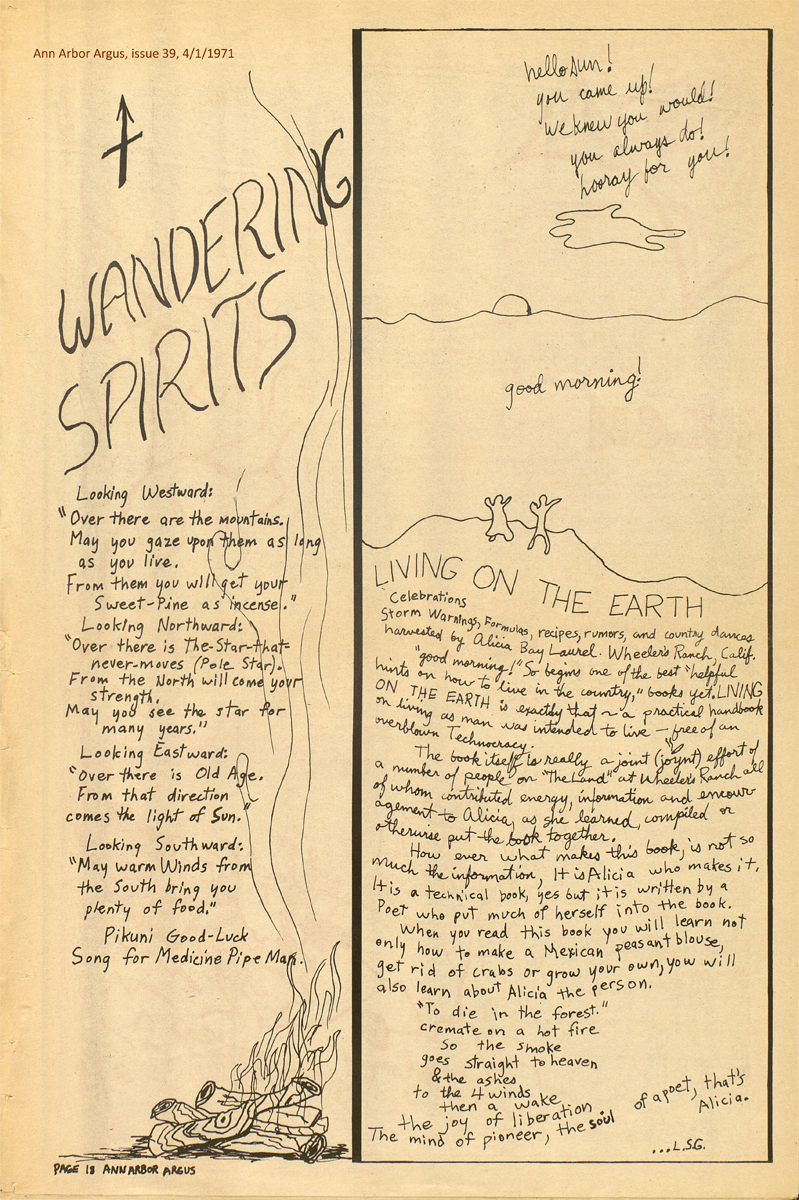
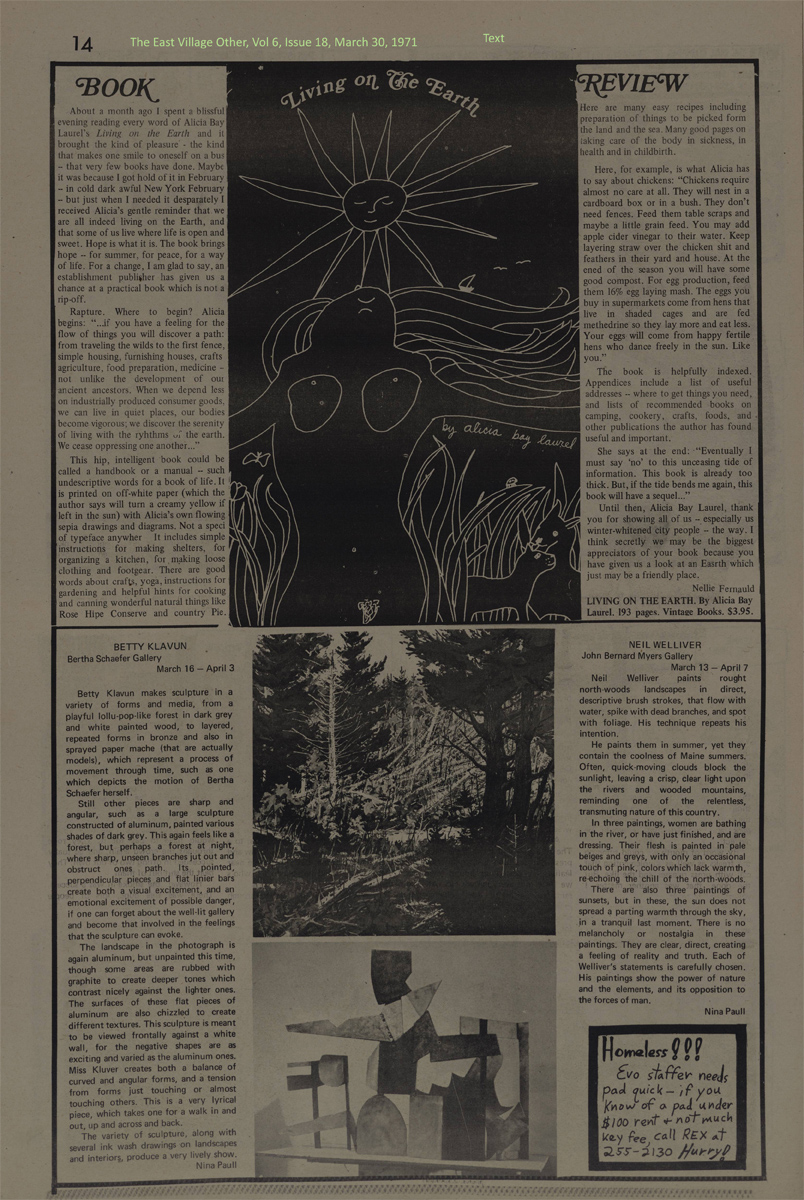
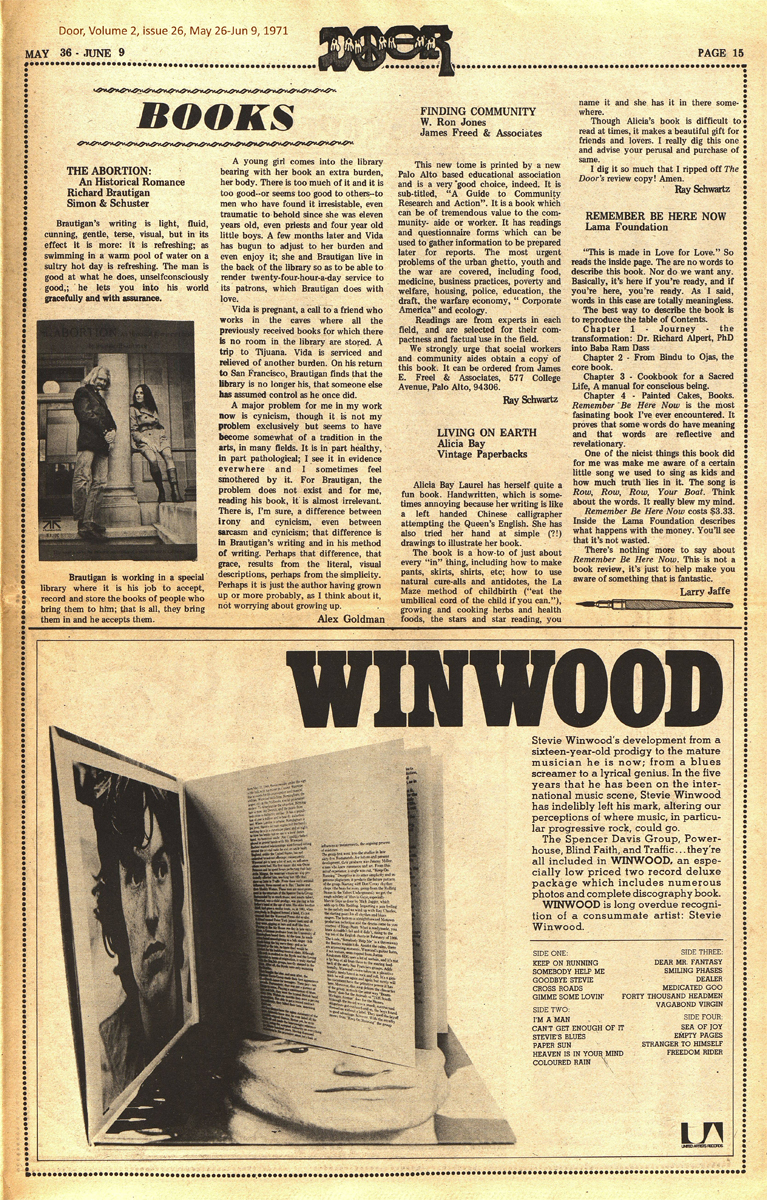
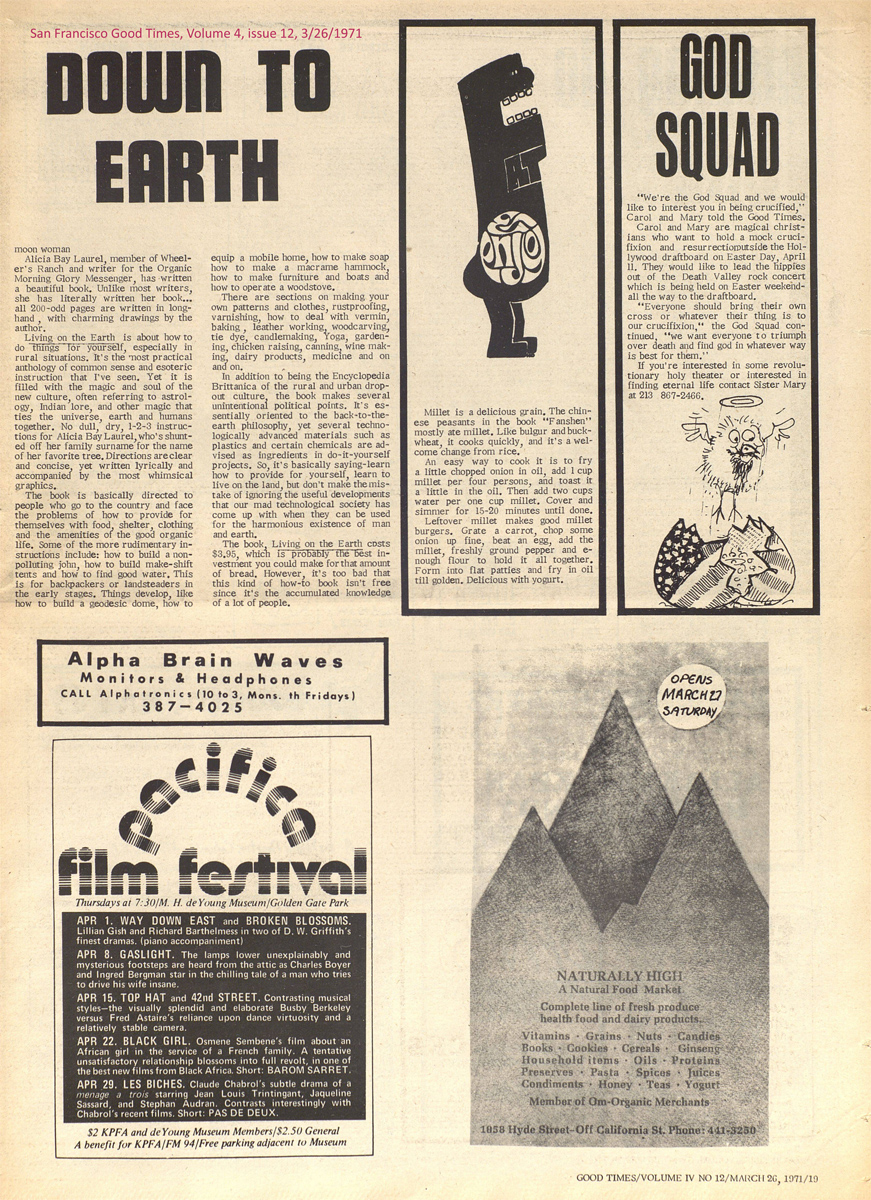
Living on the Earth reviews from 1971

Sincere thanks to wonderful Greg Castillo, Professor at the Department of Architecture, College of Environmental Design, at the University of California at Berkeley, who has been doing the first academic research and writing about Living on the Earth.

Yesterday he sent me this message: “I was just procrastinating from writing by doing some internet research on a subscription based site called Independent Voices, a database of alternative publications. I typed “Alicia Bay Laurel” into the search bar and came up with a number of reviews of Living on the Earth that you might not have.”

And here they are – five clippings displaying reviews of Living on the Earth surrounded by some of the countercultural icons among which it was born – Richard Brautigan, Steve Winwood, Baba Ram Dass’ Be Here Now, the East Village Other, How to Keep Your Volkswagen Alive, Alpha Brain Wave Monitors, and the Pacifica Film Festival.

LOTE review in Ann Arbor Argus 04-01-71-smaller

LOTE review-East Village Other 3-30-71-smaller

LOTE review-Door 05-26-71-smaller

LOTE review-Great Speckled Bird 02-15-71-smaller

LOTE review-SF Good Times 03-26-71-smaller


Appreciation for, and from, the amazing Dennis Kucinch

In the 2003 and 2004, as the US invasion of Iraq was raging, I campaigned for peace activist, US Representative, and former Cleveland mayor Dennis Kucinich‘s presidential primary run on the Big Island of Hawaii, where I was living then.  That’s me in this photo, with one foot in the street, at a demonstration in Hilo.

03-20-04-HI-Hilo-Peace demo-part of line w puppets

With my tribe of fierce peace and environmental activists, we offered voter information from booths we set up at farmers’ markets (“Dennis is the only necktie in Washington that represents YOU.  He’s anti-war! And he’s a vegan!”), got trained to offer voter registration and then offered it everywhere, including in the theatre lobby during a three-week screening of Michael Moore’s Fahrenheit 9/11 at the Palace Theatre in Hilo, and, later, got trained to be a poll watcher at our local primaries.   While engaging in these actions, I wrote my rant/waltz, America the Blues.

Our campaigning worked!  People that had never voted before turned out in droves and swamped the normally tiny Democratic Party caucuses, giving Kucinich 60% of the vote in the Puna District, 50% of the vote for the Big Island (Hawaii County), and 33% of the vote for the state of Hawaii, which, along with the state of Washington, were the two states that sent Kucinich delegates to the 2004 Democratic Party National Convention in Boston.

Those of us that had organized this victory suddenly found ourselves officers of our precincts, writing resolutions and platform planks to present at the Hawaii State Democratic Party Convention in Honolulu, which I attended.

05-29-04-HI-Honolulu-Dem Convention-ABL-smaller

I wrote nine resolutions – one to outlaw GMO crops in Hawaii, and eight for election reform.  One of these resolutions not only passed the vote on the convention floor, but also passed the vote in both houses of the Hawaii state legislature and was signed into law by the Republican governor, Linda Lingle.  That is why all forms of voting in the state of Hawaii must produce a hand-countable paper trail.  You’re welcome.

I had the pleasure of meeting Congressman Kucinich a couple of times during and shortly after the campaign.  Here’s a photo from 2006 in which he graciously posed with me after a giving speech in Kahului, Maui, on behalf of Senator Daniel Akaka’s re-election campaign, in which he ennumerated Senator Akaka’s achievements in limiting the use of nuclear weapons.

ABL meets Dennis Kucinich 2006 Maui

I then presented this brave peace activist politician with a poster print of my painting, Peace Girl, which he liked very much.

peace girl web-sized

Dennis ran again in 2007 and 2008. I would have liked to campaign for him again, but, during those years, I was responsible for my mother’s end-of-life care, and, afterwards, with addressing the various types of chaos she left behind.   Even so, I posted about Dennis’ campaign, his platform and his speeches on this blog during those years.

I was pleased to reconnect with Dennis Kucinich again in 2020, on Facebook.  I had replied to one of his posts on his wall that I had been a volunteer on the Big Island of Hawaii during his presidential primary campaign in 2003 and 2004.  I did not expect a reply, since I was one of thousands of volunteers and voters that he met during those busy years, but, to my astonishment, he sent me the following message:

Dear Alicia,

I treasure your brilliant, memorable art, and your support.

I still have it. It is extraordinary, incandescent, as are you. Yes, I remember.

Best wishes, Dennis


Examples of my art, 2017 to 2019

Seven fortune-telling cards commissioned by Creomoir, an aromatherapy and massage spa in Shibuya, Tokyo, Japan.  Please click on the images to enlarge them.


Drawing printed on Creomoir’s catalog cover and canvas tote bag.

Creomoir brochure cover drawing-90 dpi

Illustrations for souvenir ceramic tea mug set and organic cotton bath towel, featuring Amaterasu, the Shinto sun goddess carrying the sun over Mount Fuji, for the Artist Power Bank Music Festival, 2018, Tokyo, Japan.  The double-sided saucer/lid bears a Pagan proverb, “As above, so below.”


Drawing, wording and lettering for 25th anniversary commemorative canvas tote bag for People Tree, a fair-trade fashion and craft import company and chain of stores, Tokyo, Japan.

People Tree Finished Art online

Logo drawing for Miho Ogura’s hula studio, Tokyo, Japan

Art for Miho Ogura-email sized

Illustrations and lettering for Orie Ishii’s cookbook, Rainbow Sweets:  Cover, title page, end papers, chapter headings.


Logo for Orie Ishii’s organic vegan bakery, Rainbow Caravan (used on packaging and website), as printed in her cookbook, Rainbow Sweets:

Rainbow Sweets-bakery logo

Logo and commissioned drawing for AO Birth Clinic, Tokyo, Japan:


New illustrations for the two author introductions to the 2019 Spanish translation of Being of the Sun (Ser Del Sol), hand-lettered by the translator.


Logo and hand-lettering for Good Earth Sandals, Hilo, Hawaii.  Used on signage, stationery, advertising, web site and stamped into the sandals.


Screen Shot 2019-06-28 at 2.59.58 AM

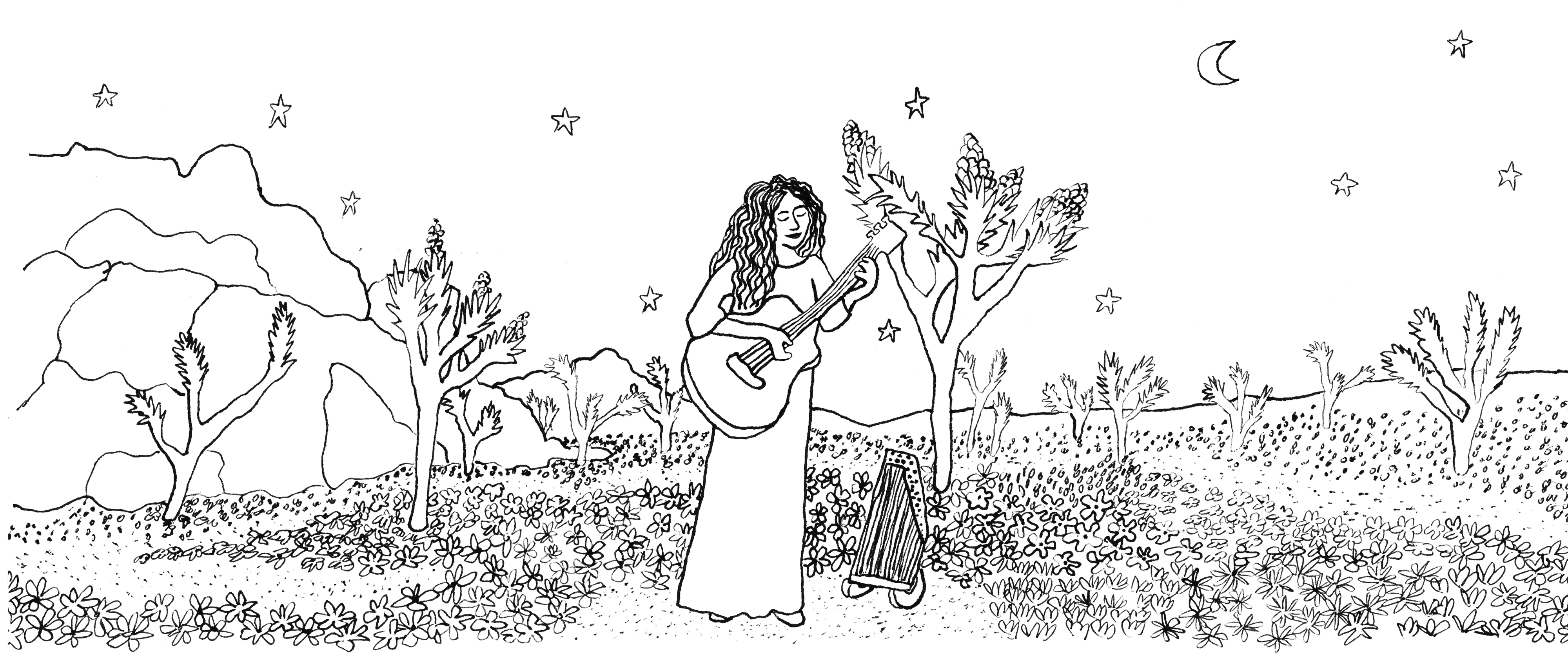
Art for my concert in Joshua Tree, California:

Joshua Tree concert poster drawing

Art for organic garden vegetable seed packets:

Maggie's Garden Seeds packet at 110 dpi-color-websized and cropped

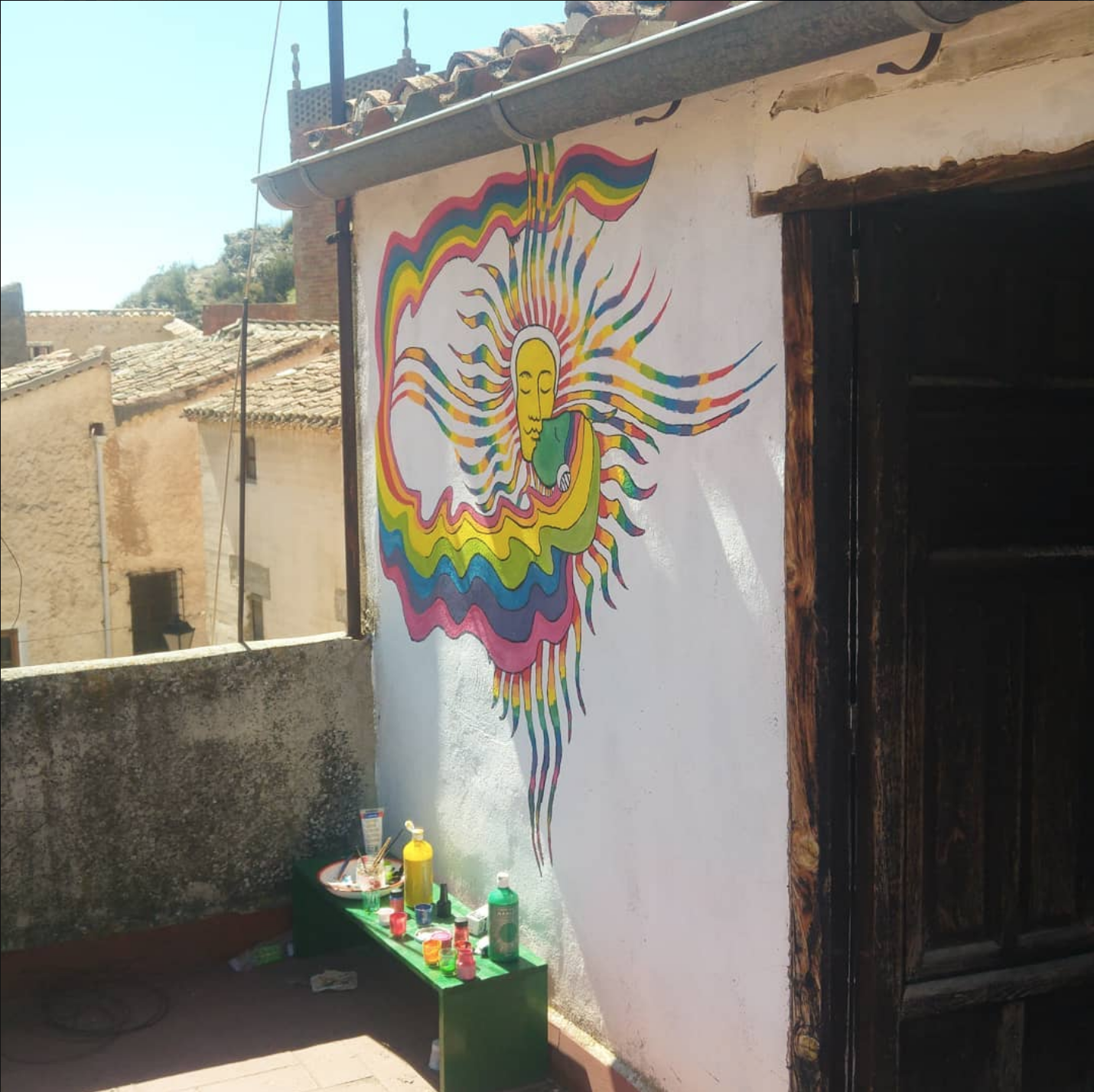
Cover art from Being of the Sun in the ancient Moorish village of Milinicos, Castilla-La Mancha, España

04-01-19-Spain-Milinicos-Antonio's mural of BoTS cover art

Juan Antonio Martínez Sarrión, who had translated, relettered and published (in 2017) Living on the Earth as Viviendo en la Tierra, was translating and relettering Ser Del Sol, a Spanish edition of Being of the Sun, with the idea of also publishing it through his company, Kachina Ediciones, when he painted the cover art on an old, traditionally styled house in the ancient Moorish village of Milinicos, in the mountains near the city of Albacete, in the autonomous community of Castilla-La Mancha.


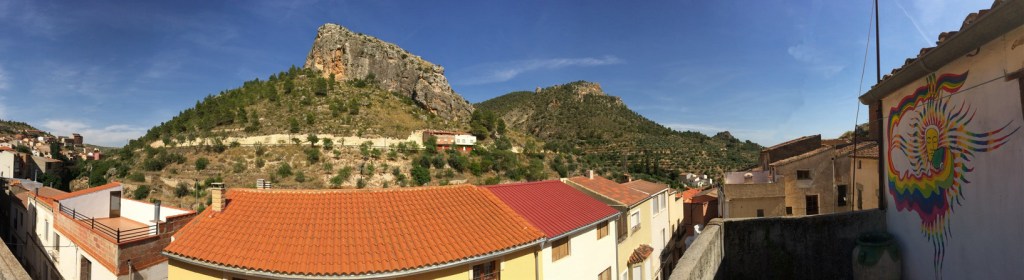
A panorama of Milinicos, with the mural of the Being of the Sun cover.

Reviews of What Living’s All About

PERFORMING SONGWRITER MAGAZINE, MAY 2007

TOP 12 DIY PICKS by Mare Wakefield, Indie Music Editor

What Living’s All About—a title that’s appropriate for a woman who has lived her life with such gusto. A Bohemian artist, Alicia Bay Laurel lived on a houseboat off Sausalito and a commune in Sonoma before spending 25 years on Maui. In addition to her music, she’s worked as a cook, collage artist, yoga instructor, wedding planner, underwater photographer and she’s the author of a New York Times bestseller, the whimsical Living on the Earth, first published in 1971.

The rich tapestry of her life translates to her music. In the Billie Holiday-esque “Floozy Tune,” Laurel plays the role of the Sunday School teacher turned barfly. In “America the Blues” she dishes out scathing political commentary to the tune of “America the Beautiful” (“America, America, greed sheds disgrace on thee / You don’t need nukes, you don’t need slaves, you don’t need gasoline”). She has fun with the smart “Aquarian Age Liberated Woman Blues” (“Seaweed for breakfast is good for you”) and the gospel-imbued “Doctor Sun and Nurse Water.” Laurel’s jazzy Earth-mother sound will seduce and inspire.


Review by John Stevenson of Ejazz News in London, June 2006

Dear Alicia,

Just a quick note from London. I have reviewed your last CD at ejazznews.com. It is excellent. As I wrote in the review, by far one of the best for 2006.

I get close to 200 CDs a week sent to me, but yours stood out because of its transparently high level of musicianship and sincerity – qualities which are very rarely found combined these days.

Kind Regards,

John Stevenson

Alicia Bay Laurel: What Living’s All About, Jazz Blues & Other Moist Situations (IWS)

With a provocative title like this one, Ms. Laurel will certainly catch the attention of any reviewer! This is most certainly one of the most audacious, heartfelt and honest discs I’ve put in my CD player for the year. Alicia (who sounds like the artistic love child of Joan Baez and Tom Waits) brings a folk-singer’s sensibility to bear on jazz and pulls no punches: On America The Blues, she declaims: America, the beautiful/you’re thorny as a rose:/Radiation, global warming/Poisoned food from GMOs./ She also sings a delightful version of Eden Ahbez’s Nature Boy. The accompaniment from guitarist Nels Cline, bass player John B. Williams and pianist Rick Olson is divine.

*                    *                        *                      * 

BLUES REVUE MAGAZINE January 2008
Tom Hyslop
Blues Bites: Reviews in Brief

Alicia Bay Laurel conveys life’s sudden shifts and jarring juxtapositions on What Living’s All About (Indigo With Stars 003). Sandwiched between the opener, “Floozy Tune,” and “Aquarian Age Liberated Woman Blues,” two formally classic blues that could have come from Ma Rainey if not for the namechecks (belly dancing, astral projection, The I. Ching, bee pollen candy and natty dread), comes “America the Blues,” with strident references to economic inequality, environmental rapine, corporate greed, and political corruption. Laurel moves from girlish singing on the Twenties-style songs to this doomy incantation, the arrangement taking full advantage of the jaw-dropping talent of avant-guitarist Nels Cline (best known as Wilco’s secret weapon). With cuts such as “Doctor Sun and Nurse Water” (a gospel-drenched number with oddly matched lyrics), and the Fever tribute of the title track, Living will strike some as too California in its outlook. But lovely touches abound, such as the stately, quietly anthemic “Love, Understanding and Peace,” and Doug Webb’s beautiful alto work on “Zero Gravity.”


FEMINIST REVIEW, Friday, June 1, 2007
Alicia Bay Laurel – What Living’s All About

All would-be writers who have studied how to write know the rule: “show me don’t tell me.” Visual artists find this advice easy to do and musicians are, perhaps, the same way. When the creative instrument does not rely solely on words, showing is not too difficult.

Alicia Bay Laurel wrote Living on the Earth, a cult classic and the first paperback on the New York Times Bestseller List (spring 1971), which has sold over 350,000 copies. She has also written five other books. Laurel is a talented, trained musician. She grew up playing classical piano, switched to guitar in her teens and learned open tunings from legendary guitarist John Fahey, a family member. On this latest album, What Living’s All About, she works with some of the best musicians in the field, including avant garde guitar hero Nels Cline.

Alicia Bay Laurel tries to show and tell by weaving feelings, melody and an occasional diatribe word. She celebrates the Earth (nature) and embraces her sensuality. She also loudly laments the destruction of the environment, as in her song “America the Blues,” where the listing of our environmental sins drags a bit. At the same time, the song is strangely effective. The entwining hypnotic music ended with a smashing guitar rift, followed by a spine tingling sound of whale songs and a Native American Chant. This is an excellent protest song. Alicia Bay Laurel and Al Gore should be friends.

“Zero Gravity” is a haunting song about a city at night, reminiscent of Ground Zero in New York City where the Twin Towers used to be. Laurel talks about sex in this CD and does it with class, sometimes with gentle humor, like “Floozy Tune.” However, you won’t know what she’s talking about unless you listen closely. This blend of jazz, blues and gospel is a powerful feminist statement. It’s fantastic!

Review by Patricia Ethelwyn Lang


“Floozy Tune” Wins Song Contest

7/9/2007 4:38:10 PM
“Floozy Tune”
Status: Selected
Congratulations, you have been selected as a Top 20 Finalist in the Jazz Category of the 11th Annual Unisong International Song contest. Results are at http://www.unisong.com/Winners11.aspx.

This year featured the highest overall quality of songs, lyrics, and writers ever submitted by far, with the most diverse and varied entries from a multitude of countries representing every continent on Earth except Antarctica (and songwriting penguins out there).

The judging therefore was extremely competitive and to be singled out anywhere in the top 15% of all songs submitted was no easy feat.


Review of What Living’s All About by psychedelic folk radio DJ, Gerald Van Waes. His show, Psyche Van Het Folk, is on Radio Centraal, Antwerp, Belgium.

Like one of my favourite heartfelt singer-songwriter singers (Heather McLeod with ‘Funny Thing’, 1997), also Alicia went to more towards (slightly standard) jazz territories, but as a former hippie, it is clear this is not done as a compromise to please/tease a public. Her interpretations (-most songs are self penned-) are with great feelings, and a certain light happiness beyond each other idea or emotion. She describes the style mix well on the cover as “jazz, blues and other moist situations”. With additionally a a bit of New Orleans influence on “Floozy Tune”, and a bit of gospel on “Doctor Sun and Nurse Water” (about what the environment of Hawaii did to her), she wrote inspired something between jazz and jazz-blues and something else soulful. I like the idea on “America the blues” saying “America, don’t wave that flag to con us with your jive…”..”we’re all family on this planet”.. (Just imagine how America is built upon so many nationalities and bought talents from everywhere, unfortunately mostly still chosen from what are seen as the trustworthy countries and areas (so practically still excluding preferably the French, Spanish, and several Arab-speaking countries and native Indians for economic concurrence, racist, nowadays partly religious, and a few other reasons)… Potentially, I realize America still has all opportunities and a certain openness to experiment for those who succeed to start to participate in the system. This track, like a few tunes elsewhere has some, for me, rather amusing freaky electric avant-garde guitar by Nels Cline (Wilco,..). Alicia, for having experienced a certain earthbound process, matured, she still has the happiest aspects of the hippie; this sum must having benefited the soul and music of the singer, who on her recent photograph on the back cover still looks 25 or so, so I guess the message of this lies somewhere as a benefit hidden in the music. Rather brilliant as an interpretation I think is “Nature Boy” (originally by Nat King Cole, but also covered by Grace Slick), in an emotionally calm contrapoint-driven moody jazz style, with the help of John B. Williams on upright bass and Enzo Tedesco on other instruments. A really fine and enjoyable album.


Review by legendary guitarist Nels Cline on his website:

Alicia is a self-proclaimed “hippie chick” who I met through (drummer) Joe Gallivan. She had a hit book back in the 60s called [stay tuned for title – forgot it], which she says “was in practically every hippie commune outhouse in the west” (no doubt right next to “Be Here Now”!). This is, I believe, self-released, and is quite an odd but strangely entertaining, original, and disarming recording. It has some amazing L.A.-based session/jazz players like (saxophonist) Doug Webb, who reaches beyond his Coltrane-esque tenor to turn in some beautiful post-Desmond alto, brilliant drummer Kendall Kay, and bassist John B. Williams, whom many may remember as the Fender player on The Tonight Show With Johnny Carson for many years. There is a choir on here! The songs are sort of 1920s-30s era swing, acoustic swing blues, and… Well anyway, when someone like Alicia asks me to do tons of Hendrix-inspired shrieking and psych looping (“America The Blues”) or fuzzed out adversarial commentary (“It’s Not Fair”), I figure that when the disc comes out that the stuff will, as it usually is, be buried or cut out altogether. I was amazed when I heard this that Alicia REALLY WANTED these sounds and that THEY ARE REALLY LOUD! I don’t know what people who know my music will think of this, but there is something so wry and self-deprecatingly amusing about Alicia’s hippie anthems, protest songs, and tales of failed romance that I find myself grinning. Hmmmm…Oh yes, I also play slide, lap steel, and acoustic guitar on this. I’m on 4 or 5 tracks.


Review by Platinum-selling singer/songwriter Joe Dolce

I think this is a very creative record with a lot of wonderful ideas and performances and some pretty extraordinary playing, and endearing vocals all over the place. I like it a lot!! I liked all the songs much better on the second listen. A keeper. Good work.

The album is eclectic, diverse musical styles. Therefore, I can relate to it! What holds it altogether is Alicia’s musical ‘personae’ – the complex character she is creating, through her voice and ideas. As you get to know this character more and more, as the songs and ideas progress, you trust her more and it allows you to enter more easily into whatever type of musical style is coming next. (Also this trust is a reason to want to go back and listen again.) Also the IDEAS are clear. The lead vocals are strong with a lot of presence. The musicians are all brilliant and the soloing is tasteful and creative – no cliches or stumbling around musically anywhere to be found.

Re: “Nature Boy.” I believe that if you can take the listener to a unique Hilltop, and give them a view that they will never forget, even ONCE in a recording or performance, that is enough. One brilliant moment builds a bridge of trust between you and them that will allow them to be more open to whatever you do from then on, even if they don’t relate or understand it. (You may never be able to take them to that High Point again but it doesn’t matter – it’s like great sex or great playing- you may not be able to LIVE with that person, but you will NEVER forget that encounter.) This track took me to that Hill. I feel different now about the whole recording.

Re: “I Could Write a Book.” This track is the track where I first gasped: genius! What an amazing idea. A track like this makes me have to listen to the whole CD over again to see if I missed anything the first time around on those opening tracks. A totally inspired idea that works. No one else has ever done something like this with a standard. Perfect. I played this one for Lin. She liked it a lot, too. (She didn’t think her publisher would like it though! ha ha!)
Joe Dolce
Melbourne, Australia

Alicia Bay Laurel 2018 Japan Tour

This year I am having a multi-decade solo art exhibition from September 1 through 20 at fashion designer Aya Noguchi’s Sison Gallery in Daikanyama, Shibuya, Tokyo.  The opening event will be recorded as part of a documentary about my work by Setsuko Miura’s environmentalist television show, Kotonaha No Midori.

Sison Gallery show brochure-color-web size

My concerts are also CD release parties for my newest recording, “Alicia Bay Laurel: Live in Japan,” which you can buy here.

ABL LIVE IN JAPAN 3000X3000 for CD Baby


Here is the tour schedule in Japanese and then in English:

2018年8月11日(土)ニュー・ムーン・コンサート&新作CDリリース・パーティ。場所:白浜豆腐工房。18:00スタート。1,500円。住所:千葉県南房総市白浜町滝口1477

https://www.facebook.com/events/242954323164704/

2018年8月18日(土)コンサート&新作CDリリース・パーティー。場所:安房里山房るんた。18:00スタート。1,500円。住所:千葉県安房郡鋸南町217

https://www.facebook.com/events/257584581504181/

http://lungta.petit.cc

https://muraken5.com/piece/kyonan#top

2018年9月1日(土)アリシア・ベイ・ローレル個展“ダンシング・ウィズ・ネイチャー”オープニング・パーティー&コンサート。場所:代官山SISON GALLERY。15:00~20:00。ミニライブ&小倉美保さんのフラダンス19:00~。住所:〒150-0033東京都渋谷区猿楽町3-18 電話:03-6886-8048

2018年9月2日(日)~9月20日(木)個展“ダンシング・ウィズ・ネイチャー”。場所:SISON GALLERY。12:00~19:00。※月曜休館。

http://sison.tokyo/info/2175262
https://www.facebook.com/events/274301256687815/

2018年9月6日(木)コンサート&新作CDリリース・パーティ。場所:横浜ライブバー&レストラン サムズアップ。オープン18:30、スタート19:30。共演:井上オハナ、小倉美保(フラダンス)通訳:キンバリー・ヒューズ。お問合せ:045-314-8705。前売り:2,800円、当日:3,300円。住所:〒220-0005神奈川県横浜市西区南幸2-1-22相鉄Movil 3F

http://www.stovesyokohama.com/

2018年9月7日(金)コンサート&新作CDリリース・パーティ。場所:ピープルツリー自由が丘店(フェアトレード・ファッションブランドの東京フラッグシップ店)。オープン18:00、スタート18:30。共演:Rie Nobuso(創作舞)。住所:〒152-0035東京都目黒区自由が丘3-7-2

http://www.peopletree.co.jp/shop_jiyugaoka/index.html#shop_map

https://www.timeout.com/tokyo/shopping/people-tree-jiyugaoka

2018年9月9日(日)コンサート&新作CDリリース・パーティ。場所:横浜cafe ゆっくり堂。オープン17:45、平和の祈り18:25、スタート18:30。共演:馬場尚子(司会)、Rie Nobuso(創作舞)。1,500円+1オーダー。住所:〒244-0002神奈川県横浜市戸塚区矢部町125。JR戸塚駅東口より徒歩7分。電話:090-1795-0341。

https://www.yukkurido.com/access

ご予約:info@sloth.gr.jp.

https://www.facebook.com/events/1115536298622481/

2018年9月15日(土)コンサート&新作CDリリース・パーティ。場所:神戸Modern Ark Pharm Cafe。19:30~21:30。住所:〒650-0012兵庫県神戸市中央区北長狭通3-11-15。お問合せ:078-391-3060。

https://www.facebook.com/ModernarkPharmCafe/

2018年9月16日(日)大阪アート&エコロジー・センター“THE BRANCH”を応援する小さなコンサート。場所:大阪THE BRANCH。オープン15:30、スタート16:00。住所:〒559-0011大阪府大阪市住之江区北加賀屋2-8-20

http://branch.sociecity.org
https://www.facebook.com/events/284386238985308/

2018年9月17日(月・祝)コンサート&新作CDリリース・パーティ。場所:大阪茶屋町URBAN RESEARCH DOORS(エコ・ファッション・ストア&カフェ)。カフェでのライブ:19:30~20:15。住所:〒530-0013大阪府大阪市北区茶屋町15-31。電話:06-6485-0178(コーディネーター:Ryoko)

http://www.urdoors.com/

2018年9月22日(土)コンサート&新作CDリリース・イベント。場所:西光禅寺(広島西部の山間、三次市街地の近く)オーガナイザー:西光禅寺住職、檀上宗謙。14:00スタート。ベジタリアン・カレー・ディナー付き。住所:〒729-4207広島県三次市吉舎町敷地610西光寺。お問合せ:080-5338-6274。

https://www.facebook.com/SAIKOUJI

2018年9月23日(日)秋分の日パーティー&コンサート&新作CDリリース・パーティ&カントリー・マーケット。場所:イタリア会館・福岡。16:00スタート。住所:〒810-0021福岡市中央区今泉1-18-25季離宮-tokirikyu-中離宮2階。電話:092-761-8570。お問合せ:ayamomo821@gmail.com(Ayako)

2018年9月28日(金)コンサート&新作CDリリース・パーティ。場所:照明寺。18:00スタート。出店 ワークショップあり。住所:〒899-6404鹿児島県霧島市溝辺町麓溝辺町2563。

2018年9月29日(土)コンサート&新作CDリリース・パーティ。場所:宮崎県(時間と場所の詳細は追ってお知らせします。)

2018年9月30日(日)コンサート&新作CDリリース・パーティ。場所:喫茶 風の丘。

13:00スタート。住所:〒899-2431 鹿児島県日置市東市来町美山 東市来町美山2591

Here is the English language version of tour schedule:

08/11/2018 New Moon concert and CD release party and vegetarian dinner. 18:00 start. SHIRAHAMA TOFU FACTORY. 1500 yen. Address: 1477 Shirahacho Takiguchi, Minami Boso-shi, Chiba
https://www.facebook.com/events/242954323164704/

08/18/2018 Concert and CD release party and macrobiotic dinner at Lungta Yokone. 18:00 start. 1500 yen. Address: 217 Kyonan-machi, Awa-gun, Chiba-ken
https://www.facebook.com/events/257584581504181/

http://lungta.petit.cc

https://muraken5.com/piece/kyonan#top

09/01/2018 Art Gallery Opening Party for Alicia Bay Laurel’s solo exhibition, “Dancing with Nature,” and her concert, at Sison Gallery, Daikanyama, Shibuya, Tokyo. 15:00 to 20:00.  Live at 19:00, with hula by Miho Ogura.  Address: 150-0033, 3-18 Sarugakucho, Shibuya-ku, Tokyo
Tel: 03-6886-8048

09/02 to 20/2018 Sison Gallery “Dancing with Nature” exhibition open from 12:00 to 19:00, daily except Mondays. http://sison.tokyo/info/2175262
https://www.facebook.com/events/274301256687815/

09/06/2018 Concert and CD release party at Thumbs Up Live House, Yokohama.  Open 18:30, start 19:30. With the Inoue Ohana Band, hula by Miho Ogura, and translation by Kimberly Hughes. For more information, call 045-314-8705. Advance 2800 yen, Door 3300 yen. 3F Movil, 2-1-22, Minamisaiwai, Nishi-ku, Yokohama, Kanagawa 220-0005. http://www.stovesyokohama.com/

09/07/2018 Concert and CD release party at People Tree Jiyugaoka [fair trade fashion shop] (flagship store in Tokyo) 3-7-2 Jiyugaoka, Meguro-ku, Tokyo.  18:00 open, 18:30 start. With interpretive dance by Rie Nobuso.
http://www.peopletree.co.jp/shop_jiyugaoka/index.html#shop_map

https://www.timeout.com/tokyo/shopping/people-tree-jiyugaoka

09/09/2018 Concert and CD release party at Cafe Yukkurido, 125, Yabe-cho, Totsuka-ku, Yokohama, Kanagawa, 244-0002. Open 17:45, peace prayer 18:25, start 18:30. Hosted by Naoko Baba. With interpretive dance by Rie Nobuso.

Access from JR Totsuka station, east exit, 7minute walk. https://www.yukkurido.com/access Charge: 1500 yen +1 order. Booking information: info@sloth.gr.jp. Café Tel: 090ー1795ー0341
https://www.facebook.com/events/1115536298622481/

09/15/2018 Concert and CD release party at Modern Ark Pharm Café in Kobe. 19:30 to 21:30
中央区北長狭通3-11-15 Kobe-shi, Hyogo, Japan 650-0012.
For more information, please call 078-391-3060.
https://www.facebook.com/ModernarkPharmCafe/

09/16/2018 Intimate Concert to benefit The Branch Arts and Ecology Center in Osaka. Open 15:30. Start 16:00. 2-8-20 Kitakagaya, Osaka 559-0011 http://branch.sociecity.org

https://www.facebook.com/events/284386238985308/

09/17/2018 Concert and CD release party at Urban Research Doors Chaya-machi (Eco fashion store and café.)  Live in the café 19:30 to 20:15. 15-31, Chaya-machi, Kita-ku, Osaka 530-0013. Tel: 06-6485-0178 (Ryoko is the coordinator)

09/22/2018 Concert and CD release event Saikouji Zen Buddhist Temple, in the mountains west of Hiroshima, near the town of Miyoshi.  Event organized by Souken Danjo, the head monk. Start time 14:00.  Includes a vegetarian curry dinner. 729-4207 Hiroshima-ken, Miyoshi-shi, Kisa-cho, 610 Saikouji. For more information, please call: 080 5338 6274. https://www.facebook.com/SAIKOUJI

09/23/2018 Autumn Equinox Party, Concert, CD release party, and country market, at Italia Kaikan Fukuoka / Centro Italiano di Fukuoka. Address: Tokirikyu – Nakarikyu 2F, 1-18-25 Imaizumi, Chuo-ku, Fukuoka, 810-0021, tel: 092 761 8570.  Start time: 16:00. Please contact Ayako at ayamomo821@gmail.com for more information.

09/28/2018 Concert and CD release party at Shoumyouji Buddhist temple. Start time: 18:00. Address: 〒899-6404 鹿児島県霧島市溝辺町麓 溝辺町2563 Kagoshima-ken Kirishima-shi Mizobechofumoto Mizobecho 2563
出演者 アリシア ベイローレル 他 出店 ワークショップあり

09/29/2018 Concert and CD release party with shrine-building workshop in Nichinan, Kagoshima.

09/30/2018 Concert and CD release party at Kaze No Oka, outdoor restaurant and music venue. 〒899-2431 鹿児島県日置市東市来町美山 東市来町美山2591 風の丘 Kagoshima-ken Hioki-shi Higashiichiki-cho Miyama 2591 Kazenooka 出演者 アリシア ベイローレル Start time is 13:00.


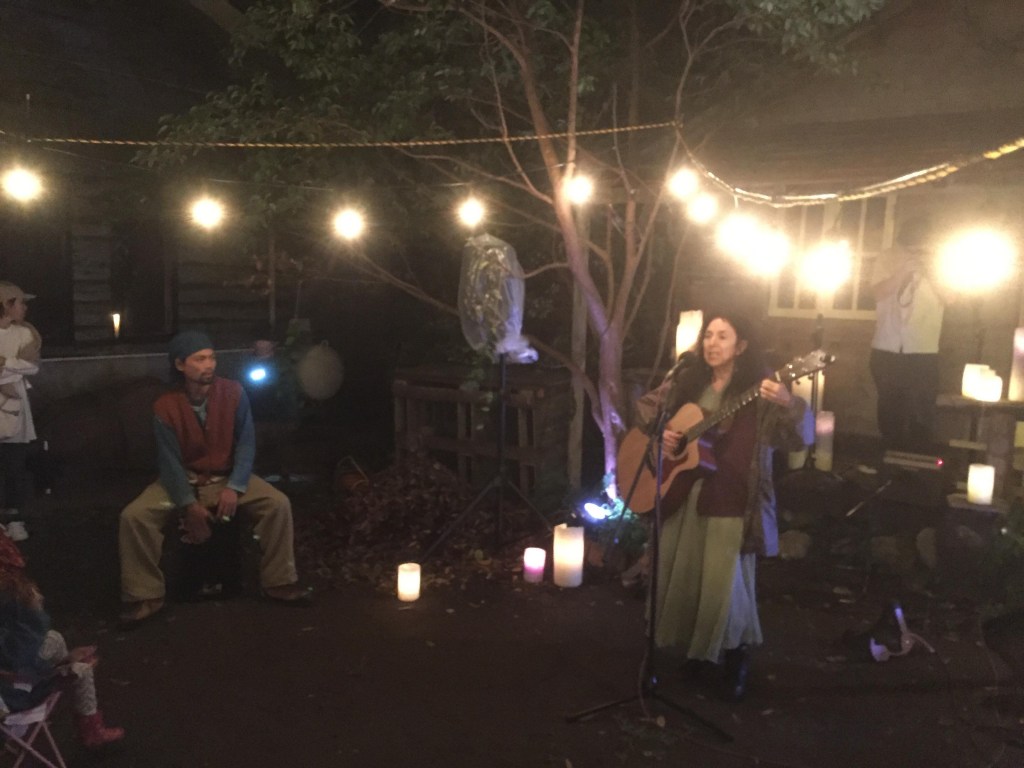
Kota drums and Alicia sings at Kaze No Oka in Miyama, Kagoshima. A typhoon had passed through the area during the early morning of the same day, but the café was full of happy people that evening.