
Of Sausages, Quinoa and Kale

Quinoa, tofu, hiziki, zucch.jpg

This is two days’ meals stemming from the act of boiling either Shelton Free Range Italian Turkey Sausages, or Tofurky (Vegan) Italian Sausages.

On the first day, I put an inch and a half of water in the bottom of a large cooking pot and float the unwrapped contents of an entire container of six (turkey) or five (Tofurky) sauages in it. On top of that I place a steel steaming basket, and on top of that a bunch of green curly kale, washed and broken into pieces about an inch wide. I put a lid on the pot, put it over a hot flame, bring the water to a boil, turn the flame down to moderate, and let the whole thing simmer until the kale is limp but still dark green (not olive green) and, if you take a sauage out and cut it crosswise, the inside is one color, tan, throughout. No pink.

Then I remove the kale from the basket with tongs into a big bowl, slice the sausages into it, and toss the whole thing with extra virgin olive oil and Braggs Liquid Aminos. (You could first infuse the olive oil with garlic if you’re not expecting company. That means you press a clove of garlic in a garlic press into a cup of olive oil, mix it well and let it stand a while before adding it to the rest of whatever you’re cooking.) Anyway, that’s dinner for two, unless somebody needs some starch with it. Pasta would be a good choice.

What’s left in the pot is a protein/Italian seasoning/kale broth with lots of flavor and nutrients in it, so you save it in a big clean jar for tomorrow.

Quinoa is a high protein grain that looks halfway between millet and the planet Saturn after it’s cooked. It likes two parts of liquid to one part of grain for cooking. So, if you start with a dry cup of quinoa at the bottom of a pot, you’ll be adding two cups of liquid. Use the broth from cooking the kale and sausages yesterday, and add a little more water if needed to make the total two cups of liquid. Also add two or three slices of extra firm organic tofu, cubed, and, if you have a heaping tablespoon of soaked hiziki (seaweed) on hand, add that. Slice in a zucchini, too. Bring it all to a boil, then cover and turn the flame to the lowest setting. When the quinoa is soft and has absorbed all of the water, it’s done. Remove to a serving bowl and season with olive oil and Bragg’s Liquid Aminos.

More excellent info on the health benefits of kale, and recipes HERE.
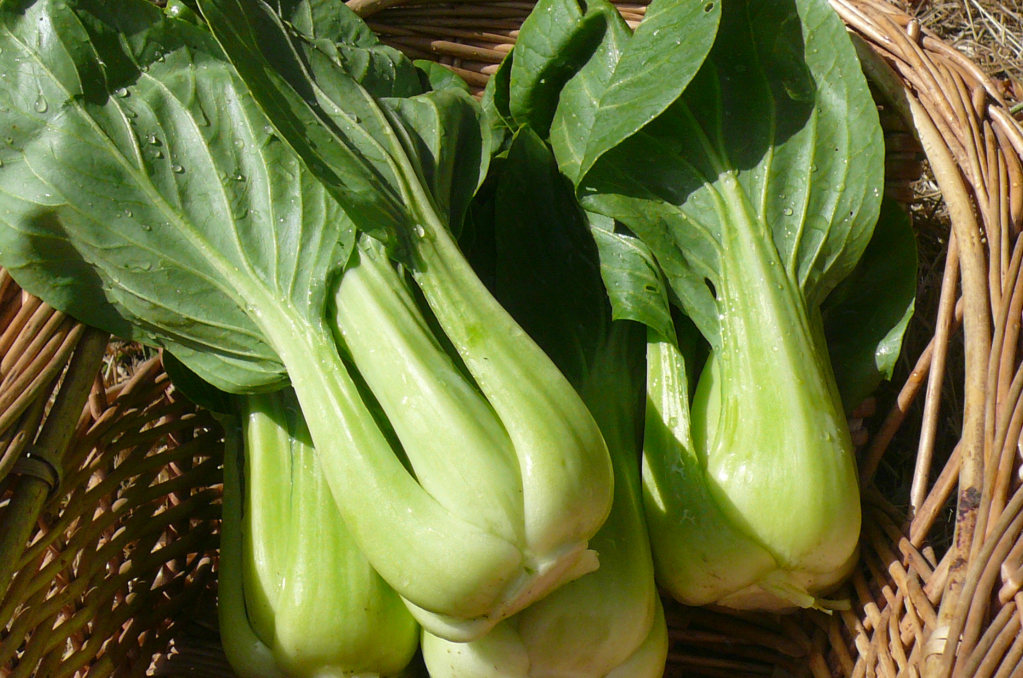
Bok Choy Stir Fry

Prepare this meal when you have an unhurried hour to revell in the beauty of the vegetables and the fragrances of the ingredients. With or without a bed of (organically grown brown basmati) rice under it, this makes a delectible one-dish meal. Really, any rice will go with it, but basmati has a wonderful aroma.

First, assemble and prepare the ingredients:
Have on hand, sesame oil for frying (not toasted sesame oil, although you may want to add a few drops of toasted sesame oil at the end as a seasoning), and organic tamari soy sauce, for seasoning.
Peel and finely chop: two medium sized cloves of garlic and a piece of fresh ginger root the size of your thumb.
Peel and coarsely cut two medium yellow onions
Cut up two or three broccoli heads, first by cutting the stems off and cutting the flowering top into separate branches, then by cutting the skin off the stems and slicing them one quarter inch thick.
Slice a couple of fresh shiitake mushrooms into half inch wide slices
Wash, spin or shake, and cut in 1 inch slices, one large head or two small heads of bok choy
Open a small can of sliced water chestnuts, drain off the water and set aside the water chestnut slices.
Open a bag of oriental style mung sprouts (the long translucent ones)
Cut into cubes: one 8 ounce loaf of very fresh extra firm organic tofu

Other ingredients you can add if you have a bit on hand and want to use it up: (any of them, thinly sliced) carrot, zucchini, Chinese cabbage, or bell pepper.

After everything is completely prepared, and only then, do you begin to cook.

In a large wok, heat three tablespoons of sesame oil, then add the garlic and ginger, stirring quickly to avoid burning them, so that they flavor the oil. When they are lightly tanned, add the onions and stir until they are soft and translucent. Next add the broccoli, and carrot slices if you are including them. Stir until they are half cooked. Then add everything else, and stir until it is all well coated with oil and the bok choy is wilted. Add one half cup of pure water, put the lid on the wok, and turn the heat down a little, and let the whole thing steam until everything is soft enough to eat. Serve immediately, and let people add their own tamari to taste (and toasted sesame oil if they like).

How to cook brown rice: In a heavy pot, place one cup of dry rice over medium heat. Stir the rice with a wooden spoon until it is slightly toasted. Then add two cups of pure water and allow it to come to a boil. When it boils, turn the heat down very low, put a top on the pot, and let the rice cook until all of the water is absorbed and the rice is fully expanded and easy to chew, about 40 minutes. It’s OK to peek, but not for long. You want to keep the heat constant. If you use a pot with a glass lid, you don’t have to remove the lid to see how your rice is doing. You can, of course, multiply the recipe as needed.

High Protein Waffles and Pancakes

High protein, moderate fat, low carb breakfasts didn’t use to appear on most menus, but now these kinds of recipes are becoming more common.  I first encountered them in 1970 in Adelle Davis’ book, Let’s Eat Right to Keep Fit and in the 1990s in Barry Sears’ Zone books.  In the 21st century, such recipes are termed Paleo or Ketogenic, and they are abundant on the Internet.    

Personally, I don’t commit to specialized diets; I notice which cuisines appeal to me depending on the weather and the current status of my health.   For example, for me, a raw food diet is perfect for speeding recovery from an upper respiratory illness, but it does not generate enough body heat for me to be active outdoors in cold weather.   High protein/low carbohydrate meals energize me and make me more alert, but they are not much help when I want to detox.

Here is the recipe:

For two waffles or a half dozen pancakes, mix 1 cup unflavored, unsweetened, organically produced protein powder, 2 tablespoons egg white powder, 2 tablespoons oat flour, 2 tablespoons lecithin granules, one half teaspoon non-aluminum baking powder, and enough pure water to make a thick but pourable batter.

Preheat well a griddle or waffle iron and spray it with sesame or coconut oil. The egg whites and baking powder will make the pancakes or waffles puff up.

With pancakes, you wait until the little bubbles pop before you turn them over. With both, you’re looking for a slightly browned surface on both sides and a dry interior before you remove them from the heat.

For a topping, I like fresh sliced fruit best, sometimes with a dollop of unsweetened vegan milk yogurt (I have a dairy allergy), or tofu faux fruit yogurt, or baked banana sauce (recipes below). If dairy yogurt works for you, by all means, enjoy!  To sweeten the yogurt carb-free, stir in a few drops of stevia glycerite.  Or, you could go savory instead of sweet, and sautee an egg and/or green vegetables to accompany your high protein pancakes.

Tofu Faux Fruit Yogurt:  Combine silken tofu and sugar-free fruit preserves in a blender or food processor.

Baked Banana Sauce:  Peel and freeze bananas.  Melt one frozen banana in a small, heavy frying pan over a low flame, mashing it as it melts.  When it’s soft and warm, season it with either a sprinkle of cinnamon powder or a teaspoon of sugar-free fruit preserves.

If you really like this pancake and waffle mix and want to have it premixed for fast preparation, multiply the quantities. For example, mix until homogenized, four pounds protein powder, one half pound each oat flour and lecithin granules, two 3 ounce cans of egg white powder, and three tablespoons of non-aluminum baking powder. Mix the powders in a big pot or bowl with a large spoon and store in a gallon glass jar in a cool, dry place.

Low-carb Latte


Time to Mellow Out, acrylic painting by Alicia Bay Laurel, 2005

Low Carb Latte

One teabag Yogi Tea Classic Indian Spice Caffeine-Free Tea
1 cup boiling water
2 tablespoons unflavored, unsweetened protein powder (any type, organic is best)
1/2 cup unflavored, unsweetened vegan or dairy milk
A few drops of stevia glycerite
a pinch of cinnamon

In a tall, inert (glass, ceramic) container, infuse the teabag in the boiling water for 15 minutes, so that the tea is strong, then remove the teabag. Add milk and protein powder and blend with a stick blender under smooth and frothy. Taste test; if you’d like it sweeter, stir in a few drops of stevia glycerite. Pour into a beautiful mug or cup and dust the top with the cinnamon.

Tofu Dips and Sauces

Two varieties of super-soft silken tofu

Artichoke dip: Instead of dipping my artichoke petals in melted butter or mayonnaise, I prepare a creamy, high protein, isoflavone rich dip made from organic silken tofu, ume (plum) vinegar, organic extra virgin olive oil, and dill weed.

Silken tofu is the thinnest, smoothest, most watery type of tofu, and is sometimes sold in boxes shelved among the dry oriental foods rather than in the refrigerated case with the other types of tofu. Ume vinegar, also found in the oriental foods section, lends both a salty and a sour taste, and makes tofu taste like fermented dairy. If you can’t get ume vinegar, you can use some of the flesh of a seeded pickled ume plum instead (season to taste). Olive oil gives a mayonnaise-like oiliness and Mediterranean taste to the mixture.

Pour off the water in which the silken tofu is floating, and then pour the block of tofu into a food processor, along with one tablespoon of organic extra virgin olive oil, two teaspoons of ume vinegar and a teaspoon of dill weed. Blend until smooth and pour into a dish. Dunk your steamed artichoke petals.

Faux fruit yogurt: vegan breakfast treat, tastes like a fruit yogurt: Place one box of drained silken tofu in the food processor with some slightly thawed frozen berries and blend until smooth. Pour into a dish, and, optionally, add more thawed or fresh fruit on top.

Kim Cheese: Spicy, low fat, high fiber, high protein topping for baked potatoes, steamed cauliflower or whole grain crackers: Pour into a food processor one carton of (drained) organic tofu (heavier than silken but not “hard”) and one jar of kim chee – preferably organic, but certainly no MSG and no preservatives. If you can’t find kim chee without MSG where you live, here’s a recipe.) Blend until smooth. Taste and correct the seasoning, using ume vinegar if it needs more salt and acidity, and olive oil if it needs a richer flavor.

Cut open the top of the baked potato lengthwise and crosswise , squish it together a little, and then add a half cup of the sauce.

Vegan cottage cheese is easy to make by mashing organic extra firm tofu (White Wave, Wildwood, etc.) with a fork, adding a dollop of Follow Your Heart Grape Seed Oil Vegenaise, and salting to taste with ume plum vinegar.

Tropical Trifle

Serves four. Using a double boiler, pour at least 3 cups of water into the lower pot. In the upper pot blend 1/3 cup tapioca pearls (the larger the pearls, the longer they take to cook), and one can of coconut milk, with enough pure water added to it to make a total of 2 cups of liquid. Bring the water in the lower pot to a boil, and then turn down the heat so it continues to simmer (boil gently). Stir the contents of the upper pot every couple of minutes. When the tapioca pearls are all translucent, the pudding is cooked. Add 15 drops of liquid stevia glycerite and stir well. Let the pudding cool a bit while you prepare the fruit.

Peel and cut into bite-sized pieces: mango, pineapple, papaya, banana. Place a few of each variety in 4 bowls, pour the hot coconut tapioca over them, and serve.

This recipe is a variation on one I read in Vegetarian Nights: Fresh From Hawaii by Bonnie Mandoe. The chief difference is that I sweeten the coconut tapioca pudding with stevia extract.

Sorbet

Loa Tsukamoto, age 10, and her brother Kea, age 6, prepare banana, pineapple and strawberry sorbet at my birthday party in Hawaii in May 2003

A really good fruit ice cream is sweet, creamy, slightly acid, and pleasing to the eye. With nothing more than three kinds of frozen fruit and a Champion Juicer, one can produce the best frozen fruit dessert I’ve ever tasted.

Bananas give the creamy mouth feel and some of the sweetness. Pineapple provides the acidity, as well as a more intense sweetness. Strawberries give the sorbet a pleasant soft pink color. All three fruits contribute their unique aromas, which blend harmoniously.

As bananas fully ripen and begin to turn brown, peel them and store them whole in a plastic freezer bag in the freezer.

To prepare a ripe (but not over ripe) pineapple, turn the green crown counter clockwise to remove it from the fruit (this is the part that is planted to make a new pineapple plant). Cut the top and bottom from the pineapple with a large sharp knife, sit the pineapple on a flat end, and then cut off the skin, cutting downward in sections, leaving a generous margin so that you don’t have the tough brown indentations in the part you will freeze. Cut the peeled pineapple into long spears, including the tough core, small enough in width to fit through the feeder of the Champion Juicer. I use a wooden bowl instead of a wooden cutting board for this operation because of the juice produced by cutting the pineapple. Store the spears in the freezer in a plastic freezer bag. Drink the fresh pineapple juice!

Strawberries need only be rinsed and the green tops removed before placing in the freezer bags. They are commonly available already frozen in most large grocery stores and some natural food stores. Because stawberries cannot be peeled and are very absorbent, I strongly suggest avoiding strawberries that have been grown with chemical fertilizers, herbicides and insecticides.

To use the Champion Juicer to produce sorbet, assemble the grinding unit with the solid plate below the grinder instead of the screen (which is what you would use instead if you were making a juice). Chill the grinding unit in the freezer for 10 minutes before mounting on the motor unit, so the sorbet comes out cold.

Place a large bowl below the end of the grinding unit. Turn on the power and push the frozen fruit into the grinder. If the pineapple spears have frozen solid together, you can separate them by placing them inside a bag and splitting them apart with a hammer.

Blend the three sorbets together with a spoon. If you completely homogenize them, you’ll get a lovely pink sorbet, and, if not, you’ll get a beautifully swirled yellow and pink sorbet.

Middle Eastern Beet Dip

Benida Solow made this for a party last winter, and gave me the recipe when I asked. Of course I asked—I love recipes that feature beets.

It was originally posted on the fabulous Stonyfield Farm website by Jodi Calhoun. My only personally preferred change to this recipe would be to use vegan yogurt instead of cow’s milk yogurt.

Middle Eastern Beet Dip

4 peeled, cooked beets, coarsely chopped
1 cup yogurt
2 cloves garlic, peeled and minced, or pressed
2 teaspoons lemon juice
lemon zest (finely grated rind)
2 tablespoons olive oil
1/2 teaspoon each cumin, paprika and cinnamon
salt and pepper to taste

Combine all ingredients until smooth in a food processor.

Serve with crackers, flat breads, and/or raw vegetables. On the same tray, at the party where Benida served this, was a spreadable chevre (goat milk cream cheese) to smear on a bit of bread or vegetable before topping with a bright magenta dollop of beet dip.

Cure for the Blues

I learned this recipe from Yolanda Parker, a Guatemalan herbalist.

Bring four cups of pure water to a boil. Remove from heat and add a dozen orange tree leaves (with blossoms if available) and three long leaves of lemon grass. Steep until the tea is cool enough to drink. This tea is specific for depression, but is useful for ordinary stress as well.

I painted these orange blossoms and leaves in 2005, in Phoenix, Arizona.

Brown Rice Mochi Waffles

Brown rice mochi waffles are not eggy and tender like batter waffles. Their texture is somewhere between Rice Krispies and bubble gum. They are firm enough to be finger food; definitely they are challenging to cut with the side of a fork. Brown rice mochi waffles are simply more entertaining than the popover form in which brown rice mochi usually arrives at the table.

I learned to prepare this dish at the Grainaissance Mochi and Amazake factory in Berkeley back in the early ‘eighties. I had met the Grainaissance folks at the Natural Foods and Products Expo in Anaheim, where I had gone to market my raw sprouted vegan ice cream recipe. I met Gypsy Boots there. His cookbook Bare Feet and Good Things to Eat is the first ever in my memory to mention eating sprouts.

Thaw any flavor of Grainaissance Mochi (Raisin-Cinnamon is a good choice.) One package of mochi makes two large waffles. Cut the mochi into 1/2 inch cubes. Heat up a waffle iron and spray with coconut oil. Place enough cubes for one waffle on the hot waffle iron, covering it evenly. It’s better to underfill than overfill, because if the mochi runs into the outer channels where there is no heat, it won’t cook. The heat will melt the mochi so that it runs together and it puffs up, and eventually it gets crisp on the outside. Open the waffle iron and remove the waffle onto a plate with a fork. Serve immediately with banana jam (see below). Or if you use a savory flavor of mochi, (say, Sesame-Garlic) serve under a curry or other bite-sized, sauce-slathered entree.

Banana jam: Whenever you have bananas going brown in your kitchen, peel them and put them into a plastic bag in the freezer. When you want banana jam for one person, place one frozen banana in a small frying pan and heat gently while mashing with a fork until it is soft and smooth. Season it with a pinch of cinnamon, and mix well. Variation: add a frozen strawberry to the frozen banana, and then mash them together while heating, but don’t add cinnamon.

Mind you, my friends in Japan consider the idea of brown rice mochi, and/or mochi with flavors like cinnamon or garlic, sheer blasphemy.  They are purists about their traditional (white rice) mochi, which they often cook over a hibachi (charcoal grill).  I have to agree – it is delicious!