



On December 15, 2010, FM YOKOHAMA’s beloved radio personality Mitsumi aired her interview of me on her show “Ine! Good for You!” She translates my answers to the interview into Japanese, but you can still hear some of what I said in English. If you speak Japanese, you will have even more fun listening to the show. It’s 17 minutes and 14 seconds long. You can listen to it here.
Blog
Alicia blog
Artist Power Bank Festival 2011 T-shirt and Towel Gather Funds for Japan Earthquake Survivors

May 13, 2011. Today the t-shirt and towel that I illustrated (both designed by Aiko Shiratori of environmentalist non-for-profit arts organization Artist Power Bank in Shibuya, Tokyo) were posted for sale on their Kurkku shop website. Both items are fundraisers for the survivors of the earthquake, tsunami and nuclear disasters, and will be sold at the annual music festival Artist Power Bank produces each summer to raise money for its projects.

Happy 40th Birthday, Living on the Earth

OK, birthday candles are in order. The 40th anniversary of the first edition of Living on the Earth (The Bookworks, Berkeley CA) was in September 2010. The 40th anniversary of the bestselling second edition of Living on the Earth (Vintage Books, Random House, NYC) was in April 2011. It’s still in print as a hardbound library edition. The 40th anniversary of Mariko Fukamachi’s translation of Living on the Earth (Soshisha Ltd., Tokyo) was in April 2012. It’s still in print as a paperback book.
Living on the Earth sold somewhere in excess of 350,000 copies, and it’s still selling in English and Japanese, and maybe still in Korean. I heard a rumor that the Provos in Amsterdam made a bootleg translation back in the 1970s (I’ve never seen one of those either, but I would LOVE to have one if it exists!!)

LOTE’s illustration and design style was so revolutionary when it first came out that Publishers Weekly devoted two pages to acknowledging this with an article in handwriting, illustrated with drawings selected from LOTE. I scanned and posted the PW piece here.
LOTE’s illustration and book design begat The Massage Book (and the Random House/Bookworks series), The Moosewood Cookbook series, The Vegetarian Epicure series, Survival into the 21st Century, and numerous others. More recently, motivational writer/speaker SARK told me that Living on the Earth’s illustration and design had inspired her graphic style as well.
Soshisha, Ltd, in Tokyo released the Japanese translation in 1972, with a blurb on the cover from Japan’s poet laureate, Shuntaro Tanikawa. It says, “I want to do everything in this book. If I can’t do everything in this book, then I want to dream about it, because I know that if I do, I will be a better person to the marrow of my bones.”
Tokyo Fashion T-shirt printed with Being of the Sun page as fundraiser for 2011 Fukushima Triple Disaster Charity

Tokyo fashion designer Aya Noguchi and I had been collaborating for five years when the earthquake-tsunami-nuclear meldown disaster struck on March 11, 2011. We agreed to collaborate on a garment to raise money for the refugees now stranded in emergency shelters, both of us donating all of whatever we gained from this project.

The jersey shirts are half cotton, half lyocell, a wood pulp fabric, also known as tencel. Aya intentionally made a diagonal hem at the bottom, and blended illustrations and text from Being of the Sun with a newer drawing of a bird from a notebook of drawings she commissioned from me in 2009. She added applique daisies to the finished shirts after silk-screening on the art.

2010 Art Collaborations in Japan
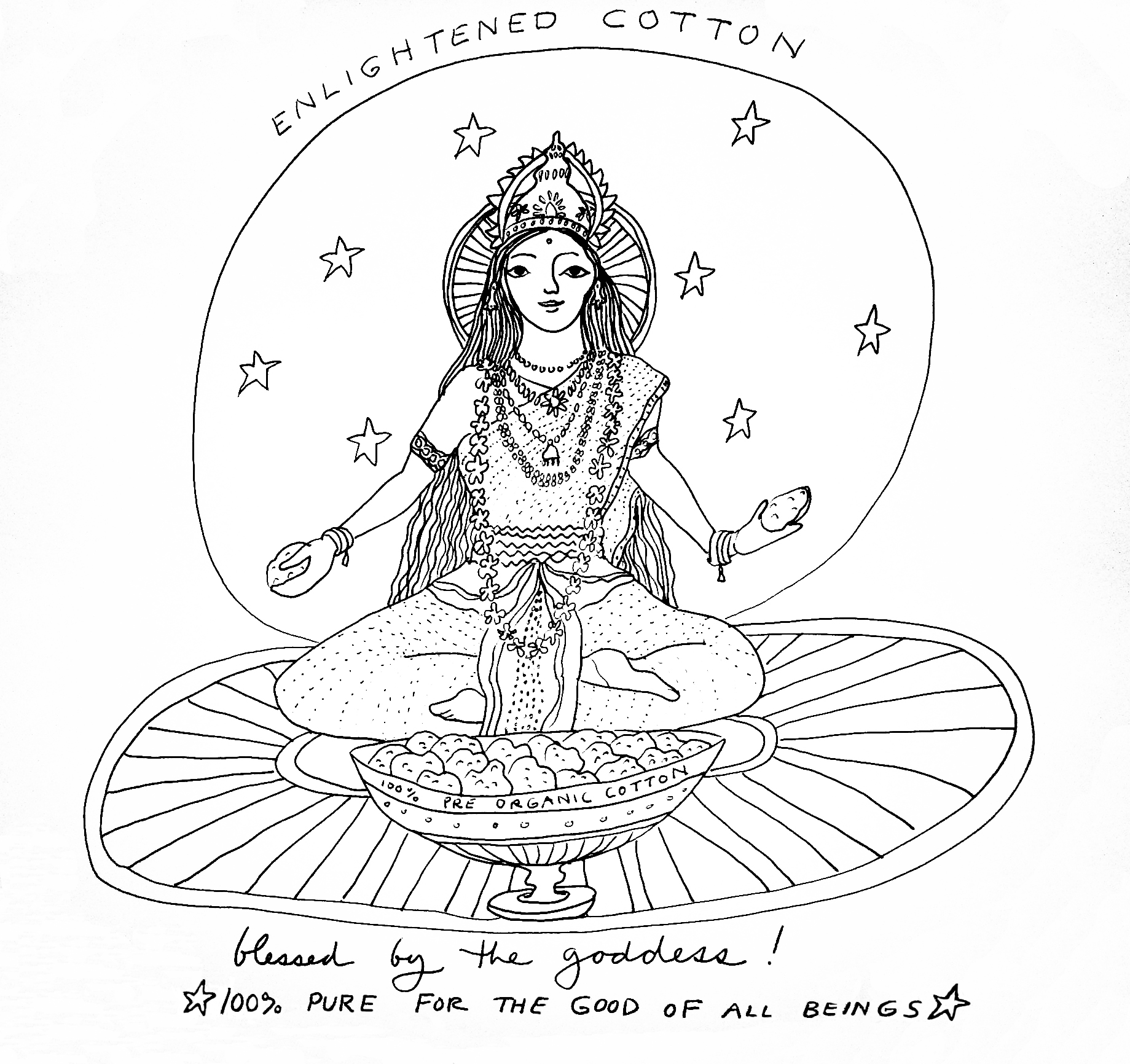
I did a lot of art collaborating in Japan via internet in 2010, thanks in great part to my art agent, Keisuke Era, who is also the director of Kurkku, an arts and environmental action center in the Harajuku district of Tokyo. Kurkku is funded by Artist Power Bank, a not-for-profit with impressive environmental protection projects like Pre Organic Cotton.
Pre Organic Cotton is an non-governmental organization that approaches cotton farmers in India and offers to support them for the three years it takes to transition from petro-chemical agriculture to organic agriculture, inspect their farms to be sure the soil and plants are chemical-free and healthy, and then buy all the cotton they grow from that time onward. (Major advantage: some villages in India no longer have carcinogens in their water supply and in the air surrounding their cotton fields.) I was inspired when I first read about this much needed work to draw the Hindu goddess Lakshmi blessing the farmers, the organic cotton, and the people working for Pre Organic Cotton.
Pre Organic Cotton also approaches major clothing manufacturers and sells them organic cotton. Lee Jeans Japan made a line of women’s jeans from Pre Organic Cotton’s cotton this past year, and when they did, I was hired to illustrate a booklet that was attached to each pair of jeans, which explained the work of Pre Organic Cotton, and its value to the planet and the people. Here’s the cover of the booklet:

When Artist Power Bank (aka ap bank) held their annual summer rock festival in 2010, I was hired to design a jacquard towel and a t-shirt drawing as festival merchandise, and, of course, both were made of organic cotton.
Here is the illustration I made for the front of the ap bank 2010 music festival t-shirt.
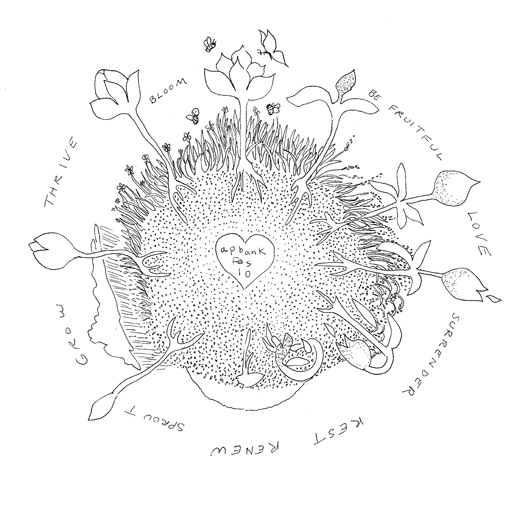
Here is the “label” I made for the t-shirt, which was printed on the outside of the back of the shirt, close to the neck:
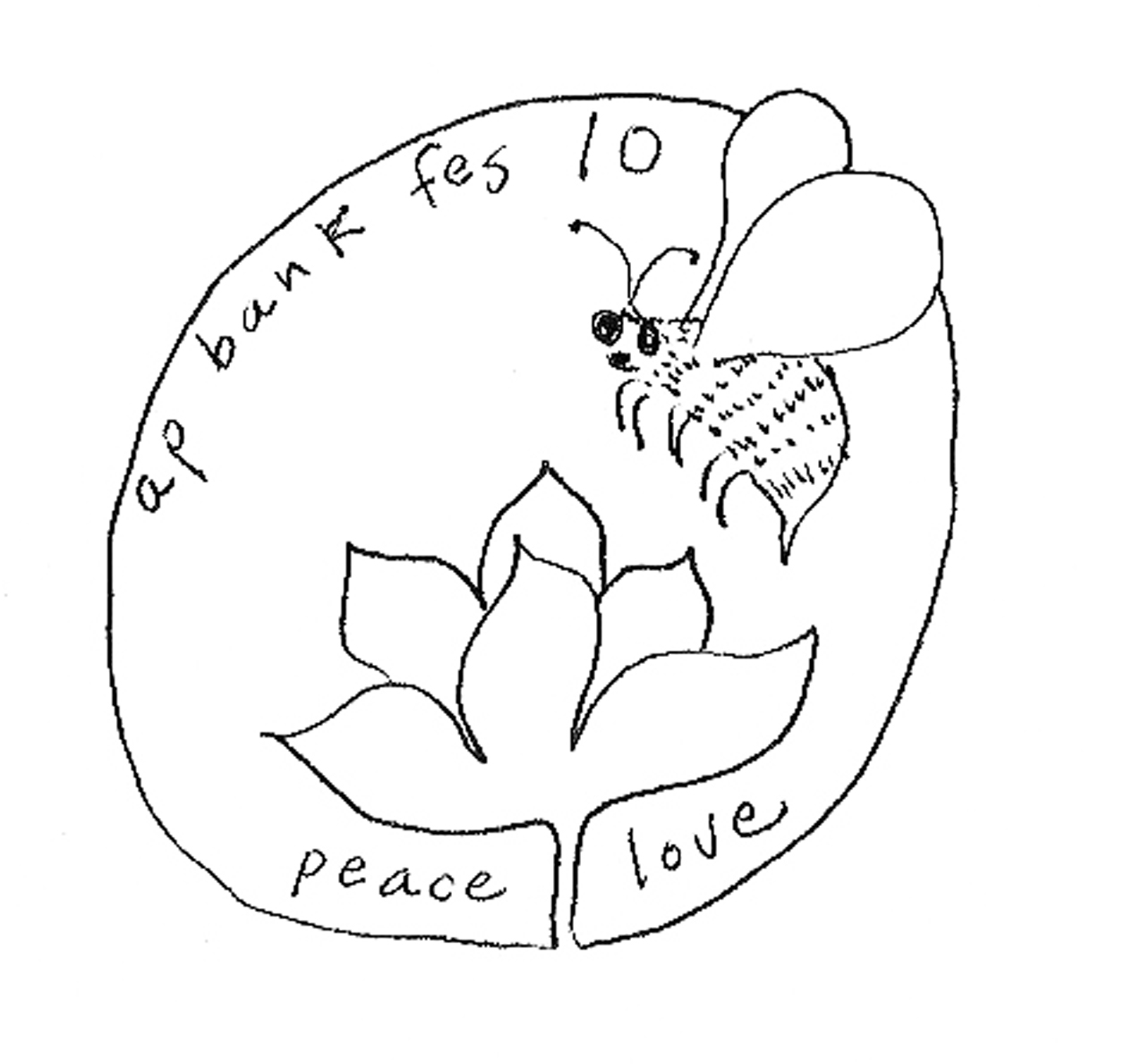
Here is the 2010 festival towel, designed by Aiko Shiratori of Artist Power Bank, using a drawing she requested from me of a large flower (I made an echinacea blossom). Keisuke said the festival looked like a field of yellow and blue flowers, so many of the attendees had them wrapped around their shoulders.

Kurkku’s merchandise designers, Miyumi Ichikawa and Yoshiko Takeuchi decided to have a traditional tenugui maker in Kyoto print some tenugui for them on Pre Organic Cotton’s fabric, and commissioned a design from me for it. They requested an image of a little girl playing in the woods. Here it is:


Here are my collaborators. The gentleman on the right is Keisuke Era. On the left side, in the red shawl is Kurkku’s Miyumi Ichikawa and, to her right, Yoshiko Takeuchi. Next to them, in very dark blue, is Aiko Shiratori, who designed the merchandise for Artist Power Bank’s festival this year.
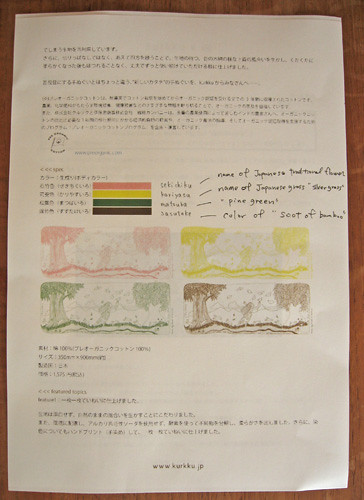
This is an information sheet on the tenugui. It explains that the image was printed in four different traditional colors: pine green, the brown of bamboo shoot, the yellow of “silver grass” and pink of a flower called “Sakichiku.”
In Which I Illustrate a Pouch and a Shawl for a Major Japanese Pop Star
A few blog posts ago, I promised that when the shawl and pouch I illustrated for Sony artist Yuki’s 2010 tour were available for viewing on line, I would share them with you. So I am happy to say, here they are!

This is the artist herself holding on her head a pouch shaped like one of my birds, printed with part of the illustration I made for the shawl that she described and I drew. It’s lined with lavender satin, and embroidered with metallic gold thread.

Here she is, wrapped in her own poetry and the images she suggested to me, in a long and lovely natural gauze shawl. The images on the shawl are from the poem (actually a song lyric) which she wrote in English, and which I wrote in my handwriting into the images on the shawl. As of today, October 26, 2010, the shawl has completely sold out.
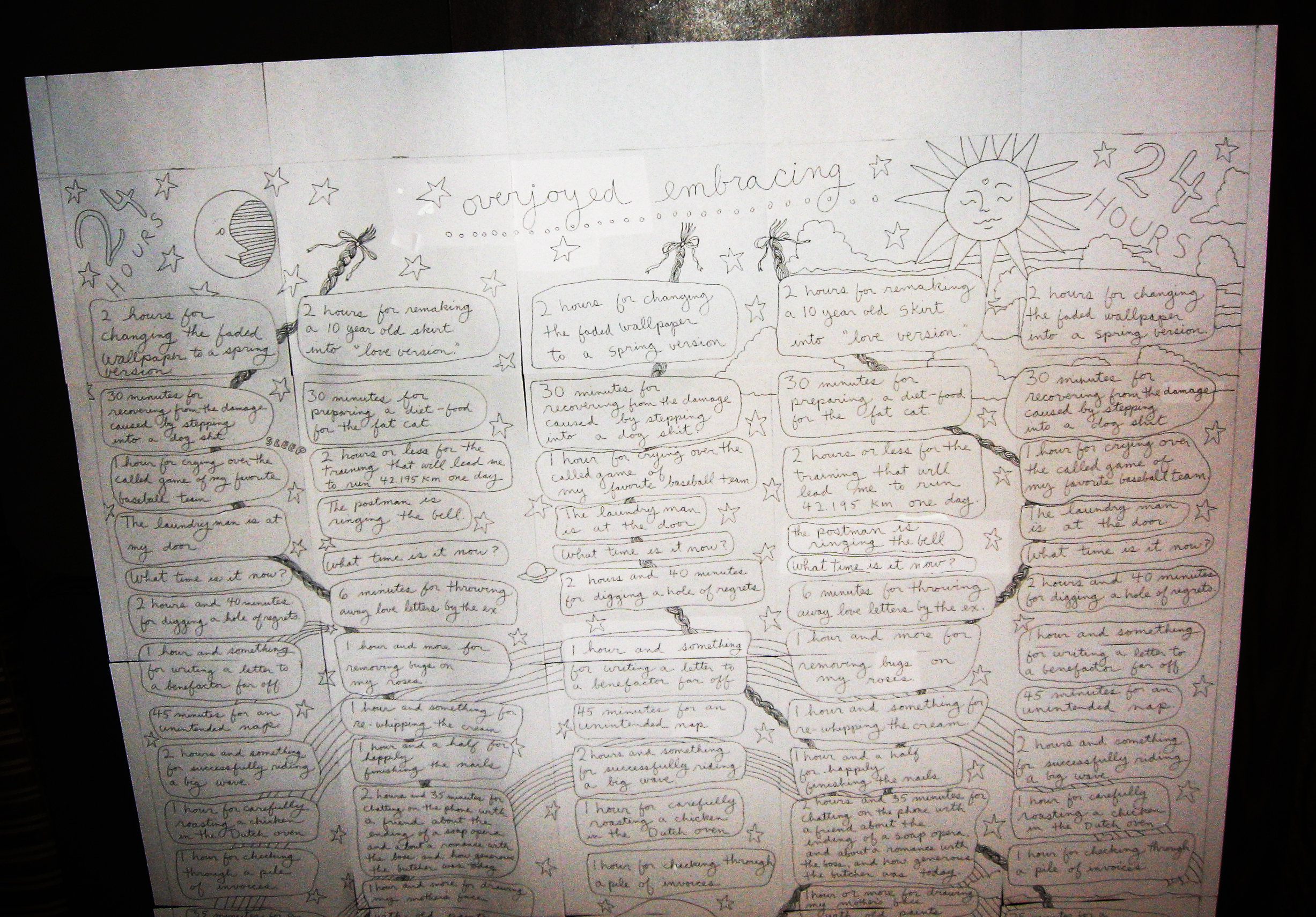
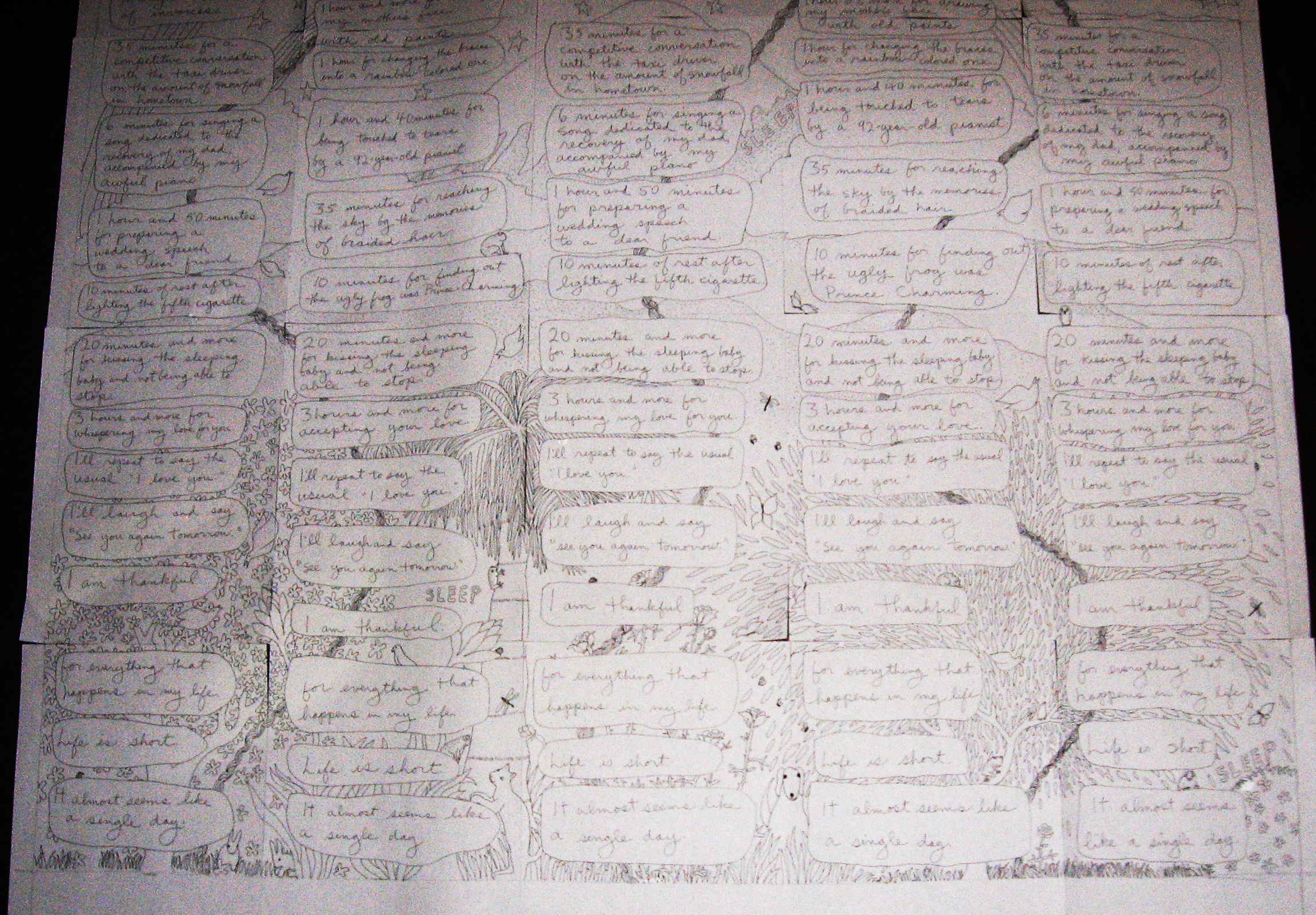
I took these snapshots of the upper and lower halves of the paper layout of the fabric print that would appear on the shawl, before numbering and then separating all of the sheets, scanning each one, and sending the scans, along with a numbered chart, to the manufacturer in Japan to be reassembled and then printed on huge pieces of white gauzy cotton:
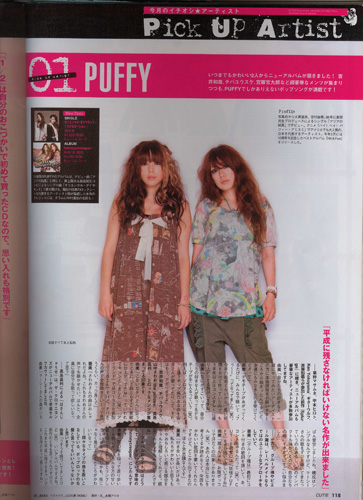
I realized tonight that this is the second time I’ve seen my drawings adorn a Japanese pop star. The first time was in 2007, when the duo Puffy Amiyumi was photographed for the teen fashion magazine Cutie, one of them wearing a Living on the Earth print dress by designed by Aya Noguchi for her Tokyo fashion company, Balcony & Bed.
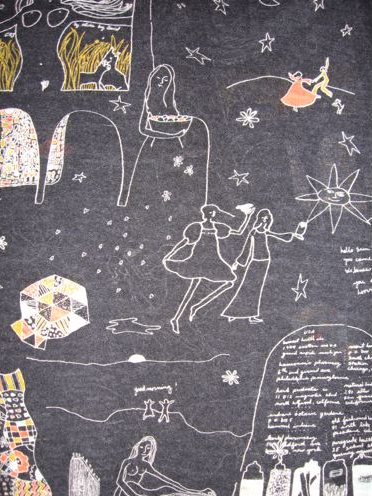
Here’s a close-up of the Living on the Earth wool jersey fabric print. There were three color variations, one with a black background (below), one with a brown background (above), and one with a yellow background.
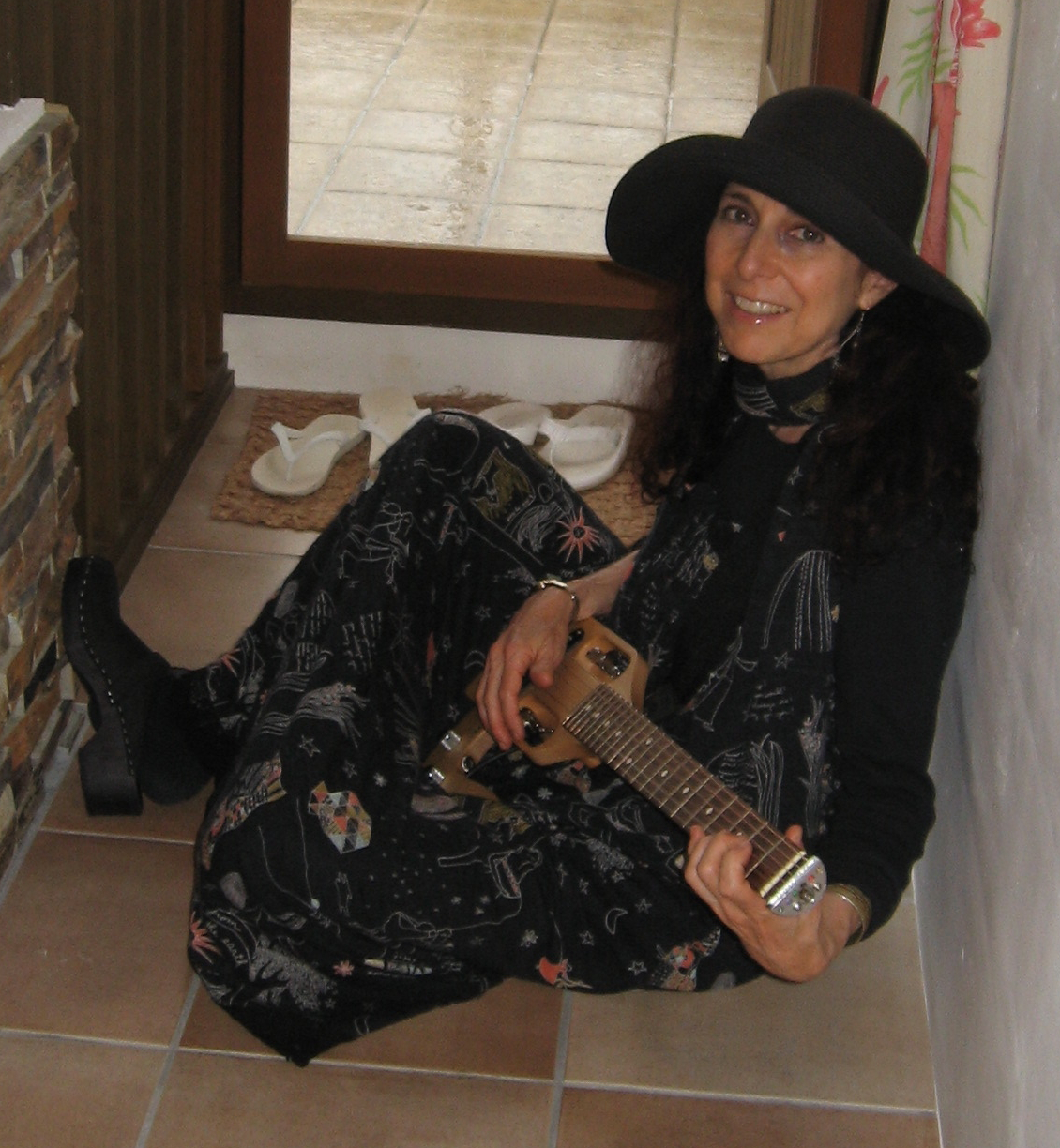
Here I am, modeling the black background print dress with a matching scarf at Aya Noguchi’s house near Hayama, Kanagawa, on May 24, 2007, as part of a fashion shoot by Switch Magazine. I am holding my Traveler Pro Series Guitar.
Alicia Bay Laurel Patchwork on Display in San Francisco

The autobiographical patchwork crazy quilt that I made between 1967 and 1974 was on display in the lobby of the historic Mills Building in downtown San Francisco from October 18, 2010 to January 15, 2011 as part of a show called “Still Crazy,” which included Victorian and 20th century crazy quilts, loaned by the San Jose Museum of Quilts and Textiles. Deborah Corsini, curator at SJMQT, created the show.
The piece is 8 feet high and 5 feet wide, and contains “guest embroideries” by my dear friends, author Ray Mungo and composer/author Ramón Sender Barayón, as well as a small piece by quilter Charlotte Lyons, who befriended me at Wheeler Ranch commune while I was writing and illustrating Living on the Earth.
Curator Deborah Corsini wrote:
“Alicia Bay Laurel’s crazy quilt is an excellent example of a 20th century crazy quilt from the decades of the 1960s – 1970s. It is composed of a multitude of irregularly shaped fabrics, many typical of the time period. There are large scale printed florals and smaller ditsy prints as well as embroidered and woven lace. Many of the blocks contain unique and personal appliqued and embroidered scenes. Some examples that clearly reflect on the universal (and astrological) themes that were of interest at the time are a God’s eye and embroidered solar system, a bull (her sun sign), and a flying lion (for Leo rising in her natal chart.) Other blocks charmingly depict the Sausalito houseboat where she lived in 1967 and her guitar with “real” strings. Like the crazy quilts of the 19th century, the one is filled with symbolic and personal references, and clearly references the cultural influences that were surrounding her. Most importantly, this quilt has an embroidered date, 1967 – 1974, and an embroidered signature, Alicia bay laurel, which gives it true authenticity.
“…it is especially compelling because it is the authentic handiwork of a well-known woman, artist, author and creative spirit from that extraordinary ‘hippie’ time. Alicia Bay Laurel’s crazy quilt is an excellent example of the continuum of the crazy quilt’s evolution and is a singular artifact by a multi-talented artist as a part of her early creative output and rich legacy.”

Here I am on the last day of the show, January 14, 2011 with my quilt. You might notice a few minor differences between this one and the one at the photo at the top, which was taken in 2002. That’s because the quilt suffered some damage in 2008 and was expertly restored by Karen Stern at her quilt and textile restoration studio in Berkeley.

Signature on lower right hand corner: “1967 – 1974 Alicia bay laurel”
2010 Japan Tour Schedule

What an amazing 11 weeks that was! I am resting up and contemplating the joy and wonder of it all.
September 28 8:30 AM Teach art workshop for Fujino Steiner (Waldorf) High School. (Alas, this workshop was cancelled due to flash flood warnings closing the school system for the day.)
October 3 – 4 PM Concert at Studio M
5-5-14 Maehara-cho,
Koganei, Tokyo 184-0013
Tel.042-381-0176
The closest train station is Musashi Koganei on the Chuo line.
The house concert was a great success – standing room only! 77 happy attendees. Here’s how it looked:

October 15 Concert at Nanso Bunka Hall in Tateyama
With tribal stomp and trance band RabiRabi x Piko, and local percussion band Awa Lion.
It was a fabulous and eclectic offering. At one point there was a taiko drum troupe, a belly dancer and an African dancer all performing together. Here’s the finale piece in RabiRabi x Piko’s set, with the belly dancer and the African dancer on stage with them:

October 22 and 23 Concerts at Yukotopia Deadheadsland
Yukotopia is a block from the Umejima train station, which you can reach via the Hibiya line from central Tokyo. Turn right when you exit the station. It’s right across the street from the Star King Pachinko. The address is:
3-2-18 Umejima
Adachi-ku, Tokyo 120-0816
Tel. 033-886-2996
There will be 4 other acts on before me (I go on last). Yukotopia is a cosy room with lots of psychedelic ambiance and welcoming friendliness. It has a full bar and offers some inexpensive entrees and snacks. People bring their kids sometimes. It hosts poetry readings on Saturday afternoons.
Here’s the schedule for Friday, October 22 (5 solo artists):
19:00~19:40 Hiroshi Sawada(Pop music)
19:40~20:20 So Terui (Acoustic)
20:20~20:50 Huga Matsuyama(Acoustic)
20:50~21:30 Roku
21:30~22:30(or longer) Alicia Bay Laurel

Here I am on October 22, 2010, singing Floozy Tune at Yukotopia.
Here’s the schedule for Saturday, October 23:
19:00~19:50 Tsumugine(Improvisational vocal performance)
19:50~20:50 Shinokuni(Pop music)
20:50~21:50 Howdy Moonshine (former members of Electric Building band)
21:50~22:50 (or longer) Alicia Bay Laurel

Roku, the manager of Yukotopia, and I play “Ripple in Still Water” by the Grateful Dead to close my set.
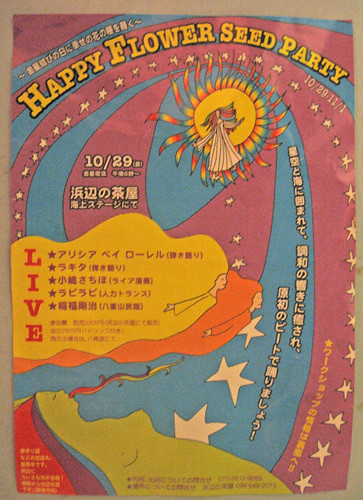
October 29-31 “Happy Flower Seed Party” (spiritual retreat) at Donto-in, Tamagusuku, Okinawa hosted and lead by Sachiho Kojima. Unplugged Concert with RabiRabi x Piko, Lakita Kudomi, Sachiho Kojima and me on 10/29. I teach an art workshop on 10/31. Please contact me if you’d like to join us!
A typhoon postponed the outdoor concert at Hamabe No Chaya from 10/29 to 10/31, so we had an unplugged indoor candle light concert at Donto-in on the 29th in addition to the outdoor show on the 31st. Hamabe No Chaya is a tea house with windows looking out over a calm bay enclosed by a coral reef. The stage was actually erected on the sand below the high water line, at low tide. The first act was a wonderful Okinawan traditional singer, next Sachiho played her lyre and sang spiritual songs, then I played guitar and sang original songs, and last RabiRabi played and everyone else danced.
The workshop included Sachiho’s sacred sites of Tamagusuku tour, this time augmented by the presence of Professor Hiroshi Nago, who has researched and written extensively about the Tamagusuku castle ruins, which appears to have been a temple rather than a castle. He brought a slice of a rare seashell that is found on the outside of the coral reefs in Okinawa, and showed us that the entire structure of the castle is based on the structure of this shell. This shell became a icon for a philosophy of peaceful relations, and bracelets made from it have been found in the tombs of emperors.
I lead the workshop participants in making visualization altars from found objects, including shells we picked at the beach. I was astonished, when each person shared after building his or her altar, how deeply we were all thinking and feeling after visiting the sacred sites of Tamagusuku.

November 3 Concert at Cafe Unizon in Ginowan, Okinawa, on the closing date of a one-month art show of original drawings from Living on the Earth. Alicia Bay Laurel plus all-woman trance band Amana.
Cafe Unizon’s sophisticated and comfortable room has a big view of Ginowan city, with the ocean in the distance. They always have an art show installed, lots of great books for sale and excellent food. Sachiho (on electric bass), Yoko Nema (on harmonium) and I had a great time playing original songs together. Mingo Kazumi did an improvisational modern dance to my autobiographical song 1966. Yoko lead a yoga breathing session between the session in which I talked about my art and the session inwhich she and I and Sachiho performed. Mieda-san, the owner, invited me back for next year!

November 28 3 PM Concert at Alishan Organic Center
Komahongo 185-2 , Hidaka-shi,
Saitama-ken, Japan 350-1251
office phone +81-(0)429-82-4811
Alishan Organic Center is a beautiful building overlooking a river. It houses an organic food wholesale and retail company owned by Jack Bayles and his wife, Fay, and a cafe and event space, where art classes, healing classes, and other community events are held. If you shop for organic foods anywhere in Japan, you are likely to find their products. Alishan is named after a mountainous area in Taiwan, the birthplace of Jack’s wife.
At 11 AM, Liane Wakabayashi will present her fascinating Genesis art workshop at Alishan, and at 3 PM I’ll sing my songs about the natural, organic life that Alishan Organic Center is all about. For my concert, admission is 1500 yen, and includes a beverage. Liane’s workshop also has an admission fee of 1500 yen and includes tea service.
Liane and I had a wonderful day together riding to remote Hidaka village on the train and doing our respective events. I had a standing room only audience, and Mingo Kazumi came all the way from Tokyo to dance for me on the song 1966 again. Jack invited me to come back and perform next year!


December 1 Opening at Gallery Le Deco, in Shibuya, Tokyo, of a new fashion line by Kaorico Ago owner/designer of Little Eagle and Lotus Heart fashion labels, some printed with drawings from Living on the Earth by Alicia Bay Laurel. The garments are manufactured from organically grown cotton and linen and hand sewn in a fair trade factory in India. The show will also feature framed original drawings from Living on the Earth. There will be no music on December 1, but the next three nights there will be plenty!
Gallery Le Deco is on Meijidori, about one minute walk from the new south entrance to the JR Shibuya Station, or a five minute walk from the east entrance. Phone 03 5485 5188.
December 2 show begins at 6:30 PM (18:30) with a hula kahiko halau (group) in performance, followed by a musical performance by Peace-K and Han-chan, and after that, an hour of Hawaiian songs and slack key guitar by Alicia Bay Laurel. Admission is 1200 yen in advance or 1500 yen at the door.
December 3 show begins at 6:30 PM (18:30) with the band Monk Beat, then Peace-K and Han-chan, and then Yammie, the creator of the Yappooo television series for children, will show a video of her latest work. At the end, an hour of songs about the natural organic life by Alicia Bay Laurel. Admission is 1200 yen in advance and 1500 yen at the door.
December 4 show begins at 6:30 PM with a modern dance by Shizuno, a dancer based in New York and Hawaii. Next, the wonderful singer/songwriter Yoshie Ebihara will perform. After Yoshie, Alicia will perform 45 minutes of original music, and finally, the great traditional Japanese vocalist Ikue Asazaki will thrill us with her songs. Admission is 1500 yen in advance and 1800 yen at the door.
Advance tickets may be purchased at Le Deco Gallery.
This had to have been the most astonishing three days of my life. Each night the place was packed, and on the last night there were lines in the street of people waiting to come in, including many of my dearest friends. The staff had to take the potted plants out of the gallery to make room for everyone who wanted to stand. I can’t take credit for this; the line-up on that night was stellar, and three very famous singers, Ua, Ikuko and Sandii Manumele came and performed in addition to those already on the schedule.
The reason so many great performers came to sing on behalf of Kaorico and her clothing is because Kaorico’s clothes are not just fashion. They express a philosophy that reveres Native American spirituality, Hawaiian spirituality, the works of Mother Teresa and Gandhi, and my book, Living on the Earth. All of these are about naturalness and simplicity, loving the earth as our common mother, and seeing all beings as family. Kaorico’s newest line of clothing is called “Loving and Sharing.”
In Which I Illustrate a Tour T-shirt for a Major Japanese Pop Star

Singer/songwriter Yuki, a Sony Japan label artist, released an album this year called The Present, and I was hired to draw and letter a design proscribed by the singer herself, for her 2010 tour t-shirts.
The t-shirts have just been released. Yuki and her staff chose the colors of the drawing and lettering as well as the shirt. What I found amazing about the this t-shirt is that the design is not printed – it is machine embroidered onto the t-shirt. Even the handwriting!
Next month Yuki’s staff will release a shawl and matching pouch I illustrated and lettered per their design, also to be offered on Yuki’s tour. I’ll let you know when they are posted.
The lettering on the shawl is the lyrics to Yuki’s lovely song in which a man and a woman describe what they think and do over the course of 24 hours, which contrast interestingly and become confluent at the end. My illustrations for the shawl feature images from Yuki’s lyrics, including her requested frogs, braids, and roses.

Yuki specifically requested that the drawing for the back of her t-shirt look like the illustration on the back cover of my book Living on the Earth, only with braids, roses and frogs – all elaborated in embroidery.

Another World, a novel by Yoshimoto Banana, with drawings by Alicia Bay Laurel

When I met Yoshimoto Banana in September 2009, I asked her if she’d like my illustrations for her next book. It turned out, she did. Here it is, published on May 30th, 2010, with one of my drawings on the cover and one opposite the title page (the drawing below).
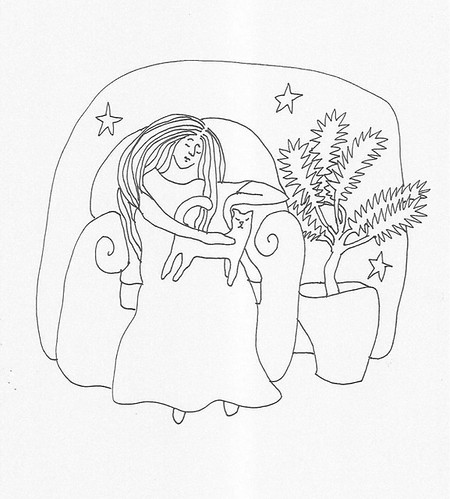
The assignment was this: an ink line drawing of a woman, a cat and a plant. I made nine of them and send them all for consideration. Banana-san and her publisher chose two. Here are some of the out-takes.

The novel is not translated into English yet, but gist of the story, as I understand it, is this:
A young woman falls in love with an artist who is grieving his departed wife. The artist keeps drawing pictures of the wife, who was not really a human, but a cat in human form. His wife cared only about other cats, and thought the kind of things cats think. Eventually, though, he does come to appreciate the young woman and return her love. Along the way we also get an environmental message about making a better world. The title of the work is “Another World.”

Banana-san wrote in the afterword of her book:
It is my feeling that the difficult times we are facing now will continue for a while.
We should trust in our intuitions and instincts and not lose sight of ourselves. Otherwise, we’ll find it too hard to keep living in this world. In such times, I hope this novel of mine will stay close to the reader as a useful tool to overcome such difficulties, even if for a little while. You don’t have to follow the same lifestyle as the characters in the novel. It’s just my wish that you will at least read and feel their emotions that constantly vibrate in sympathy with Nature.
This series of novels titled “Kingdom” has been written during a peculiar period of my life. It has been hard work, but I do adore my characters.
Also, this is going to be the last novel that my father had read with his own declining eyes, because he has lost his eyesight now. He has seen the sceneries of this novel with his heart; I will hold this fact in my arms for the rest of my life.
Since my childhood, I have admired Alicia Bay Laurel, the author of “Living on the Earth”. I always wished that someday I would also be living in a forest like she does. The reality is that I am still living in Tokyo as an author. Even so, that wish is still there, just like in those long ago days.
When I met Alicia, she told me once that she could draw a picture for the cover of my book. I was so overwhelmed with joy, I didn’t know what to say. In my mind I was pinching my cheek to make sure that I was not dreaming.
She has no equal when it comes to drawing the most appropriate picture for this novel. She is the person who has cast a most beautiful spell on this novel. And I thank her for that.


 Alicia Bay Laurel
You must be logged in to post a comment.