



Buy the “Alicia Bay Laurel – Live in Japan” CD here.
July 23, 2018. Just coming off the press today is my 8th album, a collection of recordings by audio engineer Yasushi Yamaguchi from my concerts in Japan. Three of the recordings were made on August 8th, 2015, at a peace concert in at Hiroshima Nakaregawa Church, at ground zero in Hiroshima, during the week of the 70th anniversary of the bombings of Hiroshima and Nagasaki in 1945.
The album also includes a duet with legendary Japanese traditional singer, Ikue Asazaki, and a live rendition of my song Ukulele Hula with the Inoue Ohana Band, during kumu hula Miho Ogura‘s debut performance of her original choreography created for this song.
Also, I recorded a medley that evolved onstage over three years of concerts in Japan, often with interpretive dancers, blending the four chants of the solstices and equinoxes from the book Being of the Sun, both the book and the songs a collaboration with composer/author Ramón Sender Barayón.
My cover drawing, Amaterasu Seen From Mori Tower depicts the Shinto sun goddess Amaterasu appearing over Tokyo as a cloud lifting the sun from the eastern horizon across the bay. The orange and white Eiffel-Tower-like Tokyo Tower, a television tower, stands directly between Mori Tower, a residential sky scraper in the Roppongi area, and Tokyo harbor. The art gallery that sold this drawing is in the building next to Mori Tower. However, I sell greeting cards with this image in my online store.
Listener feedback for Alicia Bay Laurel: Live in Japan
Charming! A wonderful CD, light and lyrical and still timely and deep. I especially liked the crowd singing along parts. Such cosmic threads run through your life and music and art. Wow!
Sophia Songhealer
Singer/songwriter and recording artist/producer
Clearlake, California
_____________________________________________
Alicia,
Thank you very much for sending us your new CD: Live in Japan.
Your voice, so pure and warm, makes me feel at home.
With so many people suffering from cruelty of wars, and new totally devastating nuclear war still looming, your message reminding people of the beauty of life, and the warmth of peace is more meaningful than ever.
Ikue Asazaki’s voice is so soulful!
Kenichi Iyanaga
Professor Emeritus of Mathematics
Tokyo University
_________________________________________________
Wow, the CD looks and sounds great Alicia.
Nice balance, guitar solo works, and you sound great.
Paul Metzke
Jazz/blues guitarist
New York City, NY
___________________________________________________
Alicia Bay Laurel is back in Japan and Okinawa. In this [track “Imagine”], she sounds like an angel in a church at ground zero in Hiroshima. Can’t stop listening, so beautiful, and a special time, place convergence for peace. Thank you!
Jean Downey
Attorney, Professor, Journalist and Activist
Winter Park, Florida
____________________________________________________
Thank you for sending me your new CD.
I am really enjoying listening to it right now!
I was surprised to hear how good your Japanese pronunciation is.
You sound so Japanese!
I love your voice on “Imagine”.
And I love the sweet face of Amaterasu on the jacket!
Great CD!
Mayu Jensen
Translator, graphic artist, and singer/songwriter
Nagano Prefecture, Japan
_______________________________________________________
Six small but powerful tracks — as relevant today as when the songs were first written — speak to the depths of our souls and the heights of our spirits. Alicia Bay Laurel’s soulful renditions are the perfect balm for our troubled times, making Live in Japan another timeless gem in our collective treasure box.
今だからききたい Ima dakara kikitai
大地の音色 Daichi no neiro
今だからききたい Ima dakara kikitai
心の響き Kokoro no hibiki
今だからききたい Ima dakara kikitai
アリシアの唄 Alicia no uta
(it’s hard to translate the Japanese into English… Literally, it would mean, “Because it’s IMA (now), we want to listen to the tones of Mother Earth/Because it’s IMA, we want to listen to the vibrations of the heart/Because it’s IMA, we want to listen to Alicia’s songs” But it sounds much better in Japanese!)
Carole Hisasue
Former Radio and TV Personality in Tokyo
Now Organic Farmer and Activist in California
___________________________________________________
Your voice is heavenly! Your music too. As a die hard Beatlemaniac, I am not easily moved by new versions of Beatles/Lennon songs…but you moved me to tears.
I grew up in Israel listening to the Beatles…it’s how I learned English! Of course, the most important thing I learned from their music was to imagine a world renewed by hope and faith and youth. I remember when they broke up and the acrimony that followed. My ideal was shattered…but, of course, we all have to grow up. Now I’m a grandma and I worry about the future for my grand kids. Hearing you sing these classics with the same spirit as the originals restores my faith in the dream. Thank you and, of course, you may post my comments.
Peace and love,
Sigalit Avigdory
Jerusalem, Israel
__________________________________________________
I sing answer song to LAST NIGHT I HAD THE STRANGEST DREAM.
♪ If it’s a dream, please don’t wake me up.
where is that ? Costa Rica ? Andorra ? No ! That is Japan !
We vowed never to go to war again.
Tetsuya Hikida
Musician, singer/songwriter
Niiza, Japan
_________________________________________________
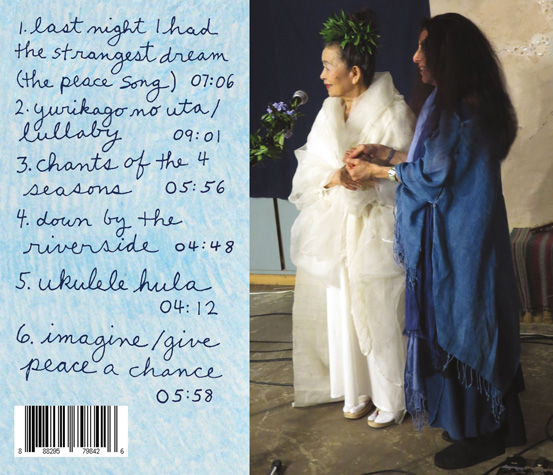
Production Notes and Lyrics:
Produced by Alicia Bay Laurel for Indigo With Stars, Inc. © 2018
All tracks recorded, mixed and mastered by Yasushi Yamaguchi, for Monk Beat Studios.
except for track 3, which was recorded by Mark Hewins of Musart
Drawing Amaterasu Seen From Mori Tower and graphic design by Alicia Bay Laurel
Photos of Alicia Bay Laurel and Ikue Asazaki by Kensuke Ishii
Costumes worn by Alicia Bay Laurel and Ikue Asazaki created by Kaoriko Ago Wada, owner/designer of organic fiber/fair trade fashion company, Little Eagle
Digital layout by Hoshi Hana
1. Last Night I Had the Strangest Dream
Music and lyrics by Ed McCurdy © 1950, Folkways Music Publisher, Inc.
Recorded at an all-day peace concert produced by Kaoriko Ago Wada, designer and owner of the organic fiber/fair trade fashion company Little Eagle, at Hiroshima Nakaregawa Church, located at ground zero in Hiroshima, on August 8, 2015, during the 70th anniversary of the atomic bombing of Hiroshima and Nagasaki. It was the final song of the concert, and everyone was swaying together in a circle, a garland of 1000 paper cranes draped around all of our shoulders, folded in prayer and remembrance for those that died in and after the bombings.
Lead vocal and melody guitar: Alicia Bay Laurel
Harmony vocal and harmony guitar: Takuji
Lead (electric) guitar: Paul Metzke
Plus the entire cast (including the Lily Choir and the Inoue Ohana Band) and the audience at the event, all of whom joined us in singing the second time through the song.
Last night I had the strangest dream
I never had before
I dreamed the world had all agreed
To put an end to war
I dreamed I saw a mighty room
The room was full of men (and women!)
And the paper they were signing said
They’d never fight again.
And when the paper was all signed
And a million copies made
They all joined hands and bowed their heads
And grateful prayers were prayed.
And the people in the streets below
Were dancing ‘round and ‘round
And swords and guns and uniforms
Were scattered on the ground.
2. Yurikago No Uta/ Lullaby
Yurikago No Uta (Cradle Song): Words by Kitahara Hakushu, Music by Kusakawa Shin
Lullaby: Music and lyrics by Alicia Bay Laurel © 2000, Bay Tree Music, as part of the album Music From Living on the Earth
Recorded at a June 6, 2015 concert and fashion exhibition produced by Kaoriko Ago Wada, at Café Slow. This restaurant and performance venue in a straw bale and cob building in Kokubunji, Tokyo, was created by and for the people of the Slow Life movement, which values creating things by hand and growing one’s own food, both to help preserve nature and to nourish one’s spirit. Yurikago No Uta/Lullaby was the final song of the show, at the end of (my idol!) the legendary singer Ikue Asazaki’s set. I thought she was going to sing Yurikago No Uta both at the beginning and at end of the piece, but, to my surprise, when I paused for her to begin singing it the second time, she motioned that she wanted me to sing it instead! So, I jumped in on the second line and sang it to the end.
Lead vocal: Ikue Asazaki
Lead vocal and melody guitar: Alicia Bay Laurel
Lead guitar: Atsushi Tanaka
Yurikago No Uta
1) Yurikago no uta wo Canary ga utauyo The canary is singing a cradle song.
Nen neko Nen neko Nen nekoyo Sleep well, child, sleep well, child, sleep well, child.
2) Yurikago no ueni Biwa no m yureruyo Biwa (loquat) is swaying above the cradle.
Nen neko Nen neko Nen nekoyo Sleep well, child, sleep well, child, sleep well, child.
3) Yurikago no thuna wo o Kinazumiga ga yusuruyo The squirrel shakes the rope of the cradle
Nen neko Nen neko Nen nekoyo Sleep well, child, sleep well, child, sleep well, child.
4) Yurikago no yume ni kiiro no tuki ga kakaruyo. Yellow moonlight shines on your dreams in the cradle.
Nen neko Nen neko Nen nekoyo Sleep well, child, sleep well, child, sleep well, child.
Lullaby
Verse 1
I won’t leave you alone
I won’t leave you alone
Until you’re ready
To start off on your own
I won’t leave you alone
I won’t leave you alone
Verse 2
I won’t leave you at night
I won’t leave you at night
Until the morning
Fills your window with its light
I won’t leave you at night
I won’t leave you at night
Verse 3
I won’t stop you when you go
I won’t stop you when you go
But I’ll be ready
To smile and say hello
I won’t stop you when you go
I won’t stop you when you go
Verse 4
I won’t leave you alone
I won’t leave you alone
Until you’re ready
To start off on your own
I won’t leave you alone
I won’t leave you alone
3. Chants of the Four Seasons from Being of the Sun
Music composed by Ramón Sender Barayon
Lyrics by Alicia Bay Laurel and Ramón Sender Barayon
Summer Solstice Chant, Autumn Equinox Chant, Winter Solstice Chant, and Spring Equinox Chant, © 2013 Bay Tree Music, as part of the album Songs from Being of the Sun and © 1973 as part of the book Being of the Sun (Harper & Row, New York)
This is the only track in this album that was not recorded at a live event. Instead, it documents a medley that evolved onstage, often with an interpretive dancer, during my performances in Japan in 2015, 2016 and 2017.
Lead Vocal and Zither (Evo Bluestein Sparrowharp): Alicia Bay Laurel
Summer Solstice Chant:
You have reached the highest in our heavens
And the widest span of our horizon
As we traverse the summer side of the sun
We are in the joy of your attendance
Upon this half of our mother’s breast
Autumn Equinox Chant:
Once again the night is equal to the light
On the autumn side of the sun
We have gathered to make light
For the darkness approaches
Thank you for the bounty of the summer
Thank you for the fullness of the harvest
Winter Solstice Chant:
Our half of the earth has tipped away from you
And we are on the winter side of the sun
When we are in cold and darkness
We see you in candle flames and fires
We have stored your energy to feed us
Until the day you warm us through our skin
Spring Equinox Chant:
Today the darkness gives way to daylight
Wakening from winter on the spring side of the sun
How the narrow path of sunlight has widened
As our hemisphere returns to the light
Plant we now our gardens
Blossom now the love in our souls
4. Down by the Riverside
African-American Spiritual from the early 1800’s, in public domain
Lead Vocal and Melody Guitar: Alicia Bay Laurel
Additional Vocals: The Lily Choir
Also recorded at the peace concert produced by Kaoriko Ago Wada at Hiroshima Nakaregawa Church on August 8, 2015, during the 70th anniversary of the atomic bombing of Hiroshima and Nagasaki. Singing “Down by the Riverside” raised our spirits at many an anti-war protest rally during the US invasion of Vietnam in the 1960s and ‘70s. As is customary when singing this lively song, I made up a few verses of my own. The audience joined in with me and the Lily Choir as well.
Verse 1
Gonna lay down my sword and shield
Down by the river side
Down by the river side
Down by the river side
Gonna lay down my sword and shield
Down by the river side
And study war no more
Chorus
I ain’t gonna study war no more
I ain’t gonna study war no more
I ain’t gonna study war no more
I ain’t gonna study war no more
I ain’t gonna study war no more
I ain’t gonna study war no more
Verse 2
Gonna walk with the people of peace
Down by the river side,
Down by the river side,
Down by the river side,
Gonna walk with the Queen of Peace
Down by the river side
And study war no more
Chorus (same)
Verse 3
Gonna hold hands around the world
Down by the river side,
Down by the river side,
Down by the river side,
Gonna hold hands around the world
Down by the river side
And study war no more
Chorus (same)
Verse 4
Gonna lay down that atom bomb
Down by the river side,
Down by the river side,
Down by the river side,
(spoken) “Gonna disassemble that atom bomb!”
Down by the river side
And study war no more (spoken) “we don’t need those things anymore!”
Chorus (same)
Verse 5
Gonna lay down my attitude (“my attitude” means “my anger” or “my cynicism”)
Down by the river side,
Down by the river side,
Down by the river side,
Gonna lay down my attitude
Down by the river side,
And study war no more (spoken) “I don’t want to fight anybody!
Chorus (same)
5. Ukulele Hula
Music and Lyrics by Alicia Bay Laurel © 2001, Bay Tree Music, as part of the album Living in Hawaii Style
Lead Vocal and Melody Guitar: Alicia Bay Laurel
Harmony Vocal and Ukulele: Kathie Inoue
Lead (electric) Guitar: Keni Inoue
Recorded July 25, 2015 at Surfers, a restaurant, bar and performance venue on a cliff overlooking the ocean, just outside the town of Zushi, Kanagawa. At this event, kumu hula Miho Ogura premiered her original choreography for my song “Ukulele Hula,” in performance with five of her students. I wrote “Ukulele Hula” soon after beginning to study slack key guitar in the Hawaiian village of Hana, Maui, in 1974.
Verse 1
I’m dreaming to the sound of ukuleles
Playing all night long for a wedding of our family.
In paradise, everybody is lover,
And the more you let go the more that comes back to you.
Refrain 1
So, surrender to the beautiful island,
And she’ll give you everything that you need.
Verse 2
Feasting on a sun-ripened papaya,
Playing all day in the waves along the sand,
Breezy afternoon and a sunset on the ocean,
Sailing away on a song of Bali Hai.
Refrain 2
Let me make you feel good; that’s what we’re here for:
For ecstasy, delight and bliss.
Verse 3
It’s so balmy, such a balmy evening,
To melt in love in a tropical paradise.
Let’s swing and sway to the sound of ukuleles
Like the gentle green fronds of the lovely coconut tree.
Refrain 1, again
Surrender to the beautiful island
And she’ll give you everything that you need.
Verse 1, again
I’m dreaming to the sound of ukuleles
Playing all night long for a wedding of our family.
In paradise everybody is a lover,
And the more you let go the more that comes back to you.
6. Imagine and Give Peace a Chance
Imagine: Music and Lyrics by John Lennon, © 1971, Lenono Music
Give Peace a Chance: Music and Lyrics by John Lennon, © 1969, Sony ATV Tunes
Lead vocal and melody guitar: Alicia Bay Laurel
Harmony vocal and lead guitar: Takuji
The opening song of my set (and the closing song of Takuji’s set) at the peace concert produced by Kaoriko Ago Wada at Hiroshima Nakaregawa Church on August 8, 2015, during the 70th anniversary of the atomic bombing of Hiroshima and Nagasaki. Thank you, John Lennon, for this anthem to the new paradigm of reunion with nature, loving, sharing, and peace, arising as the old paradigm of dominion over nature, hate, greed and war falls out of favor.
Imagine there’s no heaven
It’s easy if you try
No hell below us
Above us only sky
Imagine all the people living for today ahaa haa
Imagine there’s no countries
It isn’t hard to do
Nothing to kill or die for
And no religion too
Imagine all the people living life in peace yoohoo ooh
You may say I’m a dreamer,
but I’m not the only one
I hope someday you’ll join us
And the world will be as one
All we are saying
Is give peace a chance
All we are saying
Is give peace a chance
Imagine no possessions
I wonder if you can
No need for greed or hunger
A brotherhood of man
Imagine all the people sharing all the world yoohoo ooh
You may say I’m a dreamer,
but I’m not the only one
I hope someday you’ll join us
And the world will live as one
All we are saying
Is give peace a chance
All we are saying
Is give peace a chance
______________________________________________
I meant to tell you how sweet your voice is. I listened to Imagine/Give Peace a Chance three times on the first day. John Lennon would have teared up. I did.
Timothy Sparks
Portland Oregon
______________________________________________










 Alicia Bay Laurel
You must be logged in to post a comment.