Low-carb Latte


Time to Mellow Out, acrylic painting by Alicia Bay Laurel, 2005

Low Carb Latte

One teabag Yogi Tea Classic Indian Spice Caffeine-Free Tea
1 cup boiling water
2 tablespoons unflavored, unsweetened protein powder (any type, organic is best)
1/2 cup unflavored, unsweetened vegan or dairy milk
A few drops of stevia glycerite
a pinch of cinnamon

In a tall, inert (glass, ceramic) container, infuse the teabag in the boiling water for 15 minutes, so that the tea is strong, then remove the teabag. Add milk and protein powder and blend with a stick blender under smooth and frothy. Taste test; if you’d like it sweeter, stir in a few drops of stevia glycerite. Pour into a beautiful mug or cup and dust the top with the cinnamon.

May 14 Birthdays

This Hawaiian birthday card comes with a recording of
Alicia’s Hawaiian birthday song (both digital downloads) – here.


Alicia Bay Laurel (artist/writer/musician)
David Byrne (musician)
Jill Stein (politician and physician)
Bobby Darin (singer)
George Lucas (filmmaker)
Otto Klemperer (conductor)
Gabriel Fahrenheit (physicist)
Patrice Munsel (opera diva and actress)
Sidney Bechet (jazz clarinet player)
Cate Blanchett (actress)
Danny Wood (singer – New Kids on the Block)
Jose Da Silveira (artist)
Tim Roth (actor)
Robert Zemeckis (director)
Jack Bruce (musician)
Al Porcino (jazz musician)
Richard Deacon (actor)
Norman Luboff (choral leader)
Joe Louis (boxer)
Skip Martin (composer)
Billie Dove (actress)
Thomas Gainsborough (artist)
Sofia Coppola  (screenwriter, director, producer, actress)
Mark Zuckerberg (inventor and owner of Facebook)
Rober Zemekis (director, producer, screenwriter)

Toby Hemenway

Our sixth nominee for the Living on the Earth Award is Toby Hemenway, author of the permaculture classic Gaia’s Garden, and urban permaculture classic The Permaculture City, as well as numerous articles on, and teacher of workshops on, permaculture and sustainability.

I met Toby when I performed a Living on the Earth: The Musical show at Center of Conscious Oneness, a beautiful performance space at the Pangaia commune in Puna, on the Big Island. Toby was on the island to teach a permaculture course at La’akea Gardens, and he invited me to perform the show for his students a week later. Toby and I traded books, and I became an instant fan of Gaia’s Garden. At La’akea Gardens I met permaculture teachers Ryan Holt and Tara Robinson, who came to my home in Kea’au, and planted a food forest and perennial vegetables for me, bringing the permaculture principles to life right in my own back yard, and remaining my friends ever after (I sang at their wedding!)

Toby’s book Gaia’s Garden surrounds the reader with rich and instructive images from his country farm in Oregon and from others he knows. My favorite story in his book is of two brothers who remove a cement sea wall from their land, causing a natural wetlands to return. Soon cattails grow, and the brothers enjoy cooking with them. Then the cattails disappear, and the brothers realize the abundant cattails have attracted muskrats. Instead of fighting off the the muskrats, they wait and observe, and eventually the cattails return, along with a population of sea otters who are feeding on the muskrats. Later, they see an eagle hunting for muskrats and otters, a sight unknown for decades in those parts. By removing the cement sea wall they unleashed a cascade of bio-diversity.

In Toby’s gardens, plants radiate from the home in zones, with those that require the most supervision closest to the doors, and those requiring the least farthest away. Plants are grouped together in “guilds” to benefit one another, planted not only to benefit people, but also to feed the local wildlife, including insects and birds, to fix nitrogen and minerals in the soil, and to provide beauty and shade.

Toby’s gardens begin with sheet mulching, which is layering soil-building materials and leaving them to disintegrate naturally, so that the small denizens of the soil will live undisturbed by metal blades and better do their part in enriching the soil. All creatures, including insects and other arthropods, have their rightful place in a permaculture garden, and a job to do in building the biomass from which gardens and orchards grow.

Last year, Toby wrote about the fantasy versus the reality of sustainable living in the country. He realized that when petroleum becomes scarce and super-expensive, farming will not be a better way to survive, since farmers actually drive farther than urban dwellers, and use products that must be delivered far from the central distribution centers in cities. He noticed that his rural neighbors did not share his beliefs about preserving the environment and interacting peacefully. So Toby and his wife moved to Portland, and have been enjoying an urban permaculture environment as well as goodhearted neighbors who share their ideals.  He later wrote the book, The Permaculture City, about these discoveries.

Back in the 1960’s, Paolo Soleri had much the same idea: that the ecological footprint of a city dweller is much smaller than that of a country dweller, and that vertical cities save horizontal open spaces from being paved.

EMDR

Recording my vocal parts for the CD What Living’s All About,
at Scott Fraser’s studio in Mount Washington, Los Angeles.

As I was preparing to record my third CD, What Living’s All About, I thought about how, when I was recording my first two, I always got a fever and a sore throat on the day I was to sing the vocal tracks, so that they never sounded quite as good as the way I sound in live performance.

I decided that this time, I would take the opportunity to change that pattern of subconscious self-sabotage. Fortunately, my sister is a psychotherapist and current with the latest healing techniques. She had used something called EMDR to prepare herself for a much needed, much dreaded surgery, and not only did she go through the surgery without her expected panic, but she healed so quickly that her surgeon was amazed.

EMDR (eye movement desensitization and reprocessing) moves the attention of the traumatized person from the right to left to right to left sides of the body, seemingly from the sympathetic (fight or flight) to the parasympathetic (rest and digest) nervous systems, so that the mind can rapidly process stressful memories and information that may have been “stuck” or undigested, sometimes for decades. Successfully healing combat veterans and rape survivors of post traumatic stress disorder (PTSD) in only a few sessions (rather than years of talking therapy), EMDR works equally well with less intense problems, including my musical performance issues.

Developed by Francine Shapiro, PhD, a clinical psychologist, EMDR holds up to rigorous double blind testing. No one is exactly sure WHY it works, only that, when it is administered correctly by a therapist trained in the technique, it rocks.

I went to the EMDR International Association website, looked for therapists in my geographical area, and found one that specialized in arts issues, Paulette Rochelle-Levy. I had four appointments with her before recording. The first was “intake,” that is, she asked me questions and gathered information about my life and my issue at hand.

On the second appointment, Paulette helped me find the life moments where my fears around singing were catalyzed, and then, as I pictured them, patted first my right hand, then my left, then my right, and so on. My homework was to write a letter to the 12 year old girl I once was, and tell her what is ahead of her in her life, from the perspective of what I have lived to this date.

On the third appointment, Paulette, instead of doing EMDR, lead me in an exercise that I thought, at first, was sort of silly, but it turned out to be just as profound as the EMDR. She asked me to walk, eyes closed, in her living room and say “I am Alicia’s Higher Self” three times, and then to describe myself.

I said, “I am a vortex of swirling energies: elemental nature energies rising from below, inspirational and angelic energies descending from above, genetic, societal, cultural, familial, and past life energies swirling together from all sides. I am the sum of all of these currents of energy coming together.”

Paulette said, “That’s the answer to the question, ‘Who are YOU to be making a CD of your own music.’”

On the fourth appointment we did more EMDR. Two days later I went into the studio, did not have a sore throat, and sang well.

Was I 100% cured? No. On the day I recorded the vocal for Nature Boy, I had a throat issue again, and, as it was an improvised piece (couldn’t re-record it later) with a legendary player who had made some sacrifices to be at the studio for me that day, I had to just do it anyway. To my delight, improvising that song with John B. Williams and Enzo Tedesco turned out to be a peak experience. I like listening to it, too.

Post EMDR, the studio experience was, for me, on the whole, very much more exciting than it was stressful. Good stuff! And my sister will be taking a professional training in EMDR this fall.  Meanwhile, she lent me the EMDR book, and I highly recommend it.

Weird Violins

Robert Cauer’s legendary by-appointment-only shop in Hollywood builds, sells, repairs and accessorizes violins, violas and cellos; on the walls of the waiting room hang Cauer’s collection of historic and bizarre violin permutations that he acquired at auctions over the years.


A scalloped violin and a violin with two points instead of four


A rounded violin with crescents instead of f holes, and a violin with exaggerated points and a stepped tail piece


A violin jigsaw puzzle and a violin with a double length neck, two instead of four points, and wavy lines instead of f holes


A violin with a piano style keyboard over the neck


An electric rhinestone studded cowboy fiddle, probably from the 1920’s or 1930’s, a striped violin, and a violin with wavering outlines, as if it had been drawn by a child


An aluminum violin with a metal bow, and a bowed zither, a fretted instrument played flat on a table


An old German violin with a carving of a human head instead of scroll at the top, a practice violin, which won’t annoy the neighbors because it lacks a resonating chamber


A Stroh violin, invented in the late 19th century by John Matthias Augustus Stroh, a German-born mechanic and inventor living in London and the first person to build a phonograph in England. In the early days of recording on wax rolls, violins did not generate a strong enough signal to record easily, so Stroh added a conical aluminum diaphragm and a large horn to transmit the sound toward the recording horn transmitting the sound to the needle imprinting the wax roll. Stroh added a smaller horn so the musician could also hear himself play. With the advent of the microphone and electric recording in the mid-1920’s, demand for the Stroh decreased, leaving only violinists wanting a louder sound for live performance. Discontinued from manufacture in 1942, the Stroh violin lives on in collections like Robert Cauer’s, in the occasional novelty act, in Tom Waits recordings, and in the Biho region of Transylvania, where their odd, somewhat nasal sound is highly prized.

More wonderful collections of unusual stringed instruments here and here.

Starhawk


Starhawk embodies her ethics and principles in direct physical action, in highly engaging books, and by teaching. She burst to stardom in the late 1970’s with her bestselling book The Spiral Dance, which introduced the Old Religion (Wicca, Paganism, Nature Worship) to modern spiritual seekers.

Starhawk’s love of nature and humanity expresses itself not only in spiritual practices, but in working vigorously to promote permaculture and environmentalism, and through political activism for peace and against corporate globalization.

These major threads of her life weave through her delightful autobiographical novel Walking to Mercury, and her intense, sweeping novel of a future lifetime, The Fifth Sacred Thing and her terrifyingly prescient sequel, City of Refuge.

To get the gritty flavor of the frontlines of the demonstrations where she organized nervous demonstrators to resist police on horseback, or her courageous actions to protect Palestinians in the violent occupied territories, read her activist diary Webs of Power.

To get down and dirty, learning permaculture and earth activism with Starhawk, click here.

Tofu Dips and Sauces

Two varieties of super-soft silken tofu

Artichoke dip: Instead of dipping my artichoke petals in melted butter or mayonnaise, I prepare a creamy, high protein, isoflavone rich dip made from organic silken tofu, ume (plum) vinegar, organic extra virgin olive oil, and dill weed.

Silken tofu is the thinnest, smoothest, most watery type of tofu, and is sometimes sold in boxes shelved among the dry oriental foods rather than in the refrigerated case with the other types of tofu. Ume vinegar, also found in the oriental foods section, lends both a salty and a sour taste, and makes tofu taste like fermented dairy. If you can’t get ume vinegar, you can use some of the flesh of a seeded pickled ume plum instead (season to taste). Olive oil gives a mayonnaise-like oiliness and Mediterranean taste to the mixture.

Pour off the water in which the silken tofu is floating, and then pour the block of tofu into a food processor, along with one tablespoon of organic extra virgin olive oil, two teaspoons of ume vinegar and a teaspoon of dill weed. Blend until smooth and pour into a dish. Dunk your steamed artichoke petals.

Faux fruit yogurt: vegan breakfast treat, tastes like a fruit yogurt: Place one box of drained silken tofu in the food processor with some slightly thawed frozen berries and blend until smooth. Pour into a dish, and, optionally, add more thawed or fresh fruit on top.

Kim Cheese: Spicy, low fat, high fiber, high protein topping for baked potatoes, steamed cauliflower or whole grain crackers: Pour into a food processor one carton of (drained) organic tofu (heavier than silken but not “hard”) and one jar of kim chee – preferably organic, but certainly no MSG and no preservatives. If you can’t find kim chee without MSG where you live, here’s a recipe.) Blend until smooth. Taste and correct the seasoning, using ume vinegar if it needs more salt and acidity, and olive oil if it needs a richer flavor.

Cut open the top of the baked potato lengthwise and crosswise , squish it together a little, and then add a half cup of the sauce.

Vegan cottage cheese is easy to make by mashing organic extra firm tofu (White Wave, Wildwood, etc.) with a fork, adding a dollop of Follow Your Heart Grape Seed Oil Vegenaise, and salting to taste with ume plum vinegar.

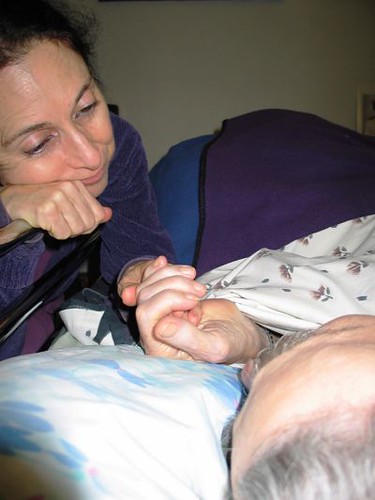
My Father is Dying

My father is dying. He is 95 years old. He refuses food, a feeding tube, the morphine provided by the hospice care. He sleeps a lot. This is how lions and tigers die, when they are very old.

Sometimes he wakes up and speaks clearly. He asks me about my brother. They have not spoken in twenty years. They are both stubborn in their silence. Yet, this is the first question my father asks me every time I talk with him. Where is your brother?

I am committed to unconditional love for all of my family members, no matter how they act. I want the last words they hear from me to be “I love you.” Since I don’t know when they or I will disappear from this particular reality, I tell them I love them frequently.

Drawing the Divine

My tendency as a visual artist is to portray Divine Energy in human form, in ecstatic union with nature. By definition the All Mighty (all energy and matter without exclusion) is boundless and eternal, and therefore unknowable by the human mind. How can one paint the face of God/Goddess?

Muslims and Jews say you can’t. Christians, Buddhists, Hindus, and what I call post-psychedelic artists (for example Mayumi Oda and Susan Seddon Boulet), catalog the characteristics of a spiritual outlook in visual form: The divine is compassionate, serene, appreciative (often to point of ecstasy), harmonious with the energy flow of the moment, wise, inspired, generous, mysterious, at one with nature, and capable of impossible things.  Tibetan Buddhists refer to these images as Thangka.

May Day 2006

Today when I set out for my walk, I spied seven helicopters over Wilshire Boulevard near La Brea, where four hundred thousand Latinos and sympathizers marched against the deportation/exploitation of non-resident workers from Mexico and elsewhere.

I saw the marchers, dressed in white t-shirts and waving American flags, and reflected that when I see American flags being waved, I generally expect they are being waved to arouse support for policies that are counter-productive to the needs of the population, and favorable to the rich. This time the flags have a different meaning: “This is our home, too.”

That a May Day strike by immigrants for better working conditions has historical verasity did not escape me, and I found resonance in this article on Truthout.org (originating from TomPaine.com).

The labor movement has not been silent on the illegal invasion of Iraq, either.  Two days ago, on April 29, 2006, over 350,000 demonstrators thronged New York City calling for withdrawal of US troops from Iraq.  USLAW and union organizer (and my fellow member of the American Federation of Musicians Local 677, Honolulu) Steve Dinion sent the following email today:

The march was kicked off by a labor rally at which leaders of
delegations from around the nation took the podium to acknowledge their
members’ presence.  One highlight of the rally was a powerful
denunciation of the war in Iraq by Roger Toussaint, President of
Transit Workers Union Local 100, who had been jailed followed a strike
by NYC transit workers embroiled in a struggle for a fair contract.
Brother Toussaint was ordered to serve ten days in the NYC jail after a
judge ruled the union had violated the anti-union "Taylor Law" which
bars strikes by public workers and imposed fines and suspended dues
checkoff in addition to jailing the union’s president.  He was jailed
just a block and a half from the Foley Square terminus of the march
where a Peace, Justice and Democracy Grassroots Action Festival was
being held.  TWU members maintained a 24-hour a day vigil outside the
Tombs (as the NYC jail is locally known).  On the eve of the
demonstration in which the labor contingent planned to join the vigil
en masse following the march, Brother Toussaint was unexpectedly
released.  He was welcomed as a working class hero by the throng of
labor marchers gathered shoulder to shoulder in the labor contingent
assembly area on 19th Street at Broadway.  Toussaint spoke about the
relationship of the war in Iraq and the war at home against working
people and their unions.

Another major speaker was John Wilhelm, President of the Hospitality
Industry Division of UNITE HERE, who expressed his gratitude to U.S.
Labor Against the War for organizing what by all accounts turned out to
be the largest such labor contingent in the history of all antiwar
protests (including those during the Vietnam War).
 Both Presidents
Wilhelm and Toussaint took their places at the front of the labor
contingent behind the USLAW banner.  They were joined by union leaders
and members from UNITE HERE, TWU, CWA, SEIU, AFT, AFSCME, NEA, IBEW,
USWA, NJ IUC, UE, BMWE, UAW, AFM, IBT, Pride at Work, LCLAA, a number
of labor councils and many others in a massive outpouring of labor
antiwar sentiment.

The rally was co-chaired by Nancy Wohlforth, Co-Convenor of USLAW, who
is Secretary-Treasurer of OPEIU (and also Co-President of Pride at Work
and a member of the AFL-CIO General Executive Council) and Wilfredo
Larancuenta, Manager of the Laundry Division of UNITE HERE.  It was
opened by Gene Bruskin, Co-Convenor, who greeted the crowd on behalf of
USLAW.  A delegation from Military Families Speak Out and Iraq Veterans
Against the War also made a powerful presentation, demanding the
immediate return of the troops as the only meaningful way to support
them.  The labor contingent drew participants from unions on both sides
of the AFL-CIO/Change to Win divide in the labor movement.

The labor rally featured music from the NY Labor Chorus, NJ Industrial
Union Council Solidarity Singers, a percussion group, and chants led by
Steve Kramer, Executive Vice President of 1199SEIU, the largest local
union in the nation with more than 240,000 members.

It took nearly four hours for the march to proceed from its kickoff at
17th and Broadway to the festival site in Foley Square, two miles
away.

At the festival, USLAW (US Labor Against the War) sponsored one of 19 tents in which literature was distributed and "Meeting Face to Face", the documentary about the 25-city 2005 tour by six Iraqi labor leaders, was shown on a monitor,
and where copies, along with buttons and bumper stickers, were sold.
<!– D(["mb","labor marchers gathered shoulder to shoulder in the labor contingent
assembly area on 19th Street at Broadway.  Toussaint spoke about the
relationship of the war in Iraq and the war at home against working
people and their unions.

Another major speaker was John Wilhelm, President of the Hospitality
Industry Division of UNITE HERE, who expressed his gratitude to U.S.
Labor Against the War for organizing what by all accounts turned out to
be the largest such labor contingent in the history of all antiwar
protests (including those during the Vietnam War).  Both Presidents
Wilhelm and Toussaint took their places at the front of the labor
contingent behind the USLAW banner.  They were joined by union leaders
and members from UNITE HERE, TWU, CWA, SEIU, AFT, AFSCME, NEA, IBEW,
USWA, NJ IUC, UE, BMWE, UAW, AFM, IBT, Pride at Work, LCLAA, a number
of labor councils and many others in a massive outpouring of labor
antiwar sentiment.

The rally was co-chaired by Nancy Wohlforth, Co-Convenor of USLAW, who
is Secretary-Treasurer of OPEIU (and also Co-President of Pride at Work
and a member of the AFL-CIO General Executive Council) and Wilfredo
Larancuenta, Manager of the Laundry Division of UNITE HERE.  It was
opened by Gene Bruskin, Co-Convenor, who greeted the crowd on behalf of
USLAW.  A delegation from Military Families Speak Out and Iraq Veterans
Against the War also made a powerful presentation, demanding the
immediate return of the troops as the only meaningful way to support
them.  The labor contingent drew participants from unions on both sides
of the AFL-CIO/Change to Win divide in the labor movement.

The labor rally featured music from the NY Labor Chorus, NJ Industrial
Union Council Solidarity Singers, a percussion group, and chants led by
Steve Kramer, Executive Vice President of 1199SEIU, the largest local
union in the nation with more than 240,000 members.
“,1] ); //–><!– D(["mb","
It took nearly four hours for the march to proceed from its kickoff at
17th and Broadway to the festival site in Foley Square, two miles
away.

At the festival, USLAW sponsored one of 19 tents in which literature
was distributed and "Meeting Face to Face", the documentary about the
25-city 2005 tour by six Iraqi labor leaders, was shown on a monitor,
and where copies, along with buttons and bumper stickers, were sold.

The labor rally was taped by WBAI for broadcast on May Day evening
(check their website for an archival recording).

Sent to you by Hawai’i Labor for Peace and Justice*
Steve Dinion, Coordinator

Hawai’i Labor for Peace and Justice is an ad hoc group made up of union members, unorganized workers, and their supporters.  By sharing information on the interrelated wars on the Iraqi people, working people in the US and internationally, and immigrants, as well as struggles for peace and justice in Hawai’i, HiLPJ serves to build solidarity and promote activism among the workers of Hawai’i and their allies.

*You have been included on this e-mail list upon your request.  If you wished to be removed from this list, please let me know by responding to this message with the words "remove from list" in the message.


“,0] ); D([“ce”]); //–>