Some of My Favorite Flowers of Hawaii


Dinner plate sized yellow Hula Girl hibiscus


White hibiscus


Plumeria (aka frangipani), whose spicy fragrance makes it popular for leis.


A bromeliad in full bloom.


Bouganvillea


Datura, or angel trumpet


Lobster claw heliconia


Parakeet heliconia


Waterlily and lilypads


Red anthurium


Pale pink anthurium


Blue ginger


Chenille plant


Impatiens, practically a weed in the rainforest areas of Hawaii


Psitticorum, a smaller member of the heliconia family. This red and orange variety is often referred to as “parrot,” while the pale yellow and deep pink variety is called “peaches and cream.”


Purple tulip anthuriums, with their eliptical shape instead of a heart shape, stand next to a mysterious spiraling plant. I’d never seen one before I took this picture at Donna Keefer’s house in Pahoa.


Fragrant white ginger blooms beside the roadways of windward Hawaii in the summer, dazzling all with its bewitching frangrance.

Hawaii Tree Lore


Three flowering tropical trees: monkeypod, African tulip, and golden shower.


Beside a kukui tree, and young jacaranda tree with one burst of periwinkle flowers.


The silvery leaves and oil-rich nuts of the kukui tree. An indigenous tree, the kukui was considered sacred to the woodland and healing god Lono. The outline of the leaves resembles that of the head of a pig, one of Lono’s totem animals. Ancient Hawaiians used the nuts to make torches, and ground them as a sparingly used condiment (which, consumed in larger quantities, rapidly evacuates the bowels). Contemporary Hawaiians use them to make kukui nut oil soaps and massage oils.


A variety of imported palms at the gate to a private home. Many palm and cycad collectors live in Hawaii. Alas, when nurseries began importing palms from Puerto Rico, they inadvertently imported the tiny, loud-voiced coqui frog along with the palms, and, having no predators in Hawaii, the coqui is proliferating in the windward parts of the islands. The state and county officials have been so slow in responding to this particular infestation of alien species that it is now beyond control.


A rare Australian palm whose fruit is so poisonous that getting the juice on your skin can land you in the hospital for a week. Donna Keefer, who grew this hardy specimen, speculates that the tree must fight other organisms to survive in its native harsh climate, and it is over-armored for Hawaii.


A papaya tree loaded with fruit. Hawaii once exported Solo (yellow fleshed) and Strawberry (pink fleshed) papayas, but, because the ringspot virus was decimating much of the crop, chemical giant Monsanto and the University of Hawaii collaborated on creating two genetically modified strains, Rainbow and Sunrise. Today virtually all of the papayas in Hawaii have been contaminated with the GMO papaya pollen, since the field testing of these strains is open to the wind. This burdens organic farmers, since the standards to which they must conform exclude GMO species, and, worse, it emboldens Monsanto to sue those whose fields are thus contaminated for copyright infringement, since they consider the two GMO strains their intellectual property. Permaculture teachers say that ringspot virus wouldn’t proliferate in diversified agricultre; indeed most “pests” are the direct result of monoculture farming.

Uncovering an Ancient Village


The meadow below David and Wendy’s house site, with old Hawaiian rock walls and ti plants. On a clear day you can see the ocean, too.

“I’ve long held a vision of creating a place where people could come and learn where they are, about the ‘aina, about Hawaii,” Wendy Vance told me, regarding the off-the-grid homestead she and husband David Vance have been creating over the past six years in the remote and magical wilds of the Ka’u District, near the southernmost point of Hawaii Island.

Wendy’s deep into the ‘aina, both as an environmental activist from ‘way back, and as a practitioner of Hawaiian traditional culture, including chanting, drumming and dance, which she studied for many years with a respected Hawaiian kumu hula (teacher of dance).


Ohia trees surrounded by other Hawaiian native plants, including ti, mamaki, and fern.

When they bought the seven acres across the highway from the rented home where they lived outside Waiohinu, it was covered in Christmasberry bramble. Anyone else would have hired a bulldozer. Over a period of years, David painstakingly cleared the Christmasberry by hand, and underneath it, discovered the rock walls and house foundations of a Hawaiian village. As they cleared the land, Wendy and David planted Hawaiian native plants that had once been replaced by more aggressive alien species. In some areas, once they cleared the Christmasberry, the native plants simply reappeared and flourished.


The ruins of an ancient wall beside a wood pile and a very old tree.

As they continued to uncover and preserve the ancient village, to their astonished delight, the land adjacent on the ocean side of the land was cleared of Christmasberry for a twenty year cattle operation, and miraculously, the bulldozer driver left standing all of the native ohia trees on it. It was as if the peaceful force of their creativity and respect for Hawaii had rolled out beyond the boundaries of their land.

Hello Holualoa

Near the Blums’ house is a nearly 45 degree angle half mile road up to the Kona coffee capital of Holualoa. I walked it daily during my weeklong visit; a butt-restructuring walk, with bone-building and aerobic benefits galore. As I walked back down the hill, I feasted my eyes on huge views of the ocean and Kailua-Kona town in the distance, and the tropical plants growing abundantly along the road.

On my last walk for this sojourn, I brought along my camera, so you could see them, too.


Up the hill. Panting, but not stopping. Dense clouds but no rain.


Kona coffee plantations along the way.


Coffee cherries ripening on the trees.


Almost to the top of the hill.


Coming down again. The horizon is blurred from vog, Hawaii island’s own natural smog, from the world’s most active volcano, Kilauea.


Looking down from the mountain. The white spot on the ocean is a huge cruise ship near Kailua-Kona’s harbor. Some of the town is visible, too. The dark spot is a small plane.

Passionfruit Juice Recipes


Lilikoi are ripe when their shells wrinkle.

In tropical jungles, passionfruit, aka granadilla, aka lilikoi, vines drop their yellow or purple oval fruits in the late summer, summoning wild pigs, fruitarians and gourmet chefs to a wet-footed Easter egg hunt. This latter group will use the juice to create Lilikoi Chiffon Pie, Lilikoi Vinaigrette, and bright yellow Lilikoi Sauce to drizzle onto plates on which desserts and main dishes are served.

The name passionfruit does not refer to any aphrodesiacal qualities, but to the extra-terrestrial looking flower of the same vine, which has a three pronged pistil that someone decided harkened to the Holy Trinity. The vine itself is brewed as a sedative. The fruit is rich in vitamin C.

Here’s how to extract the perfumed essence of these fruits for gastronomic purposes.

Take your freshly harvested lilikoi to a tap, rinse off any dirt or vegetable matter, and let them drain in a collander. The ones with obvious flaws (soft spots, cracks, etc.) should be set aside and opened immediately to check the viability of the contents (throw out the bad-smelling ones; eat the good-smelling ones). The others should be left at room temperature to ripen, which occurs when they wrinkle.

The lilikoi has a firm (but not brittle) shell with a shiny exterior, with many tiny small black seeds inside, each in a tiny membrane sack full of sweet, sour, fragrant juice. You can eat the pulp with a spoon, crunchy seeds and all, from the little cup of its shell.

To make juice, cut the fruit in half with a sharp serated knife and scoop the seed pulp into a blender jar. When you’ve got two cups of seed pulp, put the top on the jar and pulse the blender for a second, three times, max. You don’t want to grind the seeds; you just want to break open the membrane sacks. Pour the blended pulp through a large wire strainer into a bowl, stirring the pulp in the strainer with a wooden spoon until you have nothing but black seeds left in the strainer and pure juice in the bowl. Discard the seeds. Compost the shells.

Lilikoi Fizz: Pour a half cup of lilikoi juice into an eight ounce tumbler, and fill it the rest of the way with chilled sparkling mineral water. Sweeten to taste with stevia glycerite; stir well.

Klezmer in Paradise


The Blums at their 40th anniversary party. They met in college, honeymooned in the Peace Corps, and are living happily ever after.

When I met Gloria and Barry Blum in the 70’s, they already were performing with a klezmer (Jewish party music) band they had founded called the Golden Gate Gypsy Orchestra of America and California, Otherwise Known as the Traveling Jewish Wedding. When I heard them play at Caffe Trieste in San Francisco, they blew off the roof.

A year before the Blum’s daughter, Katie, left the nest, eventually to get her degree in social work, the Blums moved to Kailua-Kona, on the island of Hawaii, leaving their beloved band behind. Kona Community Hospital was thrilled to have Barry as their only orthopedic surgeon, and the Blums were thrilled to trade their Mill Valley digs for a spacious, airy home on a hillside with a huge view of the ocean. Soon they began looking for band members.


The Kona Traveling Jewish Wedding Band onstage.

This time their band didn’t just play lots of wedding gigs. Gloria and Barry assumed leadership of Congregation Kona Beth Shalom, and they began performing Jewish wedding ceremonies in addition to the music. The band recorded a wonderful CD called Shaloha Oy, the title track being a minor key, up-tempo send-up of Queen Liliuokalani’s timeless Aloha ‘Oe. On the cover is a blurb from me: “Gloria Blum is the Janis Joplin of klezmer.”


Gloria singing with the band.

Kona Beth Shalom became a kick ass congregation, producing Karen Breier’s Shaloha Cookbook, which garnered an article in the New York Times, and adopting a torah (Old Testament scroll in Hebrew) that had belonged to a Czech congregation massacred during the Holocaust. The governor of Hawaii attended Kona Beth Shalom’s celebration of the old torah’s expert restoration.


My illustration for the backs of Gloria’s Feeling Good Cards. This image is copyrighted by Gloria Blum.

Gloria’s gift to humankind, a method of teaching appropriate behavior, self-esteem and social skills to mentally disabled teenagers, inspired her to create a resource curriculum guide, Feeling Good About Yourself, and also a communicaton card game, Feeling Good Cards, enjoyable by any group of people. Last year I drew a card back picture exactly to Gloria’s specifications, and re-designed the graphics for the box. That’s Barry playing his bass balalaika, and Gloria beside him, singing with her arms upraised in joy.

Kanikapila In the Heart of Waimea


Cattle ranching history in a mural by Marcia Ray in the food court of the Parker Ranch Center, Waimea, Hawaii

When people think of Hawaii, they don’t often think of cowboys, but, in some parts of Hawaii, cattle ranching is still a way of life. Mind you, these are cowboys who proudly hula and make feather bands for their hats. These are the people who created slack-key guitar.


Pasture and ocean seen from the Old Mamalahoa Highway, from Ahualoa to Waimea

The cattle pastures of Hawaii overlook the ocean and enjoy a perpetually balmy climate. I figure this is where you reincarnate if you were a very good cow last time.


Clouds creep over the crest of Kohala Mountain toward the pastures.

Hawaiian cowboys are called “paniolos,” a Hawaiian-ized word originally meaning Españolo, or people who speak Spanish. The first cattle were given to Hawaiian chiefs by visiting British tall ships, and they roamed the islands destroying everything in their path, until the Hawaiians imported people with cattle controlling skills to put an end to that. The first cowboys came from Argentina, speaking Spanish, and bringing guitars, Spanish open tunings, roping and riding, and the Brazilian tipo, a tiny four-stringed instrument the Hawaiians adopted as the ukulele (jumping flea).


Braddah Smitty, whose beautiful heart resonates in his voice.

Last night I spent three happy hours in Tante’s Bar and Grill in Waimea, Hawaii, the heart of the vast Parker Ranch, listening to the great Braddah Smitty and his band. Braddah Smitty’s very Hawaiian family includes his famous uncle Gabby Pahinui, the father of modern slack key guitar, and Gabby’s guitarist sons Cyril and Bla Pahinui. Braddah Smitty resembles his uncle, and sounds a lot like him when he sings Gabby’s hits “Hi’ilawe” and “Moonlight Lady,” but his talent is unique. His rich baritone soars like an opera star’s, but without the pomp. Braddah Smitty is all about having fun. The whole room has no choice but to join him.
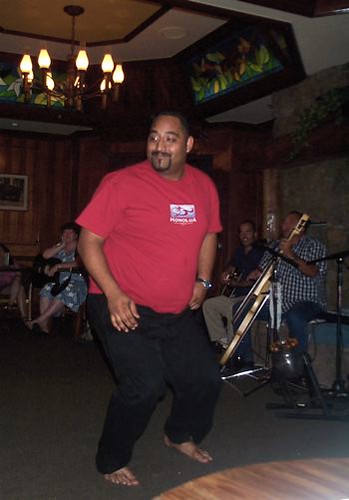

An member of the audience performs a masculine hula to Smitty’s music. Several others, including my friend Lynn, got up and danced when they heard songs to which they knew the choreography. In hula, there is only one correct choreography to each song, so that dancers from disparate locations should all be able to move in unison.

He is also all about heart. He graciously invites in whoever wants to play along. Among those sitting in on this occasion was the ancient and legendary Uncle Martin Purdy, son of the famous cowboy Ikua Purdy, depicted in an enormous bronze riding horseback and roping a cow, that stands in the parking lot outside Tante’s Bar and Grill. His wife, Auntie Doris Purdy, played ukulele and performed a stately hula from her chair. Her daughter played guitar, and a couple of young local guys sat in on guitar and ukulele and sang.


The whole line-up of Smitty’s band and friends picking and singing at Tante’s by the great stone fireplace.

I’d kanikapila’d (jammed) with Braddah Smitty a few years ago at the birthday party of Edie Bikle, best-selling children’s book author and the owner of Taro Patch, a scrumptuous gift store in nearby Honoka’a, and he remembered that I played slack key, so he invited me to play some songs during the break between the sets.


I perform some slack key tunes for the folks at Tante’s.

Edie and her boyfriend Tony, both present and clearly having a wonderful time, egged me on, and so did Lynn Nakkim, novelist, comedienne, former Green Party candidate, Waimea resident with her own horse ranch and my friend for over thirty years, whose idea it was to come to Tante’s in the first place. So, I played two slack key pieces over one hundred years old, and sang and played two original slack key songs, Auntie Clara and Living in Hawaii Style, all of which I recorded in 2001 on a CD of the same name. Edie carries it in her store.


Afterward, I joined the line-up of friends playing along with the band.  This is what “kanikapila” means.  Everyone joining in the music together.

At the end of the show, the audience rose as one and joined hands in a circle, something I’ve never seen happen in a bar. We all sang Hawaii Aloha, the unofficial national anthem, swaying and harmonizing together. Then that trickster, Braddah Smitty, sang the Hokey Pokey, and we all got really silly dancing that. After that, people were hugging and kissing each other Good Night and Aloha, and heading out into the mist.


Hawaii Photo Safari


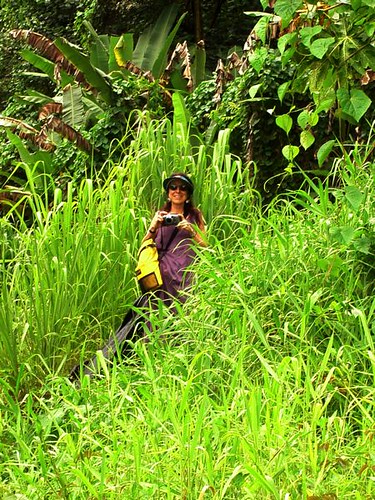
Alicia photographs the jungle. Photo by Linda Kane.

Linda Kane and Mary Goodrich are professional fine art photographers and both have moved within the last two years to the windward side of Hawaii island from northern California. They’ve been promising each other for quite a while that they would go out together shooting pictures, and today is the day. Mary’s husband Ken Goodrich, an audio-visual tech for large corporate functions, and I, Linda’s houseguest for the week, and friend for over twenty years, are invited along. Linda, who lives on the Hamakua coast, guides us to her favorite bridges, beach and jungle places, including two old cemeteries.


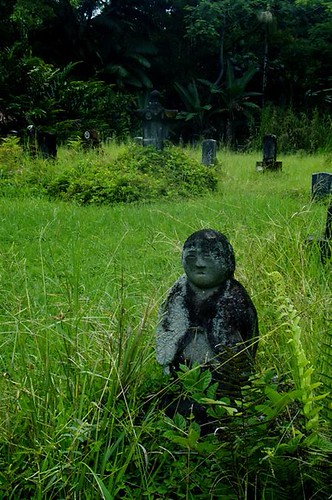
Our first inspirational environment is the old Honomu cemetery. I discover an unusal stone Buddha in the tall grass.


Ken and Mary Goodrich and Linda Kane take photos on the black sand beach at the mouth of the Hakalau River.


Side road off the Mamalahoa Highway. The cathedral heights of the trees, the sweet fragrances of the roadside ginger blossoms and ripening guava and passionfruit, the warm moist air, the sounds of rushing rivers and calling birds fill me with gratitude for life itself.


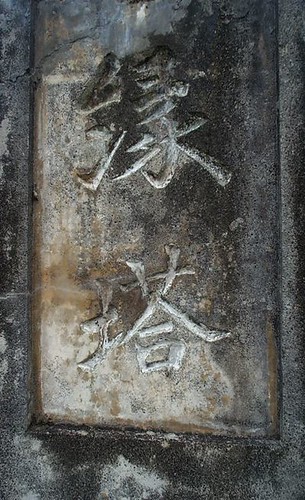
I am fascinated by the calligraphy carved into Japanese headstones, and the weather’s effect on it.


Mary Goodrich documents a monument at Honohina Cemetery in Ninole. Check out her beautiful website! Photo by Linda Kane.


Two streams join into one river above the wooden bridge at Waikaumalo Park in Ninole.

Throwing a CD Release Party for WLAA in Hilo

Kahuina Gallery.jpg

I decided to have a CD release party for my third CD, What Living’s All About while I am here on the Big Island. I called artist Tomas Belsky, whose Kahuina Gallery in downtown Hilo is a favorite bohemian haunt, the scene of poetry readings, left wing political gatherings, and small dances and concerts. I got to know Tomas when I was organizing for Kucinich in 2004; he hosted our meetups at the gallery. Tomas was more than gracious in offering the space for my event on Friday, September 1, at 8 PM, right after the poetry reading.

Next I called Peter Serafin, the editor of the Hawaii Island Journal, which is the alternative paper in these parts. I met him through Sachiho Kojima, the leader of the three-woman trance band, Amana, when she and her band came here to the Big Island to do a memorial for Sachiho’s husband, and, afterwards, do a tour I set up for them. Peter has worked many years as a journalist in Japan, and generously provided me with a list of media contacts in Tokyo. He bent the rules at the Journal to get my event into the calendar even though I called a couple of days after the deadline. He also requested a copy of the CD for a review.

The Hawaii Tribune-Herald’s calendar has a more leniant deadline since it’s a daily instead of a bi-monthly paper. I listed the event in their calendar through their online robot. They don’t review CDs.

I have emailed all of my friends on the Big Island for whom I have current email addresses. I’ve posted to my blog. Next I will design and print a flyer and post it on bulletin boards.

I contacted a couple of local radio stations for airplay. KAPA Radio has already featured my second CD, Living in Hawaii Style, in its rotation in 2002 and 2003. I don’t know that they play jazz and blues. The other station, KHBC, certainly does; they are so eclectic that I will bring all three of my CDs when I stop in to meet Brad (who has a great radio voice) on Monday.

All that being done, it’s all about rehearsing, gathering up my sound equipment and making sure it all works well, and making sure there are enough chairs. I love performing, and this will be very casual, with lots of friends and not too much pomp and circumstance.

Follow up: It’s the next day after the show.  Kahuina Gallery is not a large room, but it was ‘way overflowing with friends and fans for my show.  I was ecstatic to be performing for them, and they cheered me roundly and bought CDs.

buy What’s Living All About

Visiting a self-sufficient farm in Kaupo, Maui

Today my dear artist friend, Stephanie Farago, and I circumnavigated Maui’s Haleakala Volcano, and visited friends who live in remote Kaupo.


We passed through Kanaio, a high elevation desert community overlooking the Alenuihaha Channel and this single cinder cone (that’s “pu’u” in Hawaiian).


We passed the Kaupo Gap, which is the lower reaches of a huge amphitheatre-headed valley that forms the eastern half of Haleakala’s crater. The original caldera of Haleakala has long since eroded away, but the two huge valleys created by wind and rain erosion (the other, on the wet windward side of the island, is called the Ko’olau Gap) were united into a single caldera-like crater by later volcanic eruptions that destroyed the wall between the two valleys, and created a wonderland of magestic cinder cones, lava tubes, caves, and other multi-colored volcanic structures.


We visited friends who have created a sustainable farm, complete with alternative power (solar, wind and hydroelectric), a spring and a well, orchards, gardens, chickens, ducks, a goat, a horse, cats, handbuilt houses of local rock, cement and recycled lumber, a solar oven, a solar dehydrator, and, yes, a computer that connects to the Internet.  The chickens are not allowed in the vegetable garden, but they forage for insects in the pineapple patch.  But the ducks, who do not harm the vegetables, happily gobble a variety of pests that would otherwise eat the garden greens.  The eggs of both are therefore highly fortified with natural protein.


Rarely driving to town for supplies, they grow most of their food and cook everything “from scratch.” They cook on a table-top two-burner propane gas stove, and they bake in the solar oven.  They are as healthy as human beings can be in these times, and extremely strong from their daily work maintaining and developing the farm.


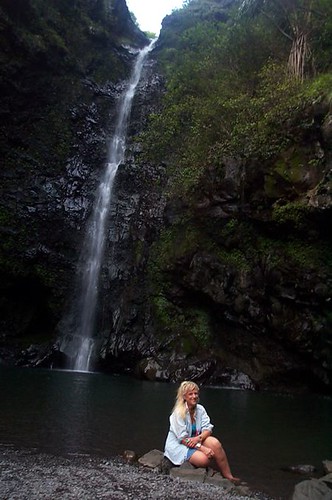
Stephanie beside the waterfall pool at Alelele Stream. I went skinnydipping there, and feel like a new woman for it, but I’m not posting photos of that.