Living on the Earth Chosen as One of the 101 Most Influential American Cookbooks of the 20th Century

10-04-12-NYC-Cover of 101 Classic Cookbooks.jpg

On October 24th and 25th, 2012, Rizzoli Publishers (Random House, New York) unveiled 101 Classic Cookbooks – 501 Classic Recipes, a collection edited by Marvin J. Taylor, Director of the Fales Library and Special Collections at New York University, home to over 55,000 volumes about food, and Clark Wolf, a New York-based food and restaurant consultant.

Their panel of culinary experts, including food writer and academic Michael Pollan, Los Angeles Times food critic Jonathan Gold, New York Times food critic Florence Fabricant, and chef, food writer, and PBS producer Ruth Reichl,  chose what they considered the most influential American cookbook for each year of the 20th century, and, from those, the quintessential recipes of each book.

From Living on the Earth, they chose four recipes: Dandelion Wine, Sunflower Milk (actually, How To Make Baby Food), Yogurt, and How to Smoke Fish. In addition, six of the original illustrated and hand-lettered page layouts, plus the cover of the Random House second edition are displayed on pages 136 and 137.

Other authors included in the book include Julia Child, Irma S. Rombauer and Marion Rombauer Becker, Alice Waters, Martha Stewart, Fanny Farmer, Madhur Jaffrey, Molly Katz, and Laurel Robertson.

Here‘s more information about some of the major organizers and contributors to the book.

10-24-12-NY-NYU-reception-LOTE pages in 101 Classic Cookbooks.jpg

buy Living on the Earth’s 50th Anniversary, 5th English Language Edition

Happy 40th Birthday, Living on the Earth

LOTE_71_cover.jpg

buy Living on the Earth

OK, birthday candles are in order. The 40th anniversary of the first edition of Living on the Earth (The Bookworks, Berkeley CA) was in September 2010. The 40th anniversary of the bestselling second edition of Living on the Earth (Vintage Books, Random House, NYC) was in April 2011. It’s still in print as a hardbound library edition. The 40th anniversary of  Mariko Fukamachi’s translation of Living on the Earth (Soshisha Ltd., Tokyo) was in April 2012. It’s still in print as a paperback book.

Living on the Earth sold somewhere in excess of 350,000 copies, and it’s still selling in English and Japanese, and maybe still in Korean. I heard a rumor that the Provos in Amsterdam made a bootleg translation back in the 1970s (I’ve never seen one of those either, but I would LOVE to have one if it exists!!)

LOTE_71_bk_cvr.jpg

LOTE’s illustration and design style was so revolutionary when it first came out that Publishers Weekly devoted two pages to acknowledging this with an article in handwriting, illustrated with drawings selected from LOTE. I scanned and posted the PW piece here.

LOTE’s illustration and book design begat The Massage Book (and the Random House/Bookworks series), The Moosewood Cookbook series, The Vegetarian Epicure series, Survival into the 21st Century, and numerous others. More recently, motivational writer/speaker SARK told me that Living on the Earth’s illustration and design had inspired her graphic style as well.

Soshisha, Ltd, in Tokyo released the Japanese translation in 1972, with a blurb on the cover from Japan’s poet laureate, Shuntaro Tanikawa. It says, “I want to do everything in this book. If I can’t do everything in this book, then I want to dream about it, because I know that if I do, I will be a better person to the marrow of my bones.”

In Which My Drawings are Featured in a Coffee Table Architecture Book

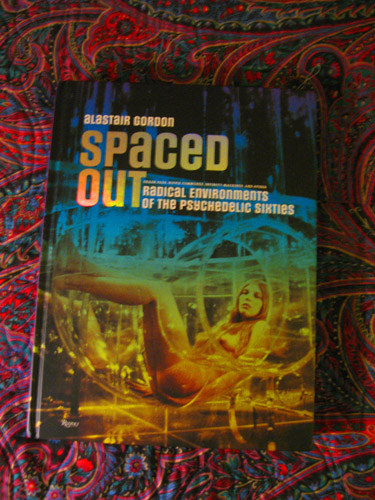
spaced out-cover

I neglected to write to you last spring about the publication of Alastair Gordon’s SPACED OUT, Radical Environments of the Psychedelic Sixties (2008, Rizzoli). A gorgeous coffee table architecture book about the wiggy shelters my friends built back in the day, for us, it’s more like a family album. It’s an absolutely fun read/look.

“If you don’t have recourse to memory or the spaces themselves, Alastair Gordon’s crucial new book, Spaced Out, will bring you closer to a time when architecture was expanding its horizons…Architects today have a lot to learn from these hippies.”– Metropolis Magazine (6/18/08)

I was thrilled to have my work included in the book, and curious to see which drawings Alastair would choose include. This color page is from Being of the Sun (Harper & Row, 1973), which I co-wrote with Ramón Sender Barayón and illustrated and designed myself. The illustrations on the facing page are from my first book, Living on the Earth (Bookworks, 1970, Random House 1971 and 2000, Gibbs Smith, Publisher, 2003, Echo Point Books and Media, 2021).

Alastair wrote about Living on the Earth with a waggish smile in his voice.

I was honored to be in the august company of environmental-activist designers like the folks at Drop City, an early Colorado artists’ commune, whose geodesic domes made of sheet metal recycled from roofs of cars at the wrecking yard became their signature visual.

I met Paolo Soleri, the architect who designed and was building Arcosanti, back in the 1960s when he did a fundraising talk and slide show at my mom’s house in L.A. As a result, I wrote about Arcosanti in Living on the Earth.

Here’s an interior photo of Soleri’s semi-subterranean home and studio, Cosanti, in Scottsdale, Arizona.  I made a pilgrimage to both of Soleri’s architectural wonders in November 2000, during my epic 8 month book tour for the 30th anniversary edition of Living on the Earth and the release of my first CD, Music From Living on the Earth.

We Plan the Art Show


April 15, 2008. The next morning after our return from Hazu, Kaorico and I breakfasted on kiwi, miso soup with tofu and wakame sea vegetable, green salad with sesame-miso dressing, rice, and two different cooked vegetable dishes. Japanese food is amazing. It looks beautiful, tastes great, and you feel good afterwards. How great is THAT?


After breakfast we visited a local music store to see if someone there could repair the jack on my guitar, which had become unreliable in sound output. No one could. So, for the rest of my tour, I played the guitar into a microphone instead. Back in LA, I took it to a guitar repair shop, and discovered the problem was only dirt in the jack, which the repair guy removed with a cotton swab. Even I could have done that., if I had been able to figure out what to do.


Next I traveled by train into Tokyo. I saw this anti-litter advisory in the Harajyuku station.


My mission for the day was to meet with Keisuke Era and Junko Tamaki, who are organizing an art show of the original drawings and layout of Living on the Earth at the Kurkku complex in Harajyuku. I delivered the work, for which master craftsman Yuji Kamioka would eventually create 178 one-of-a-kind drift wood frames. We would only show 30 pieces in the upcoming show, but we would have other shows in the future, until all the images were sold.


Yuji showed me a sample of the frames. I was delighted.


On my way back to Harajyuku Station, I walked through one of my favorite Tokyo places. Takeshita Street, a bustling neighborhood where throngs of high school-and-college-aged people shop, eat and go to night clubs. It has the air of a carnival, and there are lots of people in costume.


This lovely girl in white agreed to let me take her picture.


Easter on Takeshita Street


A very theatrical storefront.


The bargain rack. One thousand yen is about $10.00


The layered look is much favored here.


Next, I took the train to Shibuya to buy art supplies at Tokyu Hands, a big department store with a big art and craft supply department. The intersection outside of the Hachiko entrance to Shibuya station reminded me of Times Square, with its gigantic animated signs.

Puffy Wears Living on the Earth Clothes

puffy in ABL dress-web.jpg

Posting from Jodi Mitchell, who lived at Wheeler Ranch commune when I did, in the late ‘60s and early ‘70s:

I have a new part time librarian gig staffing the groovy Teen Zone at
the downtown Oakland Public Library. I love this job, as I am
surrounded by teens and pop culture. We have a wonderful periodical
collection, and I love looking at Japanese fashion magazines, as they
are so much cooler and more creative and cutting-edge-trendy fashion
wise than we are in the dowdy old frumpy US of Ass. One of my favorite
mags. is called Cutie: it has the best ever fashions, and I get ideas
for my thrift-store outfits from it. They always spotlight a latest
rock band in each issue.. I can’t read any of it because it is all in
Japanese, but today I was reading the October 2007 issue and on page
118 they spotlighted the popular girl rock group Puffy wearing none
other than Alicia’s Living On the Earth fashion line. It is so awesome
to see this trendy, Japanese, teenager, contemporary fashion and pop
culture magazine with a very popular girl pop group wearing Wheeler’s
Ranch motifs . LOL! I love it. It made my day to see this. Thanks
Alicia. When I land my ultimate, high-paying librarian gig_I’m going
to buy one of these dresses! They are so cute!

Comments fellow commune alumna Judith Gips: Japanese cutting edge meets ‘70s California rural hipdom meets urban Oakland teens inthe fashion Zone…hoowee…

Alicia comments: If only they knew where I buy 90% of my fashion wardrobe:

The Goodwill!

Now Madonna, she knew…

Cuteness is a quality greatly cherished in Japan, in women, in kids, in animation, and in advertising and manufacturing.  Perfect name for a teen mag.

The Diggers and the Summer of Love

Living on the Earth-Digger bread-100 dpi
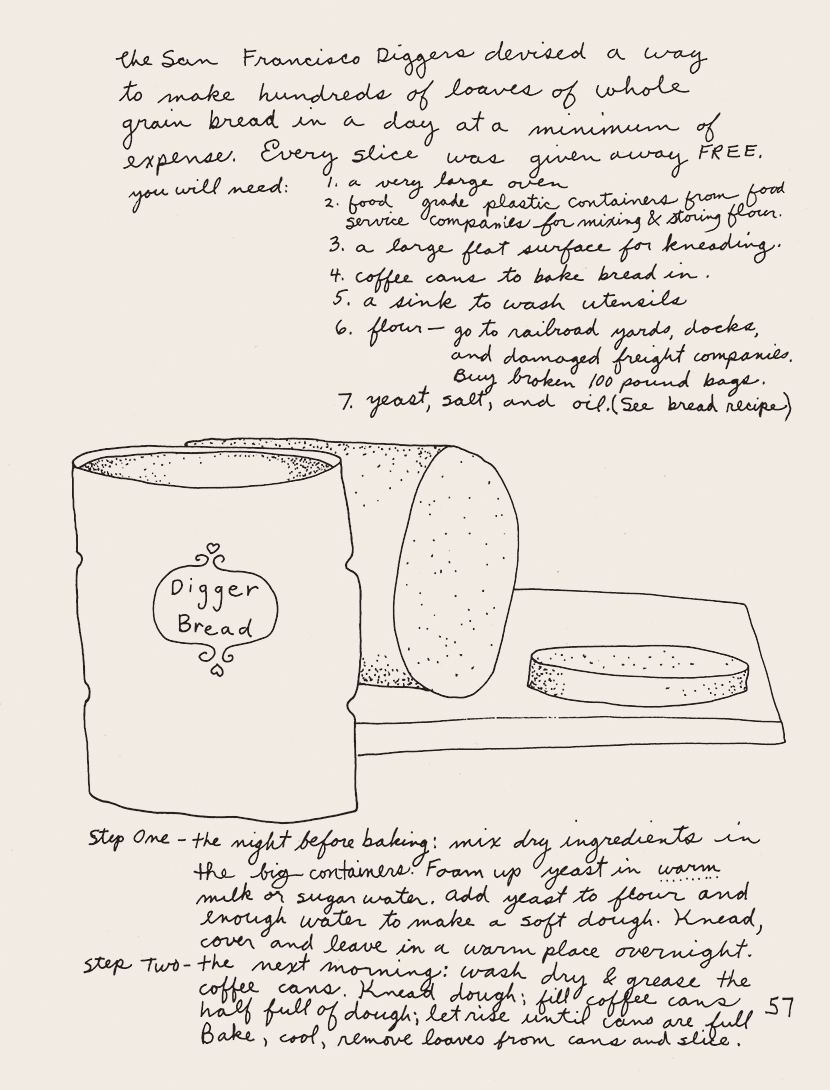
Page 57 of Living on the Earth, with the Diggers’ recipe for
mass quantities of bread baked in coffee cans to serve
for free at their 2 PM soup kitchen in the panhandle
of Golden Gate Park, San Francisco, in 1967.

Mmmm, the Summer of Love.

I was living in San Francisco the year before (1966), and, in my 17 year old eyes, it was all magic, artists and musicians, color and innovation.

I was visiting family in Ann Arbor, Michigan when the media created the Summer of Love. In March 1967, two articles about the hip scene in the Haight Ashbury appeared, one in Time Magazine and one in Esquire. Before that date, none of the freaks I met in Ann Arbor had heard of the Haight; after that date, all of the freaks I met were planning to go. Multiply that times everywhere freaks were.

When I came back after a winter of wandering, the Haight was crowded and sodden with hard drug users and dealers, winos, panhandlers, young runaways, and various religious orders trying to recruit converts. So, I settled in the houseboat haven at Gate 5, Sausalito, which, in 1967, was all magic, artists and musicians, color and innovation.  Soon I began working out of my own art studio there.

I met Peter Coyote in the Haight Ashbury Free Store one day and learned about what the Diggers were doing that summer. Now THAT was magical: The response of the resident artists and musicians to the wave of human misery that was the Summer of Love breaking over the Haight Ashbury. They fed people at 2 PM, daily, they opened “free stores” that gave away donated clothing and furnishings, they started a free clinic that still operates. It was compassion in action. May the Diggers be forever celebrated in the history of Bay Area counterculture.

Still Peace and Love,

Alicia Bay Laurel

The first Living on the Earth clothing line


It’s really true! Adorable fashion designer Aya Noguchi (on left above) made a line of clothes for Fall 2007 printed with illustrations from Living on the Earth. Her company, Balcony and Bed, boasts two stores in Tokyo, and she wholesales to stores throughout Japan. She came over to Koki and Ayako’s house with her assistant, Chihiro (to her right), bearing clothing samples. I am overwhelmed with joy.


As you can see in the mission statement from her catalog (above), Aya created the line to harken back to the 1960’s and 70’s (was she even born yet then?), so, of course, I feel quite comfortable in her clothes!


I tried on a black background print wool jersey dress over my long sleeved olive green t-shirt (it’s kind of a chilly day). I love it! I think when I wear it for events, I’ll wear a black long sleeved t-shirt under it. All of Aya’s wool jersey items are also available in a brown background print and a light gold background print.


Here’s a closeup of the black background version of the print.


And here’s a closeup of the brown background version of the print.


Here’s an organic cotton knit cowl collar long sleeved t-shirt.


Here’s a loose fitting short dress with elasticized hem in the light gold background version of the print wool jersey.


Here’s how the long dress looks in brown.


Here’s a much more feminine organic cotton Living on the Earth t-shirt. All of Aya’s organic cotton knit items are available in light gray-green, pale salmon pink, or cream.


A big serged square of the printed wool jersey makes a shawl or ample neck scarf (Aya calls them “boas”).


A flowing light gray-green organic cotton knit smock printed on the back with moons and stars. The front closure is asymmetrical.


Aya gave me three of the samples (my choice). I chose a gray-green t-shirt, the black dress I’m wearing in the photo above, and a black print scarf. I’m thrilled I get to wear these during my tour. By the way, the wool jersey does NOT itch. I’ve had the scarf around my neck for four hours at this writing, and, while my skin is often irritated by wool, I am totally comfortable in this.


Throughout my tour I will be distributing Aya’s posters at the tables where I sell my books and CDs, and showing her catalogue to anyone who asks. I will also be importing her clothes next fall to sell from my website and to stores in the USA. So, if you’d like me to advance order any of the clothing for you, please let me know. (To convert the prices into US dollars, go to www.xe.com.) Each piece is available in a choice of three colors, and only one size (“free size”), which should fit women size one through ten. Few Japanese women wear sizes larger than ten, and most wear size six and under, a tribute to their magnificent cuisine and natural moderation.


Early the next morning, Aya and her husband, Kouichi, who is also president of her company, drove me to Haneda Airport on their way to work in Tokyo. She brought me a homemade breakfast – a rice ball wrapped in nori with a bit of baked salmon inside, and a delicious tea made from roasted buckwheat (soba cha!) What sweet people! When I return to Hayama in mid-May, I will visit their home, where I’ll be interviewed by their friend who writes for Switch, an arts and culture magazine. I will wear Aya’s clothing for the photos!

The Original Art and Layout of Living on the Earth is for Sale!

Cover layout with bleed borders and the original drawings for Living on the Earth.

Wow, here they are, the original drawings from which all of the books, CDs, t-shirts, fabrics, magazine illustrations and other printed images from Living on the Earth were born. Partially lettered in Press Type, yellowed with age, and stained with rubber cement and correction fluid (ah, the tools of the graphic design trade back in the late ’60’s), they are wabi-sabi, shabby-chic, framable, and absolutely authentic.

I will be having a gallery show at which the entire layout will be auctioned during the months of May and June 2008 at the Kurkku Arts and Environmental Center in Shibuya, Tokyo, Japan. 

I created the drawings, lettering and layout for the first edition of Living on the Earth in 1969 and 1970, at the ages of 19, 20 and 21. The Bookworks, Bay Area distributor Book People’s publishing imprint, released it in September 1970 as their second title ever. They sold out the initial printing of 10,000 copies in two weeks. The Whole Earth Catalog’s review: “This could be the best book in this catalog. It is a book for people. If you are a person, it is for you.”


In April 1971, Vintage Books/Random House released the second edition, which became the first paperback ever on the New York Times Bestseller List. Publishers Weekly had never seen a book design like this one before, and published a handlettered review with illustrations from the book to note this. Dozens of books with derivative book designs, illustrations and themes appeared on the market within a year, and continue to appear to this day.


I am preparing to sell the original layout as an archival manuscript (I retain the copyright of the content), and thought you might like to see what the artwork looks like now, after 37 years in the same little blue suitcase inwhich I delivered it to The Bookworks in the spring of 1970. It’s moved to Hawaii from California with me twice.


The pages in the center of the book aren’t as yellowed as the cover and front pages, probably because they weren’t as subject to the acidity of the packaging in which they were stored. The rubber cement used in layout work in those pre-computer days left stains, as did the white correction fluid.


When I updated the information in Living on the Earth for the Villard/Random House third edition in 1999 (which, with minor changes, was also the 4th edition in 2003), I clearly could not re-use the original layout, so I took apart two pristine copies of the Vintage/Random House second edition and used the pages to lay out the revised edition, still using Rapidograph pen, scissors, rubber cement and correction fluid as I did in 1970.


One of the most noted updates in the revised edition was the layout on marijuana and hemp. I realized soon after moving to Maui in 1974 and inhaling the extra-strong product available there, that it made my nasal passages swell shut, obliging me to breathe through my mouth and wonder how long until this uncomfortable side effect would wear off. So I quit smoking pot. When I updated the text twenty-five years later, I had to find and interview someone who still grew it commercially to improve the instructions. I also learned the usefulness of hemp, even without the medicinal effects of tetrahydrocannabinol.  Hemp preceeded petroleum as the material of choice for manufacturing almost everything useful. Canvas, which propelled ships across the ocean, derives its name from cannibis. Some environmentalists think we’ll be back to using hemp on a large scale after Peak Oil.


Living on the Earth was initially shelved in the Library of Congress under Home Economics, Handicrafts and Outdoor Living, but the 2000 Random House edition was categorized under Spirituality and Healthy Living, and the 2003 Gibbs Smith edition as a Reference Book. All of the above, would be my guess. I didn’t create it for a publisher. I made it as a gift to my fellow communards at Wheeler Ranch. However, the Universe had other plans.

Update as of 2021:  Many of the original page layouts, framed in handmade driftwood frames created by master craftsman Yugi Kamioka, some with mat boards bearing my new additional illustrations, have been sold at a series of gallery shows in Japan.  The cover layout hangs in the tea ceremony house of rock producer Takeshi Kobayashi.   Fashion designers Kaoriko Ago Wada and Aya Noguchi, both of whom produced fashion lines printed with the pages of Living on the Earth, have framed pages hanging in their homes.  Novelist Yoshimoto Banana bought framed pages, too, remembering how much she enjoyed the book in her childhood. 

Here is a link to a video of an art exhibition of the framed page layouts at Gallery Speak For, in Daikanyama,
Shibuya, Tokyo.

The sound track is an improvised piece called “Everything is Flowing” from the album Songs from Being of the Sun, which Ramón Sender Barayón recorded in 1973, of himself on zither and me on guitar, and both of us singing.


The Interview in Hachi Hachi Magazine


So here’s the magazine interview with me that Takashi Kikuchi wrote for 88 (pronounced “hachi hachi” in Japanese) Magazine, a permaculture journal printed with soy inks on recycled paper. Kikuchi-san is the editor, and he was assisted by Maki Ozawa, who interpreted for us. They flew over to Ohshima (island) to interview me, and they also interviewed me at Koki Aso’s house in Hayama, since he and Kikuchi-san are friends. Every one of the 88 covers is a work of art. I recycled the cover of a May 2005 issue into the shoe box shrine I made at Doshi Camp in Yamanashi Prefecture at the Kurkku weekend workshop.


Page one of the November 2006 issue. This photo of me was taken in the forest in Ohshima, on the path to the ancient style rice straw hut. The way the embroidery on the dress echoes the curve of the ferns is a tribute to the superb designer’s eye of the photographer. His name is Hiroshi.


Page two. Behind the writing is an illustration from Living on the Earth of a girl awakening at dawn at her mountain encampment to the sound of a bird calling. She sits up nude in her sleeping bag, wherein her lover still snores. It’s got to be one of the most evocative drawings in the book.


Page three. Now here’s a wink from the Universe. In 2002, when Mana Koike and Sachiho Kojima came to Hawaii Island and recorded a CD of Tara songs onwhich I sang backup, Mana came to visit me at my home, and I gifted her with a Japanese language edition of Being of the Sun. The book had been out of print since the 1970’s, and Mana thought she might want to re-publish it herself. I was thrilled with her offer, but not counting on it, either. When Kikuchi-san and his crew came with me to Mana’s house in Ohshima, Mana showed him her copy of Being of the Sun, and he had Hiroshi, the photographer, take this picture of it next to the Japanese edition of Living on the Earth. Not long after the magazine came out, I received an email from Soshisha, Ltd., which had published both books in the 1970’s and still publishes Living on the Earth, to discuss publishing Being of the Sun again.


Page four. Again, the graphic designer for the article has chosen one of the other most evocative drawings from Living on the Earth – the title page image of a young man and woman dancing on a hilltop under a moonlit sky while a dog dances beside them. I’m looking very serious in the photo at Koki’s house. I’m probably discussing politics. I wish I could read the article! I wanted to get it translated for my blog, but, mercy, it’s 5 to 15 cents per character, which adds up to hundreds of dollars! Kikuchi-san (“Kick” is his screen name) sweetly featured my new jazz CD, What Living’s All About in a sidebar, with its cover art that echoes the image of ecstatic dancing in nature by moonlight.