Tonight Jack and Kay Enyart brought me to the Downtown Artists Space in the Los Angeles Downtown Arts District to record a webcast interview for Art With Enyart, Jack’s bi-monthly show for LA Artstream.
Meet Jack Enyart, animation artist/writer/agent/consultant, my friend since junior high school, and host of the show, and Jonathan Jerald, producer of LA Artstream, Mark Walsh, our director, and Kay Enyart, soon to be head of the pattern-making department at the Pacific Design Center’s Academy of Couture. Jonathan turns out to have visited or lived almost every place I have visited or lived in the San Francisco Bay Area in the late 60s and early 70s. Amazing that we never met before.
Twilight in the first floor of the Downtown Artists Space.
DAS’ classic artist loft kitchen
I sit with Jack on the set for soundcheck. I am wearing the Living on the Earth illustration print dress that Tokyo fashion designer Aya Noguchi made for her autumn line in 2007. The interview was fun, and, at the end, I played on guitar and sang “Sometimes It Takes A Long Time,” one of my original songs from my CD What Living’s All About.
I come to Kurkku’s complex in Haragyuku for an interview by Switch Magazine, that will be a conversation between me and Japan’s beloved novelist Yoshimoto Banana (last name first is customary here, and her first name is pronounced BAH-nah-nah.)
In spring 2008, Kurkku hosted the first of what became four art shows of the original drawings and page layouts of Living on the Earth. I was delighted to hear that Banana-san had purchased my self-portrait that appears on the epilogue page of the book. She’s 15 years younger than I am, and the book was a favorite of her childhood. So, she said, she felt almost in a dream to purchase this drawing she had gazed upon so long ago.
Fujii-san, a rock and roll producer who is a friend of Banana-san’s and a friend of Keisuke Era’s (he’s the director at Kurkku) offered to introduce me and Banana-san, and Switch Magazine offered to document this event. So, here we are: Takeshi Fujii, Yoshimoto Banana, me, Miho Kawaguchi (writing for Switch), Kaori Miyagi (translating for me) and Kengo Tarumi (taking photos for Switch).
OMG! We showed up wearing the SAME EXACT T-SHIRT! It’s the Being of the Sun illustration licensed by Aya Noguchi (fashion designer and owner of Bed and Balcony) last year for her summer line.
But that wasn’t the only coincidence. After the interview was over, Banana went out to the street and there stood our dear friend in common – Sandii Manumele, vocalist extraordinaire and hula teacher of hundreds of Tokyo students, including Banana. Sandii rushed upstairs to see me and we had a happy group hug.
I had last seen Sandii at a huge rock concert memorial for Donto in Okinawa City in 2006. She danced and sang in the show, and I sang one of my songs, too. We became instant friends.
Sandii choreographed the hula for Donto’s classic song “Nami,” which women all over Japan love to dance. I just recorded “Nami” on my recent CD, Beyond Living, both in the original Japanese lyrics, and also in a Hawaiian and English translation. I was happy to present both Sandii and Banana with signed copies of my new CD.
Here‘s Banana-san’s blog about the same meeting (in Japanese).
Today I meet Liane Wakabayashi, the artist who will host my bookmaking workshop on October 18th. She wanted to meet me and see what I do, and rode up to Fujino on a train from Tokyo. We instantly become good friends. She’s from New York, and tells me she’s one of a half-dozen Jewish women married to Japanese men living in Japan. Maybe we are cousins. Behind us is the entrance to Steiner School’s brand new auditorium.
We head over to Fujino’s Steiner (Waldorf) High School, which meets in a geodesic dome built by the staff and students a few years ago. The high school students commute an hour by train from Tokyo, where the former Steiner High School has closed. I am about to meet the 12th grade English class (7 students) that day. The elementary school students use the building in the background, which is a former public school that closed due to shrinking population in the mountain town. The Steiner staff refurbished it, and the number of students is steadily growing.
One gets the feeling this is no ordinary high school.
Today I am teaching lesson #1, “Instant Books,” from my friend Esther K. Smith’s fabulous book, How To Make Books. An instant book can be folded from almost any size oblong piece of paper, with a slit cut in the middle so it can be refolded to be an eight page book, or a six page book with front and page covers. This is the cover of the instant book I made during the class.
I am not allowed to photograph the students, so I sketch them in my instant book. These seventeen-year-olds were raised on origami (Japanese paper folding) and instantly grasp and master the simple but ingenious design of the book.
The kids brought stacks of magazines, mostly fashion magazines, to cut out and write about the photos, hopefully in English. They relish the task of cutting out photos that appeal to them, and chat happily in Japanese while they are doing this. So, I use a few of the magazine images, to represent the presence of this alternate reality in our classroom. Yay recycling!
I daub on a little watercolor paint to add texture and color to my ink drawings. After we are done with our books, we will unfold them, scan them, and make color copies for each of the students and the staff in our class. Hooray for self-publishing via computer. The power of the press is in the hands of the artists! Later that day, Esther emails me from New York City, to suggest that the scans be posted on the web, as a sort of international publication that people can download, print and fold. She collects instant books.
I copy an idea from one of the projects in Esther’s book, of using photographs of eyes to add emphasis to the idea of reading and observing to the back cover of my book.
Here’s one of the student books I love, a new twist on the fairy tale of the princess and the frog. I get a kick out of the way she used magazine fashion models to depict the characters in her story.
She’s pretty clear about why she wants a man in her life, and who he should be.
But when the proposal arrives (almost immediately!), who brings it? A little bug-eyed green guy from another planet! But our heroine is not daunted.
For her positivity and willingness to look past mere appearances, she is rewarded with a commitment from the man of her dreams.
So, they live happily ever after.
Here is Liane’s book. She is welcoming me to Japan and suggesting I wear comfy shoes. I agree; one does walk a lot here, taking trains instead of driving.
Here is a book of legs and shoes, with lots of excellent English words in it. The students were still working on their books at the end of our allotted two-hour period, exclaiming loudly that they did not want to stop creating their books to do other schoolwork. I therefore consider the workshop a success. Happily, their regular teachers agreed.
After the class, Liane and I enjoy a beautiful lunch prepared by Jun on the verandah of Setsuko and Jun’s house with Setsuko and Yuko Urakami, the teacher of the 12th grade English class who kindly organized my visit to the school. I want to connect Yuko with the staff of the Haleakala Waldorf School on Maui, where I taught music and creative writing, part time, for a school year in the 1980s. The students in the two schools could become pen pals on the web, and maybe even visit one another. Those purple fruits are giant figs from a tree next to Setsuko and Jun’s house.
Yuko made a book, too, called “I believe in…” She believes in the power of flowers, in hand crafts, in “a bit of luxury” and good food. Amen.
I am the guest of TV producer Setsuko Miura, her husband Jun and their daughter Ren, in the very hip art and farming village of Fujino, in the mountains west of Tokyo. They have arranged for me to teach a class in making instant books at the local Waldorf School, which they helped to found, and which Ren attends. They also arranged a fundraising concert for the school at Shu Café in Fujino, at which I perform for about 50 people. In this photo, Jun and Setsuko are the two people with headscarves. Shu and his wife Kazu, the owners, are on either side of me. Kazu has purple hair and a very small dog in her arms. The other three ladies are part of the café staff.
Shu Café is downstairs from an airy loft that is Shu and Kazu’s home. Next to it is an organic garden where Shu grows vegetables for the café.
The elegant and natural café and residence were designed by Tsutomu Nozaki, the same architect who designed Jun and Setsuko’s ultra-green home, here enjoying a beer with Jun.
An easel outside the main café entrance announces my concert.
A small gift shop inside the café includes organic cotton socks, hand dyed with locally grown indigo and hand-knitted by a 90-year-old resident of Fujino.
Every aspect of the café features local art and organic produce, including the stepping stones at the entrance to the café.
Setsuko and Jun’s neighbor, Aki, one of the first of the audience to arrive, brought her long-out-of-print copies of the 1974 Japanese editions my three children’s books (The Rainbow Lady, The Family of Families, and Sylvie Sunflower) to sign for her and her children.
I met legendary singer/songwriter Ua, who lives in Fujino with her husband and two young children.
I sang and told stories, with the excellent translation of beautiful Yuko Urakami, the English teacher at the Waldorf School to whose 12th grade English class I taught the instant book lesson on September 24th. She also has children who attend the school, and is a close friend of Setsuko’s.
We had a full house, a most enthusiastic audience, except for the children seated in the first three rows, who were outside playing together.
After the show I signed books and CDs, and got my photo taken with lots of new friends. Everyone was so sweet.
As the title of this album suggests, Beyond Living is a collection of folk songs about death, many of them written by musicians who have passed. Alicia Bay Laurel, known for her 1971 guide to sustainable living entitled Living On Earth, collected and recorded many of the songs on this album in response to a number of deaths she encountered in recent years, including, most notably, legendary Japanese singer-songwriter Takashi Donto Kudomi, who died in 2001 at a hula performance. Songs from artists from several countries round out this decidedly international album.
While the album’s theme might suggest darkness, the album feels more like a celebration. As Laurel’s liner notes suggest “lyrics about death contain valuable instructions for living,” and these songs are no exception. Their cheery melodies, vocals, and a fingerpicked guitar mix with deep sadness in the manner I associate with children’s songs (Remember when you found out “Ring-Around-the-Rosie” was about The Plague?) The album invites the listener to engage with the certainty of death and to feel the relish that reality brings to living. Much like listening to the blues, listening to these songs provides a deep and pleasurable access to human emotion.
Review by multi-platinum-selling singer/songwriter Joe Dolce in his weekly newsletter, sent 09-25-09:
What I’m Listening to This Week ‘Beyond Living’ – Alicia Bay Laurel. This is the most recent release of my friend, Alicia Bay Laurel, with whom Lin Van Hek and I will be performing with in Okinawa and Tokyo next month. Alicia is one of the few real visionary freaked-out flower children from the 70s who has grown even further into the great dream of the Beloved Community that we all shared back then. She also had a Number One hit, so to speak, in her 20s, with a New York Times best-selling book, Living on the Earth, which changed her life, and it is an inspiration to know someone who continues to reinvent herself – without disowning her past.
Alicia and I were also both close to, and sang with, the girl who introduced me to California hippie communes back in the 70s, Janet ‘Sunny’ Supplee, and the spirit of Sunny hovers throughout this recording. Sometimes, listening to Alicia sing, I swear Sunny is in the building. Sunny and I sang together for a couple of years and she certainly influenced me in an unforgettable way. She was killed in a car crash in Maui and I still miss her.
Beyond Living collects a master’s bouquet of beautiful songs about Death that do not drag death down into the valley of shadow and fear where old time religion would like to keep it penned up, but releases it out into the empowering light and flight of warm meadows and possibilities. Alicia has included the song I wrote and sang at my own father’s funeral, Hill of Death, with lyrics by Australian feminist pioneer, Louisa Lawson, drunken Henry’s mum.
While in LA, I was lucky enough to be able to sing and play with her on this recording. I was surprised at first when the tasty, awesome, I-am-the-Fingers-of-God mandolin part I had recorded was nowhere to be found in the final mix, but after a couple of listens, I understood why it went to the cutting room floor (along with Satan, Everlasting Hell and the Edsel.) It’s not necessary. Alicia’s last album, What Living’s All About, was an eclectic brew of styles, electric guitar solos, even rap – but this one, a unique fusion of Hawaiian and Japanese sensibility, is smoothly unified by the continuity of Alicia’s lullaby-like singing and precision finger-picking guitar, the latter most notably in the fifteen minute closing instrumental, Ruminations, which is a collage of no less than fifteen tunes: Amazing Grace, The Garden, Is This Not the Land of Beulah, Will the Circle Be Unbroken, Oh Come Angel Band, Gathering Flowers for the Master’s Bouquet, Angels Are Watching Over Me, This Little Light of Mine, Swing Low Sweet Chariot, Bosan Gokko, Hill of Death, Long Black Veil, Good Night Irene, We Shall All Be Reunited, and Kumbaya – and leading to the final Hawaiian, Aloha Oe’. I wouldn’t mind at all having these fifteen minutes playing in my final hour.
There are also three tracks written by Takashi Donto Kudomi, a legendary Japanese new wave rock star turned spiritual singer/songwriter, who died mysteriously on January 23, 2001. He, his wife and their two young sons were watching a hula performance dedicated to Pele, the volcano goddess, at Hawaii Volcanoes National Park. At the end of the final chant, Donto fell to the ground unconscious, and was rushed to the hospital. The next day he was pronounced dead at age 37 from a brain aneurism. He had been in perfect health until that day. We will be staying and singing with Donto’s widow, Sachiho, in Okinawa, at Donto-in, the temple Sachiho built in his honor.
One of my favourite tracks is the quirky Altid Frejdig Naar du Gaar (Courage Always When You Walk) with melody by C.E.F. Weyse, 1838, lyrics: Christian Richardt, 1867, set into verse by Alicia. It is often sung at funerals in Denmark and is faithfully sung here in Danish. Just voice and stand-up bass, played masterfully by Chris Conner and reminiscent of her great version of Nature Boy, on What Living’s All About, the vocal seems to float in and out of ordinary tonality like a ghostly dandelion puff. One day, I do hope Alicia gets a chance to put out an album of just vocal and stand-up bass recordings, as they are always a pleasure, and a challenge, to listen to.
Review by Gerald Van Waes, host of “Psyche Van Het Folk” (a psychedelic folk radio show in Antwerp, Belgium) on his website, November 20, 2009
Alicia Bay Laurel : Beyond Living (US, 2009)
A bit different from Alicia’s previous albums, this is a conceptual piece of songs to be meant as a tuning in to a spiritual good vibration and feeling, on moments when people have passed over. When Alicia suddenly saw many related and befriended people pass over, it seemed as if she had no other option but to give all this an accompanying meaning; she started to collect songs from different countries to express this.
It starts strongly, with a Hawaiian opening chant which leads to a song inspiration, as a special moment (or person) to remember. The second song is an Australian folk gospel song, a folk version in which the backing vocals gives an Americana gospel feeling. Next we hear a traditional Japanese song, accompanied by harmonium and congas and vocals. Also this one has gospel flavours, reminiscent a bit of ‘Amazing grace’, being a more delicate, religious almost Christmas-sphere sphere. After its vocal parts with high voices (in Japanese), there’s some spoken word by Alicia giving more reference in the song. “Waltzing with Angels” sounds more like a country children song with a Hawaiian effect on the way the mandolin is played, with a happy feeling or energy. The song with original Danish lyrics by Christian Richardt (1867) is sung with a Marilyn Monroe song voice, and accompanied with bass only.
“The Garden” is again more countryesque, is sung with nice dual voices, leaving a Hawaiian feeling. “Auntie Nona” sounds like a happy children’s song, old music. The next small song has more religious Christian lyrics which appeal less to me. Also here gospel and country-flavours are mixed nicely. “Nami” turns back to Japan but leaves traces of Hawaii. On “Ruminations” we finally return to the “Amazing Grace” song, turning after a short while into a slow Hawaiian guitar medley on acoustic guitar. Also the last instrumental is a guitar piece with references to Hawaiian melodies.
Except as a dedication to the subject, the album is as much a dedication to spheres provoked from Hawaiian songs and music, to spirituality in gospel music, as quietly privately experienced music, and the fresh kindness of children songs, and a touch of country. All of this is omnipresent throughout with a happy inner strength and positivism towards life and thankfulness to people and their lives.
As my mom and I were and are fans of your work, I appreciate your staying in touch.
Moana and I send tons of aloha and wish you good luck with your music.
Thank you for helping us to keep my mom’s work alive in the world.
Me Ke Aloha,
Keola Beamer Legendary vocalist/guitarist/songwriter Son of Hawaiian Renaissance pioneer/dancer/vocalist/songwriter/historian Auntie Nona Beamer Lahaina, Hawaii
– – – – – – – – – – – – – – – – – – – – – –
Hi Alicia,
The interview is finished and runs about 63 minutes and features 5 live in-the-studio-songs (Hang Out & Breathe, Pain & Love, Love Understanding & Peace, Auntie Nona, and Doctor Sun & Nurse Water) and the rest from your new CD.
I did want to let you know we are now playing Aloha ‘Oe, Hill Of Death & The Garden in our regular new music rotation.
Once again the interview runs Wednesday May 5th at 10am on my show and then an encore airing on Friday, May 7th at 6pm.
GODDESS SISTER ALICIA! I want to send a mail just now! What a perfect timing! I listened your new CD! So beautiful. I cried…… I can feel your love and respect for Donto. Now I am looking for Japanese distributor. Tonight full moon is so beautiful and shining like you! THANK YOU ALICIA! SEND BIG LOVE TO YOU!!! Sachiho Kojima, widow of Donto Kudomi Singer/songwriter/bassist/harpist In the 1990s and 2000s, leader of the all-woman trance band Amana In the 1980’s, leader of Japan’s first all-girl punk band, Zelda Festival organizer Naha, Okinawa, Japan
______________________________
I love Beyond Living! Very strong album though it sound extremely gentle! Especially I like Nami and Hang Out and Breathe. It is surprisingly true that an artist have created her essential song in early days and gives it evolution. Love, Setsuko Setsuko Miura television producer specializing in documentaries on the environment Fujino, Japan
_______________________
Got the CD, loving it, thanks!!!
Albert Bates Founder/Director Ecovillage Training Center The Farm, Summertown, Tennessee
_____________
Thank you for bringing the most wonderful people to us here at Hopi. I enjoyed teaching them of our way of life and I pray for you all among the stars. Thank you for the CD that I received. I listen to it in the evening gazing among the skies. Thank you and keep in contact.
Dawahongnewa (Rising Sun) Hopi Elder, songwriter, weaver, and cultural envoy Shungopavi Village, Arizona
_____________________________
FROM HIROMI KONDO, percussionist with Amana [band], and other bands Konnichiwa! Arigato your new CD. So beautiful! A lot of LOVE! Hiromi Nanjo, Okinawa, Japan
______________________________
Aloha e Alicia,
I wasn’t even going to fire up the computer tonight, but I received the CD, I just wanted to say pretty awesome and what an honor. Donto is whirling in the realm of Po. Aloha! ke aloha wale, ka mahalo wale, kapo Ried Kapo Ku Singer/songwriter Performer of traditional Hawaiian dance and chant Vice President, Na Manupo Music Torrance, California
_________________________________
Thank you for “beyond living”! Your beautiful songs appreciating life and the beyond bring peace to my mind. Kenichi Iyanaga professor of mathematics Ranzan, Saitama, Japan
___________________________________
Thanks for your new album. I feel your voice is younger than last coming and guitar play is more beautiful! I understand I love your world all over again! Koki Aso magazine journalist specializing in outdoor living Hayama, Japan
__________________________________
How WONDERFUL! We’re listening to it over & over. Really love the way The Garden came out! Also the beautiful slack key medley at the end. Your BEST effort yet! Really nice. Ellie LOVES the Nona Beamer song. Looking UP,
Steve McGee Singer/songwriter/guitarist/artist/boat captain Wailuku, Maui, Hawaii
_______________________________
Hi Alicia, I’m listening to your new CD. From the opening this CD is unique. Here’s a new experience of Nami. Joe Dolce and Amana… I think I want start to sell this CDs soon. I’m gonna play this CD almost everyday in Yukotopia. Oh, Nami again, and peaceful instrumentals at last. This is a nice album. Roku Uehara Vocalist/guitarist/leader of the band HaZaMa Former manager of Yukotopia night club Tokyo, Japan
_________________________________
Alicia starts out with Hawaiian songs & then it seamlessly segues into a Japanese song & it was all ocean sounds somehow. Very beautiful. There’s an old Danish song (lovely) & the Danes are also ocean people. If you haven’t heard it yet, I recommend you get it. Pam Hanna Journalist and Political Writer New Mexico
__________________________________
It’s so beautiful CD. My tears came. So moved. Arigato so much. Satomi Yanagisawa Jewelry maker and Craftsperson Karuizawa, Nagano, Japan
__________________________________
I was particularly blown away by the 15-minute instrumental ending and the ingenious way you integrated ‘Hill of Death’ instrumentally into the timelessness of those classics. I have never thought of the song as just music before, but it works like that! I also like how the common thread of all the songs is your finger-picking style which really stands on its own. I’ve always thought that ‘Hill of Death’ felt like it could have come from the hills of 19th century Appalachia but you are only the second person to pick that up and the first to actually demonstrate it via that instrumental collage! Joe Dolce Singer/songwriter/multi-instrumentalist Melbourne, Australia
———————
I love the CD!!!!!!!!!!!!! Everything from the Bosan Gokko to Auntie Nona and Ruminations. And what a nice surprise to see the photograph from Forest Hills. You are such a visionary…all I did was snap the shutter.
It works because it is so authentic…so thoroughly full of the heart and soul of YOU – and a true reflection of your bittersweet and tender feelings after so many loved ones passed on. I love that you are so inclusive in the explanations of your relationship to each song, lyric, and tradition. Your sound and FEEL puts down a deep tap root. Then the icing on the cake is your artistic nature-centric metaphor using the morning/mourning glory blossom to show the glowing light at the end of the physical life leading the way to the next adventure. And of course the piece de resistance is that you drew the blossoms and wrote the words in your own handwriting – enveloping the recording project with your SELF. Love it all. The whole shebang.
Ruthie Ristich Jazz Vocalist and Professor at Berklee School of Music Boston, Massachusetts
___________________________
As soon as I got it, my mother and I listened to your CD and we love it!!! And when my family held a BBQ party at a tiny garden, we enjoyed your music again.
Takako Minobe Translator Wakayama, Japan
———————
My dearest amiga,
I have listened to your studio songs today (all 4 CD’s that I am aware of). “Beyond Living” is my favorite. Your playing and singing are impeccable. I think it’s quite possibly one of the greatest views on life I have ever witnessed.
Ricky Moore Musician Iowa
———————
Alicia, in my view this is your best recording yet! The songs are so movingly beautiful, no matter which culture they are from. Donto’s pieces are just beautiful. Your performance is great. The production is superb! You have done amazing things with supporting voices and instrumentation. You should be very very proud of yourself. And I was very touched at your including Peter in the liner notes. I think you have succeeded at reaching “Beyond Living” to a glorious and amazing place.
Linda Kane Photographer and Filmmaker Honomu, Hawaii
———————-
The CD is beautiful, eclectic and extremely well produced. It is appropriately other-worldly. Nami keeps going though my head like a continuous wave. I LOVE the Donto tracks and the Donto memories. Hill of Death sounds fresh and the medley is masterful. The Danish piece is a treasure and a revelation. Your guitar and vocals are so beautiful and they blend perfectly with the accompanist’s parts. And you know me…I love good liner notes and you have written the BEST ones. I’m one of those people that like “The Making Of…” even better than the movie, so good liner notes are a necessity. This is a totally unique collection of authentic and personal music. I feel like I peered into the pages of your “musical diary”. I love the Hawaiian/Japanese flavor of it all. Rock ON my courageous ONE! Love, Wildflower Revolution Artist and Environmental Activist Graton, California
_______________________________
Your new album has offered much consolation as Brandon and I mourn a good friend, a talented and spirited fiddle player. Your tunes fit so perfectly into my soul at the moment ~ THANK YOU. I would LOVE to plan a show together. I will put some feelers out.
Much love, Gwendolyn Sanford Singer/songwriter/guitarist/film composer Los Angeles, California
__________________________________
What I’m Listening to This Week 11-05-09 Beyond Living – by Alicia Bay Laurel. Having just done three concerts with Alicia in Japan and Okinawa, these tunes are still floating through my head. A very unique artist and ahead-of-her-time writer.
Joe Dolce Singer/songwriter/multi-instrumentalist Melbourne, Australia
_________________________________
I love your CD, such a wide collection of inspiration ~ today’s favorite – Hang Out & Breathe. My husband and I lived and worked in and around the Findhorn Foundation in Scotland for the last 10+ years. After he died last year I was guided to move over to Arizona, reconnect with the Earth and continue my work here. It is a blessing to have connected with you.
Jewels Hayden Anam Aire ~ Soul Midwife
___________________________________
i LOVE the CD … 🙂 Beyond Living! thank you for taking so much care in signing them so beautifully…its so lovely,…really ! GOOD JOB!
Vilma Lihau Daly
_______________________________
The CD is beautiful! It brought me so much joy – I’ve already listened to it twice through. It’s really a treasure! Thank you for making so much beautiful music with so much heart.
Lytton Dove White Environmentalist and Writer
______________________________
I absolutely love your music. The CDs are great, and now I have three of your special CDs.
Audrey Linden Actress, Comedienne, and Teacher of Comedy Improvisation Bevery Hills, CA
_______________________________
Aloha Dearest Alicia,
This is a mahalo to your from both Bruce and myself for the beautiful gift of your CD [Beyond Living]. We listened to it together as we commuted back and forth to Kapalua weddings – and we found it delightful. Bruce commented on how beautifully produced it is…A most wonderful collection of songs!
Thank you so much for sending us “Beyond Living”. You literally went “beyond” in this lovely recording. Bless you, dearest friend, for sharing your creations with us. We love you.
Wonderful slack-key musings. Soothing and profound, diverse guitar music. Lovely voice.
___________________________________
I found the CD Beyond Living, so incredibly moving. I have also lost many people I love in the last several years too, and before, but especially recently, and the music you created really made me feel connected to those loved ones, loving them and celebrating them, as you were when you created this. I loved the “Waltzing with Angels” medley–I am familiar with Kitty Wells and Hank Williams but did not know the “Gathering Flowers” song. And the “Ruminations” medley was an incredibly complex masterpiece! I have no doubt that I will be enjoying these over and over and can’t wait to share them with my sister. I just had to write and tell you how much I enjoyed them.
Many blessings and good wishes to you,
Joy Massey Author and Musician
_____________________________________
Hi Alicia, I’m listening to “Bosan Gokko” on Radio Free Phoenix right now, and I’m just struck by what a beautiful song this is.
At the invitation of my friend Satomi Yanagisawa, I am visiting her and her adorable three-year-old daughter Sola, and performing at a local festival sponsored by the Mori Café near Kobuchizawa, Yamanashi Prefecture, that is, in the Japan Alps.
Here’s the festival poster!
Satomi and I (and our friend Akiko) catch a rare glimpse of a cloudless Mount Fuji from the car window on a bridge on our drive to the festival from Satomi’s home in Miyota Village, Nagano Prefecture.
“Mori” means “forest” in Japanese, and this café sits in the middle of a forest, which is viewed on all three sides of its geodesic glass tetrahedron dining room.
Prayer flags made of t-shirts adorn the entrance path to the food court of the festival.
My friends Tabou and Hiro-san are doing the sound engineering for the concert.
Tabou also performs a two-part harmony and guitar set with his wife Kyoko, including my favorite of their repertoire, “Our House” by Graham Nash, translated into Japanese. This is a totally appropriate song for them, as they are living happily in an exquisite house in the woods, designed and hand built by Tabou. I performed a concert at their house in spring 2008.
Warm and gracious singer/songwriter Yoshie, blessed with a gorgeous, resonant voice, and whom I first met at Mother’s Day celebration at a Zen Temple in Ako City in 2007, sang a wonderful set as well.
I bought a rainbow hemp bracelet from a sweet hippie lady whose booth was next to the one where Satomi and I sold my CDs and books.
I played last on the program. I sang and played songs from my last two CDs. I am wearing culottes presented to me by Little Eagle, Japan’s leading organic fiber folk wear fashion company, and a short antique kimono that was a gift from Satomi. And, of course, the rainbow hemp bracelet, plus Ugg boots and a lavender rayon scarf, in deference to the crisp mountain air.
September 20, Mori Cafe Festival in Hokuto City, Yamanashi Prefecture.
September 24, Teach class at Fujino Steiner School. Make art books with 12th grade English class. Private.
September 27, 4 PM Concert at Shu Cafe in Fujino.
September 29, Dual interview with novelist Banana Yoshimoto. It will appear in the November issue of Switch Magazine.
September 30, Art Show Opening Party and Concert at Roppongi Hills Club. 5000 JPY admission. For reservations, please contact Kurkku staff at 03-5414-6273
October 2, 6 to 8 PM Art Show Opening Party and Concert at Gallery Speak For in Daikanyama, Tokyo. Admission is free, but you need an invitation. Please email me if you’d like to be on my guest list.
October 2 to 14, Art Show at Gallery Speak For. Framed original drawings from Living on the Earth, plus the artwork from the new CD Beyond Living.
October 6, Interview with Soto Koto Magazine at Under The Light Yoga Studio in Yoyogi, Tokyo
October 11, Concert at Teisha Garden in Komoro City, near Komoro Station, Nagano Prefecture.
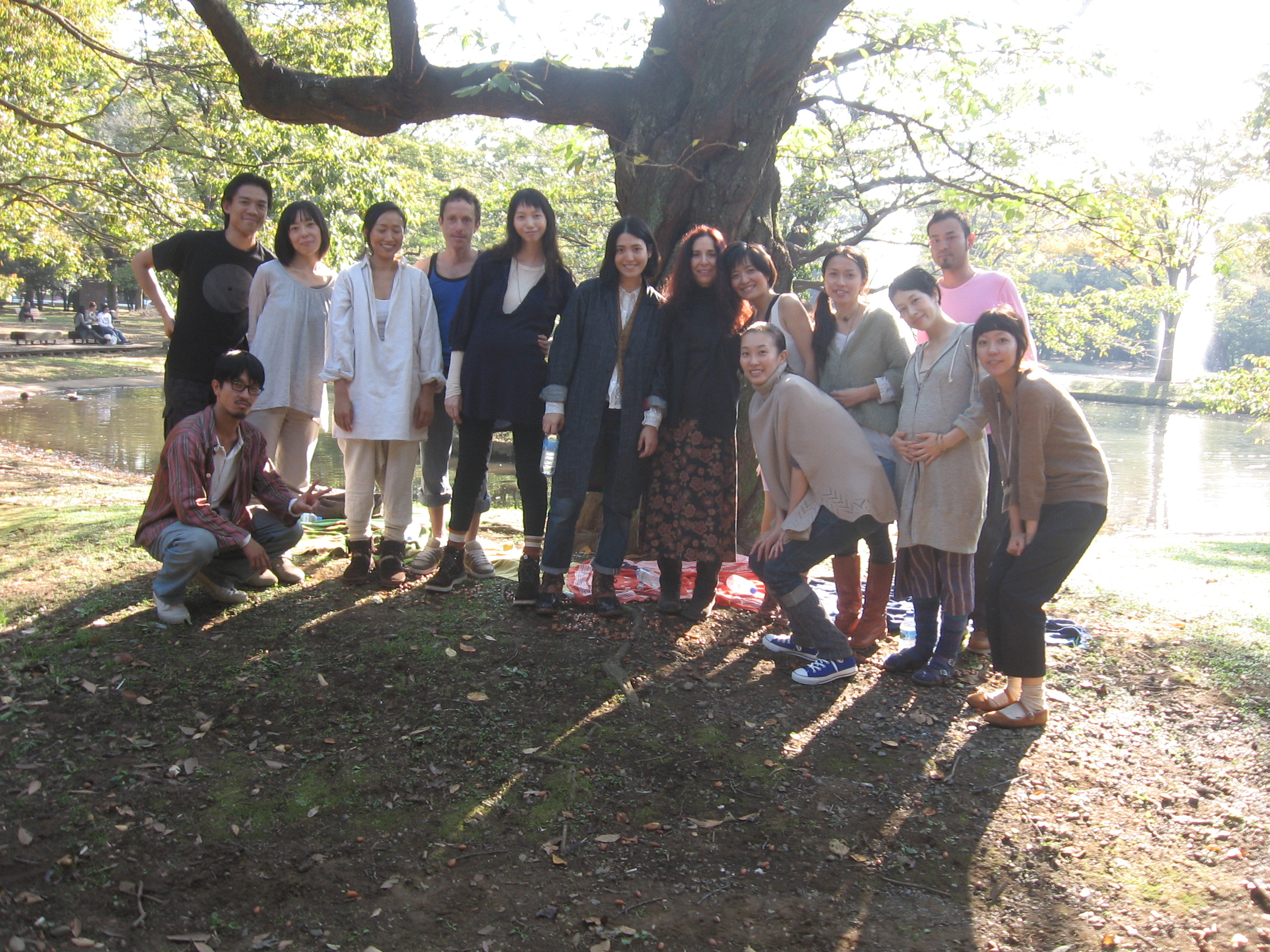
October 12, Interview with Murmur Magazine in Haragyuku, Tokyo, including a fashion modeling session in Yoyogi Park. Here is a group shot with all of the models and photographers near the lake.
October 16, 6:30 to 9 PM, Concert and talk session with special guest, actress and environmental activist Ikue Masudo (aka Saya Takagi) at her restaurant and performance venue, FU-RYU, by the beach in Minami-Bousou City. 1800 yen (free for kids under 12).
October 18, Art class, making small books at Genesis Art Lounge in Okachimachi, Tokyo. CANCELLED
October 19, Concert at Naked Loft, at the Loft Project, Shinjuku. 7:30 to 8 PM, Bobin (Nepalese Reggae singer/guitarist). 8:10 PM to 9 PM, live talk show, with Bobin and Alicia, hosted by activist/organic farmer/journalist Yumi Kikuchi. 8:10 to 9 PM, Alicia plays. Closest train station is Shin-Okubo.
October 23 or 24, Concert at Happy Flower Beach Party festival, Nago, Okinawa. Joe Dolce and Lin Van Hek from Australia will join me.
October 27, Concert at Café Unizon in Okinawa. Alicia Bay Laurel, Amana band, and Joe Dolce and Lin Van Hek from Australia.
October 30 Concert at Yukotopia live house in Umejima, Tokyo. Joe Dolce and Lin Van Hek will join me.
November 1 Concert at Yukotopia live house in Umejima, Tokyo
Beyond Living: Finger-picked Ruminations on the Hereafter and Its Messengers has come from the pressing plant this week. It’s a collection of charming antique and antique-sounding songs from the USA, UK, Australia, Japan, Hawaii and Denmark that focus on mortality, immortality, and a life that is mindful of spirit.
On this particular CD, I wrote only two of the eleven cuts, but I wrote new English lyrics from translations of two songs by Donto, a legendary Japanese new wave rock star turned spiritual singer/songwriter, and one 19th century hymn in Danish.
I also commissioned a long overdue Hawaiian translation of Donto’s famous hula, “Nami,” by Auntie Nona Beamer’s adopted son Kaliko Beamer-Trapp, an instructor of Polynesian languages at University of Hawaii in Hilo, and an opening chant for it in the ancient Hawaiian style by the late recording artist and kumu hula, Ried Kapo Ku, which opens the CD.
I also had the gall to record a 12-minute guitar solo consisting of 15 different songs.
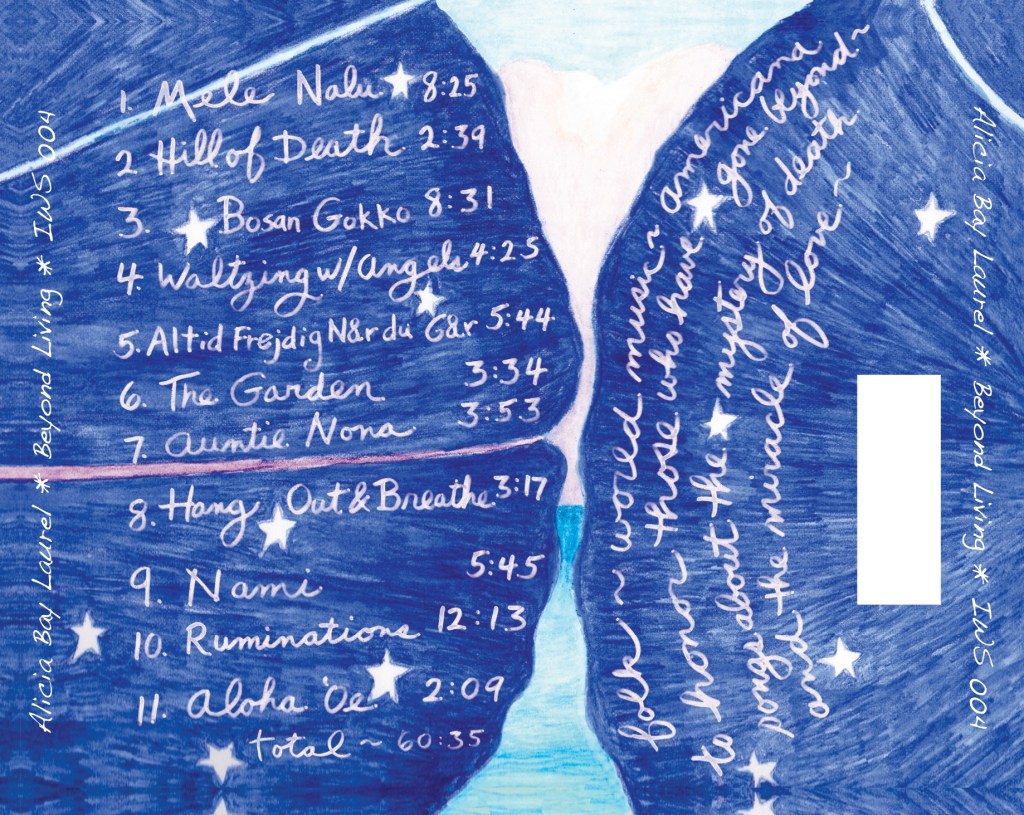
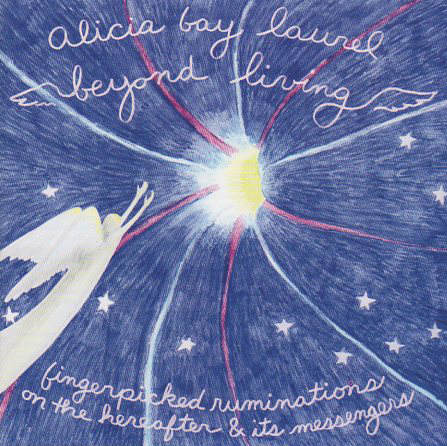
I had the liner notes and lyrics translated into Japanese so I could take it to Japan on my concert tours there. There are two different covers, but the CD itself is the same in both versions.
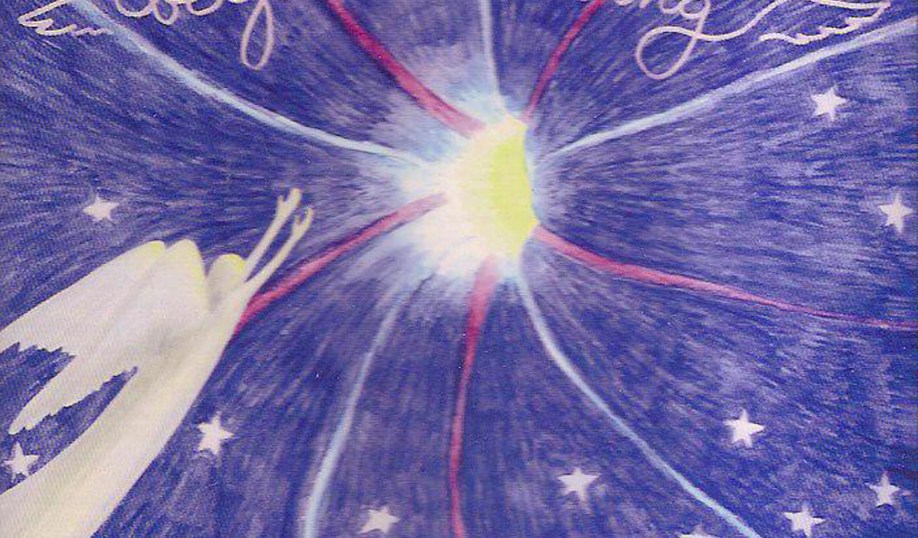
I painted the cover in watercolor pencils. My idea is that the Bardo looks like a quasar or a morning glory, which have the same mathematical shape.
Photo by Ruthie Ristich of Alicia Bay Laurel at Forest Hills Cemetery in Jamaica Plains, Massachusetts.
Beyond Living: Finger-picked Ruminations on the Hereafter and Its Messengers Liner Notes and Song Lyrics
Music that contemplates death does not have to be heavy and dark; think of the songs typical of an Irish wake, a New Orleans funeral parade or the Mexican Day of the Dead.
I collected and recorded these folk, Americana, gospel, Hawaiian, Australian, Danish and Japanese songs to honor the many I love who have passed on, and to uplift and comfort those who are grieving, providing hospice, or dying. However, even those not currently focused on the mystery of death and dying may find themselves dancing along to these sprightly tunes. I find that, quite often, lyrics about death contain valuable instructions for living.
During 2007 and 2008, an inordinate number of people close to me died, some elderly, others in their middle years. My mother and my father died on August 15, 2007. They were 500 miles apart, and had not communicated in over 45 years.
I assumed responsibility for my mother’s care during the two years before her death, held her hand as she lay dying, arranged for her cremation, wrote her obituary, coordinated her memorial service, eulogized her, put her affairs in order, and remained in her home, settling her estate, for a year after. My sister did much the same while caring for our father. We held hands over the phone, facing these challenges together, and still do.
Our parents’ simultaneous deaths came one month after the death of their friend Davida Solow, the mother of our friend since birth, Benida Solow, in whose home I lived while I cared for our mother. A month before Davida’s passing, our adored Aunt Ruth Lebow died. We’d known both of these women all our lives; their children were our earliest companions, and remain our friends today.
Auntie Nona Beamer, renowned Hawaiian singer/songwriter/dancer/storyteller, and my beloved mentor, died in April 2008. That spring, two cherished artist friends, Mayumi Hirai and Mela MacVittie, perished from cancer in mid-life.
Other dear friends and family members died shortly before or after: Peter Kane, Jacqueline Lynfield, Steve Gursky, Marty Jezer, Anson Chong, Fred Stoeber. My stepfather and Benida’s father-in-law, exactly two years apart. My sister-in-law’s mom. Both of my brother-in-law’s parents. My cousin Jay Lebow. A 40-year-old friend’s 64-year-old father.
It seemed as if the door between the physical and the non-physical swung wide, and messages zinged both ways furiously. I collected as many as I could.
Then there’s the case of Donto.
Takashi “Donto” Kudomi, a legendary Japanese singer/songwriter, died mysteriously on January 23, 2001. He, his wife and their two young sons were watching a hula performance dedicated to Pele, the volcano goddess, at Hawaii Volcanoes National Park. At the end of the final chant, Donto fell to the ground unconscious, and was rushed to the hospital. The next day he was pronounced dead at age 37 from a brain aneurism. He had been in perfect health until that day. Returning a year later to Pele’s home at Halema’uma’u Crater, Donto’s wife beheld him as a rainbow.
Later in 2001, I met her, singer/songwriter/bassist Sachiho Kudomi, through Seawest Studios, near Pahoa, Hawaii, where we had both recorded CDs. In 2002, I helped her organize a first-year memorial for Donto at Honpa Hongwanji Hilo Betsuin, a Buddhist temple in Hilo, and organized a Hawaii tour for Sachiho’s all-woman band, Amana.
I have since performed with Sachiho and her band during three visits to Japan, at numerous events, including at a huge Donto memorial concert in 2006. In May 2008, we recorded two of Donto’s songs for this CD at Donto-in, the temple Sachiho built in his honor, in Okinawa. In January 2009, I debuted “Mele Nalu,” Kaliko Beamer-Trapp’s Hawaiian language interpretation of Donto’s famous hula, “Nami,” (Wave) at the final memorial for Donto at Honpa Hongwanji Hilo Betsuin. Kaliko is Auntie Nona Beamer’s adopted son, a scholar of Polynesian languages teaching at the University of Hawaii, and a member of the von Trapp family of “Sound of Music” fame.
I first admired the songwriting of Steve McGee and Joe Dolce when I met them at the communes where we lived in northern California in the late ‘60s. In the early ‘70s, we all lived and composed songs on Maui. All of us made music in both places with the dazzling singer and midwife, the late Janet “Sunny” Supplee. Her presence is particularly felt in this recording, since it was she who taught me the 19th century hymn “Oh Come, Angel Band” while we were living at Wheeler Ranch commune, where, at the time, I was writing and illustrating Living on the Earth, and Steve McGee was composing his song “The Garden.” Joe Dolce went on to become a platinum-selling musician and songwriter in Australia and elsewhere.
Death teaches us that life is fragile, and therefore to make use of all available opportunities to be kind and to forgive.
Alicia Bay Laurel, Los Angeles, Spring 2009
* * * *
This recording was conceived, arranged and produced by Alicia Bay Laurel, for Indigo With Stars Records. Recorded, mixed and mastered (plus a lot of producer-type guidance) by Scott Fraser at his studio, Architecture, in Los Angeles, with additional recording as follows: Some of the parts for Nami, Mele Nalu and Bosan Gokko recorded in Okinawa at Donto-in by Kikou Uehara, some of the parts for Nami at Kazana Studio in Hirotsu, Japan by Tim Jensen, and some of the parts for The Garden and Nami at Maui Recording in Lahaina, Hawaii by Lynn Peterson.
Liner notes by Alicia Bay Laurel, translated into Japanese by Reiko Ashidate. Photo of Alicia Bay Laurel at Forest Hills Cemetery, Jamaica Plain, Massachusetts, by jazz vocalist Ruthie Ristich. Graphic design and cover painting by Alicia Bay Laurel. Digital layout preparation by Al Lopez. Japanese digital layout preparation and calligraphy by Atsuko Sano.
A thousand thanks to those whose inspiration, kindness and generosity helped to make this CD possible: Joe Gallivan, Sachiho Kudomi, Yoko Nema, Hiromi Kondo, Reiko Ashidate, Nona Beamer, Keola and Moana Beamer, Kaliko Beamer-Trapp, Tim Jensen, Mayu Uotani, Joe Dolce, Scott Fraser, Lynn Peterson, Kikou Uehara, Mana Koike, Kaorico Ago, Ried Kapo Ku, Moira Smiley, James Kimo West, Ray Armando, Chris Conner, Vic Koler, Steve McGee, Naoshi Omote, Yukata Arata, Kohki, Yumiko Kawashima, Satomi Yanagisawa, Keisuke Era, Koki and Ayako Aso, Setsuko Miura, Yoko Utsumi, Kim Cooper, Ruthie Ristich, Rick and Donna Keefer, Atsuko Sano, Jessica Mercure, Benida Solow, Ron Grant, and Lea Grant.
Profound thanks and love to my mentors now gone to the spirit realm: Esther Silverstein Blanc, James Leo Herlihy, Jean Varda, Louis Gottlieb, Juliette de Bairacli Levy, John Fahey, Helen Nearing, Auntie Nona Beamer, Uncle Sol Kawaihoa and Auntie Clara Kalalau Tolentino.
THE SONGS Note: Some of these songs have lyrics that were not sung or only a portion of which were sung. I include here only the lyrics that were actually sung (or spoken).
1. Mele Nalu (Song of the Wave) by Donto Kudomi, (1997 Goma Records JASRAC). Donto’s famous hula, Nami, translated into English by Reiko Ashidate, re-interpreted as English lyrics by Alicia Bay Laurel, 2008, and re-interpreted as Hawaiian lyrics by Kaliko Beamer-Trapp, 2008. The song opens with a Hawaiian chant composed and performed by Ried Kapo Ku, (2009 Na Manupo Music). Alicia Bay Laurel (vocal, guitar), Ried Kapo Ku (vocal, ipu heke [Hawaiian gourd drum]), James Kimo West (guitar), and Sachiho Kudomi (electric bass guitar).
Opening chant:
‘Ae, he mele nalu no Donto
(Here then, a wave song for Donto)
Ha’alele a’e ‘oe i ke ao nei
(You leave this world)
Ho’opili ‘ia i ka poli o Pele
(Drawn to the bosom of Pele)
Me ka wiwo’ole i kou pono
(Unafraid because of your righteous goodness)
E kali mäkou ma kahakai
(We wait on the shore)
No kou pane ë
(For your reply)
Aia lä! Ke änuenue!
(Behold! The rainbow!)
Eia au i ka poli o ka nalu
He mele kaʻu e mele aku ai
Ka huna kai e pulu nei
I ke ʻehu o ke kai
Palena ʻole, launa ʻole
Kani ʻole ka leo o ka nalu
ʻO kuʻu leo ke kāhea nei
Lohe ʻole ʻia mai nō
Auhea-hea-hea wale ʻoe
Auhea-hea-hea e ka nalu
Auhea-hea-hea wale ʻoe
E ō, e pane mai nō
Riding waves that praise the island
Waves of tears are falling down my face
Is this the place beyond all knowing?
Far beyond the singing of the waves.
Waves can weary with pollution
But the waves always continue to appear
Come on, waves, give me an answer
Let me know you know I’m here
Hear me, hear me, hear me, hear me, ocean!
Answer as I call to you once more.
Hear me, hear me, hear me, hear me, ocean!
I am listening from your shore.
Oneone ē ka nalu
Kāwili pū i ka lepo o ke kai
Mau nō naʻe ka poʻi o ka nalu
A pau loa ke ao nei
Inā hoʻi ua lohe ʻoe
Pane mai i ke kani o kuʻu leo E nānā mai i ʻike maila
ʻO au nō ke lana nei
2. Hill of Death by Joe Dolce (melody, 2004) and Louisa Lawson (lyrics, first published in Louisa’s late 19th century Australian feminist newspaper, The Dawn, and later in her 1905 poetry collection The Lonely Crossing) Dolceamore Music APRA (Australia). In 2004, Hill of Death won the Best Folk Gospel Award in the Australian Gospel Awards. Alicia Bay Laurel (vocal, guitar), Joe Dolce (vocal), James Kimo West (guitar) and Chris Conner (upright bass).
No downward path to death we go Through no dark shades or valleys low, But up and on o’er rises bright Toward the dawn of the endless light. For not in lowlands can we see The path that was and that to be, But on the highlands, just where the soul Takes deeper breaths to reach the goal. No downward path to death we go Through no dark shades or valleys low, But up and on o’er rises bright Toward the dawn of the endless light. There we can see the winding way That we have journeyed all our day, Then turn and view with spirits still Our future home beyond the hill.
3. Bosan Gokko (The Monk Song) by Donto Kudomi (1995 Yano Music JASRAC), plus Yamadera No Oshosan, a traditional Japanese children’s song. Translation of both songs by Reiko Ashidate and Yoko Nema, set into English verse by Alicia Bay Laurel, 2008. The piece opens with the first lines of Shoshinge, a sutra by Shinran Shonin (1173-1262), the founder of Pure Land Buddhism, translated by Yoko Nema. Sachiho Kudomi (vocal, electric bass guitar), Yoko Nema (vocal, harmonium), Hiromi Kondo (djembe), Ray Armando (congas), and Alicia Bay Laurel (guitar and spoken word).
(Translation of opening lines of Shoshinge) I take refuge in Amitabha Buddha, Who has eternal life, And light beyond human knowledge. (Translation of Bosan Gokko) On the mountain, the temple bell tolls. The aroma of supper greets me. Potatoes cooked with tofu; Let us say grace and enjoy it. No electronic sounds at the temple. When I hear ravens call, I go home. Yes, I would be really comfortable Living in the temple. A candle burns in the silent temple hall, Before dawn, the time of the wisdom of the universe. The sun rises. Wake up! I am a pillar of Japan. So long I gaze at the lotus Blooming in the pond of the garden. Head shaven and devoted to the temple, I am reincarnated into this world again. Take care until I see you again Live and let live. Live and let live. (Rough translation of Yamadera No Oshosan, a traditional Japanese children’s song) High on the mountain, there is a temple. In the temple, there is a priest. The priest wants to play with a ball But, there is no ball. The priest is longing to play with a ball But, there is no ball. So the priest plays with a cat.
4. Waltzing with Angels (medley): Alicia Bay Laurel (vocal, guitar), Moira Smiley (vocal), and Vic Koler (mandolin and upright bass).Oh Come, Angel Band (The Land of Beulah) by Jefferson Hascall 1876. Gathering Flowers for the Master’s Bouquet by Marvin E. Baumgardner, (1940 Stamps-Baxter Music BMI). Gathering Flowers was a hit in 1947 for Miss Kitty Wells, “The Queen of Country Music,” both as a solo and in duet with Hank Williams, Sr. I alternate between the two songs here.
Oh Come, Angel Band
My latest sun is sinking fast; My race is almost run. My greatest trials now are past; My triumph has begun. Oh come, angel band, Come and around me stand. Bear me away on your snowy wings To my immortal home. I’ve almost found my heavenly home My spirit softly sings. The holy ones, behold they come, I hear the sound of wings.
Gathering Flowers for the Master’s Bouquet
Death is an angel sent down from above, Sent for the buds of the blooms that we love. For it is so we must all pass away, Our souls to be flowers in the Master’s bouquet. Gathering flowers for the Master’s bouquet, Beautiful flowers that will never decay, Gathered by angels and carried away Forever to bloom in the Master’s bouquet. Loved ones are dying each day and each hour, Passing away like the life of a flower, But we shall all be together some day Transplanted to bloom in the Master’s bouquet.
5. Altid Frejdig, Når du Går (Courage, Always, When You Walk) Melody by C.E.F. Weyse, 1838, lyrics by Christian Richardt, 1867, English translation by Jessica Mercure, set into verse by Alicia Bay Laurel. Alicia Bay Laurel (sung and spoken vocal), Chris Conner (upright bass). Often performed at funerals in Denmark, this hymn served as a rallying call in the struggle against the occupation of Denmark from 1940 to 1945.
Altid frejdig, når du går (Courage, always, when you walk) Veje, Gud tør kende, (On paths only God may know,) Selv om du til målet når (Even if you don’t reach your goal) Først ved verdens ende. (Until the end of time.)
Aldrig ræd for mørkets magt! (Fear not the powers of darkness!) Stjernerne vil lyse; (The stars will shine.) Med et fadervor i pagt (With the Lord’s Prayer as your pact) Skal du aldrig gyse. (You will not quake with fear.)
Kæmp for alt, hvad du har kært; (Fight for all you hold dear.) Dø, om så det gælder, (Die, if you must.) Da er livet ej så svært, (Then life is not so hard,) Døden ikke heller. (And neither is death.)
6. The Garden by Steve McGee, 1969 (self-published). About finding heaven on earth. Alicia Bay Laurel (vocal, guitar), Steve McGee (vocal, lead guitar), James Kimo West (rhythm guitar), and Vic Koler (upright bass).
And it’s a hard rocky road that we’re going down, And I know we won’t make it by ourselves. For it’s love and believing in what we have found That will take us to the garden that the Great One has grown. Love, only love, can take you there To the place where we all can be free. Love, only love, is the way to find peace; It’s the answer to all that we need. And it’s a place where the people are filled with joy, And it’s a place where we all can be free to roam. Where the music flows as though it came from above, It’s a place that we all can call our own.
7. Auntie Nona/Kahuli Aku/Pupu Hinuhinu Auntie Nona by Alicia Bay Laurel (2008 Bay Tree Music ASCAP), Kahuli Aku by Nona Beamer, (circa 1955), Pupu Hinuhinu by Nona Beamer (circa 1955), sample from The Story of Pua Polu by Nona Beamer, 1996, on her gorgeous CD collaboration with Keola Beamer, The Golden Lehua Tree (all from Starscape Music ASCAP). Alicia Bay Laurel (vocal, guitar), James Kimo West (guitar), and Chris Conner (upright bass).
Dear Auntie Nona, mother of aloha, Songwriter, storyteller of our isles, We loved your twinkling eyes; we loved your gentleness; We loved your intellect, your heart and smiles. A leader of community who fostered peace and dignity Always with serenity, yet practical, Keeper of the ancient chants, you could do a rascal dance, Sing about Hawaiian plants and animals. (Melody of Kahuli Aku) You taught the children hula and decency Your songs with nature themes, Hawaiian nursery rhymes. These songs went on to be classics of the repertoire, Along with your stories of your life and times. Hula girl in Waikiki, Columbia University, Taught for half a century, Kamehameha School. Beamer family music camps, Mauna Kea oil lamps, Soon your face will be on stamps because you’re so cool. (Melody of Pupu Hinuhinu) Please, Auntie Nona, from your perch in heaven, Visit our memories and our dreams. Angel of aloha, bless us with peacefulness, Beamer of love and light, send your beams! You kept an open mind; your eyes were color-blind; You welcomed every kind who came to learn. You loved the mountains high; you loved the ocean side; You traveled far and wide, and returned. (Melody of Kahuli Aku and the ending of Pupu Hinuhinu) (Voice of Auntie Nona) Yes, you are always loved.
8.Hang Out and Breathe by Alicia Bay Laurel (1969 Bay Tree Music ASCAP). Alicia Bay Laurel (vocal, guitar), Joe Dolce (vocal), James Kimo West (guitar) and Vic Koler (upright bass).
What I want to do now is hang out and breathe, Take care of the family at hand, Live in the moment and be who I am, For things may go different than that which we planned. Oh happy most wonderful, Hang out and breathe ’til I die. Meet my Creator with open heart, Surrender my body with joy in my eyes. When I can remember to hang out and breathe, And let all my worrying cease, Thing can go crazy and things can go fine; I’ll be a love fountain in a garden of peace. Oh happy most wonderful, Hang out and breathe ’til I die. Meet my Creator with open heart, Surrender my body with joy in my eyes. Nothing is more simple than to hang out and breathe, You’d think that’s what all of us do. We come to this planet to live and to learn, So don’t hold your breath ’til your wishes come true.
9. Nami (Wave) by Donto Kudomi, (1997 Goma Records JASRAC). Alicia Bay Laurel (vocal, guitar), James Kimo West (guitar), Sachiho Kudomi (electric bass guitar), Hiromi Kondo (djembe), and Naoshi Omote (congas, surdo, cajon, rainstick, and assorted hand percussion). Choir: Sachiho Kudomi, Hiromi Kondo, Yoko Nema, Mayu Uotani, Tim Jensen, Yukata Arata, Kohki, Alicia Bay Laurel.
In this, the original Japanese version, I envision the song sung by friends, sitting around a campfire on the beach under a starry sky, playing drums and guitars.
10. Ruminations (medley): Alicia Bay Laurel (guitar and arrangement)
Amazing Grace, traditional Celtic melody, lyrics by John Newton, 1779, The Garden by Steve McGee, 1969, Is This Not the Land of Beulah? by Harriet Warner ReQua, 1890, Will the Circle Be Unbroken by Charles H. Gabriel (melody) and Ada H. Habershon (lyrics), 1908, Oh Come, Angel Band by Jefferson Hascall, 1876, Gathering Flowers for the Master’s Bouquet by Marvin E. Baumgartner (1940 Stamps-Baxter Publishing BMI), Angels Are Watching Over Me Traditional African-American Hymn, This Little Light of Mine Traditional African-American Hymn, Swing Low, Sweet Chariot Traditional African-American Hymn, Bosan Gokko by Donto Kudomi (1995 Yano Music JASRAC), Hill of Death by Joe Dolce (melody, 2004) and Louisa Lawson (lyrics, circa 1895) (Dolceamore Music APRA), Long Black Veil by Marijohn Wilkin and Danny Dill (1959 Universal Cedarwood BMI), Good Night Irene traditional folk song, first recorded by Huddie Ledbetter (Leadbelly) in 1934 for the Library of Congress. (Ludow Music and Andite Invasion), We Shall All Be Reunited by B. Bateman and Alfred Karnes (1929 Peer International BMI), Kumbaya (Come by Here, My Lord) Traditional African-American Hymn
11.Aloha ‘Oe (Farewell to Thee) by Queen Liliuokalani, 1878. Not penned for someone dying, but rather to a beloved to whom one expects to return. Alicia Bay Laurel (guitar), and James Kimo West (guitar)
Alicia Bay Laurel serenades Juliette de Bairacli Levy as she communes with a bee, August 26, 2000 at the New England Women’s Herbal Conference in Peterboro, New Hampshire.
Notice from Juliette’s daughter, Luz, and Luz’s husband Gunter and daughter Adaya:
She passed away at the 28 of May 2009, peaceful without pains.
We don’t organize an official announced funeral,
We plan to bring the ash back to Kythera.
In Loving Memory,
Luz, Gunter and Adaya
Ninety-six years strong,
Juliette changed our world
With the courage to go her own way
Back to nature and to fellow wilder beings.
Gentle of manner and determined in action,
She lived adventures that instructed for the good.
She blithely ignored the blind strictures of society
While carefully paying attention to the tiniest creatures,
Assuaging their pain
With mosses, spider webs, roadside weeds
And her endlessly kindly gaze.
Mother of the wildwoman in my soul,
Boddhisattva,
I salute you as your make your triumphant rise
To the realms of pure spirit,
Leaving behind your example
To hold aloft as we continue
Living on the earth.
Alicia Bay Laurel
May 29, 2009
———————————————————————
From Susun Weed’s Ash Tree publishing company, which offers many of Juliette’s books:
Juliette de Bairacli Levy is a world renowned herbalist, author, breeder of Afghan hounds, friend of the Gypsies, traveller in search of herbal wisdom, and the pioneer of holistic veterinary medicine. Juliette has a long record of spectacular cures to her credit and the books she has written have been a vital inspiration for the present day herbal renaissance.
Juliette was born on the 11th hour of the 11th day of the 11 month, almost in 1911 (actually 1912) in Manchester, England. Her parents were Jewish – her mother from Egypt and her father from Turkey. Juliette was raised in a household with three sisters and two brothers, a nanny, chauffeur, maid and gardener. She was educated at Lowther College, one of the best girls schools in Britain, and went on to study veterinary medicine at the Universities of Manchester and Liverpool. However, Juliette did not approve of the vivisection and animal experimentation that was going on in the universities in the name of science and health. So she left university after two years and went to study with the Gypsies and peasants of the world. In the late 1930’s Juliette ran a distemper clinic in London where, at a time when many dogs were dying from this disease, she treated and cured hundreds of dogs with fasting, herbs and a natural diet. When many Afghan hound puppies were dying of distemper, Juliette raised a litter of puppies on her natural rearing methods and these puppies won Best of Show at Crufts Dog Show.
It was in the 1930’s that Juliette developed a line of herbal supplements for animals known as Natural Rearing Products. For the next 50 years these were the only products of their kind on the market. Today these supplements are still distributed world wide.
During the World War II Juliette worked in the Women’s Land Army gathering sphagnum moss which was used on soldiers’ wounds. After the war she went to Yorkshire where she cured thousands of sheep who had been declared incurable by conventional vets. This work brought her to the attention of Sir Albert Howard, founder of the Soil Association and creator of modern day “organic” farming methods. Sir Albert Howard encouraged Juliette to learn all she could about herbal treatments for animals.
In the 1940’s, while travelling in America, Spain, France, North Africa and Turkey, Juliette gathered herbal remedies from the nomadic and peasant peoples of these lands. When her Complete Herbal Handbook for Farm and Stable was published in 1951, it was the first veterinary herbal ever to be published as before this time, the art of farriers, gypsies and peasants had been passed on only by the spoken word.
Thus Juliette became THE pioneer of what is known today as holistic animal care. She went on to write The Complete Herbal Book for the Dog. Both these books together with Juliette’s Illustrated Herbal Handbook for Everyone and Natural Rearing of Children have become classics and many generations of humans & animals have been raised & healed on these books.
Faber and Faber, one of Juliette’s publishers, say that for the past 50 years they have always received more inquiries about Juliette than about any of their other authors who include T.S. Eliot, Ted Hughes and William Golding.
Juliette’s two children, Luz and Rafik, were born in the early 1950’s. She took her children to live in Israel where they raised owls, hawks, dogs, goats, donkeys and bees. Juliette became famous for saving her hives of bees from shell attack during the six day war. In Israel and later when she moved to Greece, Juliette continued to write, to raise Afghan hounds, to garden and to gather herbal remedies. As well as her herbal books, she has written several travel books, two novels and three books of poems.
For the past many years Juliette has been coming to America every summer to give lectures, workshops and seminars on herbal medicine. In America she has become recognized as the grandmother of today’s herbal renaissance. In 1998 at their HerbFest in Iowa, Frontier Herbs presented Juliette with a Lifetime Achievement Award for her contribution to the herb world.
Send love letters and words in memory to wisewoman@herbshealing.com
——————————————————————-
Note from Tish Streeten, who created a bio-documentary, interviewing and filming Juliette de Bairacli Levy, titled Juliette of the Herbs:
Dear Friends,
After several days of not eating, and sleeping more and more, Juliette died very peacefully and calmly in her sleep in the night of May 27th/28th. She was in a lovely home in Switzerland near her daughter Luz, her grand-daughter Adaya and her son-in-law Gunter who took very good care of her these past few years.
Juliette was 96, had a remarkable life, a peaceful death and will leave an incredible legacy. Even while feeling the beauty of the completeness, i will miss her presence in this world.
Peace, my heart, let the time for the parting be sweet.
Let it not be a death but completeness.
Let love melt into memory and pain into songs.
Let the flight through the sky end in the folding of the wings over the nest.
Let the last touch of your hands be gentle like the flower of the night.
Stand still, O Beautiful End, for a moment, and say your last words in silence.
I bow to you and hold up my lamp to light you on your way.
~Rabindranath Tagore
Luz, Gunter and Raffi have asked me to make a page on the web site julietteoftheherbs.com for everyone to send their memories, prayers, thoughts, photographs etc. I will get this up as soon as i can. Also on this page will be information on where and when there will be a gathering (with lots of chocolate) to celebrate and remember Juliette’s amazing life and legacy.
With much love to all of you who cared so much for Juliette, and who carry on her work,
Memories from writer Jodi Mitchell, who lived at the Wheeler Ranch Commune where I wrote Living on the Earth:
Her book, Natures Children (1971), was my Dr. Spock. I literally raised my son, Mitch on its advice when he was a baby (and my pets as well). I used all herbs and medicinal plants for his healing and health; never took him to an MD. Spent lots of time outdoors and within nature celebrating all the seasons. He was breast fed until 1.5 years at which time he informed me he wanted to drink from a cup and be weaned! I planned to breast feed him much longer; but he chose to wean himself. He spent that milestone day with a group of my men friends – about 6 of them. They went off for a day of hiking in the woods. He came back weaned, and drinking from a cup. That was it. I then made all of his own baby food by blending whatever I ate in a blender for him. He was raised vegetarian. I grew lots of my own organic veggies or traded for them. There was also an ancient apple orchard on our land. I made applesauce from the old, tough apples. He was also fed brown rice cream: brown rice ground fine and cooked as a cereal for protein, and black strap molasses for iron. He was never sick, even through the long, cold snowy winters. Someone once told me he was healthy like a bear cub! We lived in rural West Virginia at the time.
Juliette was so inspirational to me as a young (age 19, 20) woman, as well. This was of course, after my life on the back-to-the-land commune Wheeler’s Ranch, where I knew Alicia and owned a copy of her own amazing educational/inspirational book, Living On the Earth. Still have my original copy! The elder Juliette was in the forefront of the whole natural living, natural eating, natural healing lifestyle which so informed the rest of my life. She also guided and inspired me as a young woman in that she helped me to believe that I had innate wisdom of my own and self-worth.
Luckily, I found a first addition copy of the original book online last night and ordered it. I am sure it will flood me with many sweet memories when I see it again. I probably referred to it daily when Mitch was a baby. I also very much wanted to live a life like Juliette: strong, independent, living a rural simple lifestyle surrounded by animals, children, art and beauty. Maybe I’ll still get there.
———————————————————————–
A beautiful memoir from master herbalist and teacher Susun Weed:
I Remember Juliette de Baricli Levy
by Susun Weed
June 1, 2009
I met Juliette de Bairacli Levy almost three decades ago, but I remember our meeting as though it were yesterday. My heart beat fast as the glass door opened and the woman whose books I adored entered. Smiling broadly, both from delight and nervousness, I eagerly awaited her.
“I brought this for you,” I said, offering her a weighty bag. Inside was a quart of goats’ milk yogurt and a pound of goats’ milk cheese—made by me from the milk from my goats. It was the right gift at the right time, and Juliette warmed to me.
Our talks were many over the years we worked together. Most were about animals, some were about herbs, all were about the gifts of the Earth. Juliette and I shared a love of goats and a child-like delight in the miracles of life. We both bowed to no man-made rule, but spent our lives in strict obedience to Nature’s laws.
I feel keenly grateful for Juliette’s stance as a woman who found her own way. I feel deeply thankful for her friendship and mentorship. I feel profoundly humbled by her trust in me to publish her books and keep them in print. And I feel keenly, deeply, profoundly sad that she is no longer with us in her body.
I commit to keeping Juliette’s words available to all who wish to drink from her well of knowledge and delight. She did delight in the beauty and wonder of the world and its creatures. In these times when major publishers are faltering, Ash Tree Publishing is thriving. Ash Tree Publishing will continue to provide access to Juliette’s work, both in print and in modern formats.
Three of her out-of-print works are in line for publication. We anticipate presenting them to you in the very near future.
So Juliette lives on in our hearts and minds and through her books. And she will continue to live on, influencing new generations of herbalists.
Juliette de Bairacli Levy is the woman who was the greatest influence on my path as an herbalist. I hope she lives on through me.








 Alicia Bay Laurel
You must be logged in to post a comment.