Joe Dolce

Please meet my long-time friend, singer/songwriter/poet/chef Joe Dolce! Everything you could possibly want to know about Joe’s illustrious career you can research here. He’s politically aware, witty beyond comprehension, emotionally evolved, and brings it all to his music.

I met Joe briefly at the Star Mountain Commune in Sonoma County, California, in the early 1970’s. He’d arrived as I was just leaving—for Vermont, and then Hawaii. But I’d heard our mutual friend, singer Sunny Supplee, sing his beautiful, spiritual, and sometimes sexual songs. I met him again when we were both living on Maui. Later I heard he’d moved to Australia and had a big hit with a song that was NOTHING like his songs that my friends had been singing.

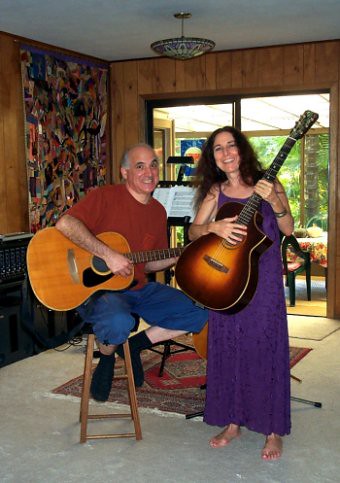
In the summer of 2004, after decades out of touch, he visited me in Hawaii (see photo above). He’s now a pillar of the Australian music scene, a loud voice for the left, a doting grandparent, and formerly the author of a funny, funny email newsletter complete with fabulous recipes, political commentary, great poetry, cultural anomalies, reader comments, and torrents of jokes.  More recently, he moved all of that into a Facebook account, allowing him to include videos of his performances.

I am equally a fan of his many-decade partner, the fabulous author, visual artist, fashion designer, and performance artist, Lin Van Hek.  In 2009 we all toured together, playing music in Japan.


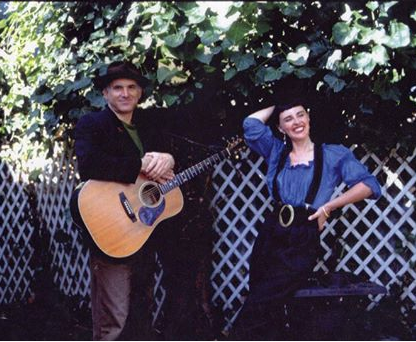
Joe Dolce and his partner, Lin Van Hek

Eco-Wedding

Last September I sang at the wedding of my dear friends, gorgeous young permaculture teachers and environmental activists Tara Robinson and Ryan Holt, who I met through performing music and stories during courses at La’akea Gardens Permaculture School in Puna, Hawaii.

Tara and Ryan carefully planned every aspect of the wedding to harmonize with their ethics and principles. The invitations arrived wrapped in rich crimson recycled paper. They chose a ceremony site on a high hill overlooking forested slopes and a lake in northern Vermont.

The bridal party dressed in natural fiber clothing and arrived in a horsedrawn carriage. The congregation sat on biodegradable haybales, and the altar included offerings to all of the directions and elements of nature. Tara and Ryan’s friend Sarah Sullivan, a fellow permaculture teacher and environmental activist, co-wrote the ceremony with Tara and Ryan and conducted it. Another wonderful friend from La’akea Gardens, Liz, sang a song she wrote in honor of their wedding. I played an hour of slack key guitar before the ceremony, sang two songs I wrote during the ceremony, and performed an hour of jazz standards after the ceremony. After the reception dinner (in a barn) everyone danced to an eight piece funk band that accommodated Tara and Ryan’s request for a Michael Franti tune with the mantra “All the freaky people make the beauty of the world.”

All of the food was organically grown by local farmers, many of them friends of the bride and groom. The groom and his family personally prepared the rehearsal dinner.

I loved the wedding cake, decorated with fresh glazed fruits. Organically grown grapes in the wine, organically grown apples in the cider; even the flowers (lots of amaranth and sunflowers) were locally and organically grown, and arranged by friends (including me). They used pumpkins for centerpiece vases!

Ryan’s brother Sean, a glassblower, provided wonderful bridal goblets.
Tara’s female relatives and friends each created patches with poems and pictures on them, and sewed them together into celebratory bridal quilt that hung on a wall during the reception.

The day after the wedding, the family gathered for a bonfire by the lake to enjoy the luscious leftovers. Nothing goes to waste in this family!

Magnesium

Is there a link between heart disease and lack of magnesium in our food?

“Widespread research shows that our diets are seriously low in magnesium, that heart disease is widespread, and that many heart disease cases might be prevented and even treated through magnesium supplementation.” Dr. Andrea Rosanoff PhD, a mineral nutrition specialist whose book, The Magnesium Factor, co-written with the late Dr. Mildred Seelig, has made big waves in the nutrition study community. Dr. Rosanoff, founder of the Center for Magnesium Education and Research, confided to me that many of the “blockbuster” drugs that account for much of pharmaceutical companies’ large profits are treating the symptoms of a magnesium deficiency rather than going to the root cause.

Magnesium can be valuable in treating hypertension and migraine headaches, and is important in keeping bones strong, Dr. Rosanoff told me. “Many of us take calcium supplements to stave off osteoporosis, but without enough magnesium, this practice won’t help our bones and could even make things worse. We need magnesium, especially, in a stress filled life. It is richly supplied by leafy green vegetables, nuts, seeds, and whole grains. But, magnesium is lost in milling away the bran and germ of the wheat grain to make white flour. Our national diet contains too much white flour and white sugar, which not only lack magnesium, but actually require magnesium to metabolize [digest].”

Recently, Dr. Rosanoff began offering Magnify, a product she invented; it’s a topical cream to apply to muscle spasms and strains. I always keep a good supply of it at home. You can buy it online here.

Shari Elf

Shari didn’t invent making folk art from found objects, but she informs her high level recycling with a dry humor that makes her pieces irresistable to a growing, adoring audience. To wit: her motto is “Good and Sturdy Art,” and her gallery show at the Light Box Gallery in Kansas City was titled “95% Trash.”

Shari’s marketing history is remarkable. Although she had already made lots of exuberantly whimsical art, both wearable and decorative, before moving from Kihei, Maui (where her family had moved when she was eight), to Santa Monica, California, the roots of her success began at the Rose Bowl Flea Market and the Santa Monica Airport Swapmeet. She was adding a second income to her seamstress business, buying and selling stuff that amused her, and occasionally painting on something to make it into something else: Flowers on oxford shoes, smiling dogs on purses. Whenever someone bought an art piece, she wrote their name, address, phone and email address on a 3×5 card, plus the name of the piece, the date, and how much they paid for it. If the buyer returned and bought another piece, she added the info to the first card. Gradually her booth evolved into a display of all original works of art; gradually return customers became avid fans; gradually she acquired a card file full of client information.

Next she held a yard sale. She made a whole bunch of pieces, sent out amusing postcard invitations to her customers, and sold all of the art from her yard in a day. A month later, she held another sale the same way, with equal success. So she gave up swapmeets, and sold enough art from her front yard to make a good living.  She began performing her original music with her All Star Steamstress Band, which featured two drag queens running sewing machines as percussion to her guitar (or Omnichord) and vocals.

Next came a series of retail outlets that asked to display and sell her pieces, then a formal gallery show in LA, and then a national agent who wanted exclusive right to sell her work. At that point Shari decided to go back to selling it all herself, since she enjoys the personal contact with her fans (who love sending her interesting junk to add to her pieces) and prefers making her art available to them without galleries and agents in between, doubling the prices.

Next she had a website designed, informed by her unique wit, and she self-produced I’m Forcing Goodness Upon You, a comedy album of original music, which made a big splash on the college stations. A few years later, she produced a tribute album of recordings of her original songs by fans, regardless of musical ability, with packaging to match.

She turned her mailing list into an emailing list, notifies her fans whenever a new group of works is available on her site, and sells everything in less than 24 hours. I don’t know another artist who can say that. So, now she works from her high desert home as a mail order business and avoids galleries almost completely (she did have a museum show last year!). She is free of the middlemen that bleed artists, financially self-sufficient solely from her art, and having a good time doing it.

Slack Key Guitar

Alicia Bay Laurel and Hawaiian music elder statesman Bobo Brown perform at the Big Island Slack Key Guitar Festival in July 2002, in Hilo, Hawaii

What is slack key guitar, I am sometimes asked. Is it an instrument, or is it a style of playing?

“Slack key” in Hawaiian pidgen and “ki ho’alu” in Hawaiian both refer to the non-standard tunings of guitar strings used in a style of guitar playing that evolved in Hawaii during the Victorian era.

In guitar parlance, standard tuning (EADGBE from bass to treble) serves as the basis from which most western music, including classical, jazz, rock and roll, country, and folk, is arranged for guitar. However, in flamenco, in Mississippi Delta blues played with a bottleneck, and in the improvised open-tuned guitar music pioneered by John Fahey, the guitar is tuned other ways, and the music is often communicated on paper in a system called tablature instead of sheet music (which classical guitarists follow) or chord charts (commonly used in pop, country and folk music).

Like these other non-standard tuned styles, slack key is finger-picked rather than strummed with a pick. Although Hawaiian slack key evolved from Spanish open tunings brought (along with the guitar) to Hawaii in the nineteenth century by Argentinian cowboys, the rhythms of early Hawaiian slack key often reflected the popular North American music of the day—ragtime piano, with its altnernating, synchopated bass.

Since its emergence into popular music during the Hawaiian renaissance of the 1970’s, slack key guitar continues to grow in popularity. Keola Beamer’s album In the Real Old Style put slack key on the radio in Hawaii back then; he’s still pioneering musically with ki ho’alu in a masterful way.


To my ears, the most creative and skillful of all the Hawaiian singer/songwriter/guitarists, Keola Beamer, arm in arm with his mother, Nona Beamer, who defied the strictures of colonial rule to re-introduce the ancient forms of hula and chanting to Hawaii, which she had learned as a child from her grandmother. She was a mentor to me.

Teach Your Children Well


Peace quilt made by 5th grade students of Benida Solow at Kenter Canyon School

Artist Benida Solow inspires her students not only with original and exciting projects, but an appreciation of the natural world and with environmental activism. She teaches art to elementary school students and volunteers as a docent on whale watch cruises for the Cabrillo Marine Aquarium in the winter months, when whales are most likely to visit the waters off Southern California. She admires British artist Andy Goldsworthy, who creates astonishing sculpture from natural objects, and she offers his example to encourage children to get their hands into the wondrous world out-of-doors.

The life-sized (50 foot long) gray whale cow and calf sand sculpture took Benida and the children four hours to complete. They used a fire hose to keep the sand wet while working on their entry in the sand sculpture contest of the Cabrillo Whale Fiesta 2006.

“Message in a Bottle” won first place in the recycled sculpture contest
at the STAR ECO Station in Culver City, California. The children wrote messages on colored paper and stuffed them into the discarded plastic bottles before hot glue-ing them all together to create one immense bottle.

Benida brought butterfly wings into a first grade class to inspire the children to create a whole series of remarkable abstract paintings.

The children find Benida fascinating and magical; witness this mixed media contour drawing of her by a second grade student.

Honing the Spoken Word


Alicia performs her stories and music at Galapagos Art Space in Williamsburg, Brooklyn, during a 75-performance cross-country tour in 2000

Today I attended From Page To Stage: Performing Your Personal Story, a class offered by The Learning Annex on spoken word performance, a fast-growing trend in theatre. The list of spoken word venues continues to grow in cities with art scenes; in Los Angeles, for example, you’ll find Word-a-Rama, Melt in Your Mouth, Mortified, Show and Tell, Dear Diary, Say the Word, Sit ‘n Spin, Story Salon, Word Theatre, Tasty Words, Word Nerd, Word Space, Cornucopia and Afterbirth. These evenings feature four to seven readers of personal stories in an atmosphere of hipness bordering on a poetry slam.

I certainly recommend both teachers. Amy Friedman, a much-published writer of fiction, non-fiction, screenwriting, and a syndicated newspaper column, teaches Writing Your Personal Story through UCLA extension. Jim Pentecost has acted, directed and produced plays and musicals in New York, came to LA to produce Disney’s Pocahontas, and now is coaching spoken word. Both are personable and communicate well.

Amy led us in writing what she calls “personal essays”—intimate, honest, and revealing narratives about small, distinct events in our lives. You can find abundant examples of this genre in The Sun Magazine.

As our first task, we composed lists of as many memories, absolutely any memories, as we could think of in ten minutes. Then we were asked to quickly jot down ten more memories and were asked to look for our repetitive life themes in this seemingly random set of ten memories. Finally, we wrote a short personal essay using anything from our memory lists, or on subjects suggested by Amy and Jim, including What No One Knows About Me, My Morning Ritual, and How I Learned About Sex.

Three volunteers read their first drafts to the class while Jim coached them on reading with emphasis and good dramatic timing.

I discovered that what I really want to do is not the same as spoken word performance. I want to do more one-woman shows of my humorous autobiographical stories and original music, like the shows I created and toured in 2000, 2001 and 2002. So, I will seek coaching in this particular dramatic form.

Ratatouille

Alicia cooking in Hawaii

Ratatouille (pronounced Ra-ta-too-ee)

My mom used to make this luscious eggplant stew to accompany barbequed marinated lamb. Lamb is not necessary for the enjoyment of this dish, which can be transformed from a side dish to a one-dish meal with the addition of tofu or cubes of freerange chicken or turkey breast. I’ll explain how to add options in the recipe.

One large eggplant cut into one inch cubes (remove stem connection and dimple at bottom of eggplant)

Two large yellow onions, peeled and chopped coarsely

Ten cloves of garlic, peeled and chopped finely

Two medium sized zucchini, ends cut off and sliced in 1/4 inch slices

One can of tomato paste (6 ounces)

One can of stewed tomatoes (8 ounces)

One large green bell pepper, stem and seeds removed, cut into one inch pieces

Optional: one block of extra firm tofu, OR one raw (thawed) turkey half breast OR two or three raw (thawed) chicken half-breasts, cut into 1/2 inch cubes

Sesame oil for frying and olive oil for seasoning after it’s cooked

Bragg’s liquid aminos for salty seasoning

A handful of fresh basil leaves, rosemary needles and oregano leaves, if you can get them, or two tablespoons of finely minced dried herbs if you can’t.

Mix together the stewed tomatoes and the tomato paste and set aside. Be sure to include all of the water in the can with the stewed tomatos.

In a large non-aluminum wok, heat 3 tablespoons of oil and add the garlic. Stir it around until the garlic is golden brown. Add the onions, and stir fry them until they are translucent. Add the dried herbs next if you are using them. (If you are using fresh herbs, add them with the vegetables.) If you will be adding chicken or turkey, add them now, and cook until not pink inside a cube you break open to test. Keep the fire moderate so that nothing burns. Next add the eggplant, zucchini, bell pepper, optional tofu and optional fresh herbs. Stir around until all of these are evenly coated with oil. Pour in the tomato mixture, stir to distribute evenly throughout the stew, put the lid on the wok, and let the whole thing simmer until the vegetables are tender. Season to taste with Bragg’s Liquid Aminos and olive oil. Serve immediately, or cool the mixture to wrist temperature, and store, refrigerated, in an airtight glass container (tomato stains plastic and reacts with aluminum). The taste improves overnight, so it’s a dish you can prepare for a party the day before.

Alternatives to Corporate Globalization


Jerry Mander and his son Yari at the 2003 Bioneers Conference

In October 2003, I was signing Living on the Earth books at the Bioneers Conference, an annual weekend event in Marin County, California, that brings together thousands of activists working toward a sustainable world, to witness a panoply of educational presentations. At the table next to mine, Jerry Mander and John Cavanaugh, co-chairs of the International Forum on Globalization, were signing their book, Alternatives to Economic Globalization. We made friends and traded books.

I began reading their book the following December. Don’t be fooled by the dry title; this one’s a page-turner. It links together all of today’s issues—from global warming to in the invasion of Iraq to the AIDS epidemic in Africa to the attempted private sector takeover of Social Security—and places them in the context of a single looming menace: giant multi-national corporations that consider themselves above the law of any land. Indeed, if they find a country’s laws an impediment to their profit making, they will impose trade sanctions until those democratically created laws are repealed. We’re talking laws about environmental protections, food safety, labor, and monopoly.

The global conglomerates seek to control public water supplies around the world. Those who cannot afford the market price go thirsty, as do their crops. This assists in the corporations in herding cheap labor off the land and into their factories, while global corporations acquire the land for mono-crop agriculture exclusively for export—where self-sufficient agricultural communities had existed for thousands of years. Result: famine.

Meanwhile, pharmaceutical and agricultural chemical companies are patenting seeds and folk remedies developed over millennia by indigenous communities, and suing these same communities for using the corporation’s “intellectual property.” In addition, the chemical companies develop genetically modified seeds created to withstand the toxicity of chemical fertilizers, insecticides and herbicides, so that the farmers become dependent upon these megaliths for their seeds and farming supplies. Should a neighboring farmer refuse to use the GMO seeds, the wind carries the pollen from the GMO plants into the neighbor’s fields, and he can be bankrupted by a lawsuit from the chemical company for “stealing intellectual property.”

Some things were not meant ever to be owned by a single individual or organization. These are what Mander and Cavanaugh call “the Commons”—that which belongs to all and shared for the common good, including clean air and water, wilderness, biodiversity, the air waves (radio and TV), the basic human rights to medical care, education, and food safety.

What can we citizens do to protect the Commons, and to avert the social and environmental tragedies being promulgated by international administrative bodies that favor multi-national corporations over the needs of the people and the environment?

We can start by getting informed. Everyone from high school on up should read Alternatives to Economic Globalization. You can easily order one for $15.95 from Berrett-Koehler Publishers in Vermont at (800) 929-2929. Bulk discounts are available.

We all need truthful daily news, and one can find it online at www.commondreams.org, www.buzzflash.com, www.alternet.org, www.truthout.org, and www.tompaine.com.

We can speak out, calling and writing our representatives in Washington DC, writing letters to print publications, posting on web logs, talking with friends, and joining in public demonstrations.

We can create self-sufficient communities based on diversified agriculture, small businesses, seed saving, bartering, and community schools and clinics.

Absolutely, we need to support the few, brave politicians who are working to regulate corporate globalization and reverse its damage to our beautiful planet.

Two More Rules

I liked your Three Rules, but what about losing weight? I noticed from your photos that you were heavier at one time and not now.

Blimpie

Dear Blimpie,

You’re right, I’m fifty pounds lighter now than I was at my top weight, and I’ve been this size for about twenty years. The three rules have been enough for some of my friends to lose whatever extra weight they wanted to lose, but if they’re not enough for you, here are two more rules that will do the trick.

Don’t feed Santa: Like, skip the sweets.

Free your inner pig: Wild pigs are lean and mean because no one is fattening them up for slaughter with grains and other starchy foods.

All of that being said, I don’t think that losing weight is necessarily heroic. What’s heroic is to appreciate the precious miracle that you are, and to ignore Hollywood, Madison Avenue, and any critical friends, relatives and associates that might opine otherwise.