I met Ira Ono when I first moved to Maui in 1974. We were all Maui Family in those days, but I soon discovered that Ira and I both had paternal grandfathers with the same last name, who came to New York City from the same area around Kiev before the turn of the century. So, we determined, we are cousins.
Ira Ono, artist Sally French, Alicia Bay Laurel, fiber artist Pam Barton
Ever graceful, gracious, grateful, Ira never loses his cool. And he is absolutely the first guy I EVER knew who shaved his whole head on purpose.
Ceramic masks on sticks for garden decor
Some artists have a single running signature through their art, but Ira has many. One is the long faced, decorated mask that he produces in raku-ware ceramic. Another is is Japanese paste paper, made from dollops of blended acrylic paint and wallpaper paste mushed around on paper and textured with combs made from discarded credit cards. Strips of this become backgrounds for his collages and elements in his array of gift items, including blank journals.
An elegant “feng shui compliant” collage.
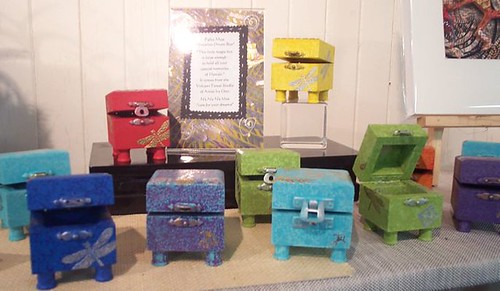
Ira collects little things he calls “goo-gahs,” parts from board games, small toys, pieces of machines, spiritual icons, measuring tape ribbon, cookie fortunes, postage stamps, all of which become elements in his mysterious large shadow box collages. Ira uses gold and silver powder to stencil designs on his painted wooden gift items (dream boxes, rainbow man christmas decorations, dragonfly magnets, for example). And Ira is a master at displaying his work in stores, and in his own semi-open air gallery in Volcano, employing fabrics and props with panache. A professional dancer since his teens, Ira’s got all the moves, and, at 61, he photographs exquisitely.
Dream boxes stencilled with gold and silver powders.
Ira is legendary in Hawaii not only for his art but for his scintillating public personna. At the first
“Feast or Famine” all Maui juried art show at Hui Noeau Arts Center, Ira danced into the opening night festivities on a rope, wearing nothing but Speedos, catsup, mustard and chocolate sauce.
Bedecked in flower leis, Ira and his twin brother Billy celebrate their 60th birthday with sixty friends. Between them is Billy’s wife Andrea.
Yearly on Maui, Oahu and Hawaii islands, Ira juries his invention, the Trash Art Show, which touts the virtues of recycling and invention, while entertaining hilariously with a trash art fashion show on opening night. He’s still got one of the winning pieces in the kitchen of the studio – a naked man doll made entirely from bottle caps.
Decorated masks displayed with eyecatching fabric in the Ono style.
So, do you think Laura Bush would have any of Ira’s art? She does. Ira’s bird tree ornament (feathered with color copies of antique Hawaiian postage stamps) was selected to decorate the White House Christmas tree in 2003.
Another birthday, swathed in leis by loving friends in true Hawaiian style
Ira opened Volcano Garden Arts, his studio/gallery in Volcano Village on the Big Island in a historic estate, and you must visit it when you drive up to Hawaii Volcanoes National Park. You never can tell what might be going on at Volcano Garden Arts. He hosted a couple of my music and storytelling shows there, and I gifted him on his 60th birthday with two hours of guitar music for his grand and memorable fete.
Ira’s a vegetarian, so, for Thanksgiving one year, he rescued a male and female turkey, and gave them the run of his lot. He complained that they were copulating constantly.
This is a song about speaking truth to power—not only to despots, but to our own collective power. The operative lyric here is VOTE. If everyone who could vote actually did vote, we could elect representatives who would work with us to reverse the vast environmental, public health, diplomatic, and human rights problems we earth-dwellers face, and make this a sustainable, joyful world for all who live in it, now and in the future. To vote well, we need truthful media (for example Truthout.org or Commondreams.org.) Also, we vote daily with our money; we need to support businesses that further sustainability and social justice, and boycott the rest. We need elections with publicly-funded election campaigns and hand-countable paper audits. Thank you.
Katharine Lee Bates wrote the lyrics to American the Beautiful on July 4, 1893; the melody comes from the hymn Materna, composed by Samuel A. Ward in 1882. Ms. Bates, a professor of English literature at Wellesley College, prolific poet and author, and ardent feminist, lived openly as a lesbian with her lifelong partner, Katharine Coman, Dean and professor of economics at Wellesley.
Curiously, the lyrics to America the Blues also revealed themselves on July 4th, 2003, while I was registering voters for the 2004 presidential election.
Arranged by Alicia Bay Laurel and Ron Grant, Singing and Speaking Vocal, Rhythm Guitar: Alicia Bay Laurel, Speaking Vocals: Jody Ashworth and Jessica Williams, Vocal Harmonies: Alicia Bay Laurel, Ron Grant and Jody Ashworth, Electric Guitar: Nels Cline, Electronic Symphony Orchestra: Ron Grant, Upright Bass: John B.Williams, Drums: Enzo Tedesco
America, the beautiful,
You’re thorny as a rose:
Radiation, global warming
Poisoned food from GMOs.
Your poor die sick and hungry,
And your wealthy live tax-free,
While they murder ancient forests
The soil and the sea.
America, America,
Greed sheds disgrace on thee.
Vote corporations out of power;
Revive democracy
For future generations
And human decency.
America, don’t blow it
All to smithereens.
You don’t need nukes; you don’t need slaves,
And you don’t need gasoline.
What you do need is compassion,
And respect for human rights,
Permaculture, sustainable systems,
Mediation instead of fights.
America, don’t wave that flag
To con us with your jive.
If the multi-nationals have their way
Even rich folks won’t survive.
We’re all family here on this planet,
So lay down that smoking gun,
And start sharing with your neighbors;
There’s enough for everyone.
I pledge allegiance to the earth
In the myriad stars of the universe
And to all the beings who upon her stand
One family, indivisible,
With liberty and justice for all.
America, America,
Greed sheds disgrace on thee.
Vote corporations out of power,
Revive democracy
For future generations
And human decency.
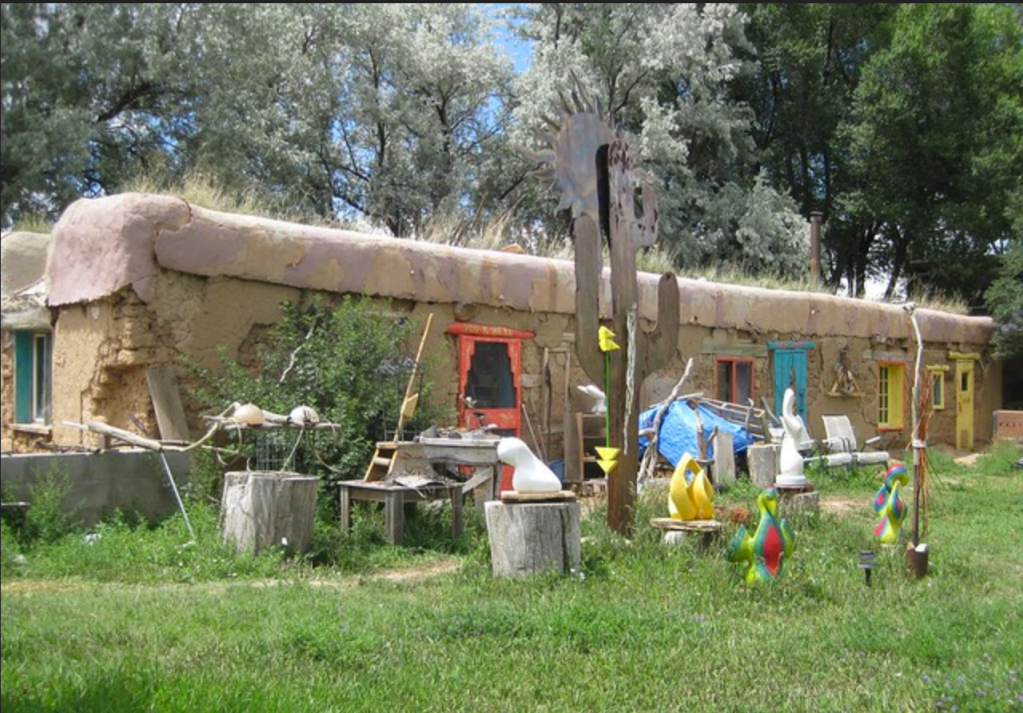
Adobe and sculpture at New Buffalo commune, Arroyo Hondo, New Mexico
New Buffalo Summer Solstice Gathering June 21, 2006 by Iris Claire Keltz Author and editor of Scrapbook of a Taos Hippie
The long languid lazy days of summer hold an amazing paradox: At the pinnacle of light and warmth the days begin to grow shorter, while on the darkest, often coldest day of winter the light begins to return to earth. The ancients were acutely aware of these celestial cycles as were the counter culture peoples of the sixties, who identified with and emulated indigenous cultures across the globe. This year thousands of revelers gathered at Stonehenge, England on the same day as we gathered at New Buffalo, in Arroyo Hondo, New Mexico to celebrate the longest day of the year in the northern hemisphere. New Buffalo, once a thriving 60’s commune and sanctuary to many, was the perfect place to rekindle dreams of youth and reflect on the blessing of family, friends of long standing and abundant gifts from earth. In the distance, a dramatic shale colored escarpment guides the Hondo River on its course to the Rio Grande. This piece of land is where I witnessed the journey of the sun on its northern and southernmost points. Eyes range unimpeded across the Sangre de Cristo Mountains in the east to the sloping west mesa that will eventually blanket the sun.
‘Welcome Home’, read the sign leaning into the wire fence at the beginning of the long rocky driveway. I return with my 29 year old daughter Minka, who has heard the hippie stories countless times and smiles patiently at her aging mom. New Buffalo was the commune where I lived in the late 60’s, a place where many of us hoped to spend the rest of our lives, to share everything, births, deaths, raising our children, building homes. We would live off the land. Bless the seedlings in the garden, the maturing crops, the birth of new animals. Comfort each other during times of hardship and tragedy. This is true social security. Even imagining that possibility makes me feel secure, less alone, more hopeful, making it easier to resist the fear being hurled at us these days, about terrorists, global warming, climate change, never ending wars and environmental degradation.
The original New Buffalo, 103 acres of sage and pinon, was purchased in the late ‘60’s by Rick Klein, a young poet from Pittsburgh who generously used his inheritance to start a commune and went on to build an organic looking adobe home for himself and his wife on Lama Mountain with western views to eternity.
Like butterflies and grasshoppers, we didn’t pay attention to the passing of time. Some of us didn’t stop to gather nuts or build winter shelters and were caught unprepared to sustain the dreams of youth. Idealistic they were. Practical they were not. We were young, on a chartless course, gloriously ignorant of the pitfalls and perils of communal life where anarchy was the accepted law with powerful personalities ruling the roost. We lost our way or got seduced back into a capitalistic system that offered many rewards. Max Feinstein, one of the original New Buffalo dwellers, commuted between Israel and New Mexico, getting disillusioned in one place and migrating to the other. But even the kibbutzim in Israel, supported by the government, could not stand against a relentless capitalism. These once socialistic communities have become profit making enterprises with expensive guest houses and tourist amenities. You can no longer drop in, find a home and help with the orange harvest as I once did.
But the dream survived the excesses of youth.
We have come from far and wide to be here. Some have not passed this way for a long time. Some never left this mountain valley and some are here for the first time, like a woman I met from Holland. Some could not face our youthful dreams without derision and cynicism. But for those of us who chose to share this moment of hope, we form a circle in the courtyard, like in times past, to hold hands and pray. We call out the names of those who have died and bless this most recent attempt to rekindle an old dream. There are cemeteries in New York filled with landslot, people who once lived together in villages in eastern Europe. Maybe there could be a cemetery at New Buffalo for us, to help future generations remember the dream we tried to do here.
The kitchen is still a place to quench one’s thirst and gather. My daughter helps the women working in the kitchen, just like I did so many years ago. A few hours later, she feels at home and understands something that my words could never convey. Shrieks of joy, laughter and tears, sounds of heatfelt reunions happening all around. Some were young children when they last met. Some barely recognize friends in our newly old bodies but we can still seduce each other with stories, dreams and memories. Graying, bald, overweight men and women, some using canes and walkers rise to the music that still excites us and gets us on our feet. Back then, the message was in the music. You didn’t need a weatherman to know which way the wind blew. The times were changing cause the revolution was comin’ and we were going to get there on our horse with no name. We were and still are stardust, golden and trying to get ourselves back to the garden.
While not exactly lying fallow since the agrarian dream faded, New Buffalo has been through a variety of incarnations- as a private school and a bed and breakfast. Although he was never part of the counter-culture as a young man, the new New Buffalo Bob Fies, has put and put his fortune on the line to refurbish the crumbling buildings and to rekindle a dream because he understands that sustainable creative communities are the best antidote to gluttonous consumerism, alienation and fear that afflict modern American society. If this sounds familiar, it’s because we have been at this juncture before, only this time the stakes are higher. Whether you identify yourself as progressive, liberal, conservative, anarchist, Democrat, Republican, Green or other, there are basically two choices facing humankind- those who are trying to bring on Armageddon, end time, and leave no tree standing and those who understand that all life forms on this planet are sacred and have the right to life. Our Native Americans taught us that every decision and action we take affects seven generations.
We are faced with an “inconvenient truth” Al Gore’s film forces us to face. The frightening reality which we all share calls for nothing less than paradigm shift. No longer can we operate for profit only. No longer victors and victims, empires and subjects, exploiters and slaves. We enter the age of interdependence and sustainability. The resurgence of New Buffalo, and other intentional communities offer us a chance to re-create this movement in the quiet of our older years, through the lens of wisdom that has taken us a lifetime to garner. People still want to live in community and realize that rules protect as well as limit. To those who would scoff and call me naive, I ask you to consider that our youthful folly may be the compost that gives seed to sustainable forms of living together that enable us survive and thrive during the difficult days ahead.
To be or not to be was the ultimate existential question for our friend Hamlet. Those of us gathered here on this solstice might not have the luxury of that choice, for unless we ask ourselves how to be, we all might not be at all.
Today I presided and sang at Kim and Richard’s wedding at the Velaslavasay Panorama Union Theatre in the West Adams District of Los Angeles, surrounded by dozens of their friends, all artists, writers, musicians, and their families. Kim and I go back 24 years. Richard designed this blogsite.
The appropriately titled marquee of the Union Theatre, an antique being gorgeously restored by Kim and Richard’s friend Sarah
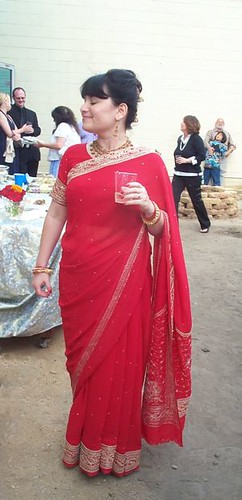
Kim Cooper, a regal bride in her red sari
Everything about this wedding, from the movie poster invitation that Kim and Richard designed together, to the cakes each iced with rice paper prints of their favorite paintings, to the ceremony’s highly original writing, to the inclusion of a cat fortune reader and a psychedelic-painted bus, added up to a unique and memorable afternoon.
Mio the gypsy, with his fortune telling cat
The Party Bus, which conveyed celebrants from distant parking
Jasper Rose, professor of art history at UC Santa Cruz, had four favorite students, who he considered most gifted. Two, Kim and Richard, could not abide one another, but Jasper told Cathy, Kim’s roommate, best friend, and the third student of this group, that he thought Kim and Richard were soul mates. Eighteen years later they fell in love. So now, twenty years later, they are marrying, with Cathy as matron of honor and Nathan, the fourth, and most dramatic, member of this group, reading a wedding oratory sent by Jasper from England for the occasion.
Jasper Rose had compared the marrying process to baking a simnel cake:
“Well! There you have it. You must, long since, have realized that I was dealing in allegory. As in all allegories some bits fit perfectly. Trusty old baking tin—this handsome Gazebo. The cool fingered cook, our Queen of the Hippies, whose dextrous hands enable her to ride even a bad tempered giraffe, our presiding genius.
(Kim had described me to Jasper as the Queen of the Hippies, and he wrote it into the script!)
“INGREDIENTS: it is pretty obvious that Kim must be demerera sugar. But Richard—can he be that unsalted fresh Normandy butter that nonetheless needs a bit of warming? Or is he just stone ground flour—watch out for the lumps!
“And the saffron. What can that be that we have to be so beware of substitutes, imitations? You’ve guessed it: the ultimate spice, the overarching blessing—LOVE.”
Clarence Johnston, Jacob Johnston and Cal Bezemer cook up some jazz on the stage of the theatre. For Kim and Richard’s first dance, I sang with the trio “(Our) Love is Here to Stay.”
I am a huge fan of Living on the Earth, but after a recent post in your blog, I now have reasons to hunt for your other books!
I have a rather odd question, but I have been wondering: What do you do for fun, what brings you joy in your spare time, when you are not working on your book projects or making music?
Lots of love & light, Amy Durwaigh
Hi Amy!
Thanks so much for your sweet letter.
I am, as you might suspect, a nature freak. I love to walk around (or swim around, or dance around) looking at plants, animals, and geologic forms. I also love to applaud other artists doing their art, which means I like to read, see movies, attend performances, gaze at art and architecture, and listen to music. I call all of this “visiting shrines of nature and shrines of culture.”
I spent my entire walk today obsessing about who will win the Living on the Earth Award, and decided that, since I’m The Decider here at aliciabaylaurel.com, I’m going to award SEVEN Living on the Earth Awards!
The Living on the Earth Award for consciousness-raising filmmaking, inspiration to millions of children, and truly handmade animation goes to Karen Aqua! (a theatre full of applause!!!)
Ken Field and Karen Aqua
The Living on the Earth Award for performing and composing jazz, avant-garde, performance dance music, film music, and voodoo dance music, while also making a living, adoring his wife, and having a radio show, goes to Ken Field! (stomps, cheers and whistles!!!)
Ayala and Alicia
The Living on the Earth Award for actually living on the earth, and in the most creative and elegant manner possible, while also actually making a living as folk artist-entrepreneur, and while also doing community organizing, goes to Ayala Talpai! (a plethora of felted hats thrown into the air!!!)
The Living on the Earth Award for balls to the walls international and domestic political and environmental activism, while also making a living writing books and giving workshops, and while also promoting spirituality through her work, goes to Starhawk! (a volley of seedballs fly everywhere!!!)
Joe Dolce and Alicia
The Living on the Earth Award for outrageous songwriting, singing, guitar-playing, harmonica mastery, humor, cabaret theatre, newsletter writing, political activism and dada recipes, and making a living by doing all of these with panache, goes to Joe Dolce (a cacophony of screaming fans!!!)
Jeff Gere
The Living on the Earth Award for superb storytelling, story festival organizing, puppet theatre, storytelling radio, acting, dancing, enchanting children and adults wherever he performs, and making a living doing all of that at the same time as participating actively in politics, goes to Jeff Gere! (all kinds of funny sound effects and a sea of tiny hands clapping!!!)
The Living on the Earth Award for permaculture writing and teaching, producing that classic on the subject, Gaia’s Garden, and remaining active in his community as a voice for sustainability as well as being an example of it in his own life, goes to Toby Hemenway! (a gale of birds, the gurgle of a running brook, and a mighty roar of wind in the trees!!!)
Janet Klein singing at McCabe’s in Santa Monica, California, with seven of her eight Parlor Boys
Janet Klein studied the gestures and expressions of the silent screen stars, collected the clothes, graphics, recordings and sheet music of their time, injected her own intelligence and joie de vivre, and evolved a character so convincingly authentic and yet so lighthearted and witty that she has stage presence for miles. Each of the three performances I’ve attended in LA was packed, and many audience members told me they were regulars.
Everything moves on Janet’s face when she sings. In between songs, she jumps for joy and flounces around. Miraculously, nothing she does is corny. Eyebrows raise when she dances, lifting her long skirt to expose long calves and ‘20’s style character shoes, with T straps and Cuban heels.
Janet listens raptly to a trumpet solo.
Her shows include surprises. The second show I saw was a Fanny Brice variety show, with comedians, knife throwers, and a redheaded flapper who would dance on and off stage bearing a sign that said “Applause.” That was the first time I heard Janet sing with a Yiddish accent. This year at the Steve Allen Theatre in Hollywood, she’s got a fabulous early film archivist sharing his treasures as the first set of her show. She’s there the first Thursday of each month.
The sheer number of musicians on stage with her staggers the senses: Seven or eight, most nights. At the last show, I counted two guitars, two violins, a tuba AND an upright bass, a piano AND an accordion, and, at one point, two cornets and a slide trombone. (No drums!) Musicologist and performer Ian Whitcomb, descended from the British music hall entertainer who wrote “Let’s All Sing Like the Birdies Sing,” always sings at least one solo, plays a panoply of instruments, and delights the audience with his dry humor.
Janet Klein and Her Parlor Boys have many albums out now, each loaded with retro gems of song and graphic art. Both her CDs and downloads are available from Amazon.
Greg Palast signs Armed Madhouse for Alicia Bay Laurel
June 9, 2006. Greg Palast’s booksigning at the Immanuel Presbyterian Church drew at least 500 highly appreciative people, including me. I subscribe to Greg’s mailing list and, as you have noticed, post some of his writing on my blog.
Greg speaks as delightfully as he writes. He’s got great comic timing. He told us of being shushed by horrified hosts on NPR who said “We don’t do THAT any more!” Of course not, sighed Greg. He winked at us and said “National Petroleum Radio.”
Greg Palast speaks. Jerry Quickley listens.
KPFK Pacifica Radio sponsored and benefitted from the event, and KPFK radio host and poet Jerry Quickley, who spent time dodging bullets in Bagdad as a non-embedded journalist, opened the evening with a recitation of a poem about life in the Iraq war.
My glistening new copy of Armed Madhouse, signed by Greg Palast
I can’t wait to read my signed copy of Armed Madhouse. I gifted Greg Palast with a copy of my CD What Living’s All About and asked him in particular to listen to America the Blues.
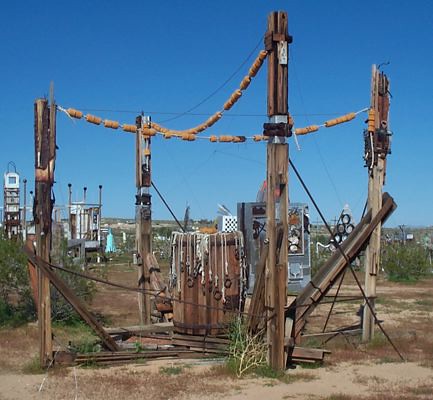
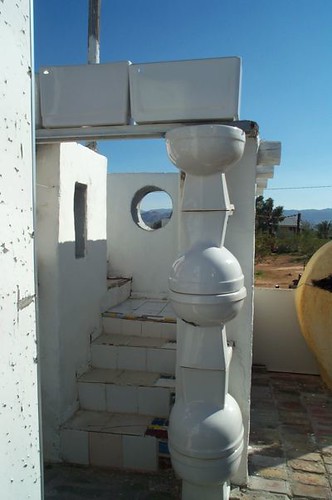
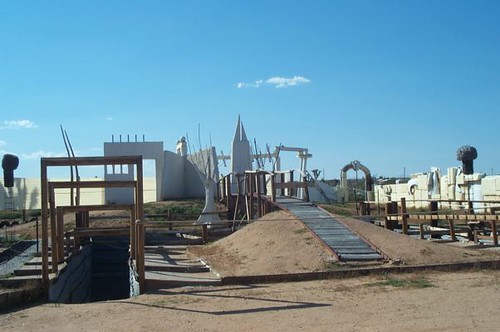
Purifoy enjoyed a considerable reputation as a sculptor, and was the founder of the Watts Towers Art Center, preserving Simon Rodia’s folk art treasure after the artist simply walked away one day forever, and the city of Los Angeles tried desperately to tear it down. It was simply too well built.
Play along! Don’t Contradict!
The facilitator had magic markered, Hard yet bearable.
Arpeggios as surf: my mother’s
Beaked hands pick back toward Chopin.
White keys froth against ebony pebbles.
Her baby grand’s the shape of a rock
You don’t often see. A glacier sheers off
A massive slab. Salt cuts it down to size.
My mother has a small bleed. One night
She freezes, thaws and nobody knows what
Synapses no longer fire. Once the water’s
Frilled lace at Rockaway skirted her ankles
Like Mozart. At 10 she could fill her hands
With sounds. Be private even when the shore
Teemed with good daughters like her
On trolley holidays. My mother practiced
Passages on sand. Her fingers made do
With a cardboard key chart on the kitchen
Table before they purchased week by week
A piano. Eighty summers from that sea
She leaves the brick home rarely willingly;
The glare hurts her laser-ed cataracts.
Let Venetian blinds divide the light in staves.
Baubles on the chandelier fill spaces in with
Half and whole notes scored across the walls.
She asks: When did your friend come to
Tune my piano? Were we over at Foodtown?
He did a lovely job. When I play now listen.
My mother places the beige receiver sideways
On the table’s plastic lace. I listen to the ghost
Twangs of unvoiced strings. Chopin tosses
The piano overboard. My mother floats away
On its polished lid. Five states from her capsized
Living room I catch my breath and dive. How far
She swims my coaxing arms can’t fathom.
We play along shirring the foam. Only the chaos
My mother’s joy provokes comes home.










 Alicia Bay Laurel
You must be logged in to post a comment.