Hello Japan!


The last time I played music with the Amana band was in 2002 in Hawaii. They’ve been inviting me to visit them in Okinawa ever since.

Whoopee. I am going to Japan for a month—to play music, talk about sustainable living, and lead a weekend workshop October 20-22 at a campground where we make magical objects from recycled materials per instructions in Living on the Earth, walk in the forest, do yoga, massage each other’s feet, cook outdoors and sing for each other at our campfire. All this as the guest of the Artist Power Bank, an environmental arts group, at whose Tokyo cafe and educational center Kurkku I will do my environmental awareness concert and talk at 7 PM on October 18th.

When I first get to Tokyo, I’ll perform jazz and blues from my 3rd CD, What Living’s All About, at the deadhead nightclub Yukotopia, founded by my friend Yuko Tsukamoto. That will be at 8:30 PM on October 8 and at 7:15 PM on October 9.

Toward the end of my stay, I’ll visit the three-woman trance band, Amana, in Okinawa, where I will play a mixed set (folk, Hawaiian, jazz, blues) on October 28 at the two-day Happy Flower Beach Party Festival. On October 29, I’ll attend Soul of Donto, a tribute festival that Sachiho Kojima, the leader of Amana, is putting on to honor her late husband, the rock star Donto, at which his songs are performed and the devoted fans in the audience sing along.

All of this was made possible by Koki Aso, the journalist who created a six-page photo and interview article about me that ran in the June 2005 issue of Be Pal, an environmental and outdoor living magazine in Japan. He wanted to see me have a Japan tour, so he contacted Artist Power Bank, which is buying my plane ticket.

In between the Artist Power Bank activities and the Okinawa trip, I get to visit him and his wife at their traditional Japanese farmhouse outside Kamakura, too, where he has a vegetable garden and makes his own miso. Goes fishing on weekends. He’s a real back-to-the-land kinda guy.

I am returning for the first time since 1974, when I toured as a guest of Soshisha, Ltd., my publisher, in support of the Japanese editions of Living on the Earth, Being of the Sun, and my three children’s books. I was astonished to discover large political demonstrations and honored to meet artists, writers and environmental activists.

I delighted in the beauty of even the most mundane things, drew lots of pictures, and ate everything served to me with pleasure. As a California native, I’d rarely seen buildings over 100 years old. In Japan I saw temples and statues over 1000 years old. Mercy! The gardens. The architecture. The crafts. The graphics and design. And what sweet people.

I can hardly wait.

Slow Down

Boy, can I relate to this page from Living on the Earth, even though I drew it 37 years ago. I’ve been nearly a week in bed with the flu. I am waiting for my vitality to return.

I just finished reading Mezz Mezzrow’s Really the Blues, the autobiography of an early 20th century jazz musician and social justice advocate from Chicago. I drink Throat Coat tea, consume various natural remedies and sleep. Nothing works better than applying heat. Viruses die when the body’s temperature raises, so I press a heating pad to my sinuses and upper chest. The pain retreats.

In my temporary quarters at my aunt’s house I am obliged to use dialup. What will slow you down better than that? One can meditate between page openings.

Stephen Gaskin, the author and philosopher from whose Monday Night Class in 1968 in San Francisco I picked up the quote above, lead the group that founded The Farm, arguably the largest, most financially successful, most charitable, most influential, and most long-lasting hippie commune in the world.

I’ve got months of fabulous travels ahead, so I am going to take my time resting to let my body really get over this.

Aloha ‘Oe to my beloved Hawai’i Volcanoes


Leaving beautiful Hilo, Hawai’i on a rainy morning, looking down upon her harbor and sea wall. Mauna Loa and Mauna Kea are obscured by clouds.


The summit of Mauna Kea, with Mauna Loa on the horizon.


Mount Hualalai, on the Kona coast, appears as we round the summit of Mauna Kea, Mauna Loa in the background.


Pearl Harbor from the air, just before we land in Honolulu to change planes. The coastlines of the islands vary by 1000 feet of elevation between ice ages; Pearl Harbor was once a river valley.


The Kalaupapa peninsula, a separate volcano from the rest of Moloka’i island, once famed as a leper colony, is at the bottom of the photo. Beyond Moloka’i (in the foreground) lie the West Maui Mountains and Haleakala volcano on Maui, and to the right of Maui, Lana’i island and beyond it, Kaho’olawe island. On the horizon are the peaks of Mauna Kea and Mauna Loa on the island of Hawaii.


The tallest sea cliffs in the world, on Moloka’i, are at the bottom of the photo. Above, the family of volcanic islands that comprise the eastern, most recently formed, end of the archipelago.

What are the oldest Hawaiian islands? Kure and Midway Islands, at the western end of the archipelago. And the newest? It’s called Loihi. Its summit is 2000 feet below the surface of the ocean, but it’s 18,000 feet high (and growing). It’s to the east and south of the Big Island, just where you would have expected it to be if you drew a curved line through the volcanoes of the Hawaiian Islands and predicted where the lava flume would come up next as the earth’s plates shift. When it erupts, clouds of steam and vog obscure the horizon for miles. Scientists visit it in submersibles.

Volcanoes in the Sea


Today the clouds lifted, offering a rare view of the summit of Mauna Loa from Hilo. Erosion makes mountains steep; Mauna Loa’s gradual slope to 13,000 feet above sea level shows it is still a young volcano, what geologists call a shield volcano. But Mauna Loa grew from a vent in the ocean floor twenty thousand feet below sea level, so it is really 33,000 feet tall, and, unsurprisingly, holds the world record as a mountain for sheer cubic feet of mass. Although neighboring Kilauea volcano has erupted almost constantly for decades, making it the world’s most active volcano, Mauna Loa’s summit has expanded over the past couple of years, arousing speculation it is due to blow some time soon. I saw fire fountains on Mauna Loa through a telescope from Hana, Maui in 1975.


Sunset and full moon light up Mauna Kea, the tallest volcano on Hawaii Island. At the summit stand a dozen astronomy facilities from as many countries. Hawaii’s pure air and isolation from the electrically illuminated continents make it the premier spot on the planet for star gazing. This could end soon; the already huge military facility in the saddle between Mauna Loa and Mauna Kea was expanded this year to include a training ground for using weapons and armored vehicles, both of which raise dust, which is anathema to telescopes. The trainings also destroy the fragile desert eco-system and ancient Hawaiian archeological sites in the saddle, disturb the people whose homes are in earshot, and possibly are contaminating the soil and the headwaters of Hawaii’s streams with radiation from depleted uranium in the weapons.


Mauna Loa and Mauna Kea from an airplane, the morning after a March 2002 snowstorm.


Haleakala, a 10,000 foot volcano on Maui, from the air the same day. The shoreline to the left is the Wailea resort area, the broad white beach directly below is Makena Beach. La Perouse Bay (with lava flows on both sides) is to the right, and beyond lies the desert coast of Kanaio and Kaupo.

In a Tropical Garden

Landscape plants in Hawaii. Some native, some alien. All beautiful.


Laua’e fern, a native plant with a distinctive fragrance similar to that of maile, the leafy vine used to make leis presented to honor people. Laua’e is widely used in floral arrangements and table decorations in Hawaii.


Red ti plant. Ti is also indigenous to Hawaii. Sacred to the healing god Lono, ti is still planted at the corners of many homes for protection. Ancient Hawaiians used the fiber to make rope and sandals, the leaves for transporting or cooking foods, the root to make an alcoholic beverage. Hula dancers still use the leaves to make skirts, and lei makers make leis of fresh ti leaf fiber.


Monstera deliciosa is an introduced species that produces a fruit shaped like a corn cob that ripens a few kernels at a time, making it inconvenient to pick and eat, but the ripe fruit is sweet and smells like pineapple.


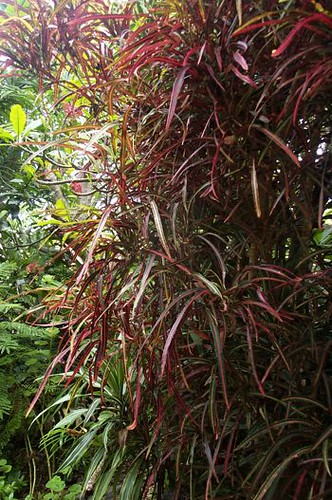
Crotons come in dozens of sizes, shapes and colors. One plant will sprout leaves a variety of color combinations.


Narrow-leafed crotons are great fun to use in tropical floral arrangements.


Hapu’u (tree fern) a native species, seen from above, growing amid ohia trees in the windward rainforest. The pink small-leafed plant is Hawaiian Snow, and the larger red and green leaves are ti.


Bamboo, a fastgrowing and therefore sustainable source of building and craft material as well as a wellspring of grace and privacy in the garden. Gardeners plant miniature bamboo to make stakes for vines.

Hula Queen


Meet my dear friend Norma Bell, septugenarian Italian hula queen from Brooklyn. Mind you, she’s lived in Hawaii since the early ‘sixties, and she’s got the aloha spirit. In this photo I’m playing guitar and she’s dancing a choreography she composed to my song Ukulele Hula, from my CD Living in Hawaii Style. We’re at her birthday party in 2004.


This is her hula halau (hula school), all senior women in her neighborhood in Keaau, Hawaii. The troup is called Pua Kea (white flowers). I love Hawaii. I hope I’m getting together once a week with my best girl friends to sway my hips to songs about nature when I’m in my seventies. Norma’s the last one on the right. What expression she has!

Some of My Favorite Flowers of Hawaii


Dinner plate sized yellow Hula Girl hibiscus


White hibiscus


Plumeria (aka frangipani), whose spicy fragrance makes it popular for leis.


A bromeliad in full bloom.


Bouganvillea


Datura, or angel trumpet


Lobster claw heliconia


Parakeet heliconia


Waterlily and lilypads


Red anthurium


Pale pink anthurium


Blue ginger


Chenille plant


Impatiens, practically a weed in the rainforest areas of Hawaii


Psitticorum, a smaller member of the heliconia family. This red and orange variety is often referred to as “parrot,” while the pale yellow and deep pink variety is called “peaches and cream.”


Purple tulip anthuriums, with their eliptical shape instead of a heart shape, stand next to a mysterious spiraling plant. I’d never seen one before I took this picture at Donna Keefer’s house in Pahoa.


Fragrant white ginger blooms beside the roadways of windward Hawaii in the summer, dazzling all with its bewitching frangrance.

Hawaii Tree Lore


Three flowering tropical trees: monkeypod, African tulip, and golden shower.


Beside a kukui tree, and young jacaranda tree with one burst of periwinkle flowers.


The silvery leaves and oil-rich nuts of the kukui tree. An indigenous tree, the kukui was considered sacred to the woodland and healing god Lono. The outline of the leaves resembles that of the head of a pig, one of Lono’s totem animals. Ancient Hawaiians used the nuts to make torches, and ground them as a sparingly used condiment (which, consumed in larger quantities, rapidly evacuates the bowels). Contemporary Hawaiians use them to make kukui nut oil soaps and massage oils.


A variety of imported palms at the gate to a private home. Many palm and cycad collectors live in Hawaii. Alas, when nurseries began importing palms from Puerto Rico, they inadvertently imported the tiny, loud-voiced coqui frog along with the palms, and, having no predators in Hawaii, the coqui is proliferating in the windward parts of the islands. The state and county officials have been so slow in responding to this particular infestation of alien species that it is now beyond control.


A rare Australian palm whose fruit is so poisonous that getting the juice on your skin can land you in the hospital for a week. Donna Keefer, who grew this hardy specimen, speculates that the tree must fight other organisms to survive in its native harsh climate, and it is over-armored for Hawaii.


A papaya tree loaded with fruit. Hawaii once exported Solo (yellow fleshed) and Strawberry (pink fleshed) papayas, but, because the ringspot virus was decimating much of the crop, chemical giant Monsanto and the University of Hawaii collaborated on creating two genetically modified strains, Rainbow and Sunrise. Today virtually all of the papayas in Hawaii have been contaminated with the GMO papaya pollen, since the field testing of these strains is open to the wind. This burdens organic farmers, since the standards to which they must conform exclude GMO species, and, worse, it emboldens Monsanto to sue those whose fields are thus contaminated for copyright infringement, since they consider the two GMO strains their intellectual property. Permaculture teachers say that ringspot virus wouldn’t proliferate in diversified agricultre; indeed most “pests” are the direct result of monoculture farming.

Uncovering an Ancient Village


The meadow below David and Wendy’s house site, with old Hawaiian rock walls and ti plants. On a clear day you can see the ocean, too.

“I’ve long held a vision of creating a place where people could come and learn where they are, about the ‘aina, about Hawaii,” Wendy Vance told me, regarding the off-the-grid homestead she and husband David Vance have been creating over the past six years in the remote and magical wilds of the Ka’u District, near the southernmost point of Hawaii Island.

Wendy’s deep into the ‘aina, both as an environmental activist from ‘way back, and as a practitioner of Hawaiian traditional culture, including chanting, drumming and dance, which she studied for many years with a respected Hawaiian kumu hula (teacher of dance).


Ohia trees surrounded by other Hawaiian native plants, including ti, mamaki, and fern.

When they bought the seven acres across the highway from the rented home where they lived outside Waiohinu, it was covered in Christmasberry bramble. Anyone else would have hired a bulldozer. Over a period of years, David painstakingly cleared the Christmasberry by hand, and underneath it, discovered the rock walls and house foundations of a Hawaiian village. As they cleared the land, Wendy and David planted Hawaiian native plants that had once been replaced by more aggressive alien species. In some areas, once they cleared the Christmasberry, the native plants simply reappeared and flourished.


The ruins of an ancient wall beside a wood pile and a very old tree.

As they continued to uncover and preserve the ancient village, to their astonished delight, the land adjacent on the ocean side of the land was cleared of Christmasberry for a twenty year cattle operation, and miraculously, the bulldozer driver left standing all of the native ohia trees on it. It was as if the peaceful force of their creativity and respect for Hawaii had rolled out beyond the boundaries of their land.

Hello Holualoa

Near the Blums’ house is a nearly 45 degree angle half mile road up to the Kona coffee capital of Holualoa. I walked it daily during my weeklong visit; a butt-restructuring walk, with bone-building and aerobic benefits galore. As I walked back down the hill, I feasted my eyes on huge views of the ocean and Kailua-Kona town in the distance, and the tropical plants growing abundantly along the road.

On my last walk for this sojourn, I brought along my camera, so you could see them, too.


Up the hill. Panting, but not stopping. Dense clouds but no rain.


Kona coffee plantations along the way.


Coffee cherries ripening on the trees.


Almost to the top of the hill.


Coming down again. The horizon is blurred from vog, Hawaii island’s own natural smog, from the world’s most active volcano, Kilauea.


Looking down from the mountain. The white spot on the ocean is a huge cruise ship near Kailua-Kona’s harbor. Some of the town is visible, too. The dark spot is a small plane.