Why I Blog

Why I Blog

I like to write, take and edit photographs and post stuff online.
Anything done daily gets done better and better.
I like the spontaneity of blogging. I do it when I like, about whatever I like.
My voice, not often available in corporate media, is available online.
I want to help raise political awareness; it’s going to take a lot of us participating vigorously to save democracy in the USA.
I want to recognize publicly the works and celebrations people are creating to promote sustainability, peace and social justice.
I’d like more people to know about my artist friends and their works.
I’m hoping to contribute to the physical health of my readers with recipes and health-related information.
I love the way my blogposts are finding their way around the ‘net.
I’m amazed at how many people are visiting my website. Today (March 28) the counter says nearly 28,000 readers have visited since the new site went up on January 15.

Living in the Art

How much fun are you having with your house?

Stephanie Farago’s legendary artist house in West Hollywood has vanished (she sold it and moved to the tropics), but I was lucky enough to visit while she was still living in the midst of her ongoing creation. She painted the elaborate wall decor herself, collected the abstruse and mysterious furnishings during her travels, upholstered some of the furniture, and arranged everything like a set designer. Stephanie paints wonderful oil paintings, created two coffee table books, one on collecting pre-World War II boudoir dolls, and an upcoming book on the life and work of artist Steven Arnold, and once made a video of Carnivale in Venice.

Here is a mini-tour of Stephanie’s creation:

Stephanie Farago in the Bali-Tibet room:

The Rudolph Valentino room:

The Carmen Miranda breakfast nook:

The Chinese salon:

A side room of the Chinese salon:

Stephanie’s livable art was her creative mind projected in 3-D. I wonder what her new place is like?

Cure for the Blues

I learned this recipe from Yolanda Parker, a Guatemalan herbalist.

Bring four cups of pure water to a boil. Remove from heat and add a dozen orange tree leaves (with blossoms if available) and three long leaves of lemon grass. Steep until the tea is cool enough to drink. This tea is specific for depression, but is useful for ordinary stress as well.

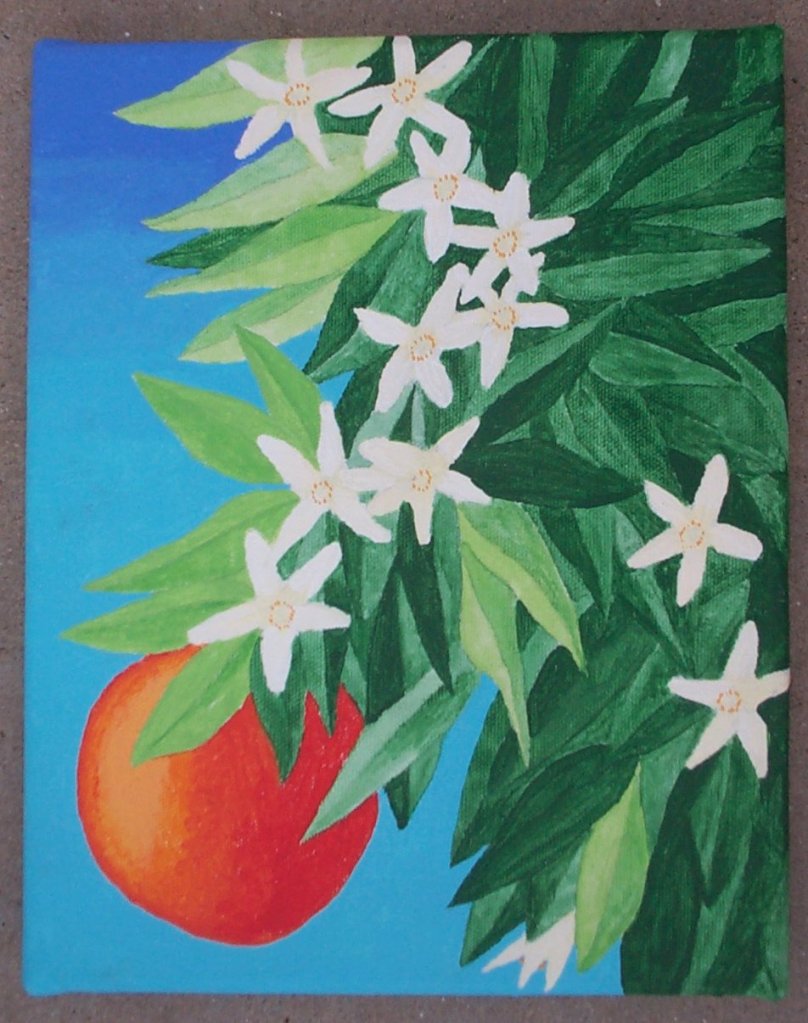
I painted these orange blossoms and leaves in 2005, in Phoenix, Arizona.

Altar Party

January 8, 2005, Phoenix, Arizona. Six of us women artists gathered to craft visionary altars at Tracy Dove’s house. Tracy Dove and Kathy Cano-Murillo provided boxes of printed images, old greeting cards, glitter, beads, glass jewels, tile, scrabble letters, miscellaneous small objects and glue. One of Tracy’s friends brought over a stack of cigar boxes to decorate. Shari Elf and I drove in from California for the festivities.

My altar is about a transformation into high gear art manifestation. Summer 2005 I spontaneously began making my blues/jazz CD What Living’s All About, my most exciting project to date.

Shari Elf made a mosaic of a man’s face with scrabble letters saying Nice Man. Last summer she met and began dating her favorite man so far.

Kathy Cano-Murillo’s altar says “Frisky Love” and contains images from Mexican pornographic comic books (“you get them at the carneceria, but you have to ask the butcher” she told us.) No report on the enlivening of her love life, but Tracy says Kathy has been inundated with book and TV deals lately, and looking especially beautiful. She’s been happily married for many years.

Tracy’s choice of image was a mermaid, and her year has been an intense voyage into the oceanic realm of the subconscious, totally transforming her life in ways she never dreamed possible. (That’s one of her paintings behind her.)

Tracy’s niece April’s beautiful altar features a three dimensional snake. Her life, in the past year, has taken many twists and turns through subterranean spaces.

Other visonary art parties I’ve attended: making crowns or tiaras, creating “treasure maps” (flat montages of visionary images), and decorating masks or blown eggs with paint and decoupage. I’ve saved most of what I’ve made at these events; they feel powerful to me.

Why I Walk

No fees, uniforms or equipment required.
Any time of day, and almost any location is suitable.
It can be done alone or in any size group.
One can walk to portable music or the local soundscape.
It lends itself to observing nature, people, and architecture.
It can be part of making a living or protesting injustice.
One can walk and focus on breathing at the same time.
Walking is a great time to stretch and align one’s body.
The rhythmic crosscrawl movement soothes the nerves.
Saves on gasoline.
Walking alone inspires creativity.
Fine time for a cell phone call, too.
I’ve even attended 12 step meetings by cell phone while walking.
To think outside the box, I get out of the house.
Doesn’t jar my joints or my breasts like jogging does.
Happy muscles, happy lungs, happy heart.

Me, walking on the beach in 2016.

Brown Rice Mochi Waffles

Brown rice mochi waffles are not eggy and tender like batter waffles. Their texture is somewhere between Rice Krispies and bubble gum. They are firm enough to be finger food; definitely they are challenging to cut with the side of a fork. Brown rice mochi waffles are simply more entertaining than the popover form in which brown rice mochi usually arrives at the table.

I learned to prepare this dish at the Grainaissance Mochi and Amazake factory in Berkeley back in the early ‘eighties. I had met the Grainaissance folks at the Natural Foods and Products Expo in Anaheim, where I had gone to market my raw sprouted vegan ice cream recipe. I met Gypsy Boots there. His cookbook Bare Feet and Good Things to Eat is the first ever in my memory to mention eating sprouts.

Thaw any flavor of Grainaissance Mochi (Raisin-Cinnamon is a good choice.) One package of mochi makes two large waffles. Cut the mochi into 1/2 inch cubes. Heat up a waffle iron and spray with coconut oil. Place enough cubes for one waffle on the hot waffle iron, covering it evenly. It’s better to underfill than overfill, because if the mochi runs into the outer channels where there is no heat, it won’t cook. The heat will melt the mochi so that it runs together and it puffs up, and eventually it gets crisp on the outside. Open the waffle iron and remove the waffle onto a plate with a fork. Serve immediately with banana jam (see below). Or if you use a savory flavor of mochi, (say, Sesame-Garlic) serve under a curry or other bite-sized, sauce-slathered entree.

Banana jam: Whenever you have bananas going brown in your kitchen, peel them and put them into a plastic bag in the freezer. When you want banana jam for one person, place one frozen banana in a small frying pan and heat gently while mashing with a fork until it is soft and smooth. Season it with a pinch of cinnamon, and mix well. Variation: add a frozen strawberry to the frozen banana, and then mash them together while heating, but don’t add cinnamon.

Mind you, my friends in Japan consider the idea of brown rice mochi, and/or mochi with flavors like cinnamon or garlic, sheer blasphemy.  They are purists about their traditional (white rice) mochi, which they often cook over a hibachi (charcoal grill).  I have to agree – it is delicious!

Marching for Peace and Justice

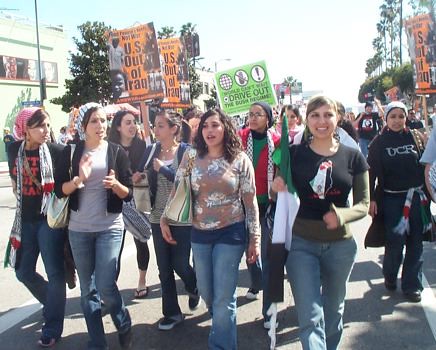
Today I joined tens of thousands of other Los Angeles residents marching in protest of the US invasion of Iraq and against the numerous incursions against the planet and her children by bloodthirsty corporate greedheads.

The march and rally, organized by International ANSWER, began at noon at the corner of Hollywood Boulevard and Vine Street. The police were present, but not intrusive. I saw marchers of all ages and genders, and of varied viewpoints, but united in serious intent.

Of the speakers at the rally following the march in front of Grauman’s Chinese Theatre, Representative Maxine Waters drew the greatest applause when she said, “A member of the press just asked me if I had really said that the president had lied. I am saying it again so that everyone can hear. The president of the United States, George W. Bush, has lied to us. He should be impeached.”

One group wrapped US flags over a dozen coffin-shaped cardboard boxes to create a flotilla of perished military, and carried them the length of the march.

Signs I hadn’t seen before:
Dear US Taxpayers, thanks for all the money. Sorry about your children. Love, Halliburton.
The only Bush I trust is my own.
Jail to the chief.
(Photo of a hand flipping the bird) Wiretap this!
Support Our Troops—Drive a Hybrid
Mission Failed
South Central Farmers—Feeding Families (a community gardening and food distribution project in the poorest section of Los Angeles endangered by a real estate development project)
Rich Man’s War, Poor Man’s Fight
Fire the Liar
Money for Education, not for Occupation
What Noble Cause?

Back from the 1960’s, and carried by women not even born then, was the sign with the daisy and handlettering that says “War is not healthy for children and other living things.”

Monocrops for Sustainability

The vast, unecologically monocropped fields of the midwest USA are filling with genetically modified grains and soybeans that enrich Monsanto (now Bayer) at the expense of the health of people and animals who eat these harvests. Small scale diversified agriculture that refreshes soil, plant and animal bio-diversity (permaculture) creates a greater yield in less space. However, there are some large scale crops that are environmentally enthralling.

Oil-bearing crops including hemp, soy, sunflower, peanuts and canola provide a sustainable alternative to petroleum. The earliest diesel engine, displayed at the World’s Fair in St. Louis in 1900, ran on peanut oil. Today’s biodiesel is often made from spent frying oil from restaurants, giving it the environmental beauty of recycling, the political beauty of being readily available without import, the aesthetic beauty of smelling like popcorn, and the sustainable beauty of being significantly less polluting and greenhouse gas-producing than petroleum.

My friend Ano Tarletz runs his farm truck on homemade bio-diesel. He says it takes one restaurant to support one truck. Since the restaurant pays Ano to take away their spent frying oil, his diesel fuel costs him “minus twenty cents per gallon.” Artist Shari Elf does not make her own bio-diesel—a neighbor who does delivers a 55 gallon drum to her house, from which she gasses up her new diesel Volkswagen Jetta. She pays $3.50 per gallon for it, but says it’s worth it.

Another large scale crop that makes my heart sing is kenaf, a relative of cotton and okra, grown as a tree-free paper, fabric and industrial fiber. It grows up to eighteen feet in five months, uses no harmful chemicals in processing, and is fully recyclable. Kenaf paper saves forests. We need to support this industry! I look for kenaf products when I buy cards and stationery.

Food Grade Plastic

Which plastics pose health hazards as containers for food or drink?

This information is from the Green Guide:

Look on the bottom of the plastic container for the recycling logo (a triangle of three arrows) with a number inside it. Sometimes, on very small containers, the number appears without a logo.

The plastics that pose no known health hazards:

1. Polyethylene Terephthalate (PET or PETE)

2. High Density Polyethylene (HDPE)

4. Low Density Polyethylene (LDPE)

5. Polypropylene (PP)

Plastics with potential health hazards:

3. Polyvinyl Chloride (PVC or vinyl)
Some research has shown that the phthalates in PVC food wraps and vinyl flooring are endocrine disruptors linked to various health problems. Water and vegetable oils sometimes are bottled in PVC, and many toys and baby teethers contain PVC.

6. Polystyrene (PS or Styrofoam)
Styrene is a possible carcinogen and endocrine disruptor. Avoid consuming hot liquids, fatty foods or alcoholic drinks from styrofoam containers, as these leach out styrene. Some opaque plastic cutlery is PS as well.

7. Other resins, including polycarbonate (PC):
Bisphenol-A (BPA), a main building block for PC products, is an endocrine disruptor. Most clear baby bottles and five gallon water bottles, as well as Lexan (Nalgene) water bottles and plastic-lined food cans, are made of PC.

Weirdo Smoothie Bowl with Spirulina

What I eat for breakfast most days creates controversy wherever I go.

Many people think it looks awful (and say so), and among the few who have tasted it, some didn’t like it at all. Nonetheless, it’s what I’ve craved when it’s time for my first meal of the day, since about 1990, and I find it energizing, nourishing and slimming. I also noticed that my facial skin began looking smoother soon after I started eating spirulina regularly. So, on the off-chance that you, too, are a weirdo that likes spirulina smoothie bowls, here’s my recipe:

I like to prepare a large quantity of the powder ahead of time, and then use a 1/4 cup scoopful each morning. If you can’t find beet powder or stevia powder in your local natural foods store, they are easy to find online.

2 pounds protein powder (your choice of source)
8 ounces Hawaiian spirulina (for carotene, GLA, and a host of other nutrients)
8 ounces beet root powder (for iron, and to aesthetically counteract the green of the spirulina)
8 ounces roasted carob powder (to flavor it and further add to the illusion of chocolate-ness instead of algae-ness)
8 ounces stevia leaf powder (to sweeten it without carbs)
8 ounces lecithin granules (a brain food that makes the smoothie creamy)

Sift the first five ingredients through a sieve into a large bowl or pot, so there won’t be hard lumps in the smoothie. Beet root powder is particularly prone to this. Just keep stirring the powder and lumps around in the sieve with a wooden spoon, and after a while it will all go through. Last add the lecithin unsifted, as it will only gum up your sieve.

Stir the stuff until it is all the same light cocoa powder color. Lift the powder from the bottom of the bowl as you stir.

Store it in an airtight glass or food grade plastic container. When I am traveling, it’s usually in a Ziploc gallon freezer zipper bag, inside another plastic bag. It’s handy to have a low carb breakfast with me on the road.

My actual breakfast starts with a serving of fresh fruit, then the smoothie powder mixed with enough pure water to give it the texture and look of chocolate pudding. Sometimes I mix it with yogurt (I like vegan yogurt, of course) so that I get the health benefits of the lactobacillis. The baroque versions include a dash of vanilla extract, and unsweetened vegan milk instead of yogurt or water. You can blend it in a blender, but it mixes up easily with just a bowl and spoon (with which you’ll eat it, anyway, saving you the hassle of washing a blender afterwards.)