Karen Aqua


A cell from Karen Aqua’s Nine Lives

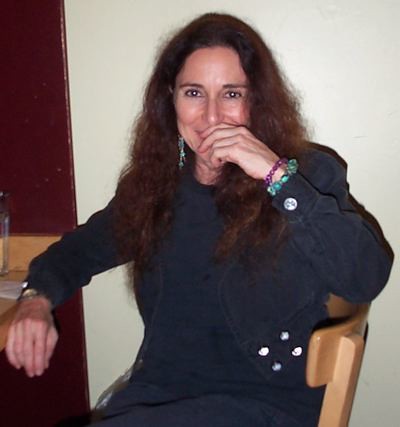
Our fourth Living on the Earth Award nominee is animation artist Karen Aqua.

The first time I met Karen, she was presenting a screening of her films up to that time, in January 1994 at Kalani Honua Oceanside Retreat. The films, none longer than ten minutes, totalled about an hour of viewing, and over a decade of work. She was just about to begin what turned out ot be a long and successful work relationship with Sesame Street, for which she created many animated sections.

Karen shared that the stack of drawings needed for a ten minute animated film would fill a medium sized closet, stacked floor to ceiling. She explained that her work time is chiefly paid by grants, some to do animation and some to teach. She travels widely as artist in residence, but she works mostly in her studio in Cambridge, Massachusetts.


Karen’s well-loved and well-used animation stand

Eleven years later, I visited Karen and saw her studio, with its animation stand and many framed animation cells on the wall. I asked a lot of questions.

Karen explained to me that the sound track for an animated film is created first, because it is much simpler to draw in synch with the music and/or script than it is to record the sound track to follow the drawings. She likes scripts to move along quickly, so that the animator doesn’t have to create extra seconds worth of art. How much art?

If the animation is of the highest, densest quality (say, a Disney cartoon), that’s 24 frames per second. But low tech animation is in vogue right now, particularly in television advertising, and that’s twelve frames per second.

If you want the drawings to flicker, you make three similar but different drawings and alternate them. Each drawing is based on the last one; the animation stand contains a light box so that the drawing underneath the one being drawn acts as a guide. The paper is prepunched with holes that match upright rods on the stand, so that each animation cell is perfectly aligned. The cells are digitized by scanning or photographing with a digital camera on a stand. Karen prefers the camera. So, even though the artwork is created by hand, the animation itself is put together in a computer program, rather than with film, as it was in decades past.

Ken Field and Karen Aqua 

Karen’s long and happy marriage to jazz saxophonist Ken Field has included a number of wonderful collaborations, including the film Ground Zero/Sacred Ground, a protest against the use of nuclear weapons danced for us by petroglyphs from an ancient Native American rock site.

Find Intentional Communities?


Caper charts, hand-painted prayer flags, and notice of a sweat lodge (inipi) on the chalk board behind the kitchen at Lost Valley Educational Center

Subject: Re: Intentional communities

True enuf and I am trying my bejesus best to move into one of em..
Any one have a lead, suggestions, or otherwise help?
I have rent monthly income covered; I am not destitute
just clueless…
serious here.
love and thanks,
priscilla*****

Dear Priscilla and everybody,

Have you looked at the Fellowship for Intentional Communities website? They have a huge database of intentional communities all over the USA and in other parts of the world. They publish a guidebook every few years and they have a magazine that has “members wanted” ads in the back. Rural and urban communities, religious, art-centered, permaculture, all kinds. Check it out.

Blessings,

Alicia

Tropical Trifle

Serves four. Using a double boiler, pour at least 3 cups of water into the lower pot. In the upper pot blend 1/3 cup tapioca pearls (the larger the pearls, the longer they take to cook), and one can of coconut milk, with enough pure water added to it to make a total of 2 cups of liquid. Bring the water in the lower pot to a boil, and then turn down the heat so it continues to simmer (boil gently). Stir the contents of the upper pot every couple of minutes. When the tapioca pearls are all translucent, the pudding is cooked. Add 15 drops of liquid stevia glycerite and stir well. Let the pudding cool a bit while you prepare the fruit.

Peel and cut into bite-sized pieces: mango, pineapple, papaya, banana. Place a few of each variety in 4 bowls, pour the hot coconut tapioca over them, and serve.

This recipe is a variation on one I read in Vegetarian Nights: Fresh From Hawaii by Bonnie Mandoe. The chief difference is that I sweeten the coconut tapioca pudding with stevia extract.

Where Else to Find Me on the Web

Where else to find me on the web:

http://en.wikipedia.org/wiki/Alicia_Bay_Laurel (a stub of a bio, so far)

https://soundcloud.com/alicia-bay-laurel Listen to some of my music, free.

https://www.allmusic.com/artist/alicia-bay-laurel-mn0000743517 (Allmusic.com critic Stanton Swihart’s music bio of me, plus links to his reviews of my first two albums)

http://www.diggers.org/homefree/hfh_12.html (my early days at Wheeler Ranch, as told by Bill Wheeler)

https://www.worldcat.org/search?q=Alicia+Bay+Laurel  A search for my name in the World Library Catalog

https://archive.org/details/AliciaBayLaurelAmericatheBlues Free download of my protest song, “America the Blues”

More About Community Supported Agriculture


Creek garden at Lost Valley Educational Center, Dexter, Oregon

Revolutions come in odd packages. Tonight I read an article on Truthout.org about the missionary zeal of a farmer who raises animals as food for sale in a community supported agriculture system in Virginia. His clients don’t sound at all bohemian, but they speak earnestly of making a difference by buying their food from a local farmer who uses sustainable farming methods rather than buying from multi-national corporations, particularly Wal-Mart. The farmer sees his CSA as part of an international movement to take back the production of food from big industrial agriculture.

Considering massive moves on the part of chemical giant Monsanto to control agriculture worldwide, this is good news indeed. I recommend a film The Future of Food, by Deborah Koons Garcia, and a book, Seeds of Deception, by Jeffrey M. Smith, for well-presented information on the genetic engineering of crops.

CSA farms are often easy to find if you live in a rural community. During my years on Maui I subscribed to two of them. In cities, small farms offering subscriptions may be hours away, and farmers’ markets are the next best thing. The farmers pride themselves in offering produce grown from heirloom seeds, foods unlikely to be found in chain supermarkets, even Whole Foods.

For my first posting on CSA, click here.


Heirloom tomatoes at a farmers’ market in Cambridge, Massachusetts

From Beyond the Grave

Sunday, October 2, 2005, Jamaica Plains, Massachusetts, I take a walk with animation artist Karen Aqua and jazz vocalist/media maven Ruthie Ristich through the eerie beauty of Forest Hills Cemetery. More than just a place to entomb the deceased, Forest Hills functions as a picnic, walking and bike riding wonderland, arboretum, performance venue for music and poetry in particular (since such luminaries as e. e. cummings and Anne Sexton are buried there), indoor art gallery, and outdoor museum for both 19th century and modern sculpture. The Forest Hills Trust commissions artists to create works that blend into the elegant and mysterious atmosphere of the 250 acre landscape that was originally designed in 1848 as Boston’s first public park.

Mitch Ryerson’s sculptures in particular draw us. On the Sunday we are walking, world musician Ricardo Frota brings a huge collection of percussion instruments for children and adults to play along with Ryerson’s permanently installed “marimba benches,” a set of wooden xylophones so strong one can sit on them.

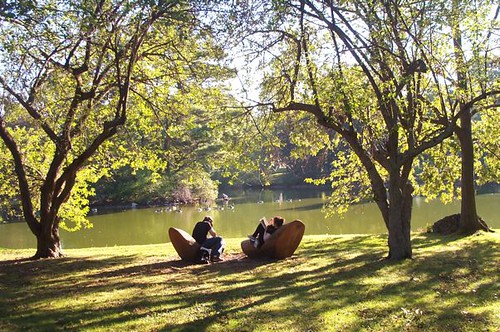
A couple sits in Ryerson’s “poetry chairs” and admires the geese paddling upon Lake Hibiscus.

Ruthie gathers inspiration from within Ryerson’s poetry shrine.

Children play in a hundred-year-old weeping beech tree.

A sunlit winged goddess in a sacred grove.

Ghostly garments sewn of metal screening adorn a grove of trees.

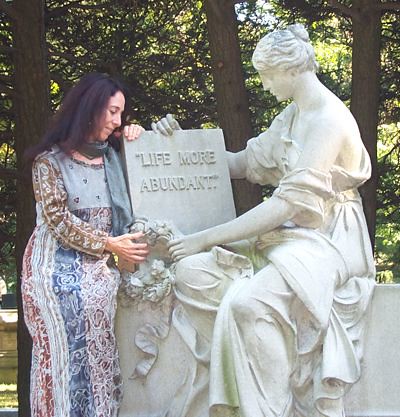
I commune with a friend from the Other Side.

Ken Field

Ken Field, raises the spirits of the dead and the living through the magic of his saxophone and flute.

I first met Ken in January 1994 when I was visiting Kalani Honua Oceanside Retreat as they were hosting avant garde ensemble Birdsongs of the Mesozoic as artists in residence. Ken brings a jazz sensibility to the group, which includes rock guitarist Michael Bierylo, classical pianist Erik Lindgren, and pop keyboardist Rick Scott. The four composers divided a trap drum set amonst them, and all four played percussion in addition to their melodic instruments. I worked as ticket taker for the standing ovation/standing room only performance, and, mind you, Kalani Honua is fifteen miles from the nearest small town.

I stayed in touch with Ken and his animation artist wife and sometime collaborator Karen Aqua (to be the subject of an upcoming blog!) from then on, and, in August 2000, visited them while I was in Boston to do a show and sign books at the local Barnes and Noble. On that trip, I got to experience Ken’s improvisational funk band Board of Education at the Middle East Cafe in Cambridge. The rhythm section would start a groove, the melodic instrumentalists would take turns soloing over it, and everyone else would dance. Everyone! No actual songs, and no two shows alike, ever. Fresh!

When I visited them next, in September 2005, Ken had just returned from the Edinburgh Fringe Festival, where he had been playing an original composition, “Under the Skin,” for Bridgman/Packer Dance, a dance ensemble from New York.  Last night, April 22, 2006, Ken and the dance group repeated the performance in Cambridge, Massachusetts.  “Under the Skin” will be released on Innova Recordings later this year.

Ken hosts The New Edge, a two-hour weekly radio program broadcasting and webcasting Tuesday afternoons from 2-4pm Boston time on WMBR, 88.1FM in Cambridge. The show features innovative and creative mostly instrumental music at the boundaries of classical, jazz, and world styles.

Ken’s latest project, a 21st century New Orleans style brass band, The Revolutionary Snake Ensemble, has marched and played in the New Orleans Mardi Gras, and made a fantastic CD, Year of the Snake, guaranteed to get your party off the couch. They will have a new CD out by the end of 2006.

Sorbet

Loa Tsukamoto, age 10, and her brother Kea, age 6, prepare banana, pineapple and strawberry sorbet at my birthday party in Hawaii in May 2003

A really good fruit ice cream is sweet, creamy, slightly acid, and pleasing to the eye. With nothing more than three kinds of frozen fruit and a Champion Juicer, one can produce the best frozen fruit dessert I’ve ever tasted.

Bananas give the creamy mouth feel and some of the sweetness. Pineapple provides the acidity, as well as a more intense sweetness. Strawberries give the sorbet a pleasant soft pink color. All three fruits contribute their unique aromas, which blend harmoniously.

As bananas fully ripen and begin to turn brown, peel them and store them whole in a plastic freezer bag in the freezer.

To prepare a ripe (but not over ripe) pineapple, turn the green crown counter clockwise to remove it from the fruit (this is the part that is planted to make a new pineapple plant). Cut the top and bottom from the pineapple with a large sharp knife, sit the pineapple on a flat end, and then cut off the skin, cutting downward in sections, leaving a generous margin so that you don’t have the tough brown indentations in the part you will freeze. Cut the peeled pineapple into long spears, including the tough core, small enough in width to fit through the feeder of the Champion Juicer. I use a wooden bowl instead of a wooden cutting board for this operation because of the juice produced by cutting the pineapple. Store the spears in the freezer in a plastic freezer bag. Drink the fresh pineapple juice!

Strawberries need only be rinsed and the green tops removed before placing in the freezer bags. They are commonly available already frozen in most large grocery stores and some natural food stores. Because stawberries cannot be peeled and are very absorbent, I strongly suggest avoiding strawberries that have been grown with chemical fertilizers, herbicides and insecticides.

To use the Champion Juicer to produce sorbet, assemble the grinding unit with the solid plate below the grinder instead of the screen (which is what you would use instead if you were making a juice). Chill the grinding unit in the freezer for 10 minutes before mounting on the motor unit, so the sorbet comes out cold.

Place a large bowl below the end of the grinding unit. Turn on the power and push the frozen fruit into the grinder. If the pineapple spears have frozen solid together, you can separate them by placing them inside a bag and splitting them apart with a hammer.

Blend the three sorbets together with a spoon. If you completely homogenize them, you’ll get a lovely pink sorbet, and, if not, you’ll get a beautifully swirled yellow and pink sorbet.

Practice

“Genius is focus,” a precept I first heard from the Abraham Tapes, helps me understand the accomplishments of people I admire. They practice daily. The effect of any one day’s practice may be practically negligible, but the effect of a year’s daily practice will be profound.

Daily practice creates a space in which new ideas can birth.

Sometimes, when I don’t practice a skill for a while, I forget that I have it. I take great comfort in remembering that I actually do, once I get back to practicing again.

Each day I aim to sing a forty-five minute set of vocal warmups. I copied the vocal warmup CD into my computer so I can scan my email while practicing, and I have another copy in my car, so I can sing them while driving, probably a droll vision when I am stopped at a traffic light.

On a good day, I also play an hour of guitar, walk an hour, make visual art and/or write, and work at my business as artist/entrepreneur.

I absolutely love those moments when I notice the effects of repetition piling up. Today was one of those days. After nine months of working steadily at producing my jazz and blues CD, What Living’s All About, I am ready to send it off to press!

Amana

In January 2001, singer/songwriter/bassist Sachiho Kudomi was vacationing on the Big Island of Hawaii with her rock star husband, Donto, and their two young sons. While they were watching a performance of a hula dedicated to the goddess Pele at Hawaii Volcanoes National Park, Donto suddenly fell over, and was rushed by ambulence to the Hilo Medical Center. The next day he was pronounced dead from a brain anurism at 38 years of age. Sachiho decided that Pele wanted to keep him as her own.

Sachiho returned to Hawaii Island a year later for a memorial service at the largest Buddhist temple in Hilo. Several dozen of Donto’s fans flew over from Japan for the service, which featured a musical performance by Sachiho’s all woman trance music band, Amana.

In between the times I recorded Music from Living on the Earth (January 2000) and Living in Hawaii Style (spring 2001) at Sea-West Studios in Pahoa, Hawaii, Sachiho recorded the CD “Rainbow Island” there with world beat band Umi No Sachi, and noticed owner/engineer Rick Keefer’s copy of Music from Living on the Earth.  She immediately recognized the cover of Living on the Earth. “Oh!” she exclaimed, “Very famous book!” Rick put us in touch by email, and the next thing I knew, I was organizing a Hawaii Island concert tour for Amana to follow the memorial service for Donto in Hilo. I had worked hard on the publicity, and we had large, enthusiastic crowds at every show.

Hiromi, the percussionist, also invited Toshi and Masaha, the members of her other band, Dinkadunk, to play between Amana’s sets. Hiromi learned to drum in Africa (and her daughter Tapiwa is half Zimbabwean).

Yoko Nema sings and plays instruments from India, where she goes often to study Indian music and buy merchandise for Tata Bazaar, her gift store in Naha, Okinawa.

About a dozen of Donto’s fans followed us from venue to venue, attending every concert. A couple of them brought their copies of Living on the Earth (Japanese edition) for me to sign. One night I performed one of my autobiographical story shows, and Toshi, whose interpreting skills are excellent, translated my entire show into Japanese for Donto’s fans as I was telling it.

The three band members all brought along their beautiful, happy, elementary school age children, who never squabbled, screamed, made demands, complained they were bored, or refused to eat what they were served. For an entire week I observed these amazing children, harmoniously playing together or quietly playing alone, utterly unlike almost every single child I’d ever met in the USA.

The band and their families stayed in a big rental home near the oceanfront volcanic warm ponds in lower Puna. When we traveled to the other side of the island, we camped out with friends of mine who have a botanical garden in Captain Cook. We had as much fun as friends can have together in a week’s time, making music together, laughing, sharing stories and meals.

I am looking forward to traveling with Sachiho and her band again in Japan some day!  (Note from 20 years later: I did twelve concert tours in Japan, from 2006 to 2019, and almost all of them included collaborations and family reunions with Sachiho, Hiromi and Yoko.)