At the invitation of my friend Satomi Yanagisawa, I am visiting her and her adorable three-year-old daughter Sola, and performing at a local festival sponsored by the Mori Café near Kobuchizawa, Yamanashi Prefecture, that is, in the Japan Alps.
Here’s the festival poster!
Satomi and I (and our friend Akiko) catch a rare glimpse of a cloudless Mount Fuji from the car window on a bridge on our drive to the festival from Satomi’s home in Miyota Village, Nagano Prefecture.
“Mori” means “forest” in Japanese, and this café sits in the middle of a forest, which is viewed on all three sides of its geodesic glass tetrahedron dining room.
Prayer flags made of t-shirts adorn the entrance path to the food court of the festival.
My friends Tabou and Hiro-san are doing the sound engineering for the concert.
Tabou also performs a two-part harmony and guitar set with his wife Kyoko, including my favorite of their repertoire, “Our House” by Graham Nash, translated into Japanese. This is a totally appropriate song for them, as they are living happily in an exquisite house in the woods, designed and hand built by Tabou. I performed a concert at their house in spring 2008.
Warm and gracious singer/songwriter Yoshie, blessed with a gorgeous, resonant voice, and whom I first met at Mother’s Day celebration at a Zen Temple in Ako City in 2007, sang a wonderful set as well.
I bought a rainbow hemp bracelet from a sweet hippie lady whose booth was next to the one where Satomi and I sold my CDs and books.
I played last on the program. I sang and played songs from my last two CDs. I am wearing culottes presented to me by Little Eagle, Japan’s leading organic fiber folk wear fashion company, and a short antique kimono that was a gift from Satomi. And, of course, the rainbow hemp bracelet, plus Ugg boots and a lavender rayon scarf, in deference to the crisp mountain air.
September 20, Mori Cafe Festival in Hokuto City, Yamanashi Prefecture.
September 24, Teach class at Fujino Steiner School. Make art books with 12th grade English class. Private.
September 27, 4 PM Concert at Shu Cafe in Fujino.
September 29, Dual interview with novelist Banana Yoshimoto. It will appear in the November issue of Switch Magazine.
September 30, Art Show Opening Party and Concert at Roppongi Hills Club. 5000 JPY admission. For reservations, please contact Kurkku staff at 03-5414-6273
October 2, 6 to 8 PM Art Show Opening Party and Concert at Gallery Speak For in Daikanyama, Tokyo. Admission is free, but you need an invitation. Please email me if you’d like to be on my guest list.
October 2 to 14, Art Show at Gallery Speak For. Framed original drawings from Living on the Earth, plus the artwork from the new CD Beyond Living.
October 6, Interview with Soto Koto Magazine at Under The Light Yoga Studio in Yoyogi, Tokyo
October 11, Concert at Teisha Garden in Komoro City, near Komoro Station, Nagano Prefecture.
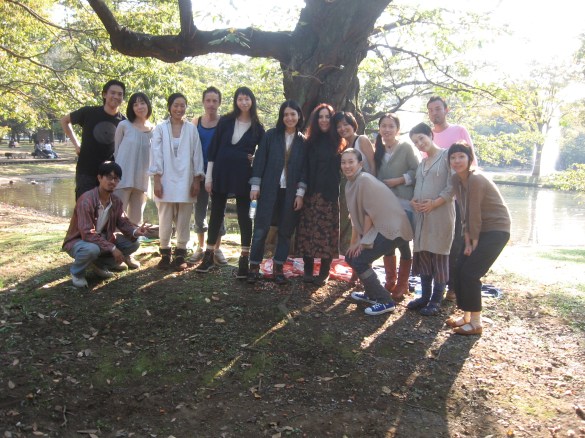
October 12, Interview with Murmur Magazine in Haragyuku, Tokyo, including a fashion modeling session in Yoyogi Park. Here is a group shot with all of the models and photographers near the lake.
October 16, 6:30 to 9 PM, Concert and talk session with special guest, actress and environmental activist Ikue Masudo (aka Saya Takagi) at her restaurant and performance venue, FU-RYU, by the beach in Minami-Bousou City. 1800 yen (free for kids under 12).
October 18, Art class, making small books at Genesis Art Lounge in Okachimachi, Tokyo. CANCELLED
October 19, Concert at Naked Loft, at the Loft Project, Shinjuku. 7:30 to 8 PM, Bobin (Nepalese Reggae singer/guitarist). 8:10 PM to 9 PM, live talk show, with Bobin and Alicia, hosted by activist/organic farmer/journalist Yumi Kikuchi. 8:10 to 9 PM, Alicia plays. Closest train station is Shin-Okubo.
October 23 or 24, Concert at Happy Flower Beach Party festival, Nago, Okinawa. Joe Dolce and Lin Van Hek from Australia will join me.
October 27, Concert at Café Unizon in Okinawa. Alicia Bay Laurel, Amana band, and Joe Dolce and Lin Van Hek from Australia.
October 30 Concert at Yukotopia live house in Umejima, Tokyo. Joe Dolce and Lin Van Hek will join me.
November 1 Concert at Yukotopia live house in Umejima, Tokyo
Beyond Living: Finger-picked Ruminations on the Hereafter and Its Messengers has come from the pressing plant this week. It’s a collection of charming antique and antique-sounding songs from the USA, UK, Australia, Japan, Hawaii and Denmark that focus on mortality, immortality, and a life that is mindful of spirit.
On this particular CD, I wrote only two of the eleven cuts, but I wrote new English lyrics from translations of two songs by Donto, a legendary Japanese new wave rock star turned spiritual singer/songwriter, and one 19th century hymn in Danish.
I also commissioned a long overdue Hawaiian translation of Donto’s famous hula, “Nami,” by Auntie Nona Beamer’s adopted son Kaliko Beamer-Trapp, an instructor of Polynesian languages at University of Hawaii in Hilo, and an opening chant for it in the ancient Hawaiian style by the late recording artist and kumu hula, Ried Kapo Ku, which opens the CD.
I also had the gall to record a 12-minute guitar solo consisting of 15 different songs.
I had the liner notes and lyrics translated into Japanese so I could take it to Japan on my concert tours there. There are two different covers, but the CD itself is the same in both versions.
I painted the cover in watercolor pencils. My idea is that the Bardo looks like a quasar or a morning glory, which have the same mathematical shape.
Photo by Ruthie Ristich of Alicia Bay Laurel at Forest Hills Cemetery in Jamaica Plains, Massachusetts.
Beyond Living: Finger-picked Ruminations on the Hereafter and Its Messengers Liner Notes and Song Lyrics
Music that contemplates death does not have to be heavy and dark; think of the songs typical of an Irish wake, a New Orleans funeral parade or the Mexican Day of the Dead.
I collected and recorded these folk, Americana, gospel, Hawaiian, Australian, Danish and Japanese songs to honor the many I love who have passed on, and to uplift and comfort those who are grieving, providing hospice, or dying. However, even those not currently focused on the mystery of death and dying may find themselves dancing along to these sprightly tunes. I find that, quite often, lyrics about death contain valuable instructions for living.
During 2007 and 2008, an inordinate number of people close to me died, some elderly, others in their middle years. My mother and my father died on August 15, 2007. They were 500 miles apart, and had not communicated in over 45 years.
I assumed responsibility for my mother’s care during the two years before her death, held her hand as she lay dying, arranged for her cremation, wrote her obituary, coordinated her memorial service, eulogized her, put her affairs in order, and remained in her home, settling her estate, for a year after. My sister did much the same while caring for our father. We held hands over the phone, facing these challenges together, and still do.
Our parents’ simultaneous deaths came one month after the death of their friend Davida Solow, the mother of our friend since birth, Benida Solow, in whose home I lived while I cared for our mother. A month before Davida’s passing, our adored Aunt Ruth Lebow died. We’d known both of these women all our lives; their children were our earliest companions, and remain our friends today.
Auntie Nona Beamer, renowned Hawaiian singer/songwriter/dancer/storyteller, and my beloved mentor, died in April 2008. That spring, two cherished artist friends, Mayumi Hirai and Mela MacVittie, perished from cancer in mid-life.
Other dear friends and family members died shortly before or after: Peter Kane, Jacqueline Lynfield, Steve Gursky, Marty Jezer, Anson Chong, Fred Stoeber. My stepfather and Benida’s father-in-law, exactly two years apart. My sister-in-law’s mom. Both of my brother-in-law’s parents. My cousin Jay Lebow. A 40-year-old friend’s 64-year-old father.
It seemed as if the door between the physical and the non-physical swung wide, and messages zinged both ways furiously. I collected as many as I could.
Then there’s the case of Donto.
Takashi “Donto” Kudomi, a legendary Japanese singer/songwriter, died mysteriously on January 23, 2001. He, his wife and their two young sons were watching a hula performance dedicated to Pele, the volcano goddess, at Hawaii Volcanoes National Park. At the end of the final chant, Donto fell to the ground unconscious, and was rushed to the hospital. The next day he was pronounced dead at age 37 from a brain aneurism. He had been in perfect health until that day. Returning a year later to Pele’s home at Halema’uma’u Crater, Donto’s wife beheld him as a rainbow.
Later in 2001, I met her, singer/songwriter/bassist Sachiho Kudomi, through Seawest Studios, near Pahoa, Hawaii, where we had both recorded CDs. In 2002, I helped her organize a first-year memorial for Donto at Honpa Hongwanji Hilo Betsuin, a Buddhist temple in Hilo, and organized a Hawaii tour for Sachiho’s all-woman band, Amana.
I have since performed with Sachiho and her band during three visits to Japan, at numerous events, including at a huge Donto memorial concert in 2006. In May 2008, we recorded two of Donto’s songs for this CD at Donto-in, the temple Sachiho built in his honor, in Okinawa. In January 2009, I debuted “Mele Nalu,” Kaliko Beamer-Trapp’s Hawaiian language interpretation of Donto’s famous hula, “Nami,” (Wave) at the final memorial for Donto at Honpa Hongwanji Hilo Betsuin. Kaliko is Auntie Nona Beamer’s adopted son, a scholar of Polynesian languages teaching at the University of Hawaii, and a member of the von Trapp family of “Sound of Music” fame.
I first admired the songwriting of Steve McGee and Joe Dolce when I met them at the communes where we lived in northern California in the late ‘60s. In the early ‘70s, we all lived and composed songs on Maui. All of us made music in both places with the dazzling singer and midwife, the late Janet “Sunny” Supplee. Her presence is particularly felt in this recording, since it was she who taught me the 19th century hymn “Oh Come, Angel Band” while we were living at Wheeler Ranch commune, where, at the time, I was writing and illustrating Living on the Earth, and Steve McGee was composing his song “The Garden.” Joe Dolce went on to become a platinum-selling musician and songwriter in Australia and elsewhere.
Death teaches us that life is fragile, and therefore to make use of all available opportunities to be kind and to forgive.
Alicia Bay Laurel, Los Angeles, Spring 2009
* * * *
This recording was conceived, arranged and produced by Alicia Bay Laurel, for Indigo With Stars Records. Recorded, mixed and mastered (plus a lot of producer-type guidance) by Scott Fraser at his studio, Architecture, in Los Angeles, with additional recording as follows: Some of the parts for Nami, Mele Nalu and Bosan Gokko recorded in Okinawa at Donto-in by Kikou Uehara, some of the parts for Nami at Kazana Studio in Hirotsu, Japan by Tim Jensen, and some of the parts for The Garden and Nami at Maui Recording in Lahaina, Hawaii by Lynn Peterson.
Liner notes by Alicia Bay Laurel, translated into Japanese by Reiko Ashidate. Photo of Alicia Bay Laurel at Forest Hills Cemetery, Jamaica Plain, Massachusetts, by jazz vocalist Ruthie Ristich. Graphic design and cover painting by Alicia Bay Laurel. Digital layout preparation by Al Lopez. Japanese digital layout preparation and calligraphy by Atsuko Sano.
A thousand thanks to those whose inspiration, kindness and generosity helped to make this CD possible: Joe Gallivan, Sachiho Kudomi, Yoko Nema, Hiromi Kondo, Reiko Ashidate, Nona Beamer, Keola and Moana Beamer, Kaliko Beamer-Trapp, Tim Jensen, Mayu Uotani, Joe Dolce, Scott Fraser, Lynn Peterson, Kikou Uehara, Mana Koike, Kaorico Ago, Ried Kapo Ku, Moira Smiley, James Kimo West, Ray Armando, Chris Conner, Vic Koler, Steve McGee, Naoshi Omote, Yukata Arata, Kohki, Yumiko Kawashima, Satomi Yanagisawa, Keisuke Era, Koki and Ayako Aso, Setsuko Miura, Yoko Utsumi, Kim Cooper, Ruthie Ristich, Rick and Donna Keefer, Atsuko Sano, Jessica Mercure, Benida Solow, Ron Grant, and Lea Grant.
Profound thanks and love to my mentors now gone to the spirit realm: Esther Silverstein Blanc, James Leo Herlihy, Jean Varda, Louis Gottlieb, Juliette de Bairacli Levy, John Fahey, Helen Nearing, Auntie Nona Beamer, Uncle Sol Kawaihoa and Auntie Clara Kalalau Tolentino.
THE SONGS Note: Some of these songs have lyrics that were not sung or only a portion of which were sung. I include here only the lyrics that were actually sung (or spoken).
1. Mele Nalu (Song of the Wave) by Donto Kudomi, (1997 Goma Records JASRAC). Donto’s famous hula, Nami, translated into English by Reiko Ashidate, re-interpreted as English lyrics by Alicia Bay Laurel, 2008, and re-interpreted as Hawaiian lyrics by Kaliko Beamer-Trapp, 2008. The song opens with a Hawaiian chant composed and performed by Ried Kapo Ku, (2009 Na Manupo Music). Alicia Bay Laurel (vocal, guitar), Ried Kapo Ku (vocal, ipu heke [Hawaiian gourd drum]), James Kimo West (guitar), and Sachiho Kudomi (electric bass guitar).
Opening chant:
‘Ae, he mele nalu no Donto
(Here then, a wave song for Donto)
Ha’alele a’e ‘oe i ke ao nei
(You leave this world)
Ho’opili ‘ia i ka poli o Pele
(Drawn to the bosom of Pele)
Me ka wiwo’ole i kou pono
(Unafraid because of your righteous goodness)
E kali mäkou ma kahakai
(We wait on the shore)
No kou pane ë
(For your reply)
Aia lä! Ke änuenue!
(Behold! The rainbow!)
Eia au i ka poli o ka nalu
He mele kaʻu e mele aku ai
Ka huna kai e pulu nei
I ke ʻehu o ke kai
Palena ʻole, launa ʻole
Kani ʻole ka leo o ka nalu
ʻO kuʻu leo ke kāhea nei
Lohe ʻole ʻia mai nō
Auhea-hea-hea wale ʻoe
Auhea-hea-hea e ka nalu
Auhea-hea-hea wale ʻoe
E ō, e pane mai nō
Riding waves that praise the island
Waves of tears are falling down my face
Is this the place beyond all knowing?
Far beyond the singing of the waves.
Waves can weary with pollution
But the waves always continue to appear
Come on, waves, give me an answer
Let me know you know I’m here
Hear me, hear me, hear me, hear me, ocean!
Answer as I call to you once more.
Hear me, hear me, hear me, hear me, ocean!
I am listening from your shore.
Oneone ē ka nalu
Kāwili pū i ka lepo o ke kai
Mau nō naʻe ka poʻi o ka nalu
A pau loa ke ao nei
Inā hoʻi ua lohe ʻoe
Pane mai i ke kani o kuʻu leo E nānā mai i ʻike maila
ʻO au nō ke lana nei
2. Hill of Death by Joe Dolce (melody, 2004) and Louisa Lawson (lyrics, first published in Louisa’s late 19th century Australian feminist newspaper, The Dawn, and later in her 1905 poetry collection The Lonely Crossing) Dolceamore Music APRA (Australia). In 2004, Hill of Death won the Best Folk Gospel Award in the Australian Gospel Awards. Alicia Bay Laurel (vocal, guitar), Joe Dolce (vocal), James Kimo West (guitar) and Chris Conner (upright bass).
No downward path to death we go Through no dark shades or valleys low, But up and on o’er rises bright Toward the dawn of the endless light. For not in lowlands can we see The path that was and that to be, But on the highlands, just where the soul Takes deeper breaths to reach the goal. No downward path to death we go Through no dark shades or valleys low, But up and on o’er rises bright Toward the dawn of the endless light. There we can see the winding way That we have journeyed all our day, Then turn and view with spirits still Our future home beyond the hill.
3. Bosan Gokko (The Monk Song) by Donto Kudomi (1995 Yano Music JASRAC), plus Yamadera No Oshosan, a traditional Japanese children’s song. Translation of both songs by Reiko Ashidate and Yoko Nema, set into English verse by Alicia Bay Laurel, 2008. The piece opens with the first lines of Shoshinge, a sutra by Shinran Shonin (1173-1262), the founder of Pure Land Buddhism, translated by Yoko Nema. Sachiho Kudomi (vocal, electric bass guitar), Yoko Nema (vocal, harmonium), Hiromi Kondo (djembe), Ray Armando (congas), and Alicia Bay Laurel (guitar and spoken word).
(Translation of opening lines of Shoshinge) I take refuge in Amitabha Buddha, Who has eternal life, And light beyond human knowledge. (Translation of Bosan Gokko) On the mountain, the temple bell tolls. The aroma of supper greets me. Potatoes cooked with tofu; Let us say grace and enjoy it. No electronic sounds at the temple. When I hear ravens call, I go home. Yes, I would be really comfortable Living in the temple. A candle burns in the silent temple hall, Before dawn, the time of the wisdom of the universe. The sun rises. Wake up! I am a pillar of Japan. So long I gaze at the lotus Blooming in the pond of the garden. Head shaven and devoted to the temple, I am reincarnated into this world again. Take care until I see you again Live and let live. Live and let live. (Rough translation of Yamadera No Oshosan, a traditional Japanese children’s song) High on the mountain, there is a temple. In the temple, there is a priest. The priest wants to play with a ball But, there is no ball. The priest is longing to play with a ball But, there is no ball. So the priest plays with a cat.
4. Waltzing with Angels (medley): Alicia Bay Laurel (vocal, guitar), Moira Smiley (vocal), and Vic Koler (mandolin and upright bass).Oh Come, Angel Band (The Land of Beulah) by Jefferson Hascall 1876. Gathering Flowers for the Master’s Bouquet by Marvin E. Baumgardner, (1940 Stamps-Baxter Music BMI). Gathering Flowers was a hit in 1947 for Miss Kitty Wells, “The Queen of Country Music,” both as a solo and in duet with Hank Williams, Sr. I alternate between the two songs here.
Oh Come, Angel Band
My latest sun is sinking fast; My race is almost run. My greatest trials now are past; My triumph has begun. Oh come, angel band, Come and around me stand. Bear me away on your snowy wings To my immortal home. I’ve almost found my heavenly home My spirit softly sings. The holy ones, behold they come, I hear the sound of wings.
Gathering Flowers for the Master’s Bouquet
Death is an angel sent down from above, Sent for the buds of the blooms that we love. For it is so we must all pass away, Our souls to be flowers in the Master’s bouquet. Gathering flowers for the Master’s bouquet, Beautiful flowers that will never decay, Gathered by angels and carried away Forever to bloom in the Master’s bouquet. Loved ones are dying each day and each hour, Passing away like the life of a flower, But we shall all be together some day Transplanted to bloom in the Master’s bouquet.
5. Altid Frejdig, Når du Går (Courage, Always, When You Walk) Melody by C.E.F. Weyse, 1838, lyrics by Christian Richardt, 1867, English translation by Jessica Mercure, set into verse by Alicia Bay Laurel. Alicia Bay Laurel (sung and spoken vocal), Chris Conner (upright bass). Often performed at funerals in Denmark, this hymn served as a rallying call in the struggle against the occupation of Denmark from 1940 to 1945.
Altid frejdig, når du går (Courage, always, when you walk) Veje, Gud tør kende, (On paths only God may know,) Selv om du til målet når (Even if you don’t reach your goal) Først ved verdens ende. (Until the end of time.)
Aldrig ræd for mørkets magt! (Fear not the powers of darkness!) Stjernerne vil lyse; (The stars will shine.) Med et fadervor i pagt (With the Lord’s Prayer as your pact) Skal du aldrig gyse. (You will not quake with fear.)
Kæmp for alt, hvad du har kært; (Fight for all you hold dear.) Dø, om så det gælder, (Die, if you must.) Da er livet ej så svært, (Then life is not so hard,) Døden ikke heller. (And neither is death.)
6. The Garden by Steve McGee, 1969 (self-published). About finding heaven on earth. Alicia Bay Laurel (vocal, guitar), Steve McGee (vocal, lead guitar), James Kimo West (rhythm guitar), and Vic Koler (upright bass).
And it’s a hard rocky road that we’re going down, And I know we won’t make it by ourselves. For it’s love and believing in what we have found That will take us to the garden that the Great One has grown. Love, only love, can take you there To the place where we all can be free. Love, only love, is the way to find peace; It’s the answer to all that we need. And it’s a place where the people are filled with joy, And it’s a place where we all can be free to roam. Where the music flows as though it came from above, It’s a place that we all can call our own.
7. Auntie Nona/Kahuli Aku/Pupu Hinuhinu Auntie Nona by Alicia Bay Laurel (2008 Bay Tree Music ASCAP), Kahuli Aku by Nona Beamer, (circa 1955), Pupu Hinuhinu by Nona Beamer (circa 1955), sample from The Story of Pua Polu by Nona Beamer, 1996, on her gorgeous CD collaboration with Keola Beamer, The Golden Lehua Tree (all from Starscape Music ASCAP). Alicia Bay Laurel (vocal, guitar), James Kimo West (guitar), and Chris Conner (upright bass).
Dear Auntie Nona, mother of aloha, Songwriter, storyteller of our isles, We loved your twinkling eyes; we loved your gentleness; We loved your intellect, your heart and smiles. A leader of community who fostered peace and dignity Always with serenity, yet practical, Keeper of the ancient chants, you could do a rascal dance, Sing about Hawaiian plants and animals. (Melody of Kahuli Aku) You taught the children hula and decency Your songs with nature themes, Hawaiian nursery rhymes. These songs went on to be classics of the repertoire, Along with your stories of your life and times. Hula girl in Waikiki, Columbia University, Taught for half a century, Kamehameha School. Beamer family music camps, Mauna Kea oil lamps, Soon your face will be on stamps because you’re so cool. (Melody of Pupu Hinuhinu) Please, Auntie Nona, from your perch in heaven, Visit our memories and our dreams. Angel of aloha, bless us with peacefulness, Beamer of love and light, send your beams! You kept an open mind; your eyes were color-blind; You welcomed every kind who came to learn. You loved the mountains high; you loved the ocean side; You traveled far and wide, and returned. (Melody of Kahuli Aku and the ending of Pupu Hinuhinu) (Voice of Auntie Nona) Yes, you are always loved.
8.Hang Out and Breathe by Alicia Bay Laurel (1969 Bay Tree Music ASCAP). Alicia Bay Laurel (vocal, guitar), Joe Dolce (vocal), James Kimo West (guitar) and Vic Koler (upright bass).
What I want to do now is hang out and breathe, Take care of the family at hand, Live in the moment and be who I am, For things may go different than that which we planned. Oh happy most wonderful, Hang out and breathe ’til I die. Meet my Creator with open heart, Surrender my body with joy in my eyes. When I can remember to hang out and breathe, And let all my worrying cease, Thing can go crazy and things can go fine; I’ll be a love fountain in a garden of peace. Oh happy most wonderful, Hang out and breathe ’til I die. Meet my Creator with open heart, Surrender my body with joy in my eyes. Nothing is more simple than to hang out and breathe, You’d think that’s what all of us do. We come to this planet to live and to learn, So don’t hold your breath ’til your wishes come true.
9. Nami (Wave) by Donto Kudomi, (1997 Goma Records JASRAC). Alicia Bay Laurel (vocal, guitar), James Kimo West (guitar), Sachiho Kudomi (electric bass guitar), Hiromi Kondo (djembe), and Naoshi Omote (congas, surdo, cajon, rainstick, and assorted hand percussion). Choir: Sachiho Kudomi, Hiromi Kondo, Yoko Nema, Mayu Uotani, Tim Jensen, Yukata Arata, Kohki, Alicia Bay Laurel.
In this, the original Japanese version, I envision the song sung by friends, sitting around a campfire on the beach under a starry sky, playing drums and guitars.
10. Ruminations (medley): Alicia Bay Laurel (guitar and arrangement)
Amazing Grace, traditional Celtic melody, lyrics by John Newton, 1779, The Garden by Steve McGee, 1969, Is This Not the Land of Beulah? by Harriet Warner ReQua, 1890, Will the Circle Be Unbroken by Charles H. Gabriel (melody) and Ada H. Habershon (lyrics), 1908, Oh Come, Angel Band by Jefferson Hascall, 1876, Gathering Flowers for the Master’s Bouquet by Marvin E. Baumgartner (1940 Stamps-Baxter Publishing BMI), Angels Are Watching Over Me Traditional African-American Hymn, This Little Light of Mine Traditional African-American Hymn, Swing Low, Sweet Chariot Traditional African-American Hymn, Bosan Gokko by Donto Kudomi (1995 Yano Music JASRAC), Hill of Death by Joe Dolce (melody, 2004) and Louisa Lawson (lyrics, circa 1895) (Dolceamore Music APRA), Long Black Veil by Marijohn Wilkin and Danny Dill (1959 Universal Cedarwood BMI), Good Night Irene traditional folk song, first recorded by Huddie Ledbetter (Leadbelly) in 1934 for the Library of Congress. (Ludow Music and Andite Invasion), We Shall All Be Reunited by B. Bateman and Alfred Karnes (1929 Peer International BMI), Kumbaya (Come by Here, My Lord) Traditional African-American Hymn
11.Aloha ‘Oe (Farewell to Thee) by Queen Liliuokalani, 1878. Not penned for someone dying, but rather to a beloved to whom one expects to return. Alicia Bay Laurel (guitar), and James Kimo West (guitar)
Alicia Bay Laurel serenades Juliette de Bairacli Levy as she communes with a bee, August 26, 2000 at the New England Women’s Herbal Conference in Peterboro, New Hampshire.
Notice from Juliette’s daughter, Luz, and Luz’s husband Gunter and daughter Adaya:
She passed away at the 28 of May 2009, peaceful without pains.
We don’t organize an official announced funeral,
We plan to bring the ash back to Kythera.
In Loving Memory,
Luz, Gunter and Adaya
Ninety-six years strong,
Juliette changed our world
With the courage to go her own way
Back to nature and to fellow wilder beings.
Gentle of manner and determined in action,
She lived adventures that instructed for the good.
She blithely ignored the blind strictures of society
While carefully paying attention to the tiniest creatures,
Assuaging their pain
With mosses, spider webs, roadside weeds
And her endlessly kindly gaze.
Mother of the wildwoman in my soul,
Boddhisattva,
I salute you as your make your triumphant rise
To the realms of pure spirit,
Leaving behind your example
To hold aloft as we continue
Living on the earth.
Alicia Bay Laurel
May 29, 2009
———————————————————————
From Susun Weed’s Ash Tree publishing company, which offers many of Juliette’s books:
Juliette de Bairacli Levy is a world renowned herbalist, author, breeder of Afghan hounds, friend of the Gypsies, traveller in search of herbal wisdom, and the pioneer of holistic veterinary medicine. Juliette has a long record of spectacular cures to her credit and the books she has written have been a vital inspiration for the present day herbal renaissance.
Juliette was born on the 11th hour of the 11th day of the 11 month, almost in 1911 (actually 1912) in Manchester, England. Her parents were Jewish – her mother from Egypt and her father from Turkey. Juliette was raised in a household with three sisters and two brothers, a nanny, chauffeur, maid and gardener. She was educated at Lowther College, one of the best girls schools in Britain, and went on to study veterinary medicine at the Universities of Manchester and Liverpool. However, Juliette did not approve of the vivisection and animal experimentation that was going on in the universities in the name of science and health. So she left university after two years and went to study with the Gypsies and peasants of the world. In the late 1930’s Juliette ran a distemper clinic in London where, at a time when many dogs were dying from this disease, she treated and cured hundreds of dogs with fasting, herbs and a natural diet. When many Afghan hound puppies were dying of distemper, Juliette raised a litter of puppies on her natural rearing methods and these puppies won Best of Show at Crufts Dog Show.
It was in the 1930’s that Juliette developed a line of herbal supplements for animals known as Natural Rearing Products. For the next 50 years these were the only products of their kind on the market. Today these supplements are still distributed world wide.
During the World War II Juliette worked in the Women’s Land Army gathering sphagnum moss which was used on soldiers’ wounds. After the war she went to Yorkshire where she cured thousands of sheep who had been declared incurable by conventional vets. This work brought her to the attention of Sir Albert Howard, founder of the Soil Association and creator of modern day “organic” farming methods. Sir Albert Howard encouraged Juliette to learn all she could about herbal treatments for animals.
In the 1940’s, while travelling in America, Spain, France, North Africa and Turkey, Juliette gathered herbal remedies from the nomadic and peasant peoples of these lands. When her Complete Herbal Handbook for Farm and Stable was published in 1951, it was the first veterinary herbal ever to be published as before this time, the art of farriers, gypsies and peasants had been passed on only by the spoken word.
Thus Juliette became THE pioneer of what is known today as holistic animal care. She went on to write The Complete Herbal Book for the Dog. Both these books together with Juliette’s Illustrated Herbal Handbook for Everyone and Natural Rearing of Children have become classics and many generations of humans & animals have been raised & healed on these books.
Faber and Faber, one of Juliette’s publishers, say that for the past 50 years they have always received more inquiries about Juliette than about any of their other authors who include T.S. Eliot, Ted Hughes and William Golding.
Juliette’s two children, Luz and Rafik, were born in the early 1950’s. She took her children to live in Israel where they raised owls, hawks, dogs, goats, donkeys and bees. Juliette became famous for saving her hives of bees from shell attack during the six day war. In Israel and later when she moved to Greece, Juliette continued to write, to raise Afghan hounds, to garden and to gather herbal remedies. As well as her herbal books, she has written several travel books, two novels and three books of poems.
For the past many years Juliette has been coming to America every summer to give lectures, workshops and seminars on herbal medicine. In America she has become recognized as the grandmother of today’s herbal renaissance. In 1998 at their HerbFest in Iowa, Frontier Herbs presented Juliette with a Lifetime Achievement Award for her contribution to the herb world.
Send love letters and words in memory to wisewoman@herbshealing.com
——————————————————————-
Note from Tish Streeten, who created a bio-documentary, interviewing and filming Juliette de Bairacli Levy, titled Juliette of the Herbs:
Dear Friends,
After several days of not eating, and sleeping more and more, Juliette died very peacefully and calmly in her sleep in the night of May 27th/28th. She was in a lovely home in Switzerland near her daughter Luz, her grand-daughter Adaya and her son-in-law Gunter who took very good care of her these past few years.
Juliette was 96, had a remarkable life, a peaceful death and will leave an incredible legacy. Even while feeling the beauty of the completeness, i will miss her presence in this world.
Peace, my heart, let the time for the parting be sweet.
Let it not be a death but completeness.
Let love melt into memory and pain into songs.
Let the flight through the sky end in the folding of the wings over the nest.
Let the last touch of your hands be gentle like the flower of the night.
Stand still, O Beautiful End, for a moment, and say your last words in silence.
I bow to you and hold up my lamp to light you on your way.
~Rabindranath Tagore
Luz, Gunter and Raffi have asked me to make a page on the web site julietteoftheherbs.com for everyone to send their memories, prayers, thoughts, photographs etc. I will get this up as soon as i can. Also on this page will be information on where and when there will be a gathering (with lots of chocolate) to celebrate and remember Juliette’s amazing life and legacy.
With much love to all of you who cared so much for Juliette, and who carry on her work,
Memories from writer Jodi Mitchell, who lived at the Wheeler Ranch Commune where I wrote Living on the Earth:
Her book, Natures Children (1971), was my Dr. Spock. I literally raised my son, Mitch on its advice when he was a baby (and my pets as well). I used all herbs and medicinal plants for his healing and health; never took him to an MD. Spent lots of time outdoors and within nature celebrating all the seasons. He was breast fed until 1.5 years at which time he informed me he wanted to drink from a cup and be weaned! I planned to breast feed him much longer; but he chose to wean himself. He spent that milestone day with a group of my men friends – about 6 of them. They went off for a day of hiking in the woods. He came back weaned, and drinking from a cup. That was it. I then made all of his own baby food by blending whatever I ate in a blender for him. He was raised vegetarian. I grew lots of my own organic veggies or traded for them. There was also an ancient apple orchard on our land. I made applesauce from the old, tough apples. He was also fed brown rice cream: brown rice ground fine and cooked as a cereal for protein, and black strap molasses for iron. He was never sick, even through the long, cold snowy winters. Someone once told me he was healthy like a bear cub! We lived in rural West Virginia at the time.
Juliette was so inspirational to me as a young (age 19, 20) woman, as well. This was of course, after my life on the back-to-the-land commune Wheeler’s Ranch, where I knew Alicia and owned a copy of her own amazing educational/inspirational book, Living On the Earth. Still have my original copy! The elder Juliette was in the forefront of the whole natural living, natural eating, natural healing lifestyle which so informed the rest of my life. She also guided and inspired me as a young woman in that she helped me to believe that I had innate wisdom of my own and self-worth.
Luckily, I found a first addition copy of the original book online last night and ordered it. I am sure it will flood me with many sweet memories when I see it again. I probably referred to it daily when Mitch was a baby. I also very much wanted to live a life like Juliette: strong, independent, living a rural simple lifestyle surrounded by animals, children, art and beauty. Maybe I’ll still get there.
———————————————————————–
A beautiful memoir from master herbalist and teacher Susun Weed:
I Remember Juliette de Baricli Levy
by Susun Weed
June 1, 2009
I met Juliette de Bairacli Levy almost three decades ago, but I remember our meeting as though it were yesterday. My heart beat fast as the glass door opened and the woman whose books I adored entered. Smiling broadly, both from delight and nervousness, I eagerly awaited her.
“I brought this for you,” I said, offering her a weighty bag. Inside was a quart of goats’ milk yogurt and a pound of goats’ milk cheese—made by me from the milk from my goats. It was the right gift at the right time, and Juliette warmed to me.
Our talks were many over the years we worked together. Most were about animals, some were about herbs, all were about the gifts of the Earth. Juliette and I shared a love of goats and a child-like delight in the miracles of life. We both bowed to no man-made rule, but spent our lives in strict obedience to Nature’s laws.
I feel keenly grateful for Juliette’s stance as a woman who found her own way. I feel deeply thankful for her friendship and mentorship. I feel profoundly humbled by her trust in me to publish her books and keep them in print. And I feel keenly, deeply, profoundly sad that she is no longer with us in her body.
I commit to keeping Juliette’s words available to all who wish to drink from her well of knowledge and delight. She did delight in the beauty and wonder of the world and its creatures. In these times when major publishers are faltering, Ash Tree Publishing is thriving. Ash Tree Publishing will continue to provide access to Juliette’s work, both in print and in modern formats.
Three of her out-of-print works are in line for publication. We anticipate presenting them to you in the very near future.
So Juliette lives on in our hearts and minds and through her books. And she will continue to live on, influencing new generations of herbalists.
Juliette de Bairacli Levy is the woman who was the greatest influence on my path as an herbalist. I hope she lives on through me.
I’m having another art show in Japan of the original drawings for Living on the Earth, opening right now. It’s at the Birdo Flugas Gallery in Sendai. Here are some photos on Flickr of the framed drawings hanging in the gallery.
The show was set up by Keisuke Era of Artist Power Bank in Tokyo, an environmental activist arts organization. We’ve been collaborating on projects over the past few years. The latest is a couple of souvenir items for Artist Power Bank’s annual outdoor rock festival. Above is my drawing on their 2009 festival t-shirt.
I also adapted a drawing of a sea turtle I made for a yet unpublished book for their souvenir towel. Here are both sides of the towel.
Here are two children at the festival wearing the towels as shawls!
One thing I encounter over and over in Japan is the request that I explain what I am attempting to communicate with my art, music and books. “What is your message?” After receiving the art, Keisuke sent me a questionaire on that very subject:
Hi Alicia-san, Would you give your messages to ap bank fes audience? It will be on web shopping site with your T-shirts and Towel graphics.
Question 1. Please tell us the concept of the design.
The swimming sea turtle shows that the ocean is healthy. Sea turtles die from drift nets and from choking on plastic bags (which look like food to them). We must stop polluting the ocean and using drift nets. In Native American and East Indian myths, the turtle is said to hold up the earth. The sea turtles slow circular movements make waves in the water, which I drew in the design.
The t-shirt design shows the divine energy all around us coming forth as life (the tree grows out of emptiness). The tree of life expresses its energy as love (leaves like hearts). The bird is the joy of making music. The rabbit is the sweetness of innocence and connection to the earth. The sun’s smiling face is the divine energy of compassion for all.
Question 2. What do you believe for making the environment better?
In our own daily lives, we need to do many small things that help. Take public transportation instead of drive a car when we can. Turn off lights we are not using. Insulate our buildings. Buy foods from farms near where we live. Try to use less packaging. Use recycling services.
In the bigger, political world, we need to elect leaders and vote for laws that stop industry from polluting and from killing wild animals, and from manufacturing things that pollute. This takes organizing. This is difficult, but it must be done in every country in the world.
Question 3. Message to ap bank audience please!!
Thank you for caring about the earth and for caring about each other. You are creating the future. Enjoy the music and the festival!
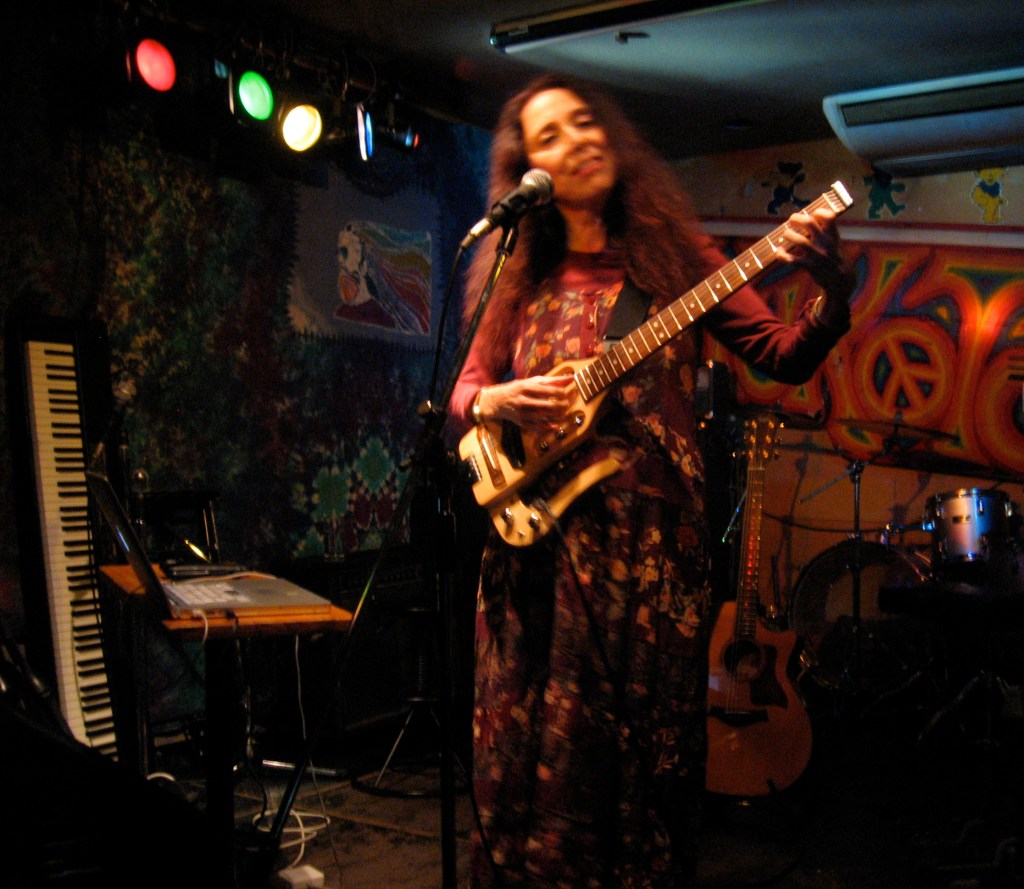
Alicia Bay Laurel performs her prize-winning song, “Floozy Tune” at Yukotopia night club in Umejima, Tokyo, in 2010.
December 12, 2008
“Floozy Tune,” the opening cut of my blues/jazz CD, What Living’s All About, has garnered a runner-up position in yet a THIRD songwriting contest, this time as a Finalist in the 100% Music Songwriting Contest.
In summer 2008, “Floozy Tune” received Honorable Mention (7th place) in the World division (which includes jazz), in the Indie International Songwriting Contest.
The first award for “Floozy Tune” was in the Top 20 Finalists in the Jazz Division of the Unisong International Songwriting Contest, in 2007.
I neglected to write to you last spring about the publication of Alastair Gordon’s SPACED OUT, Radical Environments of the Psychedelic Sixties (2008, Rizzoli). A gorgeous coffee table architecture book about the wiggy shelters my friends built back in the day, for us, it’s more like a family album. It’s an absolutely fun read/look.
“If you don’t have recourse to memory or the spaces themselves, Alastair Gordon’s crucial new book, Spaced Out, will bring you closer to a time when architecture was expanding its horizons…Architects today have a lot to learn from these hippies.”– Metropolis Magazine (6/18/08)
I was thrilled to have my work included in the book, and curious to see which drawings Alastair would choose include. This color page is from Being of the Sun (Harper & Row, 1973), which I co-wrote with Ramón Sender Barayón and illustrated and designed myself. The illustrations on the facing page are from my first book, Living on the Earth (Bookworks, 1970, Random House 1971 and 2000, Gibbs Smith, Publisher, 2003, Echo Point Books and Media, 2021).
Alastair wrote about Living on the Earth with a waggish smile in his voice.
I was honored to be in the august company of environmental-activist designers like the folks at Drop City, an early Colorado artists’ commune, whose geodesic domes made of sheet metal recycled from roofs of cars at the wrecking yard became their signature visual.
I met Paolo Soleri, the architect who designed and was building Arcosanti, back in the 1960s when he did a fundraising talk and slide show at my mom’s house in L.A. As a result, I wrote about Arcosanti in Living on the Earth.
Here’s an interior photo of Soleri’s semi-subterranean home and studio, Cosanti, in Scottsdale, Arizona. I made a pilgrimage to both of Soleri’s architectural wonders in November 2000, during my epic 8 month book tour for the 30th anniversary edition of Living on the Earth and the release of my first CD, Music From Living on the Earth.
Joe Dolce and I, along with Nick and Tanya Alva, did a live radio interview and performance at 10 PM PST, Thursday, November 13, 2008 on KPFA Pacifica Radio in Berkeley, on Derk Richardson’s show Hear and Now, followed by two concerts in the next two days, one in Sebastopol and one in San Francisco.
Joe Dolce and I are friends from our commune days in the early 1970s. He lived for a while at Star Mountain, the music commune I started in 1971 with the money from the Random House advance for Living on the Earth. We also both lived on Maui in the 1970s. He’s been living in Australia for nearly 30 years now, but we’ve been in touch by email, and he visited me in Hawaii four years ago.
Recently Nicholas Alva created the Morningstar musical, based on the story of Morningstar, the first Open Land commune, which begat Wheeler Ranch (where I wrote Living on the Earth), which begat Star Mountain (where I met Joe Dolce). Nick solicited original music from people who lived on those communes, and selected some of mine, some of Joe’s, some by Ramón Sender Barayón, and some by Lou Gottlieb, the founder of Morningstar, philosopher, and comedian/bass player of the Limeliters.
Joe, Nick and I cooked up the idea of this concert by email, and I insisted that Nick reprise Joe’s and my songs from the show with the original cast (in full hippie regalia) as a grand finale. And so it is.
Do come if you’re nearby, and please forward this blog post to any of your friends in the Bay Area who might want their minds expanded over that weekend.
Alicia tells a story at Studio E in Sebastopol, California.
August 5, 2008
The second Tokyo exhibition of the original Living on the Earth drawings and layouts (created in 1969 and 1970), opened today at the Mirai Garou (gallery) in Roppongi Hills, Tokyo. Above, my drawing and design for the invitation.
Ohta-san, the curator of the gallery, requested that I create a current piece of art as a centerpiece for the show, preferably a scene of Tokyo. I drew the view from neighboring Mori Tower (the building next door to the building where the gallery is) looking out to orange and white Eiffel-like Tokyo Tower. Since I often draw goddesses, I was not surprised when Amaterasu, the Shinto Sun Goddess, who is the mother of Japan, floated into the sky behind it.
Here’s the photo on which I based my drawing.
I missed the opening, since I am preparing to leave shortly for two weeks in Vermont, for events that were booked long before the art show, but, happily, Keisuke Era, from Artist Power Bank and Kurkku, sent me three photos. Above, some of the crowd that came for the opening.
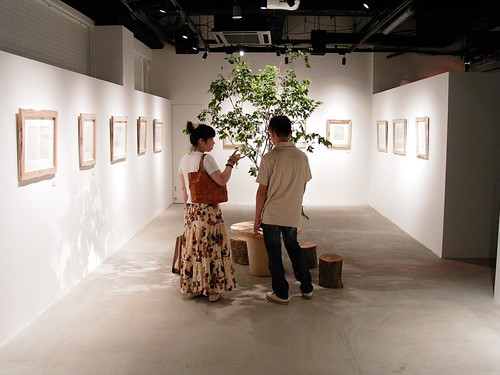
The layouts and drawings in beautiful driftwood frames created by Yuji Kamioka are here displayed in an elegant white room.
The cozy bar at Mirai Garou, with one of my two-page layouts on the wall.
















 Alicia Bay Laurel
You must be logged in to post a comment.