What Did the Hippies Want?

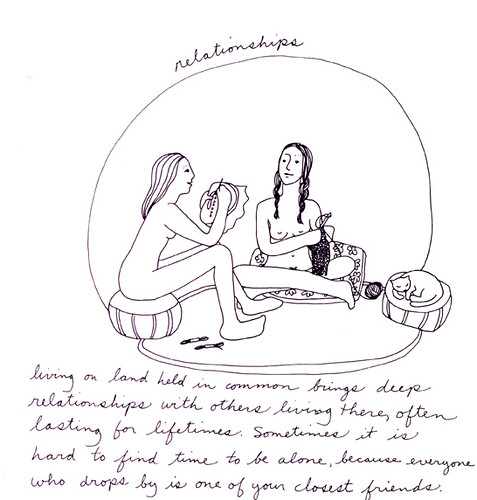
ABL and Karin Lease in BOTS illustration

I wrote this essay at the request of curator Neil Kramer, with whom I co-founded the (now defunct) online Hippie Museum. I still find it posted on various sites around the Internet – evidently it struck a chord with other people who lived in those times.

What Did The Hippies Want?

by Alicia Bay Laurel
November 19, 2001

We wanted intimacy– not a neighborhood where you didn’t know anyone on the block, or you competed, kept up with the Joneses.

A hunter-gatherer or early agricultural community meant that people lived, worked and sought deeper contact with the holy spirit as a group, and they all knew one another, from cradle to grave.

I used to call my hippie friendships “a horizontal extended family,” as opposed to the ancient tribal extended family, which was multi-generational, and therefore, vertical.

We wanted a culture which acknowledged the human body, not just for sex, but to hug each other, to be naked without shame, to revere the body with natural foods, beneficial exercise, herbs, baths, massage, deep understanding. This was not part of the culture from which we came. We wanted a culture that thrived on gift-giving. We hitchhiked, shared our food and drugs, gave away our possessions. People who could afford to buy land invited others who could not to live there.

We opened free stores, free clinics, free kitchens, not just in the Haight, but everywhere we went. We wanted be living proof that God(dess) was taking care of us and therefore there was no need to hoard.

We wanted to live without the constraints of time. We wanted to wake up each day and decide what would be the most fun to do that day-–or just find out as it went along. We wanted to go with the flow, follow our bliss, be here now.
This was in complete opposition to the culture from which we came.

We wanted new ways to value one another, rather than by wealth, status, looks, achievements, machismo, as our culture of origin had taught us, and continues to teach us through the media. We wanted to value one another for being lovable and real.

We valued spiritual depth, which we referred to as “heavy.” We admired one another for being happy. We admired those who offered selfless service or peaceful resolution of conflict. We wanted a spirituality that actually caused you to grow as a person, not one in which people attended religious gatherings for social status. We wanted to be guided by our own Inner Spirits, rather than by priests.

We thirsted for the spiritual awareness and grace we experienced on psychedelics, without psychedelics, or in addition to them. Many hippies would spend their last cent on a weekend workshop that promised to “change your life forever.” That was how so many gurus found followers in those days.

We wanted to live in harmony with the earth, the plants and animals, the indigenous peoples of the earth, with each other, with ourselves. We were the fuel behind the rapid expansion of the environmental movement. We experimented with living arrangements that we thought would harmonize with nature. We sought out indigenous tribal elders as our teachers.

We wanted to make the things we wore and used with our hands, grow our food and medicine, feel all kinds of weather – all the experiences our modern urban lives had excluded in the name of convenience and comfort. We wanted to live on the road, have adventures, build things that hadn’t been built before, and live in them.

We wanted to live our mythic selves, give ourselves names that resonated with our souls, dress in costumes that expressed our dreams, do daring deeds, dance as if no one was looking, decorate our homes with magical things, listen to music that took us out of ordinary reality into altered states of awareness.

We wanted to see life without violence. We wanted media that contained truth. Some of us risked our lives to find out what the government was doing and let the underground press know. We wanted to talk about things in print that we were not allowed to discuss in our culture of origin.

We wanted to live without stupid, arbitrary rules, either for ourselves or for our children. Some of our children, as adults today, say they wish we had been more protective of them, or offered more structure. We only knew what we endured, being as culturally different from our culture of origin as Chinese are from Italians, and punished for it, and wished to spare our children these experiences. However, some portion of kids raised by hippie parents grew up to be hippies themselves. At that point, one can say, a new culture was born and continues.

My Parents Died on the Same Day

Verna Lebow Norman and Dr. Paul A. Kaufman, at a holiday ball at Cedars of Lebanon Hospital in Los Angeles, California in 1952.

Sometimes you just know something, and you don’t know why you know it.

My parents died on the same day, August 15, 2007, on the 59th anniversary of my conception.

They hadn’t seen or spoken to one another in over 45 years, and they lived 500 miles apart.

I’d been telling my sister (who was caring for our dad), that I thought they would die on the same day, for the past three years. I was caring for Mom, and a day didn’t pass when she didn’t talk about him. She was still mad at him for things that had happened in 1962. 

Mom was 87, complained of a stomach ache and went to the hospital, was diagnosed with diverticulitis and pneumonia, but died of heart failure. She’d only been acutely ill for a week. Before that, she’d been normal, that is, not particularly sick, just a couch tomato with a passal of minor complaints, for each of which she was taken to the Kaiser Clinic, scanned and blood tested, and sent home with yet another set of allopathic drugs. (She was NOT interested in natural remedies or health food.)

During the two days before she died, I visited her at the hospital and sat holding her hand in both of mine, just sending her love, since she mostly was too sedated with painkillers to speak. (When asked by the nurse, “Who is here with you?”, she managed to mumble, “It’s my daughter.”) Somehow, I did not realize she was about to die, or I would have continued sitting with her all night.

When the attending physician telephoned in the morning and told me her heart had stopped, I instantly imagined her beloved second husband Ralph, who had died 18 months earlier, reaching out his hand and asking her to dance, and she, stepping out of that old body riddled with IVs, catheter, oxygen tube and monitors, and the two of them tangoing off into the starry skies.

Mom met Ralph when she was 22 and he 25; he was her older brother’s best friend. Her parents disapproved of the match, and they each married someone else, had some kids, and afterwards were single for decades. I designed and presided at a wedding for them on Maui fifty years after they first met. They had a ball together for fifteen years. After Ralph died from lung cancer, Mom seemed tired of life.

The first person I called was my sister. I said, “Mom just died of a heart attack,” and she said, “Dad just went into a coma.” And I said, “Wow, looks like my prediction is coming true.”

Dad had wished to die peacefully in his sleep, without illness, at home in his own bed, and that’s what he did, at 96 years and 9 months, with my sister and her best friend, who had worked as one of his caregivers, holding his hands, what we used to call “dying of old age.” An auspicious and perfect death.

Now my sister and I are like mirror images, holding hands over the phone, arranging for cremations, coordinating memorials, executing wills, writing obituaries, sorting personal effects, and occasionally crying, or thinking about them.

We are blessed to have each other’s support and love through this time.

Last week she said, “All those times you used to say they would die on the same day, I just humored you. Now I wonder what else you know.”  “I’ve been wondering myself,” I replied.

Here are the obituaries:

Verna Lebow Norman
Nov. 2, 1919 – Aug. 15, 2007. Verna was an accomplished sculptor, painter and art instructor, and a Los Angeles resident since 1926.
The daughter of C.H. and Ann Lebow, Verna was pre-deceased by her husband Ralph Norman; and is survived by three children from a previous marriage, Alicia Bay Laurel, Roberto Spinoza Alazar and Jessica Anna Mercure.
A memorial is planned for October 7, 2007. Donations to Habitat for Humanity will be gratefully received.

Published in the Los Angeles Times on 8/28/2007.

Paul A. Kaufman, M.D., F.A.C.S. (96) Died peacefully in his sleep. Renowned breast disease specialist, Dean of Breast Surgery at Cedars-Sinai Medical Center. Paul’s excellence as a surgeon attracted patients and consultation requests nationally and internationally. He authored many professional publications, developed new safety devices for the OR, and took courses in pathology in order to diagnose his surgical patients himself. He made instructional films in his specialty and served as the Medical Attache to the Consulate of Chile. He saved many lives and prevented many children from an early loss of their mothers. Served 19 months in the Pacific during WWII, including seven beach landing battles. Received special commendation as the only surgeon managing 600 casualties after a kamikaze plane hit his ship. After retirement Paul served as an expert medical witness and studied computer technology and mathematics. He was a gifted photographer and an avid reader. In his last years his sense of humor, warmth and vitality in the face of illness made him many lasting friendships. He will be missed. Survivors include daughters Alicia Bay Laurel and Jessica (Wes) Erck, son Roberto (Melanie) Alazar and their daughter Rachel; nephews (including a close relationship with nephew Dr. Saul Sharkis of Johns Hopkins University), nieces and their families: grateful patients: devoted friends, colleagues and caregivers including Alicia Enciso, his housekeeper for 35 years. Goodbyes to be held September 29 in northern California; those who care about Paul may contact us at InMemoryOfPaul@yahoo.com. Donations in his memory may be made to the National Women’s Health Network, http://www.nwhn.org.

Published in the Los Angeles Times on 9/9/2007.

Taxi Road Rally 2006, Day One


Five days after I flew back to Los Angeles from my month-long tour in Japan, I drove over to the Hollywood Renaissance Hotel in the Hollywood and Highland shopping and theatre complex (above), to attend the Taxi Road Rally, a four-day songwriters convention put on by Taxi, an independent A&R (“Artist & Repertoire”) company.


Taxi solicits performing artists, and compositions and songs from its members on behalf of record, television, and film producers, as well as for digital download companies and for libraries that sell music for advertising, video games, ring tones, and so forth. Taxi screens the submitted material and sends on what it considers appropriate. Because it performs this valuable function, it attracts many music buying entities, and, because it attracts many music buying entities, it attracts many songwriters and composers. Once a year, Taxi puts on a convention for its members, free of charge, offering classes, panel discussions, mentoring, and an open mic each night.


I joined Taxi last summer after releasing What Living’s All About, because I thought I could license my songs for performance by other artists. I realized quickly that the types of music I have created and the types commonly requested by the commercial music industry don’t overlap much, although occasionally I see a listing requesting something “quirky,” “like Tom Waits,” or “50’s style jazz” that the WLAA songs might fit. When they say “singer-songwriter,” what they mean is someone playing acoustic guitar rock and roll style, and singing about weird circumstances in a breathy voice. There’s a big market for that these days.


I don’t know how many thousands of songwriters attended the conference. It looked like at least two thousand to me. I loved being surrounded by other people who hear voices in their heads and actually do something about it. There was a sort of oximoronic quality to an event with a corporate format, attended by the very fringes of bohemian society, a convention of the unconventional.


Nonetheless, the hords of songsmiths and nightingales stood in long lines to register for the conference, receive badges, purchase luncheon tickets and carry away bags of advertising. We are a market, supporting magazines, professional organizations, music stores, equipment manufacturers, software writers, life coaches, career advisors, music and business teachers, authors and publishers. These were all present at the conference, fishing. And we were there, fishing, too. Everyone looked hopeful.


After we registered for admission, mentoring sessions, and luncheons, we gathered in the Grand Ballroom, where Michael Laskow, founder and CEO of Taxi offered a heartfelt welcome, and his thanks to the many who worked hard to make this event possible. “Every year,” he told us, “I swear I will never do another one of these again.” It was an endearing remark. Certainly none of us would have even done the first one.