Seeing the Truth, however Inconvenient

So Benida and I went to see Al Gore’s An Inconvenient Truth the night before last at the Laemmle Theatre in Santa Monica. It was a leftist’s Rocky Horror Show, that is, the audience reaction was as compelling as the film itself. The film’s violence comes off more like a college lecture than a Hollywood thriller, but, unlike most horror flicks, this one depicts an apocalypse that most likely WILL occur in real life, to US.

Critics on the right say it’s one long political ad for Gore. If so, it works. Eat your heart out, Hillary. When Gore tells an audience in the film, “There are higher priorities than terrorism,” our live audience cheered, stomped and whistled.

My friends and I have been talking and living green since the ‘sixties. It looks like An Inconvenient Truth is winning over some of the squares who’ve been pooh-poohing us up until now. And not a moment too soon.

All About “What Living’s All About”

buy What’s Living All About

Chosen by the indie editor of Performing Songwriter Magazine as one of the 12 Top DIY Picks in the May 2007 issue, praised as one of the best CDs he heard in 2006 by the editor of eJazz news in London, and hailed as “fantastic!” in the June 2007 issue of Feminist Review in New York city, What Living’s All About, Alicia’s CD debut as jazz diva and record producer, has a lot of people excited.  The opening cut, “Floozy Tune,” placed in three international songwriting contests, Unisong International Songwriting Contest in 2007, the Indie International Songwriting Contest in 2008, and 100% Music Songwriting Contest.

So what’s on the CD?

Alicia sings twelve catchy jazz, blues, and gospel tunes, ten of them original, including her in-your-face protest song, America the Blues, featuring avant garde guitar hero Nels Cline. Gorgeously (self) produced, with three ensembles of top notch professional session players in an LA studio, What Living’s All About emanates sexuality, spirituality, cynicism, humor, hip repartee, and occasional righteous rage.

Other members of the cast include jazz upright bass legend John B. Williams (Nancy Wilson, Manhattan Transfer, Arsenio Hall Show Band, Tonight Show Big Band) and his red hot R & B vocalist wife Jessica Williams, who forms the gospel choir along with her daughter Vetia Richardson, and her friend Irene Cathaway (with whom she sings backup for Connie Stevens), gospel keyboardist Reverend Harold Pittman (Minister of Music at the Greater Ebenezer Missionary Baptist Church in South Central Los Angeles), woodwind wizard Doug Webb (who totally smokes on a different instrument on each of four songs), three fabulous top flight drummers: David Anderson, Kendall Kay, and Enzo Tedesco, fluid and cool jazz pianist Rick Olson, two rock-solid, multi-talented bassists: Kevin O’Neal and Chris Conner, versatile actor/vocalist Jody Ashworth, and soulful Liberian gospel singer Francis Nyaforh.

The tunes:

Floozy Tune: A 1920’s trad jazz tune about a girl who runs off with the band. Will make you Charleston, even if you don’t know how.

America the Blues: A love song to America, rallying voters to save her from corporate greedheads. Turn up your speakers and listen all the way to the end.

Aquarian Age Liberated Woman Blues: A free-love hippie girl in her countercultural world.

Zero Gravity: Atmospheric jazz ode to night life in LA.

Doctor Sun and Nurse Water: Gospel blues waltz about the life-giving properties of sunlight and water.

What Living’s All About: Sex. Mid-century modern jazz inspired by the song Fever.

Sometimes It Takes a Long Time: A blues waltz that starts folk, ends gospel, and is uplifting enough be sung at a wedding.

Nature Boy: A spacy, improvised version, for voice, upright bass and percussion. Showcases the great John B. Williams.

Best of the Rest of You: Kick ass blues about the social mores of New Age bobos.

I Could Write a Book: Stylish rendition with classic jazz quartet and shocking revelations read from literary agent Michael Larsen’s book How To Write a Book Proposal.

It’s Not Fair: Jazzy blues bitch slap to an unfaithful lover and former creative collaborator. Great guitar solo by Nels Cline.

Love, Understanding and Peace: Gospel love ballad that reflects upon Paul’s letter to the Corinthians, Chapter 13, which Alicia wishes that some Christians would take a little more seriously.

For those familiar with Alicia’s first two CDs, this one may come as a surprise. It has a much lower glycemic index and is not recommended for children. Alicia widens her range as an actress, and addresses sticky issues personal and public. She also collaborates as musician and producer with some of the most gifted players in Los Angeles.  All three of Alicia’s CD covers are about women in ecstatic union with nature; this one is a moonlit, wet, surreal image with soft edges.

Buy the CD from Alicia’s online store

Reviews of What Living’s All About

Listener comments about What Living’s All About

Music Industry Critiques What Living’s All About

Why I’m into left politics (and have been my entire adult life)

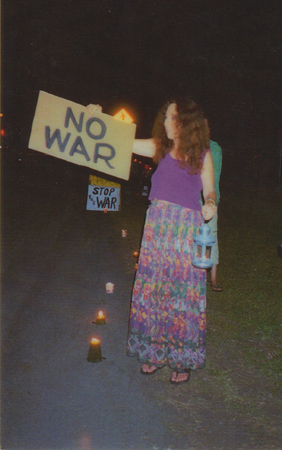
Candle light vigil against the US invasion of Iraq, Hawaii Island, 2003

Left politics is about using the nation’s pooled wealth and technology to do what is beneficial for the largest part of the population, including the poor, the disabled, the working people, and the middle class.  Left politics is about seeing human beings as one family, and as a part of nature, rather than as the dominators and exploiters of nature.  Left politics are egalitarian rather than hierarchical.

The left wants to see free, excellent education (through college) available to everyone (as it is in many other countries), to see publicly funded health care available to all (as it is in most industrialized nations), to build and maintain public infrastructure that supports a healthy and safe population, including excellent libraries, hospitals, roads, schools, highways, bridges, sewage facilities, deep draft harbors, and so forth. The left knows that the public funds for these projects could be more than amply covered by reducing corporate welfare, military spending, tax cuts for the wealthiest people, government corruption, and other blatant misuses of taxpayer dollars.

The left wants news media with a variety of viewpoints and a requirement of truth and completeness in reporting. The left wants separation of church and state and of corporations and state. The left wants transparency and accountability at all levels of government. The left wants to protect the planet from devastation by industry and war, and to protect the people from environmental pollution and unsafe foods. The left wants elections with hand countable audits and publicly funded candidates (who, once elected, don’t owe favors to wealthy donors).  The left wants to see workers controlling their workplaces as worker-owned cooperatives, and/or unions. 

The left wants to reign in corporations that perpetrate harm upon the public domesticly and abroad. The left wants to create trade agreements that are win-win with other nations. The left wants to promote peace between nations, and prosperity where there is poverty. The left believes in diplomacy and mediation, and in sustainable, aesthetically appealing solutions to the needs of people and planet. The left believes that a well-nourished, well-paid, well-cared for population will seldom resort to crime. Similarly, the left believes that well-maintained international relations seldom, if ever, require the use of military. True leftists are non-violent. Violent people are not leftists.  Violence is the hallmark of totalitarianism.

The left encourages preventative health care and a variety of treatment modalities. The left is not interested in controlling people unless they are hurting others. The left is interested in fostering the wellbeing of all people and appreciating their wide range of expression, so long as it harms no one. The left supports the arts, creativity, celebration, cultural achievements and heritage.

Ayala Talpai


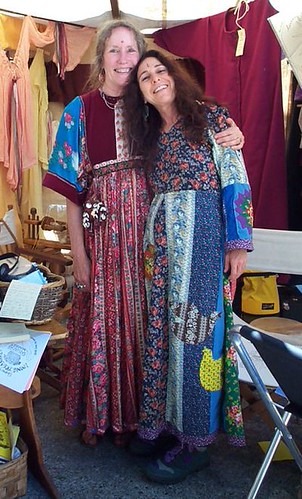
Ayala and Alicia at Ayala’s Eugene Saturday Market booth in July 2000. Ayala made the dress she wears. Quilter and fellow Wheeler Ranch alumna Charlotte Lyons made Alicia’s dress in the 1970’s.

Ayala Talpai, my dear friend since commune days and my seventh nominee for the Living on the Earth Award, writes, illustrates, calligraphs and speaks stylishly, so I prefer to let her describe herself.
Herewith:

“Ayala is a post-menopausal woman with five grown sons whom she raised in various degrees of wilderness settings. She is currently living happily ever after with the man of her dreams, at the end of a dirt road just far enough out of town.

“She was born and raised in New England by slightly crazed parents over whom hung the influence of her grandmother, a famous artist. Ayala’s solution to the dilemmas posed by these details was to play alone in the woods and her room, creating by age 15 over 100 dolls and related paraphernalia, and then as an adult, to merge her artistry into her household and its surroundings, a habit of folk artists the world over.


Ayala and Richard Talpai’s artist paradise in the woods, back in 2000.

“Daughter of an engineer and an artisan, she delights in coming up with new and unusual solutions to perceived and manufactured problems—a trait useful in her greatest joy, teaching. Ayala has eliminated the word ‘mistake’ from her vocabulary, having found that ‘opportunity’ and ‘discovery’ are far more accurate and workable concepts. She lives in delighted anticipation of what her students will come up with next!

“Ayala has spent her entire life making stuff, making do, and doing well. This happy obsession with creativity has led to the first innovaiton in fiber arts since the Stone Age—NOW! felting needles turn wool into a sculptural material! Having taught all ages and abilities all over the place, Ayala has also written two authoritative needlefelting workbooks.


A felt mermaid created by Ayala

“Ayala is a folk artist who has intentionally avoided the often political world of art galleries. She has supported herself with her art—at a booth in Eugene, Oregon Saturday Market these 14 years past: as creator of wedding garments for ceremonies both on and off the beaten path; as Artist-in-Residence for the county public schools, teaching woolwork to people of all ages and abilities.

“Ayala brought felting needles to the attention of the fiber arts world. She’s keeping this simple, affordable, and applicable anywhere fiber is found.”

[She wrote in one of her brochures:]

“Prepare for a lively, productive workshop (and quite likely, a lifetime’s absorption in needlefelting!)


One of Ayala’s felt placemats

“I want to talk with you about wool… the delectable compliant medium of WOOL, a sustainable and renewable resource produced by fashionably vegetarian animals. And it’s true—science recently discovered that wool is in electromagnetic harmony with the energy fields of the human body. We humble peasants have known that for centuries! (I cannot resist adding the fact that petroleum-based fibers like PolarFleece© are dulling to our auras, as well as to politics in the U.S. of A….)

“It’s become my (not-so) secret mission to get wool into studios, ateliers, art rooms all over America, even all over the planet-and not just for all the applications where it has performed so magnificently since the early dawn of mankind’s association with sheep, like making felt, spinning yarn, weaving fabric, but also… also as a medium for SCULPTURE.

“Yes yes, wool HAS been used for 3D sculpture already… but by traditional wet-felting techniques (cumbersome), and only with certain fleeces, since most wools will not accept more fiber after a certain point in the wet-felting process. Such inhibiting limitations! But we have now a recent event to mitigate all that: the introduction of INDUSTRIAL FELTING NEEDLES into the world of the folk artist, cottage industrialist, and fine-arts artist.

“In the early 80’s a girlfriend in New England gave me a handful of various styles felting needles. She had acquired a sample-sized needlepunch machine from an abandoned woolen mill there. Over the intervening years, as I delightedly needlfelted away alone in my kitchen, a question kept coming up: WHERE have these tiny versatile things BEEN for so long???

“A nonwoven-fabrics factory worker clued me in: the first felting needle patents were dated 1859. Needlepunch machines were originally designed to make batting and insulation from shoddy (shredded woolen garments), from slaughterhouse fibers, even from soldiers’ haircuts. AND… all this was occurring at the height of the Victorian era! Aha!! There’s the hitch: Victorians were total prudes and prissies. Junky old second-hand stuff is too disgusting for words!! We could just swoon away at the thought…. A century later, however, social mores shifted and recycling is now so politically correct. Also, automobiles have proliferated, and everything that’s not metal, plastic or fiberglas on a car is needlefelted. That machinery has moved into the Group Consciousness! Nowadays artists even rent afterhours time on needlepunch machines, the better to create rugs and large wall hangings.
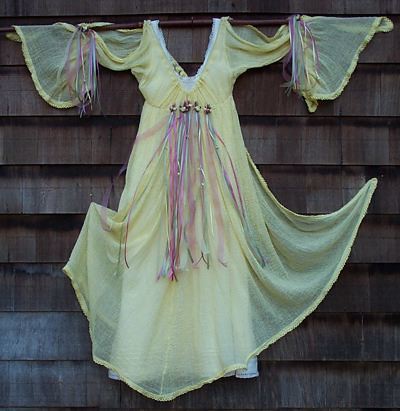

A wedding “fairy coat” designed and sewn by Ayala

“Untold thousands of felting needle styles have been developed for industry, and with good reason-those huge machines use say 150-200,000 needles at once, a situation where a tiny difference is multiplied a thousand times over, for different fibers and different applications.

“Returning to my personal journey with needlefelting: Well, one thing led to another and eventually I was drawn out of my foothills retreat in the interest of spreading the word and the techniques I’d developed for fiber artists and their lone felting needle. Wrote a couple workbooks with the hope of getting others to make some of the myriad items that needlefelting engendered in my imagination, and then maybe taking off into their own heavily populated fantasies.

“Anybody with a flexible wrist who can be trusted with sharp things could be handed some wool and a felting needle, and it is such a delight to see what folks come up with! Even boys can be inveigled into the fiber arts by a felting needle! Moreover, all sorts of ghastly damage to fiber items can be repaired with a felting needle and an agile mind.

“The most appealing aspect of this technique is that you CAN’T go wrong, you just keep adding wool until you get what you like. No mistakes! Only opportunities, or discoveries… a perfect way to get wool back in the public eye, don’t you think? In the ‘70’s when I first met up with sheep, wool was 11 cents a pound on the open market. Really, it hasn’t gotten any better. High time to remedy that… Whatever type of wool one has at hand is the perfect kind for needlefelting. Fiber differences lend their own special characteristics to what is made from them-like dancing with different partners.”

Howard Zinn, on the idea that hope is naïve


Alicia at a peace march in Los Angeles, March 19, 2005

“It’s true that any talk of hope is dismissed as naïve, but that’s because we tend to look at the surface of things at any given time. And the surface almost always looks grim. The charge of naïvete also comes from a loss of historical perspective. History shows that what is considered naïve in one decade becomes reality in another.

“How much hope was there for black people in the South in the fifties? At the start of the Vietnam War, anyone who thought the monster war machine could be stopped seemed naïve. When I was in South Africa in 1982, and apartheid was fully entrenched, it seemed naïve to think that it would be dissolved and even more naïve to think that Mandela would become president. But in all those cases, anyone looking under the surface would have seen currents of potential change bubbling and growing.”

Howard Zinn, in an interview in Tikkun Magazine, 2006


Keeping The Vision

My mother’s last birthday party, in November 2006. She transitioned in August 2007.

When my book Living on the Earth was first published in 1970, I was twenty years old, living on an open land commune in northern California in a shack built of recycled materials, dividing my time between weeding the community garden, hiking, doing yoga, practicing guitar and singing, celebrating whatever day it was with my friends, and making beautiful things out of clothes from the free box. My book conveys those free and easy days, and became a window through which people trapped in stressful urban lives could fly and dream.

Now I’m the person looking through the window and dreaming. I just turned fifty-seven, and I have a strong spiritual commitment to doing what is right by my own estimation, which, in this case, is caring for my aged mother in her home in Los Angeles. Here I am in the town I thought I had left forever at seventeen, with the woman who made my life hell until I stuck out my thumb and boogied on up Highway 1 to San Francisco in 1966.

I am cool, though. I walk a lot, practice music, write my blog, do spiritual practices, learn everything I can about elder care, work on my communication skills, work on my creative projects, work at my business as art entrepreneur. I have some wonderful friends and family in LA, some I’ve known since I could know someone. They love me and make this work.

I dream about how I will live after this is over: In a sustainably built off-grid home, in a permaculture gardening and natural farming, with pollution-free transportation, in an intentional community with other artists, musicians, writers, healers, earth stewards, and visionaries whose visions resonate with mine.

Meanwhile, I hunt for cheap gasoline, and wring my hands at the wastefulness of modern society. Happily, my mom’s a leftie, too, and she wrings her hands along with me.

May 14 Birthdays

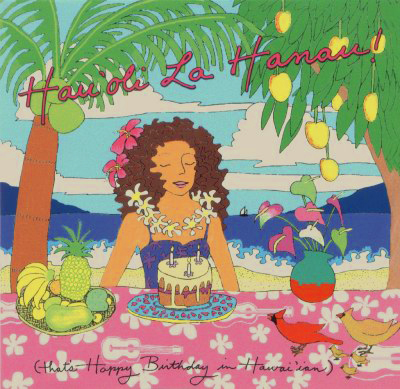
This Hawaiian birthday card comes with a recording of
Alicia’s Hawaiian birthday song (both digital downloads) – here.


Alicia Bay Laurel (artist/writer/musician)
David Byrne (musician)
Jill Stein (politician and physician)
Bobby Darin (singer)
George Lucas (filmmaker)
Otto Klemperer (conductor)
Gabriel Fahrenheit (physicist)
Patrice Munsel (opera diva and actress)
Sidney Bechet (jazz clarinet player)
Cate Blanchett (actress)
Danny Wood (singer – New Kids on the Block)
Jose Da Silveira (artist)
Tim Roth (actor)
Robert Zemeckis (director)
Jack Bruce (musician)
Al Porcino (jazz musician)
Richard Deacon (actor)
Norman Luboff (choral leader)
Joe Louis (boxer)
Skip Martin (composer)
Billie Dove (actress)
Thomas Gainsborough (artist)
Sofia Coppola  (screenwriter, director, producer, actress)
Mark Zuckerberg (inventor and owner of Facebook)
Rober Zemekis (director, producer, screenwriter)

Toby Hemenway

Our sixth nominee for the Living on the Earth Award is Toby Hemenway, author of the permaculture classic Gaia’s Garden, and urban permaculture classic The Permaculture City, as well as numerous articles on, and teacher of workshops on, permaculture and sustainability.

I met Toby when I performed a Living on the Earth: The Musical show at Center of Conscious Oneness, a beautiful performance space at the Pangaia commune in Puna, on the Big Island. Toby was on the island to teach a permaculture course at La’akea Gardens, and he invited me to perform the show for his students a week later. Toby and I traded books, and I became an instant fan of Gaia’s Garden. At La’akea Gardens I met permaculture teachers Ryan Holt and Tara Robinson, who came to my home in Kea’au, and planted a food forest and perennial vegetables for me, bringing the permaculture principles to life right in my own back yard, and remaining my friends ever after (I sang at their wedding!)

Toby’s book Gaia’s Garden surrounds the reader with rich and instructive images from his country farm in Oregon and from others he knows. My favorite story in his book is of two brothers who remove a cement sea wall from their land, causing a natural wetlands to return. Soon cattails grow, and the brothers enjoy cooking with them. Then the cattails disappear, and the brothers realize the abundant cattails have attracted muskrats. Instead of fighting off the the muskrats, they wait and observe, and eventually the cattails return, along with a population of sea otters who are feeding on the muskrats. Later, they see an eagle hunting for muskrats and otters, a sight unknown for decades in those parts. By removing the cement sea wall they unleashed a cascade of bio-diversity.

In Toby’s gardens, plants radiate from the home in zones, with those that require the most supervision closest to the doors, and those requiring the least farthest away. Plants are grouped together in “guilds” to benefit one another, planted not only to benefit people, but also to feed the local wildlife, including insects and birds, to fix nitrogen and minerals in the soil, and to provide beauty and shade.

Toby’s gardens begin with sheet mulching, which is layering soil-building materials and leaving them to disintegrate naturally, so that the small denizens of the soil will live undisturbed by metal blades and better do their part in enriching the soil. All creatures, including insects and other arthropods, have their rightful place in a permaculture garden, and a job to do in building the biomass from which gardens and orchards grow.

Last year, Toby wrote about the fantasy versus the reality of sustainable living in the country. He realized that when petroleum becomes scarce and super-expensive, farming will not be a better way to survive, since farmers actually drive farther than urban dwellers, and use products that must be delivered far from the central distribution centers in cities. He noticed that his rural neighbors did not share his beliefs about preserving the environment and interacting peacefully. So Toby and his wife moved to Portland, and have been enjoying an urban permaculture environment as well as goodhearted neighbors who share their ideals.  He later wrote the book, The Permaculture City, about these discoveries.

Back in the 1960’s, Paolo Soleri had much the same idea: that the ecological footprint of a city dweller is much smaller than that of a country dweller, and that vertical cities save horizontal open spaces from being paved.

Weird Violins

Robert Cauer’s legendary by-appointment-only shop in Hollywood builds, sells, repairs and accessorizes violins, violas and cellos; on the walls of the waiting room hang Cauer’s collection of historic and bizarre violin permutations that he acquired at auctions over the years.


A scalloped violin and a violin with two points instead of four


A rounded violin with crescents instead of f holes, and a violin with exaggerated points and a stepped tail piece


A violin jigsaw puzzle and a violin with a double length neck, two instead of four points, and wavy lines instead of f holes


A violin with a piano style keyboard over the neck


An electric rhinestone studded cowboy fiddle, probably from the 1920’s or 1930’s, a striped violin, and a violin with wavering outlines, as if it had been drawn by a child


An aluminum violin with a metal bow, and a bowed zither, a fretted instrument played flat on a table


An old German violin with a carving of a human head instead of scroll at the top, a practice violin, which won’t annoy the neighbors because it lacks a resonating chamber


A Stroh violin, invented in the late 19th century by John Matthias Augustus Stroh, a German-born mechanic and inventor living in London and the first person to build a phonograph in England. In the early days of recording on wax rolls, violins did not generate a strong enough signal to record easily, so Stroh added a conical aluminum diaphragm and a large horn to transmit the sound toward the recording horn transmitting the sound to the needle imprinting the wax roll. Stroh added a smaller horn so the musician could also hear himself play. With the advent of the microphone and electric recording in the mid-1920’s, demand for the Stroh decreased, leaving only violinists wanting a louder sound for live performance. Discontinued from manufacture in 1942, the Stroh violin lives on in collections like Robert Cauer’s, in the occasional novelty act, in Tom Waits recordings, and in the Biho region of Transylvania, where their odd, somewhat nasal sound is highly prized.

More wonderful collections of unusual stringed instruments here and here.