Hawaii Photo Safari


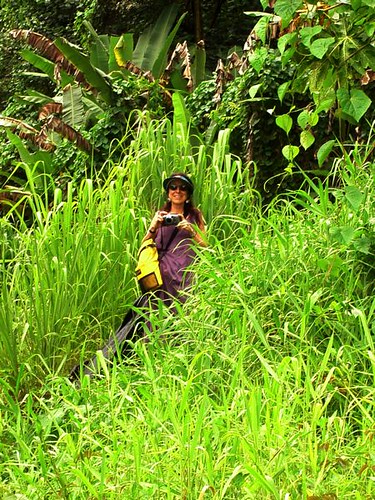
Alicia photographs the jungle. Photo by Linda Kane.

Linda Kane and Mary Goodrich are professional fine art photographers and both have moved within the last two years to the windward side of Hawaii island from northern California. They’ve been promising each other for quite a while that they would go out together shooting pictures, and today is the day. Mary’s husband Ken Goodrich, an audio-visual tech for large corporate functions, and I, Linda’s houseguest for the week, and friend for over twenty years, are invited along. Linda, who lives on the Hamakua coast, guides us to her favorite bridges, beach and jungle places, including two old cemeteries.


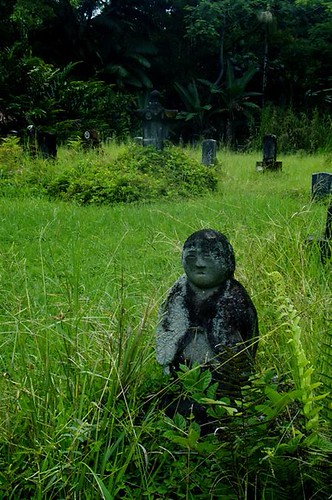
Our first inspirational environment is the old Honomu cemetery. I discover an unusal stone Buddha in the tall grass.


Ken and Mary Goodrich and Linda Kane take photos on the black sand beach at the mouth of the Hakalau River.


Side road off the Mamalahoa Highway. The cathedral heights of the trees, the sweet fragrances of the roadside ginger blossoms and ripening guava and passionfruit, the warm moist air, the sounds of rushing rivers and calling birds fill me with gratitude for life itself.


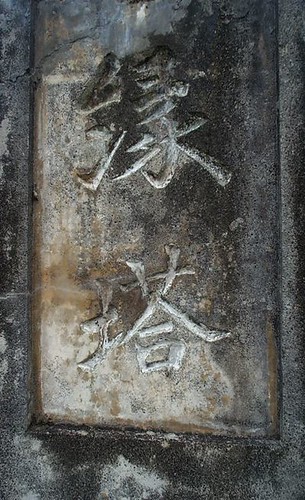
I am fascinated by the calligraphy carved into Japanese headstones, and the weather’s effect on it.


Mary Goodrich documents a monument at Honohina Cemetery in Ninole. Check out her beautiful website! Photo by Linda Kane.


Two streams join into one river above the wooden bridge at Waikaumalo Park in Ninole.

Throwing a CD Release Party for WLAA in Hilo

Kahuina Gallery.jpg

I decided to have a CD release party for my third CD, What Living’s All About while I am here on the Big Island. I called artist Tomas Belsky, whose Kahuina Gallery in downtown Hilo is a favorite bohemian haunt, the scene of poetry readings, left wing political gatherings, and small dances and concerts. I got to know Tomas when I was organizing for Kucinich in 2004; he hosted our meetups at the gallery. Tomas was more than gracious in offering the space for my event on Friday, September 1, at 8 PM, right after the poetry reading.

Next I called Peter Serafin, the editor of the Hawaii Island Journal, which is the alternative paper in these parts. I met him through Sachiho Kojima, the leader of the three-woman trance band, Amana, when she and her band came here to the Big Island to do a memorial for Sachiho’s husband, and, afterwards, do a tour I set up for them. Peter has worked many years as a journalist in Japan, and generously provided me with a list of media contacts in Tokyo. He bent the rules at the Journal to get my event into the calendar even though I called a couple of days after the deadline. He also requested a copy of the CD for a review.

The Hawaii Tribune-Herald’s calendar has a more leniant deadline since it’s a daily instead of a bi-monthly paper. I listed the event in their calendar through their online robot. They don’t review CDs.

I have emailed all of my friends on the Big Island for whom I have current email addresses. I’ve posted to my blog. Next I will design and print a flyer and post it on bulletin boards.

I contacted a couple of local radio stations for airplay. KAPA Radio has already featured my second CD, Living in Hawaii Style, in its rotation in 2002 and 2003. I don’t know that they play jazz and blues. The other station, KHBC, certainly does; they are so eclectic that I will bring all three of my CDs when I stop in to meet Brad (who has a great radio voice) on Monday.

All that being done, it’s all about rehearsing, gathering up my sound equipment and making sure it all works well, and making sure there are enough chairs. I love performing, and this will be very casual, with lots of friends and not too much pomp and circumstance.

Follow up: It’s the next day after the show.  Kahuina Gallery is not a large room, but it was ‘way overflowing with friends and fans for my show.  I was ecstatic to be performing for them, and they cheered me roundly and bought CDs.

buy What’s Living All About

Visiting a self-sufficient farm in Kaupo, Maui

Today my dear artist friend, Stephanie Farago, and I circumnavigated Maui’s Haleakala Volcano, and visited friends who live in remote Kaupo.


We passed through Kanaio, a high elevation desert community overlooking the Alenuihaha Channel and this single cinder cone (that’s “pu’u” in Hawaiian).


We passed the Kaupo Gap, which is the lower reaches of a huge amphitheatre-headed valley that forms the eastern half of Haleakala’s crater. The original caldera of Haleakala has long since eroded away, but the two huge valleys created by wind and rain erosion (the other, on the wet windward side of the island, is called the Ko’olau Gap) were united into a single caldera-like crater by later volcanic eruptions that destroyed the wall between the two valleys, and created a wonderland of magestic cinder cones, lava tubes, caves, and other multi-colored volcanic structures.


We visited friends who have created a sustainable farm, complete with alternative power (solar, wind and hydroelectric), a spring and a well, orchards, gardens, chickens, ducks, a goat, a horse, cats, handbuilt houses of local rock, cement and recycled lumber, a solar oven, a solar dehydrator, and, yes, a computer that connects to the Internet.  The chickens are not allowed in the vegetable garden, but they forage for insects in the pineapple patch.  But the ducks, who do not harm the vegetables, happily gobble a variety of pests that would otherwise eat the garden greens.  The eggs of both are therefore highly fortified with natural protein.


Rarely driving to town for supplies, they grow most of their food and cook everything “from scratch.” They cook on a table-top two-burner propane gas stove, and they bake in the solar oven.  They are as healthy as human beings can be in these times, and extremely strong from their daily work maintaining and developing the farm.


Stephanie beside the waterfall pool at Alelele Stream. I went skinnydipping there, and feel like a new woman for it, but I’m not posting photos of that.

A Beach Walk on Maui at Sunset


Today I walked on Keawakapu Beach, in Wailea, Maui, with my dear, longtime friend Lynne Ross, who lives near enough to swim there daily. She leads the way.


It’s a weekend, and Hawaiian people are camping and fishing on the beach.


Around every bend, beauty and tranquility.


At sunset, I delight in the balmy breezes.

Green Burials


Cremation page from Living on the Earth.

I first wrote about a simple alternative to the bloated waste and egotism of American funerary practices in my book Living on the Earth, first published in 1970. Probably I’d been sickened by The Loved One, a 1965 black comedy about people working in a large, decadent Hollywood Cemetery. More likely I couldn’t make sense of almost any aspect of my culture of origin, from nylon stockings to racism to skyscrapers.

It wasn’t until after Living on the Earth was published that I read The American Way of Death by Jessica Mitford, who was married to Bob Treuhaft, the Bay Area attorney who represented Mario Savio (of the Free Speech movement in Berkeley) and lots of civil rights cases…and me, for a while. I was very fond of Jessica and Bob, and miss them now. Jessica thoroughly skewered the funeral industry in the first edition of her book, and then returned to do it again with a revised edition in the 1990’s. She died before she finished it, and Bob, by then retired, continued working on the book until he died, too. “I never learned to type because I always had secretaries,” he told me, “but now I am using a computer. Think of that!”


Bob Treuhaft and I having dinner at Alice Water’s famed natural foods gourmet restaurant in Berkeley, Chez Panisse, in June 2000, about a year and a half before he died.

Now I’m in my fifties, and have seen a number of creative friends deal with the remains of their “loved ones.” In Hawaii, the hands-down winner goes like this: cremation, with the ashes being placed in a Hawaiian gourd urn, followed by a circle of friends and family on a beach singing songs and sharing memories, followed by the scattering of ashes into the ocean from an outrigger canoe, followed by a showering of flowers (all of which biodegrade) from the outrigger canoe into the sea. No fuss, no muss, no waste, no monuments. Nothing plastic to chock the creatures of the sea. The gourd urn can be re-used indefinitely for ash scatterings. Follow that with a shared potluck meal served on non-disposable plates and utensils washed afterwards by the guests, and you’ve got yourself a green funeral. 

Of course, owing to my name, chosen for my plant ally that, like me, is a California native, I’ve got this other plan, should I depart from my body in California instead of Hawaii: cremation, or a mushroom burial suit, then a hole dug in a forest where California bay laurels are already thriving, place my remains or cremains into it, then a layer of topsoil, and then plant a California bay laurel sapling on top.

Screen Shot 2021-04-03 at 8.08.35 PM

So, now that we have Zen Hospice, it only makes sense that we also have the Green Burial Council, an actual association that helps people find places to bury people sustainably, conserving nature, not wasting money and materials, and not using toxic chemicals that will leach into the soil.

Cubism, and racism, at Mount Rushmore

August 18, 2000. Cross-country road tour. A few miles south of Rapid City, South Dakota, stands Mount Rushmore. I had wondered what inspired the carving of these huge neo-classical faces into a mountain. And then I realized that the mountain had faces on it already, all of them far more interesting to my eye than the four presidents. Looked at as a line-up of ten faces, the piece takes on an evolution closer to Picasso’s Les Demoiselles d’Avignon.

Later I learned the tragic story behind Mt. Rushmore, a mountain sacred to the Lakota Sioux

The Six Grandfathers (Tȟuŋkášila Šákpe) was named by Lakota medicine man Nicolas Black Elk after a vision. “The vision was of the six sacred directions: west, east, north, south, above, and below. The directions were said to represent kindness and love, full of years and wisdom, like human grandfathers.” The granite bluff that towered above the Hills remained carved only by the wind and the rain until 1927 when [sculptor] Gutzon Borglum began his assault on the mountain.

Here’s how the sacred mountain looked before it was carved:

Here is a history of the Black Hills, from a Native American point of view.

Play It Cool


Katie Campbell, Mark Winkler, Marissa Batt, and, in the background, Andrew Pandaleon, after the show at the Celebration Theatre in Hollywood.

Tonight I went with my lifelong friend Marissa Batt to see “Play It Cool,” a jazz musical comedy set in a secret gay and lesbian bar in Hollywood in 1953. Our friend Mark Winkler wrote the lyrics for all of the songs. I remember Mark from junior high school days, and Marissa was his date for the senior prom at LA High. Mark’s recorded nine CDs of original jazz tunes and written both music and lyrics for some very enthusiastically received musicals, including Naked Boys Singing, Too Old for the Chorus, Bark!, and now Play It Cool, writing lyrics with jazz luminaries including Joe Sample, Wayne Shorter, David Benoit and David Pomeranz. Mark has toured widely, singing his wonderful songs.

I loved every aspect of this show, starting with its newness, and that, therefore, the creators of the show are still changing things from night to night to see how they might work better. That, Mark explained to me, is how all musicals are when they first open. The play, written by Larry Dean Harris and directed by Sharon Rosen, succeeded in bringing to life the denizens of the demimonde with wit, panache and pathos. All five of the singer/dancer/actors (Katie Campbell, Steven Janji, Andrew Pandaleon, Michael Craig Shapiro, and Jessica Sheridan) in the small cast dazzled us, especially through the work of choreographer Marvin Tunney.

A jazz trio (Louis Durra on piano, Al Gruskoff on bass, and Adam Alesi on drums), barely visible in the obscure back of the stage, exquisitely played standards in the style of ‘50’s jazz before and between the acts, and accomplanied the recently composed but 50’s style jazz songs for which Mark wrote the brilliant lyrics. The band did not merely accompany the show, but were characters in the play, since all of the action takes place around their gig. The set’s black on black bar interior surrounded by audience on three sides drew me into the drama, while a swirling mist that looked exactly like cigarette smoke, but wasn’t, completed the mood, fogging the lights.

After the show, Marissa and I and her cousins and friend Patti went out for a late night gourmet meal, gazing into the wild windows of the Design District. No more are gays underground in Hollywood. This is their town, and they make it so bewitchingly beautiful.

Hoshi Hana (Star Flower)


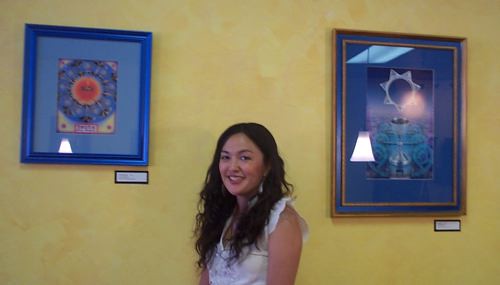
Hoshi Hana at her art opening July 16, 2006 at Petals Salon.

I first met Hoshi Hana in March of 2000, when I was about to embark upon my eight month coast to coast performance tour. She and four of her former classmates from San Francisco Art Institute offered to help me mat the art prints I had made to sell. They were fast; they knew what they were doing, and they all had fascinating stories and projects. It was an unforgettable evening.


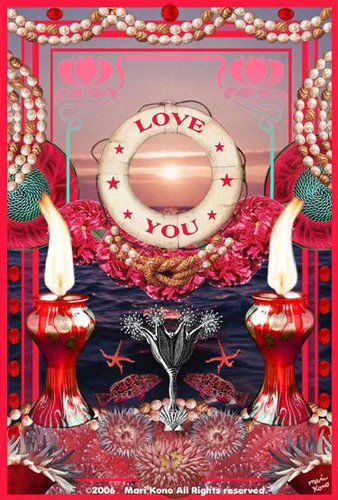
Love You, a photocollage Mari sells as an archival print.

Hoshi Hana was then doing light shows for the band Estradasphere that included slides of her amazing photo collages. She invited me to camp with her and a group of artists creating a giant flaming anus at Burning Man. She was photographing outrageous tattoos, possibly for a book. She opened an art gallery at her home overlooking the reservoir in Silverlake, and she hosted one of my story and music shows there. She visited me in Hawaii after attending surfing school. Since then, Hoshi Hana fell in love with snowboarding, sold her city home and moved to the mountains east of Los Angeles. She’s been making paper collages and framable archival prints of her work, which are available at her site.


Integration, an archival print I displayed in my home in Hawaii.

Here is her artist statement:

Inspired by psychedelic art of the 1960s, Tibetan mandalas and fantasy illustrations from faerie-tale books, my collages are intended to release more love, understanding and compassion into the world. My palette includes self-generated digital images, in combination with materials gathered from books and magazines, found scraps, wrapping paper, glitter, paint, rubber stamps and dimensional objects. As I work, I pray that my collages might instill a sense of mystical pleasure in all who encounter them.


Gray Healing, a paper collage and an example of Hoshi Hana’s tasteful and original matting and framing, in situ at her show at Petals.

And a brief bio:
Hoshi Hana is a collage artist born and raised in Los Angeles, California. She has exhibited her work at museums and galleries across the U.S., including the Honolulu Academy of Arts, the San Jose Museum of Contemporary Art, Spirit Square in Charlotte, North Carolina and Intersection for the Arts in San Francisco, California.


Butterfly Girl, an image combining the ecstatic, the retro, the mysterious and the natural elements typical of Hoshi Hana’s collages.

Today was the opening of a new show, this time at Petals, a chic nail salon in Little Tokyo, downtown LA. “The pieces are easier to see this time,” she told me, thinking back on her very recent show at the Blue Hen Vietnamese Restaurant in Eagle Rock, although I thought that, too, was a charming venue.

Her show will be up for the rest of the summer at:
Petals Nail Salon
Honda Plaza in Little Tokyo
408 E. 2nd Street
Los Angeles, CA 90012
(213) 620-9960


Hoshi Hana’s wood, paper and fabric hearts dot the walls of Petals Nail Salon.

Ira Ono


Ira Ono holds one of his shadow box collages.

I met Ira Ono when I first moved to Maui in 1974. We were all Maui Family in those days, but I soon discovered that Ira and I both had paternal grandfathers with the same last name, who came to New York City from the same area around Kiev before the turn of the century. So, we determined, we are cousins.


Ira Ono, artist Sally French, Alicia Bay Laurel, fiber artist Pam Barton

Ever graceful, gracious, grateful, Ira never loses his cool. And he is absolutely the first guy I EVER knew who shaved his whole head on purpose.


Ceramic masks on sticks for garden decor

Some artists have a single running signature through their art, but Ira has many. One is the long faced, decorated mask that he produces in raku-ware ceramic. Another is is Japanese paste paper, made from dollops of blended acrylic paint and wallpaper paste mushed around on paper and textured with combs made from discarded credit cards. Strips of this become backgrounds for his collages and elements in his array of gift items, including blank journals.


An elegant “feng shui compliant” collage.

Ira collects little things he calls “goo-gahs,” parts from board games, small toys, pieces of machines, spiritual icons, measuring tape ribbon, cookie fortunes, postage stamps, all of which become elements in his mysterious large shadow box collages. Ira uses gold and silver powder to stencil designs on his painted wooden gift items (dream boxes, rainbow man christmas decorations, dragonfly magnets, for example). And Ira is a master at displaying his work in stores, and in his own semi-open air gallery in Volcano, employing fabrics and props with panache. A professional dancer since his teens, Ira’s got all the moves, and, at 61, he photographs exquisitely.


Dream boxes stencilled with gold and silver powders.

Ira is legendary in Hawaii not only for his art but for his scintillating public personna. At the first

“Feast or Famine” all Maui juried art show at Hui Noeau Arts Center, Ira danced into the opening night festivities on a rope, wearing nothing but Speedos, catsup, mustard and chocolate sauce.


Bedecked in flower leis, Ira and his twin brother Billy celebrate their 60th birthday with sixty friends. Between them is Billy’s wife Andrea.

Yearly on Maui, Oahu and Hawaii islands, Ira juries his invention, the Trash Art Show, which touts the virtues of recycling and invention, while entertaining hilariously with a trash art fashion show on opening night. He’s still got one of the winning pieces in the kitchen of the studio – a naked man doll made entirely from bottle caps.


Decorated masks displayed with eyecatching fabric in the Ono style.

So, do you think Laura Bush would have any of Ira’s art? She does. Ira’s bird tree ornament (feathered with color copies of antique Hawaiian postage stamps) was selected to decorate the White House Christmas tree in 2003.


Another birthday, swathed in leis by loving friends in true Hawaiian style

Ira opened Volcano Garden Arts, his studio/gallery in Volcano Village on the Big Island in a historic estate, and you must visit it when you drive up to Hawaii Volcanoes National Park. You never can tell what might be going on at Volcano Garden Arts. He hosted a couple of my music and storytelling shows there, and I gifted him on his 60th birthday with two hours of guitar music for his grand and memorable fete.

Ira’s a vegetarian, so, for Thanksgiving one year, he rescued a male and female turkey, and gave them the run of his lot. He complained that they were copulating constantly.

America The Blues

America The Blues
Lyrics and liner notes by Alicia Bay Laurel
from her third CD What Living’s All About

Podcast of America the Blues

This is a song about speaking truth to power—not only to despots, but to our own collective power. The operative lyric here is VOTE. If everyone who could vote actually did vote, we could elect representatives who would work with us to reverse the vast environmental, public health, diplomatic, and human rights problems we earth-dwellers face, and make this a sustainable, joyful world for all who live in it, now and in the future. To vote well, we need truthful media (for example Truthout.org or Commondreams.org.) Also, we vote daily with our money; we need to support businesses that further sustainability and social justice, and boycott the rest. We need elections with publicly-funded election campaigns and hand-countable paper audits. Thank you.

Katharine Lee Bates wrote the lyrics to American the Beautiful on July 4, 1893; the melody comes from the hymn Materna, composed by Samuel A. Ward in 1882. Ms. Bates, a professor of English literature at Wellesley College, prolific poet and author, and ardent feminist, lived openly as a lesbian with her lifelong partner, Katharine Coman, Dean and professor of economics at Wellesley.

Curiously, the lyrics to America the Blues also revealed themselves on July 4th, 2003, while I was registering voters for the 2004 presidential election.

Arranged by Alicia Bay Laurel and Ron Grant, Singing and Speaking Vocal, Rhythm Guitar: Alicia Bay Laurel, Speaking Vocals: Jody Ashworth and Jessica Williams, Vocal Harmonies: Alicia Bay Laurel, Ron Grant and Jody Ashworth, Electric Guitar: Nels Cline, Electronic Symphony Orchestra: Ron Grant, Upright Bass: John B.Williams, Drums: Enzo Tedesco

America, the beautiful,
You’re thorny as a rose:
Radiation, global warming
Poisoned food from GMOs.
Your poor die sick and hungry,
And your wealthy live tax-free,
While they murder ancient forests
The soil and the sea.

America, America,
Greed sheds disgrace on thee.
Vote corporations out of power;
Revive democracy
For future generations
And human decency.

America, don’t blow it
All to smithereens.
You don’t need nukes; you don’t need slaves,
And you don’t need gasoline.
What you do need is compassion,
And respect for human rights,
Permaculture, sustainable systems,
Mediation instead of fights.

America, don’t wave that flag
To con us with your jive.
If the multi-nationals have their way
Even rich folks won’t survive.
We’re all family here on this planet,
So lay down that smoking gun,
And start sharing with your neighbors;
There’s enough for everyone.

I pledge allegiance to the earth
In the myriad stars of the universe
And to all the beings who upon her stand
One family, indivisible,
With liberty and justice for all.

America, America,
Greed sheds disgrace on thee.
Vote corporations out of power,
Revive democracy
For future generations
And human decency.

Don’t wave that flag at me;
Try human decency.