At Koki and Ayako’s Place


Koki Aso and his beautiful bride Ayako, who he has known since high school, live in a traditional Japanese house in Hayama, on the outshirts of Kamakura, walking distance from the beach. They just got married last Saturday. He’s a journalist and she’s a dental hygienist. Like me, they are both born in the sign of Taurus in an Ox year. We are earth people. I will be their guest for the remainder of my stay, other than a weekend at Doshi (a mountain camping retreat) and a week in Okinawa.


On my first day after returning from Ohshima, I meet again with Takashi Kikuchi, the editor of Hachi Hachi (eight eight), a permaculture magazine, and Maki Ozawa, who is interpreting for him while he interviews me. We sit in Aso-san’s airy living room.

There are signs of Koki’s art- and nature-loving being all over the house:


Bag on the kitchen wall: “Recycle to save our birds, animals, children and earth.”


Towel by the bathroom sink: “No music, no life,” hanging from a piece of driftwood.


His kitchen chair, a log section with a Kona coffee bag on it.


Outside, a surfboard next to a bonsai. A perfect metaphor for Aso-san’s life.


The old style hibachi in the living room.


Koki blows through a section of bamboo to fire up the hibachi, and he grills brown rice mochi (rice popover) for me. He’s a very good cook of traditional Japanese food, and makes his own miso.


Ayako pickles eggplant, cucumber, carrot, onion and daikon in a large ceramic crock full of a doughy brine of rice flour, bonito flakes, beer, kombu (kelp), chili, garlic and salt which she kneads daily. They tell me their grandparents’ generation prepared these foods, but that few modern Japanese do.


When the mochi is puffy and soft, Koki wraps it in nori (sea vegetable paper) and adds a little shoyu (soy sauce) and Eagle-Crow chili sauce, the Japanese Tabasco. Delicious!

Goodbye, dear Ohshima


On our last day in Ohshima, Tammy, Mayumi and I use the tickets to an oceanfront hot springs that Mika so kindly gave us. Enchan drove over to take us to the hot springs and then to the pier. Here we are: me, Mika’s son Moto, Mayumi, Enchan and her daughter Mani, and Mika, in front of Mana’s house.


We present our tickets at the hot springs.


Enchan and Mani in the hot springs pool overlooking the sea.


We stop to say goodbye at the house Mr. Aoyama is building. It’s almost done.  Aoyama-san is at the door, Kaori is upstairs, and Tomo dances in the front yard.


It’s the same ship we arrived on: The Camellia, named for Ohshima’s famous winter blooms.


To our surprise, a group of our new friends come to the pier to bid us goodbye. That’s Mika’s older son, plus Fusako Ogata, Mayumi, little Moto, Edo, who did the sound for our concert, me, and Mika.


Hiro, who met Mayumi and me when we arrived and took us to the mountain hot springs, came down to wish us goodbye. She’s on the left, then Enchan, Edo, Moto, Mika and Fusako. We have tears in our eyes, waving goodbye from the ship.


Then our ship sails off and Ohshima falls into the distance.


Mayumi is delighted to discover two of her friends on board the ship. That’s Foxy, Mayumi, Miya and me.


Daytime travel is in comfortable seats and takes less than four hours. We were told a typhoon was blowing, but I only experienced the most gentle rocking of the ship, truly a pleasant experience. Mayumi packed the persimmons and Asian pear that Taro gave us, and cinnamon toast she prepared from the loaf of bread that Fusako baked for our onboard snack.


The harborlights of Yokohama, including a huge ferriswheel, greet our return.

Art Space Whitehead


In the forest outside of Moto Machi, Ohshima, Tammy and I visited Art Space Whitehead, the studio/loft home of Fusako and Katsuyoshi Ogata. Fusako attended my show at Oasis the night before and invited us. She greeted us warmly with a freshly home-baked rye bread, and showed us around the studio. I enjoyed looking at Mr. Ogata’s abstract paintings and assemblages of found objects.


Typical of an urban art loft, the studio is one two-story-high room and the living space is at one end, with two floors connected by stairs.


A reed boat in the Ogata’s front yard (maybe the same one that inspired the grass hut built in the forest? Was Mr. Ogata involved in building the hut? I didn’t quite get the story.)


I bid Katsuyoshi and Fusako Ogata a fond farewell.

In the Ohshima Forest


Mana (center) leaves today for two weeks in Dharmasala, India, to work for the benefit of Tibetan refugee children. Tammy, Mayumi and I gathered with Mana for breakfast before Tammy drove her to the airport.


I am amazed at all of the interesting ferments that Mana creates—wines, pickled vegetables, fermented fruits. Mana explained the health benefits of each of her concoctions and offered us samples of the viva fruit.


Mana’s friend Mika comes over to take us hiking in the forest. Mika sells flower essences—homeopathic preparations of water inwhich flowers have soaked, and an interesting array of non-floral substances, including water inwhich crop circle grains and grasses have soaked, and water through which whales have swum. Mika presented me with a tiny cobalt glass pendant full of this last substance and says it opens the heart. She also gave us tickets to an oceanfront hot springs pool and a copy of her fascinating catalogue. I give her my CD.


The forest turns out to be the same one I visited while being photographed for the magazine interview on Monday. I didn’t have my camera then, and I’m thrilled to come back camera in hand. We walk to an ancient Japanese style rice straw hut, built by a local artist and a troup of children in commemoration of the sailing of a ancient style reed boat that landed at Ohshima last year.


Magnificent gnarled trees line our pathway.


We visit a temple to a healing goddess in the middle of the forest.

Concert at the Oasis Cafe


The Oasis Cafe’s exterior sign.

Junko Aoyama and her husband own and run the Oasis Cafe, Inn and handcraft shop in Moto Machi, Ohshima’s largest town. A dear friend of Mana’s, Junko was easily persuaded to host a dinner party and concert for me and Mayumi. Her husband, an artist and carpenter, created all of the furniture and interior decoration for the cafe and inn, as well as an impressive collection of bonsai in the cafe’s garden and ALL of Junko’s clothing. Junko is a master chef and she set an unforgettable meal before us.


Exterior of the Oasis Cafe


Interior of the Oasis Cafe


The dinner included grilled lotus root, slices of kabocha pumpkin, rice balls with ume plum and nori, grilled peppers, a vegetable stir fry with aburage (deep fried tofu), the grilled reef fish that Taro brought, and deep fried fish dumplings and mashed Ohshima potato. Next to me is Tammy, then another Mayumi, recently back from visiting Hawaii, next to her, a friend of hers, then Taro and our Mayumi.


In the red bowls, sea snail soup with sea vegetables. The trick is to remove the tasty sea snail from the shell with a toothpick without its slender tail breaking off inside the shell. Mana can do it perfectly, resulting in a four ringed spiral of snail.


Mayumi opened the show with four deeply felt songs.


I sang (and danced) songs from What Living’s All About, using the karaoke CD from the master mix behind my voice and guitar.


Tomo, who works for the Aoyamas, gave us the wildest applause.


Everyone enjoyed the show. That’s Junko, the chef/owner, seated on the right.

The Last Geisha in Ohshima


Mana selects a CD of Taro singing and playing shamisen to which she will dance.

For four years now, Mana has been studying traditional Japanese dance with Taro, and she invited me, Mayumi and Tammy to come with her to Taro’s house for her lesson. Mayumi, who has studied traditional Japanese dance for many years, was particularly thrilled to have this opportunity, and we all instantly fell in love with Taro.

Taro welcomed us warmly, and agreed to allow me to photograph her while she danced six dances for us. Mayumi said her dances reflected life on Ohshima; fisherman rowing, farmers planting and harvesting, the wind and the sea. She marveled at the perfection of every gesture in Taro’s dancing. Later Taro led us in Obon (ancestor worship festival) dance, and afterward would not let us leave without three large persimmons, a huge Asian pear, an offer of tea, and an offer of freshly caught fish. Mayumi and I declined everything but the fruit, but invited her to come to our performance that evening at the Oasis Cafe.

A slide show of Taro dancing 

Mana later told us Taro’s story. Taro was a widely respected geisha and the daughter and best student of a geisha famous throughout Japan for her dancing, singing and shamisen playing. The house where she now lives was once the geisha house where she and other geisha lived. At 74, she represents the last generation of geisha in Japan. When she was young, she charmed the husbands of many women in Ohshima. Four years ago, after her danna (patron and lover), the greatest fisherman in Ohshima, died, in desperation she took a job picking up trash at the public parks. The women who still hated her would throw rocks at her while she was working. She became dirty and bedraggled, and contemplated ritual suicide (hara kiri) with a large knife. Then Mana came into her life.

Mana, too, had been devastated by an unhappy marriage that ended suddenly, and she understood Taro’s pain. She persuaded Taro to teach her to dance, and at the same time, found other students and opportunities to share Taro’s tremendous cultural knowledge. She brought Taro to Hawaii to teach Obon dancing at the Buddhist temples. Taro was transformed by this journey and the love and appreciation showered upon her by her students. She got rid of the big knife and rededicated herself to her dance and music. Mana organized an art exhibition of Taro’s fabulous collection of handmade art treasure kimonos.


The former geisha house where Taro still lives, which survived a big neighborhood fire and is now the only traditional style house in her area of Ohshima.

To everyone’s astonishment, Taro attended Mayumi’s and my concert at the Oasis Cafe that night. No one had ever seen her at a public event before. Mayumi asked Taro for a CD of her songs, so she can practice playing shamisen with them, and Taro obliged her. It is Mayumi’s dream to play shamisen for Taro and Mana’s dancing and to tour Japan with them. I said, “What about Hawaii and California?”


Taro, Mayumi and Mana at the Oasis Cafe dinner and concert. Taro brought the rare and very freshly caught reef fishes she had offered us, and Junko, the owner of the cafe, cooked them up crisp and tender for everyone to enjoy.

A Walk in Moto Machi


Map of Ohshima tile set into a Moto Machi sidewalk.

Mayumi and I took a walk through Moto Machi, Ohshima’s largest town, and discovered a few of its treasures.


Mayumi led me up a steep staircase (so steep there were ropes to hang onto) to pray at the local Shinto shrine.


We passed a geodesic dome tea house that also sells handmade gifts.


Like Puna, Hawaii, where I have lived most of the past five years, Ohshima recognizes its active volcano as central to its identity.


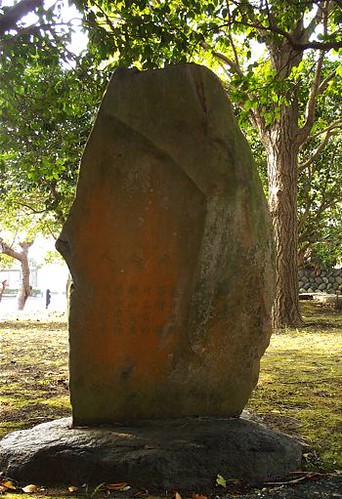
This wonderful ancient carved stone stands in a public park.


Also like Hawaii, Ohshima loves the underwater world, as witnessed by this sidewalk tile.

At Mana’s House


Today Mayumi and I moved to Mana’s house, deep in a forest, but still in town. Her house teems with life—happy guests, a frisky dog, two affectionate cats, Tibetan prayer flags, fermenting pickles, homemade cosmetics, and a sensuous two ingredient guacamole. “The avocado is like the woman, and the banana is like the man,” smiles Mana. She doesn’t have a bathtub or a shower at her place because she goes to the hot springs every day. She’s off to India for two weeks starting tomorrow to work on saving the lives of Tibetan refugee children.


Mana, me, and Tammy, a friend from Tokyo who does healing with sound and organizes spiritual and healing events. We’re sitting in front of Mana’s altar, which features a figure of Green Tara, the great Tibetan Goddess whose 21 Attibutes include Fierce Compassion, Transforming Poison, Bestowing of Abundance, Mountain-dwelling Mendicant, and Victorious Queen. How I met Mana was when she and Sachiho came to Hawaii to make a CD of songs praising Tara, I sang backup in their choir at Sea West Studios.


Here’s the guest house in the woods where I get to sleep.


Inside it’s got tatami mats on the floor, a stack of floor mattresses and quilts, a small altar of its own, and a spider as big as my hand. I ignored it and it ignored me.


The ecologically correct flush toilet: The water to fill the tank flows first from a spout into a small sink above the tank, so that one can wash one’s hands in it after flushing, and the toilet uses the gray water from the handwashing. The toilet only flushes for as long as you hold the handle down, which also reduces excessive use of water.


Mayumi Oda’s painting of the Shinto music goddess Benzaiten graces the wall of the front vestibule.

She also painted the Green Tara image on the cover of Mana and Sachiho’s album of songs praising Tara (below).

Mayumi Oda teaches at the Green Gulch Zen Center as well as at Ginger Hill Farm, her own retreat and organic farming center in Kona, Hawaii. She’s also an anti-war and anti-nuclear activist, and an artist who specializes in goddess images. Yes, of course, we know each other.


Hari, an artist friend of Mana’s made the pierced gourd light shade above the Tara statue. Indeed, her house is full of handmade gifts from friends, and her circle of friends includes many very creative people.

Enchan’s Journal

What if Living on the Earth had been drawn by a young woman artist and gardener imbued with the divine Japanese sense of design? Here are some wonderful pages from En Ando’s notebook, that offer an idea of how that would look:


Solar heated shower


Hammock from a blanket


Water catchment


Keeping chickens for eggs


Centipedes. I wonder if she mentioned that chickens love to eat them?


Snorkeling!


Bathing with a hose


Hawaii and Hawaiian songs


Working with wood


Cats


Burning to recycle

Welcome to Ohshima


Map of Ohshima at the pier.


Dawn from the deck of the overnight ship; our first view of Ohshima.


We are thrilled to be here!


Magically, Hiro, a friend of Mana’s, has arrived on the same ship and is waiting for us at the pier with her car to take us to the hot springs and the top of Mount Mihara, Ohshima’s volcano. Good thing we missed the bus!


Beside the indoor hot springs pool are showers, where we clean ourselves before entering the pool.


The outdoor hot springs pool looks out upon the summit of the volcano.


Hiro goes off to work (she’s a massage therapist), and Enchan, an artist friend of Mana’s, comes to pick us up and show us the views. Mayumi and I get up on the fence for a better look at Mount Mihara’s caldera. The last eruption occured only 20 years ago. The volcano is definitely still active.


Near the volcano visitors center, a sign showing the viewer where to look across the ocean for Mount Fuji. It’s the blue cone on the horizon, and a huge feature in the distant landscape.


The volcanic seacoast near the house where Enchan lives with her baby Mani, aged 15 months.


When we got to Enchan’s house, I took a long nap. I hadn’t slept much on the overnight ship. When I awoke, to my surprise, three people were waiting to interview and photograph me for a magazine article! Hiroshi, Maki and Takashi were good-natured about the communication mix-up, but they were also on a deadline. So, I pulled myself together, put on a lovely dress, and off we went, with Mana and Mayumi, for photos in the forest behind Mana’s house. After the magazine people left, Mana, Mayumi and I visited Junko at her very aesthetically advanced Oasis Cafe and Inn, and she served us a healing tea. Tomorrow night I will sing at the cafe.


Enchan and Mani. Mayumi and I are bedding down at their home tonight. Mayumi made pan breads with a whole wheat and raisin dough she brought from Yokohama; Enchan prepared a green salad and a pumpkin soup from her own organic garden produce and sashimi with cayenne pepper from a fish caught two hours earlier off Ohshima. Mana gave us freshly prepared brown rice, and excused herself to go teach a class. While I happily cleaned up after dinner and did the dishes, Mayumi played my guitar and sang for us.