Verna Lebow Norman and Dr. Paul A. Kaufman, at a holiday ball at Cedars of Lebanon Hospital in Los Angeles, California in 1952.
Sometimes you just know something, and you don’t know why you know it.
My parents died on the same day, August 15, 2007, on the 59th anniversary of my conception.
They hadn’t seen or spoken to one another in over 45 years, and they lived 500 miles apart.
I’d been telling my sister (who was caring for our dad), that I thought they would die on the same day, for the past three years. I was caring for Mom, and a day didn’t pass when she didn’t talk about him. She was still mad at him for things that had happened in 1962.
Mom was 87, complained of a stomach ache and went to the hospital, was diagnosed with diverticulitis and pneumonia, but died of heart failure. She’d only been acutely ill for a week. Before that, she’d been normal, that is, not particularly sick, just a couch tomato with a passal of minor complaints, for each of which she was taken to the Kaiser Clinic, scanned and blood tested, and sent home with yet another set of allopathic drugs. (She was NOT interested in natural remedies or health food.)
During the two days before she died, I visited her at the hospital and sat holding her hand in both of mine, just sending her love, since she mostly was too sedated with painkillers to speak. (When asked by the nurse, “Who is here with you?”, she managed to mumble, “It’s my daughter.”) Somehow, I did not realize she was about to die, or I would have continued sitting with her all night.
When the attending physician telephoned in the morning and told me her heart had stopped, I instantly imagined her beloved second husband Ralph, who had died 18 months earlier, reaching out his hand and asking her to dance, and she, stepping out of that old body riddled with IVs, catheter, oxygen tube and monitors, and the two of them tangoing off into the starry skies.
Mom met Ralph when she was 22 and he 25; he was her older brother’s best friend. Her parents disapproved of the match, and they each married someone else, had some kids, and afterwards were single for decades. I designed and presided at a wedding for them on Maui fifty years after they first met. They had a ball together for fifteen years. After Ralph died from lung cancer, Mom seemed tired of life.
The first person I called was my sister. I said, “Mom just died of a heart attack,” and she said, “Dad just went into a coma.” And I said, “Wow, looks like my prediction is coming true.”
Dad had wished to die peacefully in his sleep, without illness, at home in his own bed, and that’s what he did, at 96 years and 9 months, with my sister and her best friend, who had worked as one of his caregivers, holding his hands, what we used to call “dying of old age.” An auspicious and perfect death.
Now my sister and I are like mirror images, holding hands over the phone, arranging for cremations, coordinating memorials, executing wills, writing obituaries, sorting personal effects, and occasionally crying, or thinking about them.
We are blessed to have each other’s support and love through this time.
Last week she said, “All those times you used to say they would die on the same day, I just humored you. Now I wonder what else you know.” “I’ve been wondering myself,” I replied.
Here are the obituaries:
Verna Lebow Norman Nov. 2, 1919 – Aug. 15, 2007. Verna was an accomplished sculptor, painter and art instructor, and a Los Angeles resident since 1926. The daughter of C.H. and Ann Lebow, Verna was pre-deceased by her husband Ralph Norman; and is survived by three children from a previous marriage, Alicia Bay Laurel, Roberto Spinoza Alazar and Jessica Anna Mercure. A memorial is planned for October 7, 2007. Donations to Habitat for Humanity will be gratefully received.
Published in the Los Angeles Times on 8/28/2007.
Paul A. Kaufman, M.D., F.A.C.S. (96) Died peacefully in his sleep. Renowned breast disease specialist, Dean of Breast Surgery at Cedars-Sinai Medical Center. Paul’s excellence as a surgeon attracted patients and consultation requests nationally and internationally. He authored many professional publications, developed new safety devices for the OR, and took courses in pathology in order to diagnose his surgical patients himself. He made instructional films in his specialty and served as the Medical Attache to the Consulate of Chile. He saved many lives and prevented many children from an early loss of their mothers. Served 19 months in the Pacific during WWII, including seven beach landing battles. Received special commendation as the only surgeon managing 600 casualties after a kamikaze plane hit his ship. After retirement Paul served as an expert medical witness and studied computer technology and mathematics. He was a gifted photographer and an avid reader. In his last years his sense of humor, warmth and vitality in the face of illness made him many lasting friendships. He will be missed. Survivors include daughters Alicia Bay Laurel and Jessica (Wes) Erck, son Roberto (Melanie) Alazar and their daughter Rachel; nephews (including a close relationship with nephew Dr. Saul Sharkis of Johns Hopkins University), nieces and their families: grateful patients: devoted friends, colleagues and caregivers including Alicia Enciso, his housekeeper for 35 years. Goodbyes to be held September 29 in northern California; those who care about Paul may contact us at InMemoryOfPaul@yahoo.com. Donations in his memory may be made to the National Women’s Health Network, http://www.nwhn.org.
Devendra Banhart, a folkie free spirit
The ‘60s and ‘70s – obsessed musician lets his freak flag fly on a new CD.
By Richard Cromelin
Los Angeles Times Staff Writer
September 9, 2007
In Los Angeles you can take your pick of popular-music’s sacred sites, from Central Avenue near downtown to Laurel Canyon, Whittier Boulevard on the Eastside to the Sunset Strip. But from the wooden deck of his Topanga Canyon house, Devendra Banhart can drink in his own special dose of rock history.
“You see that red house there, it’s got the triangle beams, right there,” he says, pointing toward a distant ridge. “That’s where Neil [Young] recorded ‘After the Gold Rush’ and ‘Everybody Knows This Is Nowhere.’ And, as you know, 10 minutes up the road is the remains of the Roadhouse, where the Doors wrote ‘Roadhouse Blues’ and where Crazy Horse was the house band. Woody Guthrie was one of the first artists that lived in Topanga.”
All those artists figure strongly in Banhart’s music, and maybe someday the red, wood-frame house that he rents with his guitarist, Noah Georgeson, will be referenced by future students of local music lore. Unkempt and minimally landscaped, this ramshackle Xanadu is the nerve center of the international, experimental folk-music community that’s congealed around the charismatic singer-songwriter over the last five years. Banhart squirms when it’s framed that way, but he can’t easily deny that his music and his moves attract attention from like-minded musicians and a growing network of fans.
So this house, where he and Georgeson built a recording studio in the large main room on the upper story and where he wrote the songs for the album he and his band recorded here, “Smokey Rolls Down Thunder Canyon,” has seen a lot of action since they moved in, encouraged by a friend’s tarot reading, earlier this year
“At one point we’ve had 12 people living here at once,” says Banhart, rolling a cigarette on a large, round table. “We’ve had people show up, sometimes in the middle of the night. Somebody tried to crawl through my window. . . . It was harmless, but it was weird. It’s not like I sleep with a knife by my side. It was a cute hippie chick, to tell you the truth. I guess there’s worse things than that. . . . It’s still a little unnerving.”
Banhart’s fifth album, which comes out Sept. 25 on XL Recordings, is another major step beyond the quirky, minimalist folk songs that attracted his initial cult following in 2002. The music ranges from sambas to doo-wop to Jackson 5-like pop, and there’s a heavy dose of the ‘60s rock whose ghost permeates Topanga.
That ‘60s presence is no surprise. Banhart has made an impact in his corner of the indie-rock world not just as a musical force but also as an advocate of that decade’s cultural spirit. A shaman-like attunement to his surroundings and a fetish-like regard for the relics of the religion of rock are driving attributes in his makeup.
I first met Art Kunkin at the Renaissance Pleasure Faire in 1965, back when it was still a fundraiser for KPFK, my family’s radio station of preference. I was 16. The following summer he offered me my first job, doing graphic layout at the Freep. To my mind, this was the hotbed of hipdom in Los Angeles. I thrived.
Later that year, I wrote a note to my friends on the staff about some place I was traveling, and, unbeknownst to me, they published it in the Letters to the Editor. My first publication! Joan Didion saw my letter and published it in the Saturday Evening Post in her Points West column about the underground press [titled “Alicia and the Underground Press”]. The Freep actually launched my career as a teenaged author. Blessings upon you, Art!
It was only a couple of years later that Alicia wrote, illustrated and designed the boho sustainable living guide Living on the Earth, the first paperback book ever on the New York Times Bestseller List.
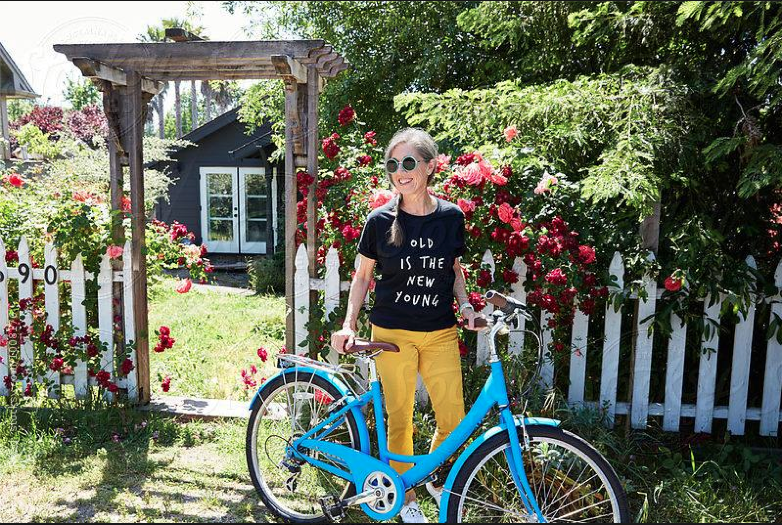
Alicia Bay Laurel currently tours as a singer/songwriter with three CDs released (psych folk, Hawaiian slack key, and jazz/blues). You can find her books and CDs, her events schedule, and her popular blog, at https://aliciabaylaurel.com.
In the morning of my last day in Fujino I took another walk using a map made by Setsuko, on a road going over a mountain pass and into another valley. From the top of the pass, I could see the Steiner School, and Lotus House quite near it.
A roadside sign with a bunny, probably about protecting the local wild animals.
The entrance to the ridge trail was well marked. I was sorely tempted, but I knew I didn’t have time.
As I descended into the next valley, I passed a busy tea farm. The owner saw me taking photos and came over and invited me to come into her home to drink some of her tea. I knew I was expected soon for lunch with friends back at Lotus House, and thanked her and did my best in my limited Japanese to explain why I couldn’t stay. I was stunned by the kindness of her offer to a mere passer-by.
The tea farm owner’s house was traditional Japanese in style, but it had a solar water heater on the roof.
Down the hill further, I got a view of Fujino’s mountain hot springs hospital. What a splendid idea.
When I returned to Lotus House, Setsuko and Jun created yet another a gorgeous luncheon on their porch, and invited over their neighbor Tomoko, the television director, and Yamazaki, a holistic healer who treats patients with acupuncture and moxibustion, teaches natural diet, and owns and runs an organic farm in Fujino from which he supplies local subscribers with weekly boxes of fresh vegetables.
Jun prepared an elaborate rice dish, with strips of fried egg, nori, and pink pickled vegetables, slices of lotus root and bamboo shoot, whole peapods, and whole tiny fried shrimp.
This amazing dish was accompanied by miso soup with chopped garden greens in it, plus a selection of cold cooked vegetables. After the delightful meal and visit with my new friends, I thanked Setsuko and Jun profoundly, and packed up the last of my bags. Jun drove me to the train station; an hour later I was changing trains in Tokyo, and heading out to the beach town of Hayama.
May 21, 2007. When I returned from my walk, Setsuko had gathered some of her dearest friends for lunch. They all were involved with the local Steiner (Waldorf) alternative school, and they all were all fans of my books. We had a lovely time together.
To my left, in red, with glasses, is Kyoko, a macrobiotic chef and teacher. She gave me a quick shiatsu massage to help strengthen me for my travels. Behind Kyoko is Hitomi, a fashion model and writer about macrobiotics. A magazine with her face on the cover appears below. Behind Hitomi (in beige jacket and glasses) sits Tomoko, Setsuko’s neighbor with the bamboo grove, and a fellow television director. Behind me, in a beige blouse and short hair with long bangs, is Naoko, an artist, actress and singer. Her art is displayed at the Steiner School. Next to her, behind me is Setsuko Miura, my hostess, and the producer of television documentaries with environmental themes. Harada, the only male guest, works as an acupuncturist and body worker. He also did a short healing session for me, right at the table. Each summer he leads a purification ceremony on Mount Fuji. He plays harmonium, he’s a devotee of Babaji, and he’s a friend of Sachiho’s. To his right, holding my hand, is Yuko Urakami, a teacher and the mother with young children at the school, and a dear friend of Setsuko’s that I met at the Natural High Festival.
Here is Hitomi as a cover girl!
It was a potluck lunch, full of surprises. I thought macrobiotic people didn’t eat potatoes (too yin), but these baby new potatoes were freshly harvested from someone’s garden, so they fulfilled the macrobiotic principals of being local and seasonal. They were exquisitely flavored with garden herbs.
I was aware that macrobiotic people like chummus. This was the first and only time I encountered this dish (ubiquitous in natural foods stores back home) during my seven weeks in Japan.
What I did expect (and I think this dish was prepared by Kyoko, the macrobiotic chef) was a hearty whole grain dish, this one with azuki beans in it. The other dish is also a potato dish, this time mashed, with rosemary garnish. Redundancy is one of the dangers of potluck meals, but both potato dishes were delicious, and quite differently seasoned.
On May 21, 2007, the next day after the Natural High Festival, I was ready for some quiet time, and went for a walk by myself (with a map drawn by Setsuko), from Lotus House around the mountain village of Fujino. First treasure I noted on this walk was a spectacular bed of iris.
Another prize man hole cover!
And a weathered fire hydrant marker.
A pond through a veil of bamboo.
A tea bush, close enough for inspection. I see the family resemblance to camellia in the leaves.
I revisited the Shinto shrine in woods near Setsuko and Jun’s fields.
This time I noticed a small separate altar to the side of the shrine.
I walked through the woods past the shrine and its outbuildings…
…and came upon the cemetery of a Buddhist temple with a wide view of the valley with Fujino town below.
Nearby buckets and ladels hung, available for people visiting the cemetery, so they could pour water upon the headstones.
Outside the temple stood a cherry tree over one hundred years old.
I could make out the outlines of the roof of the temple behind the trees.
I was fascinated by its ornate covered entrance…
…with its stylized lions and the top of the columns.
In front of temple, I stood before this statue, wondering what the role of this man in traditional garb had been. Perhaps a founder?
Beautiful Gwendolyn, gen Ypsych folk songstress extraordinaire, has just released a wonderful CD of original songs recorded in Scotland.
On this lovely CD, Lower Mill Road, Gwendolyn’s songwriting and arranging style recall the Incredible String Band, those Scottish psych folk legends of yore.
I attended her CD release party on August 7, 2007, at The Bordello, declared by City Search to be the second most “in-crowd” bar in Los Angeles. It’s in a former Mexican restaurant in an industrial area just east of downtown. When you call, the voice mail purrs, “This is the Madam at the Bordello…”
An interior wall of the Bordello, at the back of the stage. Someone had a ball decorating this bar in a sort of baroque goth style. It’s got red walls with black wainscotting and devil masks, and rows of black glittering chandeliers with red lights on the ceiling, and one room with Victorian sofas and a large nineteenth century oil painting of a reclining nude. The lighting was so low that I couldn’t quite photograph the decor without a flash, which would have spoiled it.
My dear friend Brooke Alberts, who plays recorders and pennywhistle in traditional Irish ensembles, performed with Gwendolyn’s band.
And what a band it was! Besides Gwendolyn on vocal and guitar and Brooke on woodwinds, I espied Robert Petersen on upright bass, a harpist who doubled on accordion, Douglas Lee on glass harmonica and occasionally jew’s harp, a violinist/mandolinist, and Gwendolyn’s husband Brandon Jay (behind her, so not visible in this photo) playing drums and found percussion.
On my way back to the freeway, I drove past the dragon gate to LA’s Chinatown.






 Alicia Bay Laurel
You must be logged in to post a comment.