Today I walked on Keawakapu Beach, in Wailea, Maui, with my dear, longtime friend Lynne Ross, who lives near enough to swim there daily. She leads the way.
It’s a weekend, and Hawaiian people are camping and fishing on the beach.
I look forward to preparing this red, green and gold salad, with its signature combination of sweet, savory, and spicy ingredients, for friends and family at some point in December each year. Like many holiday dishes, it’s a time-consuming production, but, unlike most holiday foods, it’s light and refreshing. It’s traditional for Christmas Eve in Mexico, hence the name.
Ensalada de Nochebuena
Eight to sixteen romaine lettuce leaves, (the number depends upon the size of the leaves and the size of the salad bowl) washed, dried in a salad spinner or by shaking the water off them into the sink, and arranged around the sides of a large bowl with the stems in the center. You can shorten the stems to make the leaves fit the bowl better, if necessary.
Dressing: juice of one orange and/or one lemon, mixed with liquid honey or agave syrup.
All of the seeds of a medium to large pomegranate
All of the sections of two navel oranges, left whole or cut into bite-sized pieces
One large jicama, peeled and cut into bite-sized pieces
One small can of mild green chiles, diced
One small sweet Bermuda or Maui or red onion, peeled and diced The diced chiles and onions can either be stirred into the dressing or into the salad.
The smaller inner leaves of the same head of romaine lettuce that you used to line the salad bowl, washed, dried and sliced or torn into bite sized pieces. Use more lettuce if you like.
Lightly toss together all of the ingredients except the big romaine leaves lining the salad bowl. Pour the tossed salad into the romaine lined bowl and serve immediately.
I love the combination of contrasting flavors in the recipe above. However, as folk traditions often do, Ensalada de Noche Buena varies from household to household. I have seen or used a variety of ingredients in this recipe, including the following:
Sliced ripe avocado
Sliced cucumber
Roasted peanuts or pinenuts, sprinkled whole on top and/or chopped and mixed into the salad
Peeled, cored, chopped apples
Peeled, sliced beets, steamed and chilled
Peeled, sliced ripe bananas
Fresh pineapple, peeled, cored and cut into bite sized pieces
I encourage you to invent your own Ensalada de Nochebuena based on what is most easily available and pleasing to your palate.
I first wrote about a simple alternative to the bloated waste and egotism of American funerary practices in my book Living on the Earth, first published in 1970. Probably I’d been sickened by The Loved One, a 1965 black comedy about people working in a large, decadent Hollywood Cemetery. More likely I couldn’t make sense of almost any aspect of my culture of origin, from nylon stockings to racism to skyscrapers.
It wasn’t until after Living on the Earth was published that I read The American Way of Death by Jessica Mitford, who was married to Bob Treuhaft, the Bay Area attorney who represented Mario Savio (of the Free Speech movement in Berkeley) and lots of civil rights cases…and me, for a while. I was very fond of Jessica and Bob, and miss them now. Jessica thoroughly skewered the funeral industry in the first edition of her book, and then returned to do it again with a revised edition in the 1990’s. She died before she finished it, and Bob, by then retired, continued working on the book until he died, too. “I never learned to type because I always had secretaries,” he told me, “but now I am using a computer. Think of that!”
Bob Treuhaft and I having dinner at Alice Water’s famed natural foods gourmet restaurant in Berkeley, Chez Panisse, in June 2000, about a year and a half before he died.
Now I’m in my fifties, and have seen a number of creative friends deal with the remains of their “loved ones.” In Hawaii, the hands-down winner goes like this: cremation, with the ashes being placed in a Hawaiian gourd urn, followed by a circle of friends and family on a beach singing songs and sharing memories, followed by the scattering of ashes into the ocean from an outrigger canoe, followed by a showering of flowers (all of which biodegrade) from the outrigger canoe into the sea. No fuss, no muss, no waste, no monuments. Nothing plastic to chock the creatures of the sea. The gourd urn can be re-used indefinitely for ash scatterings. Follow that with a shared potluck meal served on non-disposable plates and utensils washed afterwards by the guests, and you’ve got yourself a green funeral.
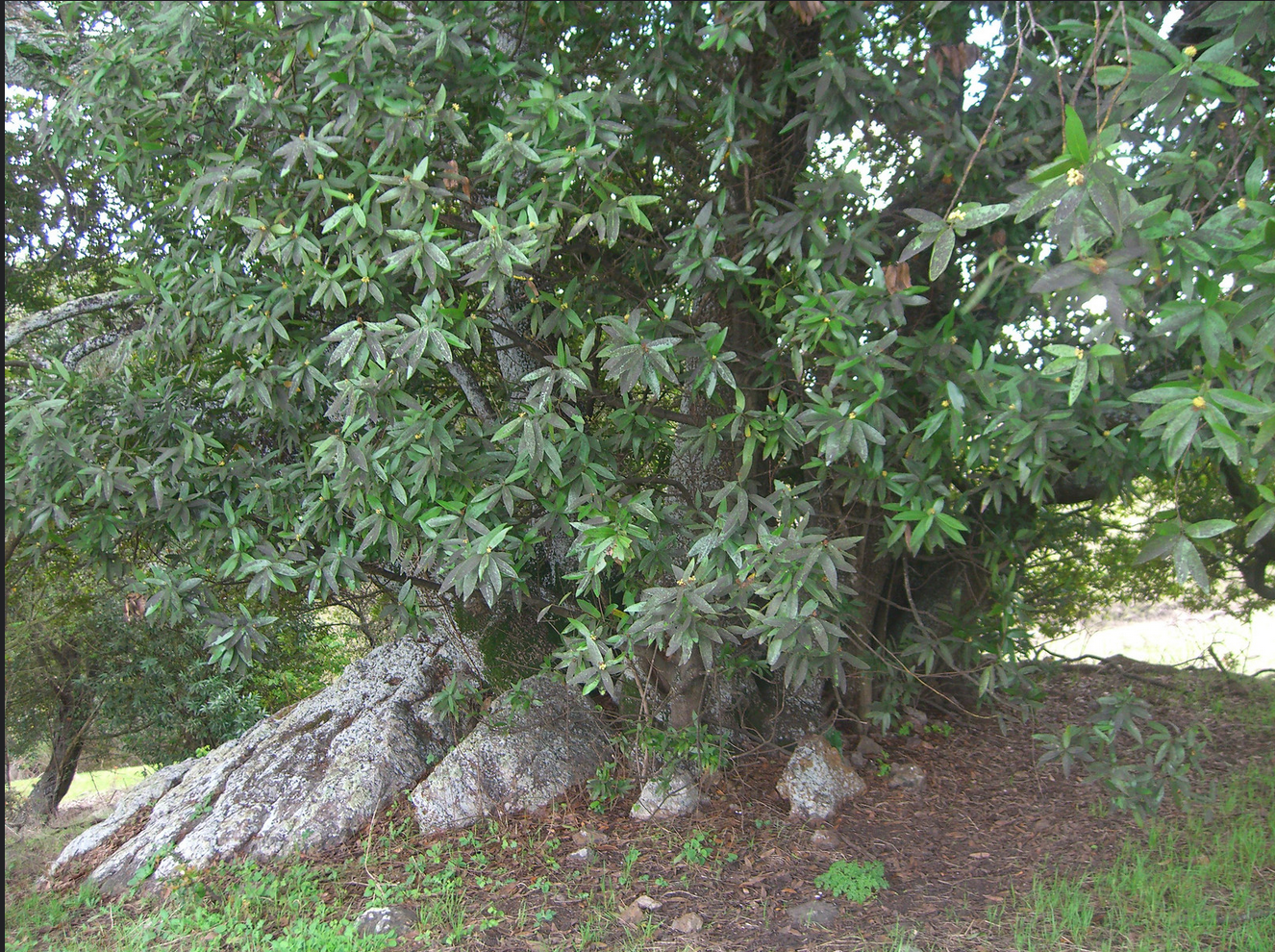
Of course, owing to my name, chosen for my plant ally that, like me, is a California native, I’ve got this other plan, should I depart from my body in California instead of Hawaii: cremation, or a mushroom burial suit, then a hole dug in a forest where California bay laurels are already thriving, place my remains or cremains into it, then a layer of topsoil, and then plant a California bay laurel sapling on top.
So, now that we have Zen Hospice, it only makes sense that we also have the Green Burial Council, an actual association that helps people find places to bury people sustainably, conserving nature, not wasting money and materials, and not using toxic chemicals that will leach into the soil.
August 18, 2000. Cross-country road tour. A few miles south of Rapid City, South Dakota, stands Mount Rushmore. I had wondered what inspired the carving of these huge neo-classical faces into a mountain. And then I realized that the mountain had faces on it already, all of them far more interesting to my eye than the four presidents. Looked at as a line-up of ten faces, the piece takes on an evolution closer to Picasso’s Les Demoiselles d’Avignon.
Later I learned the tragic story behind Mt. Rushmore, a mountain sacred to the Lakota Sioux
The Six Grandfathers (Tȟuŋkášila Šákpe) was named by Lakota medicine man Nicolas Black Elk after a vision. “The vision was of the six sacred directions: west, east, north, south, above, and below. The directions were said to represent kindness and love, full of years and wisdom, like human grandfathers.” The granite bluff that towered above the Hills remained carved only by the wind and the rain until 1927 when [sculptor] Gutzon Borglum began his assault on the mountain.
Here’s how the sacred mountain looked before it was carved:
Here is a history of the Black Hills, from a Native American point of view.
I forgot one more great hot weather fruit: prickly pears. Their flesh has the colors and flavors of melons, and this time of year they show up in the flashier produce departments (or at funky openair farmers markets, if you’re in their biome), all de-thorned and ready to eat. All you have to do is make an incision with a knife along one side and slip the skin off.
I’ve been on a prickly pear picking expedition with my friends George Wright and Rose Momsen, on the slopes of Haleakala, Maui, back in the ‘80’s. George wore electrical gloves, heavy boots, jeans and a long sleeved shirt, and he might have had something protective on his face. Prickly pears don’t just HAVE thorns. They EJECT them. So, thus attired, did George approach the cactus with a machete and a large bucket of water. The theory is that when you cut the fruit off the cactus into a bucket, it ejects its thorns into the water instead of the air. It works.
Prickly pear cactus is part of the opuntia family, and not only do its fruits taste like melon; its leaves taste like green bell pepper, and are known in Mexican cooking as nopales (noh-PAH-lez).
Here’s the killer nopales recipe page, with grilled nopales, nopales omelette, nopales salad and nopales salsa. Desert Lil has a page of prickly pear recipes, too, but they’re all about cooking the fruit with sugar. Why bother, when they are divine served raw and unadorned?
Katie Campbell, Mark Winkler, Marissa Batt, and, in the background, Andrew Pandaleon, after the show at the Celebration Theatre in Hollywood.
Tonight I went with my lifelong friend Marissa Batt to see “Play It Cool,” a jazz musical comedy set in a secret gay and lesbian bar in Hollywood in 1953. Our friend Mark Winkler wrote the lyrics for all of the songs. I remember Mark from junior high school days, and Marissa was his date for the senior prom at LA High. Mark’s recorded nine CDs of original jazz tunes and written both music and lyrics for some very enthusiastically received musicals, including Naked Boys Singing, Too Old for the Chorus, Bark!, and now Play It Cool, writing lyrics with jazz luminaries including Joe Sample, Wayne Shorter, David Benoit and David Pomeranz. Mark has toured widely, singing his wonderful songs.
I loved every aspect of this show, starting with its newness, and that, therefore, the creators of the show are still changing things from night to night to see how they might work better. That, Mark explained to me, is how all musicals are when they first open. The play, written by Larry Dean Harris and directed by Sharon Rosen, succeeded in bringing to life the denizens of the demimonde with wit, panache and pathos. All five of the singer/dancer/actors (Katie Campbell, Steven Janji, Andrew Pandaleon, Michael Craig Shapiro, and Jessica Sheridan) in the small cast dazzled us, especially through the work of choreographer Marvin Tunney.
A jazz trio (Louis Durra on piano, Al Gruskoff on bass, and Adam Alesi on drums), barely visible in the obscure back of the stage, exquisitely played standards in the style of ‘50’s jazz before and between the acts, and accomplanied the recently composed but 50’s style jazz songs for which Mark wrote the brilliant lyrics. The band did not merely accompany the show, but were characters in the play, since all of the action takes place around their gig. The set’s black on black bar interior surrounded by audience on three sides drew me into the drama, while a swirling mist that looked exactly like cigarette smoke, but wasn’t, completed the mood, fogging the lights.
After the show, Marissa and I and her cousins and friend Patti went out for a late night gourmet meal, gazing into the wild windows of the Design District. No more are gays underground in Hollywood. This is their town, and they make it so bewitchingly beautiful.
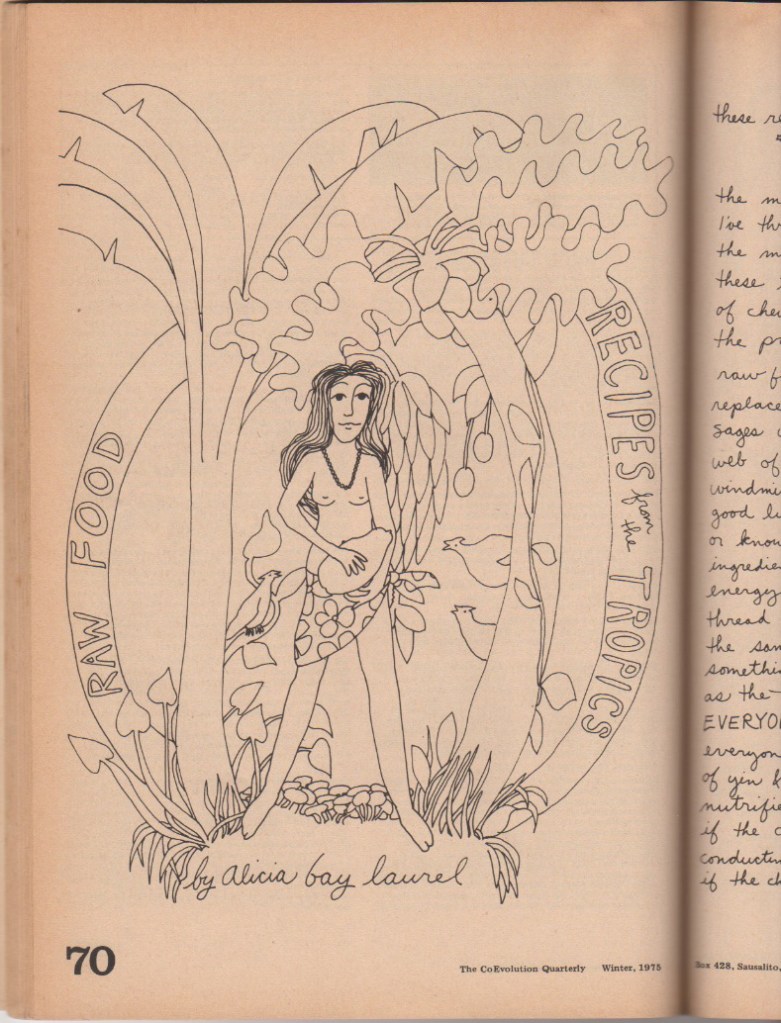
A recipe article published in CoEvolution Quarterly in 1975
Particularly cooling foods to nibble, slurp or sip during a heat wave: Watermelon Other melons: honeydew, cantaloupe, casaba Watery tropical fruit: papaya, pineapple, passionfruit Cucumber Celery Jicama Radish or daikon Fresh mint leaves or iced mint tea Young coconut water Raw non-starchy fruits and vegetables (sliced or as salads) Raw vegetable or fruit juices
I met Noriko at Hoshi Hana’s art opening last Sunday. She told me she played shamisen, and I asked when and where I could come hear her play. When I found out it would be the following Friday at Zeque (pronounced zeck-you) Sushi and Grill in the South Lake Mall in Pasadena, I called my friends and happily reserved a table for twelve. We all had a wonderful time.
Michiko, Takako, Hideko and Noriko.
The ensemble was, as follows:
In the lavender kimono, Michiko Yoshino (professional name, Bando Hiro Michiya), a traditional Japanese dancer, who sang some songs with the shamisen trio at the beginning of the set.
In the peach kimono, Takako Osumi (Kineya Yasuyo), shamisen player.
In the yellow kimono, Hideko Kamei (Kineya Kichi Kazu), shamisen player.
In the blue kimono, Noriko Britton (Kineya Roku Kensho), shamisen player.
An instrumental piece with fierce and complex rhythms.
Sometimes the songs were instrumental only and sometimes the women sang while they played. These were not songs for dance performance, but rather just for listening, Noriko explained to us later. Hoshi Hana told me that Noriko lived across the street from her parents since before her birth, and she had encouraged Hoshi Hana to learn music. “I was lousy at the koto,” she grinned. Hoshi Hana’s destiny clearly lay in the visual arts and in a world more bohemian than traditional, although she is beautifully bi-lingual.
Zeque’s appetizer specialty is a sort of giant sushi called a Mount Fuji, with three layers of rice and your choice of any three sushi toppings, two as fillings and one on top. One of these arrived with slices of avocado ornamenting the sides.
Just as we were all leaving, I saw the trio heading for the parking lot with their instruments and ran after them to photograph them one more time. So sweetly did they turn and smile.
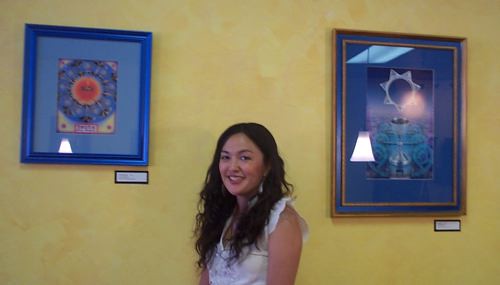
Hoshi Hana at her art opening July 16, 2006 at Petals Salon.
I first met Hoshi Hana in March of 2000, when I was about to embark upon my eight month coast to coast performance tour. She and four of her former classmates from San Francisco Art Institute offered to help me mat the art prints I had made to sell. They were fast; they knew what they were doing, and they all had fascinating stories and projects. It was an unforgettable evening.
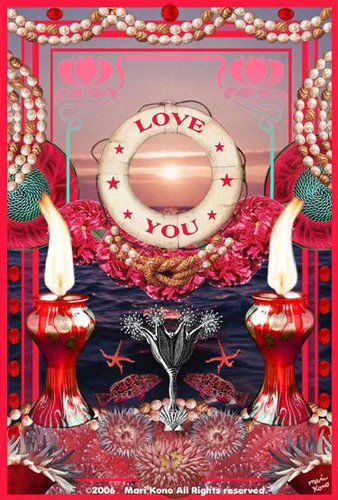
Love You, a photocollage Mari sells as an archival print.
Hoshi Hana was then doing light shows for the band Estradasphere that included slides of her amazing photo collages. She invited me to camp with her and a group of artists creating a giant flaming anus at Burning Man. She was photographing outrageous tattoos, possibly for a book. She opened an art gallery at her home overlooking the reservoir in Silverlake, and she hosted one of my story and music shows there. She visited me in Hawaii after attending surfing school. Since then, Hoshi Hana fell in love with snowboarding, sold her city home and moved to the mountains east of Los Angeles. She’s been making paper collages and framable archival prints of her work, which are available at her site.
Integration, an archival print I displayed in my home in Hawaii.
Here is her artist statement:
Inspired by psychedelic art of the 1960s, Tibetan mandalas and fantasy illustrations from faerie-tale books, my collages are intended to release more love, understanding and compassion into the world. My palette includes self-generated digital images, in combination with materials gathered from books and magazines, found scraps, wrapping paper, glitter, paint, rubber stamps and dimensional objects. As I work, I pray that my collages might instill a sense of mystical pleasure in all who encounter them.
Gray Healing, a paper collage and an example of Hoshi Hana’s tasteful and original matting and framing, in situ at her show at Petals.
And a brief bio:
Hoshi Hana is a collage artist born and raised in Los Angeles, California. She has exhibited her work at museums and galleries across the U.S., including the Honolulu Academy of Arts, the San Jose Museum of Contemporary Art, Spirit Square in Charlotte, North Carolina and Intersection for the Arts in San Francisco, California.
Butterfly Girl, an image combining the ecstatic, the retro, the mysterious and the natural elements typical of Hoshi Hana’s collages.
Today was the opening of a new show, this time at Petals, a chic nail salon in Little Tokyo, downtown LA. “The pieces are easier to see this time,” she told me, thinking back on her very recent show at the Blue Hen Vietnamese Restaurant in Eagle Rock, although I thought that, too, was a charming venue.
Her show will be up for the rest of the summer at:
Petals Nail Salon
Honda Plaza in Little Tokyo
408 E. 2nd Street
Los Angeles, CA 90012
(213) 620-9960
Hoshi Hana’s wood, paper and fabric hearts dot the walls of Petals Nail Salon.
What’s cool and refreshing, high protein, low carb, quick and easy to prepare, organic and vegan, something simple but tasty for dinner on a hot summer night? That would have to be edamame salad.
Have you never eaten edamame? Imagine tender and buttery young lima beans, only better. They are green soybeans, usually sold frozen, either in their fuzzy peapods or shelled. Japanese restaurants commonly offer edamame heated in their shells and served in bowl as an elegant snack food. (Of course, in these days of herbicide-soaked genetically modified soybeans, you must buy all of your soy products organically grown.)
I bought a package of frozen organic shelled green soybeans (edamame) this afternoon, and this evening I prowled around the Internet, looking for recipes that spoke to me.
You must be logged in to post a comment.