In the morning of my last day in Fujino I took another walk using a map made by Setsuko, on a road going over a mountain pass and into another valley. From the top of the pass, I could see the Steiner School, and Lotus House quite near it.
A roadside sign with a bunny, probably about protecting the local wild animals.
The entrance to the ridge trail was well marked. I was sorely tempted, but I knew I didn’t have time.
As I descended into the next valley, I passed a busy tea farm. The owner saw me taking photos and came over and invited me to come into her home to drink some of her tea. I knew I was expected soon for lunch with friends back at Lotus House, and thanked her and did my best in my limited Japanese to explain why I couldn’t stay. I was stunned by the kindness of her offer to a mere passer-by.
The tea farm owner’s house was traditional Japanese in style, but it had a solar water heater on the roof.
Down the hill further, I got a view of Fujino’s mountain hot springs hospital. What a splendid idea.
When I returned to Lotus House, Setsuko and Jun created yet another a gorgeous luncheon on their porch, and invited over their neighbor Tomoko, the television director, and Yamazaki, a holistic healer who treats patients with acupuncture and moxibustion, teaches natural diet, and owns and runs an organic farm in Fujino from which he supplies local subscribers with weekly boxes of fresh vegetables.
Jun prepared an elaborate rice dish, with strips of fried egg, nori, and pink pickled vegetables, slices of lotus root and bamboo shoot, whole peapods, and whole tiny fried shrimp.
This amazing dish was accompanied by miso soup with chopped garden greens in it, plus a selection of cold cooked vegetables. After the delightful meal and visit with my new friends, I thanked Setsuko and Jun profoundly, and packed up the last of my bags. Jun drove me to the train station; an hour later I was changing trains in Tokyo, and heading out to the beach town of Hayama.
May 21, 2007. When I returned from my walk, Setsuko had gathered some of her dearest friends for lunch. They all were involved with the local Steiner (Waldorf) alternative school, and they all were all fans of my books. We had a lovely time together.
To my left, in red, with glasses, is Kyoko, a macrobiotic chef and teacher. She gave me a quick shiatsu massage to help strengthen me for my travels. Behind Kyoko is Hitomi, a fashion model and writer about macrobiotics. A magazine with her face on the cover appears below. Behind Hitomi (in beige jacket and glasses) sits Tomoko, Setsuko’s neighbor with the bamboo grove, and a fellow television director. Behind me, in a beige blouse and short hair with long bangs, is Naoko, an artist, actress and singer. Her art is displayed at the Steiner School. Next to her, behind me is Setsuko Miura, my hostess, and the producer of television documentaries with environmental themes. Harada, the only male guest, works as an acupuncturist and body worker. He also did a short healing session for me, right at the table. Each summer he leads a purification ceremony on Mount Fuji. He plays harmonium, he’s a devotee of Babaji, and he’s a friend of Sachiho’s. To his right, holding my hand, is Yuko Urakami, a teacher and the mother with young children at the school, and a dear friend of Setsuko’s that I met at the Natural High Festival.
Here is Hitomi as a cover girl!
It was a potluck lunch, full of surprises. I thought macrobiotic people didn’t eat potatoes (too yin), but these baby new potatoes were freshly harvested from someone’s garden, so they fulfilled the macrobiotic principals of being local and seasonal. They were exquisitely flavored with garden herbs.
I was aware that macrobiotic people like chummus. This was the first and only time I encountered this dish (ubiquitous in natural foods stores back home) during my seven weeks in Japan.
What I did expect (and I think this dish was prepared by Kyoko, the macrobiotic chef) was a hearty whole grain dish, this one with azuki beans in it. The other dish is also a potato dish, this time mashed, with rosemary garnish. Redundancy is one of the dangers of potluck meals, but both potato dishes were delicious, and quite differently seasoned.
On May 21, 2007, the next day after the Natural High Festival, I was ready for some quiet time, and went for a walk by myself (with a map drawn by Setsuko), from Lotus House around the mountain village of Fujino. First treasure I noted on this walk was a spectacular bed of iris.
Another prize man hole cover!
And a weathered fire hydrant marker.
A pond through a veil of bamboo.
A tea bush, close enough for inspection. I see the family resemblance to camellia in the leaves.
I revisited the Shinto shrine in woods near Setsuko and Jun’s fields.
This time I noticed a small separate altar to the side of the shrine.
I walked through the woods past the shrine and its outbuildings…
…and came upon the cemetery of a Buddhist temple with a wide view of the valley with Fujino town below.
Nearby buckets and ladels hung, available for people visiting the cemetery, so they could pour water upon the headstones.
Outside the temple stood a cherry tree over one hundred years old.
I could make out the outlines of the roof of the temple behind the trees.
I was fascinated by its ornate covered entrance…
…with its stylized lions and the top of the columns.
In front of temple, I stood before this statue, wondering what the role of this man in traditional garb had been. Perhaps a founder?
Beautiful Gwendolyn, gen Ypsych folk songstress extraordinaire, has just released a wonderful CD of original songs recorded in Scotland.
On this lovely CD, Lower Mill Road, Gwendolyn’s songwriting and arranging style recall the Incredible String Band, those Scottish psych folk legends of yore.
I attended her CD release party on August 7, 2007, at The Bordello, declared by City Search to be the second most “in-crowd” bar in Los Angeles. It’s in a former Mexican restaurant in an industrial area just east of downtown. When you call, the voice mail purrs, “This is the Madam at the Bordello…”
An interior wall of the Bordello, at the back of the stage. Someone had a ball decorating this bar in a sort of baroque goth style. It’s got red walls with black wainscotting and devil masks, and rows of black glittering chandeliers with red lights on the ceiling, and one room with Victorian sofas and a large nineteenth century oil painting of a reclining nude. The lighting was so low that I couldn’t quite photograph the decor without a flash, which would have spoiled it.
My dear friend Brooke Alberts, who plays recorders and pennywhistle in traditional Irish ensembles, performed with Gwendolyn’s band.
And what a band it was! Besides Gwendolyn on vocal and guitar and Brooke on woodwinds, I espied Robert Petersen on upright bass, a harpist who doubled on accordion, Douglas Lee on glass harmonica and occasionally jew’s harp, a violinist/mandolinist, and Gwendolyn’s husband Brandon Jay (behind her, so not visible in this photo) playing drums and found percussion.
On my way back to the freeway, I drove past the dragon gate to LA’s Chinatown.
I sing at the opening party of “Dancing with Nature,” my multi-decade retrospective solo art exhibition at Sison Gallery in Shibuya, Tokyo on September 1, 2018. The event was filmed as part of a television documentary about my life and work for Asahi Television.
I am wearing a wool jersey dress printed with the pages of my book, Living on the Earth. Both the dress and the fabric were designed in 2007 by fashion designer Aya Noguchi, the owner of Sison Gallery
Marinated from birth in the world music, political folk music, classical music, jazz and Broadway tunes my parents played on the hi-fi, I succeeded (after two years of begging) in starting piano lessons at age seven, played a credible version of the Bumble Bee Boogie by age twelve, and was levitated into learning folk guitar and writing songs after seeing Bob Dylan play his powerful protest songs, shortly before I turned fourteen. A couple of years later, my cousin Jan Lebow married John Fahey, and one day I approached him when he was bored at a family party and persuaded him to teach me the basics of open tunings in the next two hours. I practiced like crazy, and that became my sound.
Most of my musician friends played rock and roll, so I was overjoyed when I first visited Hawaii in 1969 and discovered that open-tuned guitar finger-picking was part of the national music.
In 1974, I moved to Maui. There I learned to play slack key guitar and sing Hawaiian songs in Hawaiian from the family of recording artist G-girl Keli’iho’omalu, especially her mother, legendary singer, hula teacher and choreographer, Auntie Clara Kalalau Tolentino. I learned slack key guitar from Clara’s son-in-law Jerome Smith in Hana, and from Uncle Sol Kawaihoa in Wailuku.
In the early ‘80’s, I began playing in restaurants and bars for tourists in Hawaii and in northern California. Over a period of twenty-eight years I studied vocal technique with seven teachers, including pop singer/songwriter Pamela Polland. I also took lessons, at least one, and sometimes many, from an uncountable number of guitarists – including a couple of years of weekly lessons from renowned Hawaiian jazz singer/guitarist Sam Ahia.
My lifelong love of slightly sardonic vocal jazz (the first LP I bought at age 13 was “Local Color” by Mose Allison) led me to learn a repertoire of jazz standards and the jazz chords I needed to accompany myself. In the late ‘80’s I started playing at weddings and learned love songs of many genres. From 1988 to 1999 I owned a wedding business on Maui that put on 3000 weddings, and I sang at hundreds of them, sometimes accompanying a troop of hula dancers.
In 2000, Random House released the thirtieth anniversary edition of Living on the Earth. I sold the wedding business and created for myself a national book tour: a twice-cross-country road tour for eight months, delivering 75 performances of Living on the Earth: The Musical, an original one-woman, two-act show of quirky, edgy stories about the birth and aftermath of my book, and some of the songs I wrote during these times. I self-produced Music From Living on the Earth, a solo CD of the spiritual and nature-inspired songs I wrote while creating the book, to sell from the bandstand, and, to my astonishment, it was not only reviewed but selected as an album pick on All Music Guide. Then Gerald van Waes’ psychedelic folk radio show in Antwerp, Belgium, “Psyche Van Het Folk,” started playing it. Then EM Record in Osaka, Japan released it, as a CD in 2005 and as a vinyl LP in 2015.
When I returned to Hawaii from the tour, I self-produced Living in Hawaii Style, a CD of half original Hawaiian-style songs and half historic Hawaiian songs, mostly slack key guitar and tropical jazz. The CD features my former teacher, Sam Ahia, arguably the best jazz guitarist/vocalist in the islands, and Lei’ohu Ryder, a reknowned spiritualist and chanter with a string of fantastic CDs of her own. This CD got airplay both in Hawaii and on the legendary Ports of Paradise radio show in California, was re-released by EM Records in Japan, and, in July 2002, I was the only woman headlining at the Big Island Slack Key Guitar Festival in Hilo, Hawaii.
Two of my music mentors are avant-garde improvisational musicians. Ramón Sender Barayón, one of the founding composers of the San Francisco Tape Music Center in the early ‘60’s, and co-designer of the Buchla Box, the first synthesizer built on the west coast, who I met, during the time I was writing Living on the Earth, at Wheeler Ranch commune, co-authored a book with me, Being of the Sun, containing his wealth of knowledge about drones, modes and tunings, plus songs and chants we composed together and separately, celebrating the cycles of nature. In 2013, I arranged to have the 1973 reel-to-reel recording Ramón had made of us performing music from our book digitized and remastered, and released it as a CD, Songs from Being of the Sun.
In the late ‘90’s, I began partnering with Joe Gallivan, a stalwart of the free-jazz world in New York and in Europe. He developed a sound vocabulary for the MiniMoog synthesizer, worked with Robert Moog as the test driver of the Moog drum, and was among the first to play these instruments in a jazz setting, including in the Gil Evans Orchestra for two years and in a trio with legendary organist Larry Young for three years. Joe lead bands full of extraordinary players throughout his adult life. An entire section was devoted to him in the 4th edition (1998) of the Penguin Guide to Jazz on CD.
While my first CD, Music from Living on the Earth, contains a choral arrangement of my song “In the Morning” by Ramón, and my sixth CD, Songs from Being of the Sun, is entirely a collaboration with him, Joe’s influence is most evident in my 3rd release, What Living’s All About, recorded by Scott Fraser (audio engineer and producer for the Kronos Quartet) and a fabulous line-up of session players, notably avant-garde guitar legend Nels Cline (best known as the guitarist with Wilco, and who I met when his band opened for Joe Gallivan’s band at the Bell Atlantic Jazz Festival in New York City in June 2000), and John B. Williams, bassist for Nancy Wilson, the Manhattan Transfer, the Tonight Show Big Band and the Arsenio Hall Show Band. I co-produced the CD with Ron Grant, an Academy Award winning film composer, who arranged and conducted some of the material, but I also relied heavily upon the improvisational skills of these great players, and they surpassed my expectations.
From 2006 through 2019, I performed twelve concert tours in Japan, and produced/recorded/toured five more albums, bringing the total to eight (as of 2023). Two of the albums, Beyond Living and Alicia Bay Laurel – Live in Japan, included tracks recorded in Japan with Japanese musicians and recording engineers. Joe and I began living part time in Spain, and the 7th album, More Songs From Living on the Earth, included tracks recorded in Spain, with Spanish and British musicians. Like my first album, Music from Living on the Earth, the songs were composed around the time I made the book Living on the Earth, but this recording is richly collaborative instead of solo, and the songs, more romantic and passionate.
I also recorded by 5th album, Living Through Young Eyes, a solo instrumental guitar CD of songs I loved and learned during my first 25 years, as a memoir of my youth. It includes four medleys of folk songs I sang during my childhood, one medley of early ’60s rhythm and blues tunes, one medley of hippie anthems, one medley of protest songs, and one medley of historic Hawaiian melodies.
In 2021, I collaborated with Spanish filmmaker Luis Olano on the movie version of Living on the Earth: The Musical, which he filmed in November 2016 while gathering material for Sender Barayón: Viaje Hacia la Luz his documentary about the life and work of Ramón Sender Barayón, who makes a guest appearance in my show, singing with me for the first time in 43 years.
In addition to the two songs Luis Olano licensed for his movie Sender Barayón (1966 and Surviving in Style), some others that I wrote have been licensed for movie soundtracks, including New Years’ Eve Party (aka Goodbye 1974) for S.J. Chiro’s award-winninng feature-length dramatic film Lane 1974, and Sometimes it Takes a Long Time for Shinji Tsuji’s 2014 documentary Embracing the Seed of Life, about the life and work of environmental activist Vandana Shiva.
Here’s the part about me in the program notes, with a photo from my set at the Happy Flower Beach Party music festival in Nago, Okinawa, last October 2006.
The program includes a map of Doshi Camp. There’s a little fire icon next to the dark blue circle with the number 7, where I played at the bonfire concert on the night of May 19th. Next to the purple circle with the number 3 is the tent where I would do my second show, a story and music show on May 20th. My table was in the same tent as Greenpeace and Kurkku, adjacent to the festival information booth, right across the road from the #3 tent and the pond.
On the second morning of the festival, a friend of Setsuko and Jun’s, Masahiko Sano, came over to Lotus House and presented me with a piece of charcoal he made. Masahiko owns and runs a couple of businesses, is married and has a couple of kids, and he’s been a big wave surfer for twelve years and was an extreme skateboarder for five years before that. Making charcoal is his hobby and humanitarian cause. He says it clears away bad vibrations and creates centers of positive energy. He told me that he will dig a hole in the earth and fill it with charcoal to create a power spot. Masahiko makes his charcoal from ubamegashi, the hardest wood in Japan. He had installed pieces of charcoal underneath Lotus House both to reduce moisture in the house, and calm the vibrations in it. It seems to be working!
When we drove over the high mountain pass on the way from Fujino to Doshi, I was awed by a fairly close view of Mount Fuji in its startling symmetry and majesty.
My show at the festival that day was filmed for Midori no Kotonaha, Setsuko Miura’s ecological TV documentary series, to be broadcast a fews weeks later on Asahi Broadcasting Station. I told the story of how I came to create my book Living on the Earth when I was a teenager in the late 1960’s, and what happened afterward, and I performed tunes from my CD Music From Living on the Earth, a collection of psych folk songs and instrumental guitar pieces I composed during that period of my life.
After my show, Setsuko, Sayaka (the director), and Jun (the cameraman) continued working on the documentary with me. They interviewed me, and they filmed pieces of my art, mostly from my book, but also five drawings they commissioned for the show. They also integrated recorded music from my first CD.
After the interview, I met three wonderful new friends. On the left of me is Jun Hoshikawa, Executive Director of Greenpeace Japan and author and translator of dozens of books, both fiction and nonfiction, all with an environmentally conscious point of view. On the other side of me is Keibo Tsuji Oiwa, an anthropologist, teacher, author and translator who teaches International Studies at Meiji Gakuin University in Yokohama. I recently read (and highly recommend) a book he co-authored with David Suzuki titled The Other Japan. Next to Keibo is Natsu Shimamura, the author of books on Slow Food, and, along with Keibo, a leader in the Slow Life movement. They invited me to Cafe Slow, the Slow Food cafe they founded in the Kokubunji suburb of Tokyo.
I got a hug from fellow back-to-the-land author Sherpa, and we tried to take a photo of our faces together with my camera. See the bicycles on his head scarf?
This gorgeous gent is a well-respected yoga teacher, but I forgot to write down his name. I hope we meet again!
At the end of the second day of the festival, the tents surrounding the pond quickly disappeared…
..but one last tent was still broadcasting music, and this lovely girl danced to it, twirling her poi balls.
As dusk settled upon the Doshi campground, I could hear rumblings in the forest from the main stage of the Natural High Festival.
Earlier I had watched them set up the instruments for the first band…
…and run a sound check.
At night, the stage glowed, and the bands set the people to swaying and dancing.
People were still coming by my booth. We were all bundled up against the cold mountain night.
Morio Takizawa, one of the organizers of the festival, and a close friend of my host in Tokyo, Koki Aso, came by with his wife and daughter.
Near the stage, a charmingly fractured English eco-poem on a huge banner.
After the last band on the main stage, the people gathered around a bonfire in a nearby clearing.
The first entertainer was a Nepalese Rastafarian singer-songwriter. The setting suited him perfectly; he didn’t need a sound system, and he just relaxed with the audience and sang his songs. They loved him.
By the time he was finished, the sound system was set up at the tent near the bonfire, and the band Dachambo played their folk/reggae/rock songs. They are friends and collaborators of Sachiho Kudomi’s.
The whole band sings!
I came on after Dachambo. That’s Nambei-san, the chief organizer and audio engineer of the festival next to me, talking to the audience. I needed a translator, and I got a great one, who simply volunteered at the last minute: Jun Hoshikawa, the Director of Greenpeace Japan. He had lived on a hippie commune in California and at an ashram in India in the 1970s, he knew my book, had translated dozens of books, and wrote quite a few as well. He is erudite and witty. It worked out perfectly.
Wandering along the forest path, the next booth I encountered was festooned with indigo tie-dyed clothing. This color has special meaning for me. I named my business Indigo With Stars, as this is my answer to the life path question What Color is Your Parachute? Indigo with stars is how I represent the night sky, which is our constant, visible evidence that we live in an infinite universe. I consider the infinite universe the source of my sustainance, so that is how I chose the name of my business.
So, here, at this booth, I could be clad in a hoodie of indigo with stars!
And henceforth tote my belongings in indigo with stars (and a lotus!)
So, I bought them from these four women (collectively called Toshka) who made these magical indigo garments and sachels.
Next Jun introduced me to his friends, who were selling musical instruments from their booth at the festival. Left to right: Masaomi Ito plays didgeridoo. Teppei Saito makes musical instruments, some of which strain one’s incredulity. Me, happy to meet them all. Aya Uegaki, bead worker.
For instance, here is Teppei’s three-person didgeridoo, being played by Teppei, Masaomi and Aya.
And here is Teppei’s community-sized kalimba with a huge open resonator.
By now, the good folk at Kurkku were wondering when I would ever come and open my booth. So, I borrowed a tie-dyed sheet from my friends at 88 Magazine and set everything up: the Soshisha editions of Living on the Earth and Being of the Sun, the EM Records releases of Music From Living on the Earth and Living in Hawaii Style, my own release of What Living’s All About and my Living on the Earth t-shirts, the catalog and posters for Aya Noguchi’s Living on the Earth clothing line (with the scarf as a sample), a copy of the October 2006 issue of 88 Magazine, open to the interview with me. I’m wearing a festival t-shirt from the Rainbow Festival at Aso Mountain, also printed with the cover of Living on the Earth. In Japan, my dancing goddess is the icon of the Evolution.
Across the road from my booth I could see the pond with its surrounding booths…
…and next to it, a large tent for lectures, where I would do a story and music show the next day. Today my fellow author Sherpa (who I met last year here at Doshi when I lead a weekend workshop) is being interviewed about his backpacking and hiking books. He lives in a homemade house in the woods.
On the side of the festival information booth (next to mine) hung an exhilarating poster for the Kodo Drummers tour.
On the other side of me, the Greenpeace booth offered informational DVDs and books.
Sakaya Matsukawa, the director of the television documentary Setsuko is producing about my work, visited me at my booth. Behind her, the Kurkku booth display of environmentally friendly products, below curtains emblazoned with their logo.
A lovely couple brought me a gift from their artist friend Tomoko Yamada, who had been unable to come to the festival.
She had made me a colorful mobile of satin scraps, felt and cardboard, with messages lettered in acrylic paint, and weighted with pieces of wrapped candy.
At the top, a heart with the greeting, Dear Alicia-san…
On one scrap, her appreciation, which I shamelessly replicate here.
On another, the date and place the piece was made.
And, on a sail at the bottom, more praise and her name. On the back of the sail she wrote Thank You, Alicia. So, I say, Thank You, Tomoko!! I hung it outside my booth as the rainbow of hope it is. I hope I meet you someday, Tomoko.
May 19 and 20, 2007, I attended the Natural High Festival (logo above), two hours drive from Tokyo at a campground in the forest, just outside the mountain village of Doshi. Last October 2008 I lead a weekend workshop here for Kurkku. This time, I would do two performances and sell my books and CDs at a booth. Kurkku sponsored my participation in the Festival and let me use part of their booth to sell my stuff.
Soon after Jun, Ren and I arrived, we spent our lunch tickets at the vegetarian curry booth, which Jun’s chefly nose discerned as a good choice. It was! I came back for dinner.
All around us, open-air booths, handmade clothing and drums, undulating banners, and relaxed people enlivened the forest.
An air of friendliness permeated everyone.
I could hear a tabla player drumming and chanting.
There was a booth with a banner that said “Slow Life,” perhaps from the Slow Life Cafe in Tokyo, where they serve Slow Food. Slowly.
I visited the Good News booth (on the left), where tie-dyes, batik and patchwork hung for sale.
There I met Michiyo and Takeo, the owner/operators of Good News, and signed their copy of Living on the Earth. They knew I’d be at the festival and brought it along.
They presented me with one of their peace sign wash cloths. I knew I would display it on my bedroom wall instead of wash with it. So sweet.
Next I visited the Go Hemp booth, representing the Go Hemp Store in Shibuya, Tokyo (motto: “Enjoy Life”), where they were selling hemp clothing.
To my astonishment, they, too had books for me to sign, and hugs to spare. They even had me sign a t-shirt.
They presented me with one of their adorable signature hemp t-shirts.
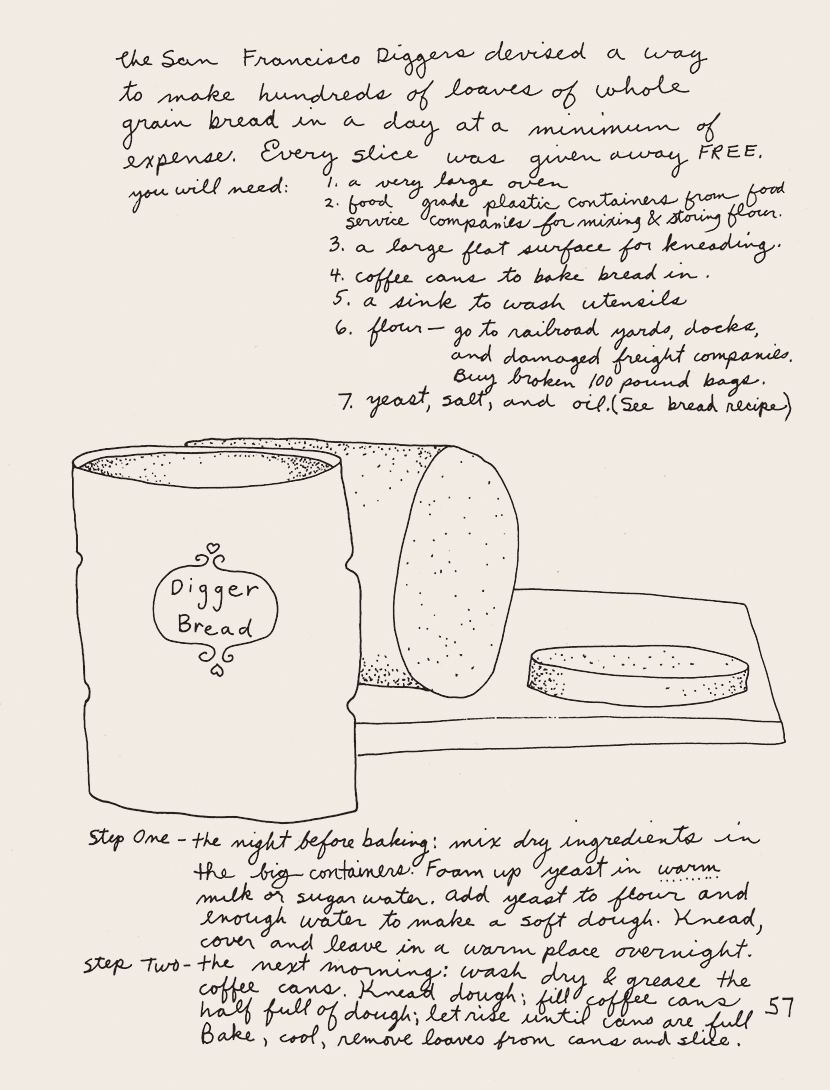
Page 57 of Living on the Earth, with the Diggers’ recipe for mass quantities of bread baked in coffee cans to serve
for free at their 2 PM soup kitchen in the panhandle
of Golden Gate Park, San Francisco, in 1967.
I was living in San Francisco the year before (1966), and, in my 17 year old eyes, it was all magic, artists and musicians, color and innovation.
I was visiting family in Ann Arbor, Michigan when the media created the Summer of Love. In March 1967, two articles about the hip scene in the Haight Ashbury appeared, one in Time Magazine and one in Esquire. Before that date, none of the freaks I met in Ann Arbor had heard of the Haight; after that date, all of the freaks I met were planning to go. Multiply that times everywhere freaks were.
When I came back after a winter of wandering, the Haight was crowded and sodden with hard drug users and dealers, winos, panhandlers, young runaways, and various religious orders trying to recruit converts. So, I settled in the houseboat haven at Gate 5, Sausalito, which, in 1967, was all magic, artists and musicians, color and innovation. Soon I began working out of my own art studio there.
I met Peter Coyote in the Haight Ashbury Free Store one day and learned about what the Diggers were doing that summer. Now THAT was magical: The response of the resident artists and musicians to the wave of human misery that was the Summer of Love breaking over the Haight Ashbury. They fed people at 2 PM, daily, they opened “free stores” that gave away donated clothing and furnishings, they started a free clinic that still operates. It was compassion in action. May the Diggers be forever celebrated in the history of Bay Area counterculture.





 Alicia Bay Laurel
You must be logged in to post a comment.