The Night Ship to Ohshima


Last night in Yokohama Harbor, at 10 PM, Mayumi and I boarded an overnight ship bound for Ohshima, a small volcanic island close enough to Tokyo to be included in its city limits, but far enough away to be another world, like Martha’s Vineyard is to Boston, or Catalina is to Los Angeles. We will visit our mutual friend Mana, who introduced us.


What you get with an economy ticket is a tatami sized piece of the carpeted area onwhich to sleep and keep your things. Mayumi and I are amused.


For 100 yen, you can rent a blanket. The black foam filled headrests are free. Pretty soon everyone is tucked in, and at 11 PM, the ship’s crew turns the overhead lights off. You can still see your way around easily with the hall lights, which remain on.


I see recycling containers everywhere I go in Japan, and the ship has six different ones at each staircase.


Toilets are traditional Japanese style; you squat, which I think is much healthier than sitting on your thighs western style, since you can actually use your abdominal muscles in a squat, and avoid straining your rectum.


There is no way I can fall asleep to the immense growling of the ships engines, so, I don’t. No one else seems to have this problem, but, so what.  The hour until the lights go out seems like as good a time as any to practice guitar. My Pro Series Traveler Guitar is practically silent, and it comes with a stethiscope (the diaphragm is built into the guitar body and the tubes to the earphones detach) so that you can hear yourself play without using an amplifier.


It’s a pretty good sounding guitar; I’ve been using it professionally for a couple of years now. It’s got two pickups with separate volume controls, one that sounds more electric and one that sounds more acoustic, and you can blend them for a third sound. It has a full sized fretboard, but the tuning pegs are in the center of the guitar (where the sound hole would be on an acoustic guitar), and the lap-rest on the bottom of the guitar detaches and then reattaches so that the guitar is ultra-compact for traveling. No one has ever hassled me about bringing it on an airplane. It’s the size of a soprano ukulele and easily fits in any overhead compartment. And it’s not an expensive guitar.

With Mayumi in Tsurumi


Man hole cover on a Yokohama city street


I am visiting musician, dancer and bodyworker Mayumi Hirai in Tsurumi, the section of Yokohama closest to Tokyo. Today she took me on a magical walk around her neighborhood.


We walked along the Tsurumi River where it flows through an industrial landscape to the sea.


We passed a little karaoke bar with a bit of everything in its decor.


Mayumi showed me three beautiful old temples, and we silently prayed at the entrace of each one.


A trio of holy statues at the entrance to a temple garden.


Before we approach the temple, we clean our hands and souls with spring water from the mountain on which the temple stands.


Dragon fountain in the temple garden.


A shrine for children next to the temple.


A Shinto shrine.


Leaving the Shinto shrine through the torii.


Down the stairs below the torii.


The Buddhist temple where the Hirai family’s ancesters lie.


The magnificent interior of the Buddhist temple.


Funerary statues in the cemetery behind the Buddhist temple.


Mayumi brings water to refresh the spirits of her ancestors.


She tenderly pours water upon the tombs of her family members.


We return to Mayumi’s apartment on a quiet side street, downstairs from her parents’ home, to which she returned five years ago after decades of travel and learning. She prepared us a scrumptuous lunch of healthful traditional Japanese foods–lotus root, edamame, tofu, sea vegetables.  Now, while I am writing this blog, Mayumi plays her shamisen. Sometimes life is just SO good.

Performing at Yukotopia Again


Tonight at Yukotopia, we blissed out to four acts, including mine. Doing the What Living’s All About show two nights in a row freed me to take new risks, especially with my choreography. I am having the time of my life.


In an ultimate act of courtesy, the club posted signs requesting that patrons not smoke until after I had finished my set. I didn’t ask for this; it’s a perk from Sandy Rothman’s residence, since he requested this on the nights he played.


First up: Catch and Release, a very large group (nine people this time, but Yuko says the personnel varies from show to show, as the group has an open policy about friends sitting in. Yes, that’s a digiridoo player on the left.) The overriding feeling was Family; the woman singing up front also works at Yukotopia tending bar, and her parents play in the group. They played trance music, that is to say, mostly, instead of songs, they improvised over one and two chord drones, although they also performed the Grateful Dead classic Uncle John’s Band.


I was next. With a sizeable contingent of the audience comprised of the members of the other three bands, the support, if possible, was even more enthusiastic than the night before. God bless the deadheads of Tokyo; they do enjoy their musicians, and the musicians appreciate each other’s work.


After me came Strange Taste, which, like me, is a singer/songwriter driven act whose songs sizzle with political outrage, humor, sex and love. Wonderful blues, reggae, singing, instrumental solos. Good fun, altogether.


Last up was Pineapple Tom, another large trance band (seven players), but this group is all about focus and sophistication, with lots of cleverly arranged musical figures, at the same time as an almost free jazz quality to the improvisation. I say “almost” because the rhythm section churned forth danceable beats, of which the audience took advantage. Good free jazz will blow your brains, but only a modern dance troupe would dance to it.


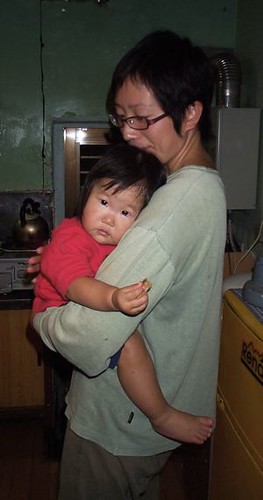
On both nights some of the deadheads brought their kids, who danced, played, and generally enjoyed themselves in the night bar scene. These two kids danced plenty, and the baby came up to me and held my hand and laughed. Yuko and Roku have three kids, and I could tell they enjoy having little ones in the club. I sure did.


Performing at Yukotopia


Tonight and tomorrow I perform at Yukotopia. I’m singing and playing guitar to a CD of ten of the twelve cuts from What Living’s All About, minus my voice and guitar tracks, prepared for me by Scott Fraser at the time he mixed and mastered the CD last spring.


What’s different about the What Living’s All About show from the shows I created for my first two CDs is that I perform them standing up, and on some of the songs I don’t play guitar. That leaves a space for a new performance realm for me: dance. I don’t leap about, but I definitely use my whole body and face to convey the song.


The first act onstage: Here’s to Theres, a bluegrass/rock/folk band celebrating its twentieth anniversary this year, and no wonder; each player astounds with virtuosity. Aki, the vocalist, has loads of personality and energy.


I played second, and the third and final act was Sandy Rothman’s Anniversary Band, with Ken and Tak on vocals and guitars. Sandy invited up the violinist from Here’s to Theres. Everyone fell into bliss listening to the string and vocal harmonies cascading from these prodigious players.


Mike Miller, brother of Tim Miller, who chaired the Communal Studies Conference, and his wife Val, live in Tokyo, where they write for Reuters News Service. At Tim’s recommendation, they atttended my show at Yukotopia. Sweet people! Val’s a folkie multi-instrumentalist, and Sandy’s band reminded her of old times when she played in a band of like mind.


The afterhours crowd at Yukotopia.

Welcome to Japan


“Cat hope welcome you cat’s happy home!”

At the end of a thirty hour day that included crossing the International Date Line and being sidelined by a typhoon, which closed Tokyo’s Narita Airport for several hours while our plane waited at the airport in Osaka, I lay my weary bones upon a floor futon in a tatami room and breathed in gratitude for Toyko’s remarkable hospitality. Dear Koki Aso waited for me for EIGHT HOURS at Narita, sweetly and cheerfully, and delivered me to Yuko Tsukamoto in North Tokyo, who waited up for me until 1:30 AM, and stayed up with me another hour to make sure I was comfortable. I am fortunate indeed to have friends such as these.

I discovered the little box above on the bathroom shelf in Yuko’s family’s apartment where I am spending four nights.

After the Communal Studies Association Conference

October begins and the Communal Studies Association Conference ends. I bid a fond farewell to my friend Tim Miller, who chaired the conference and had invited me to perform and speak at it, and who wrote a wonderful foreword to the fourth edition of Living on the Earth, chairs the department of Religious Studies at University of Kansas at Lawrence, hosted my visit to Lawrence in 2000, when I did a concert and booksigning there, lived on a rural hippie commune himself in his younger days, and has published immense amounts of scholarly research on communes through the ages. And a dear heart as well.


I drive south along Tomales Bay.


I come to the end of the bay, where the Bolinas township begins.


View of Stinson Beach, Bolinas, and Bolinas Lagoon from the cliffs of Highway One.


View of San Francisco from the cliffs of Highway One, just before I pass Muir Beach.

Communal Studies Association Conference, Day Two


Today Ramon, Delia, Art and I shared our experiences and fielded questions as a panel on northern California communes. I think the point I am trying to make in this picture is about bonding.

My sister, a psychologist, taught me that physical closeness with emotional openness (which she calls bonding) is a human need on the level of food, air, and water; certainly babies die when they are deprived of it. She says that bonding is scarce in modern societies, and that lack of bonding is the source of much of what we call mental illness. I think that the hippie communes of the 1960’s grew out of a hunger for bonding and the deep relaxation derived from an abundance of it. The bonding that we offered one another created relationships far more deep and durable than those with our blood relations, indeed, here we sat, Ramon, Delia and I, as close as family members nearly forty years after we met, due to the immensely intimate experience of living outdoors together in an anarchistic society.


I found homes for a whole bunch of my books, CDs and t-shirts among the attendees of the conference.


In the late afternoon, Nicholas Alva presented his musical Morningstar Idyll, based on the story of Morningstar commune, with songs by Ramon Sender, Joe Dolce, me, and others. Steve Fowler, an actor formerly with the San Francisco Mime Troupe, and a neighbor and long time close friend of Lou Gottlieb’s played him so closely I felt he was channeling Lou’s spirit. Delia’s son Jeremy Sharp played Ramon Sender. Nick himself narrated, and a colorful cast of Gen X and Gen Y folks sang and danced the parts of the hippie folk. I was moved to tears when the full cast sang and danced my song “Thanksgiving Hymn” (the fifth song on Music From Living on the Earth). Afterwards, the cast presented me with a bouquet.


Boats on Tomales Bay as seen from the Marconi Conference Center.

Communal Studies Association Conference, Day One


Buck Hall, the main meeting room at Marconi Conference Center, which in the 1970’s had housed one of the Synanon communites.

I arrived yesterday at the Marconi Conference Center on Tomales Bay in Western Marin County, some beautiful miles west and north of the Golden Gate Bridge, for the 33rd annual Communal Studies Association Conference, a gathering of mostly academics who research and present papers in this field.


A group of academic folk who study communes (and get a little needlework done while listening) attend one of the many presentations at the conference. We were listening to Susan Love Brown talk about a Rastafarian intentional community that flourished in Jamaica in the 1940’s.

Tomorrow I speak as part of a panel about life on Northern California communes, along with Ramon Sender Barayon (first resident of Morningstar commune, resident of Wheeler Ranch commune, author of A Death in Zamora, my co-author on Being of the Sun, and pioneer of electronic music), Arthur Kopecky (former resident of and author of two books journaling his days at New Buffalo commune in New Mexico), and Delia Moon (founder/owner of Bodega Pastures commune, former resident of Star Mountain commune, and doctoral candidate in sociology, who will presenting her documentary about communal residents.)


Ramon Sender Barayon (right) and his wife Judith Levy Sender (second from right) at lunch at the conference, along with Ruth Lambach (second from left) and Julius Rubin (left).

I guess I should qualify myself, too. I lived at Wheeler Ranch commune, founded Star Mountain commune with the advance from my first published book, lived at Packer Corners Farm commune in Vermont and participated in creating its communal book, Home Comfort, and wrote/illustrated/designed Living on the Earth, the most famous insider’s account of commune life of its time, which is still used as a textbook in college courses on the history and culture of twentieth century utopian communes. Yes, indeed. I belong here, too.


Megan Mulet presenting her paper on the gift economy at Burning Man.

One of the highlights of today’s presentations was by Megan Mulet, a sociologist from UCLA, who has been attending Burning Man the last seven years, and, in the past three, gifted her time as a census taker (her Burner nickname is “The Countess”). She spoke about the benefits of living in a gift-giving economy for those of us living in what she dubbed the “default world,” (she says that’s a Burning Man term), which is more involved in Market Pricing, Equal Exchanges, and/or Priority Status, than in Communal Sharing.


I loved presenting my show! I told stories about my communal life and how Living on the Earth came into being, plus sang songs from all three of my CDs.

So My Dad Didn’t Die After All

So last May I zoomed up to the Bay Area to see my dad, who everyone thought was about to die because he had stopped eating and lost a lot of weight. He had been moved from assisted living to my sister and brother-in-law’s house and hospice called in. My sister thought maybe he’d had a stroke that had made it hard to swallow. She tenderly encouraged him to try anyway. My brother-in-law continued to take Dad outside in a wheelchair to breathe fresh air, look at the trees, hear the birds and feel the wind. I think he appreciated all of this a lot.

One day my dad said, “There isn’t anything wrong with me, is there?” and everyone said, no, there wasn’t. “So I don’t have to die right now, right?” Dad wanted to know. “No. Not if you start eating again,” he was told. So he started eating again, gained back the lost weight, moved back to assisted living, and was in good health when I visited him today and yesterday. I think he looks great for a guy who’ll turn 96 in November.

The Music Industry Critiques What Living’s All About


Back cover/tray card of What Living’s All About with list of the songs

Taxi, a service I recently joined that sells music to record, film and TV producers, offers their songwriter members paid critiques of the songs from anonymous big time music business professionals. Taxi says they hide the names of their music biz consultants because there have been death threats!  Somehow I don’t think of songwriters as a particularly violent group, but, hey, all groups, including spiritual teachers, include a small percentage of assholes.

I sent in the ten original songs from What Living’s All About, and got some comments from four of these unnamed (but numbered) industry powerhouses, which I will share with you here. A fifth listener (#211) identifies the overall style of the CD as Jazz Cabaret, a type of music that is recently having a resurgence in New York City.

Floozy Tune: Very cool song – really good performance – I like the imagery and the approach. Vocal has a lot of feel and there seems to be a sense of knowing in the delivery – not just reading a lyric off the page. At times it has sort of a Billie Holiday-esque tease-y thing that is very fun. Music arrangement feels quite authentic and very well done – very strong playing, but mostly a real good sense of what would work for a track like this – professional. Overall, it has the feel of a jazz standard with sort of a more contemporary look at the situation than would probably be found in an older song – pretty cool. (#53)

America the Blues: Hard to place a definitive pitchable stylistic label on this one. Well played and arranged. Placement would necessitate a sympathetic political setting. Perhaps a film? (#53)

Aquarian Age Liberated Woman Blues: The title is really cool – pretty much tells the whole story right there. Nice blend of classic jazz pop and a more or less contemporary point of view. Strong vocal delivery. Good structural elements – the form is cool and natural for the vibe of the song – the musical arrangement is good – dobro guitar and more acoustic instrumentation gives it the vibe of an era. The imagery is sharp and well-defined – the continuity is really good – imagery that only someone who knows the subject could describe (“bee pollen candy” indeed). Film or TV might be a viable place to find a situational place where the blend of influences would be part of the narrative for instance. Very cool imagery and fun to listen to. (#53)

Zero Gravity: Moody jazz noir, with saxophone and vocal lines in counterpoint. Languid and hypnotic; a slow burn, as it is. The wide interval in the first line raises interest immediately. The octave lift at the end of the chorus also maintains tension and drama that the sax solo sustains. Verse two is very picturesque and vivid. The image of the corsage being tossed into the “museum fountain” and the unusual word play of “limousine muse” are probably the strongest imagery in the lyrics: very well done and unusual. (#238)

Doctor Sun and Nurse Water: You have a very interesting sense of lyricism as demonstrated through this song, Alicia. I can’t recall having ever heard this combination of words before, and that’s a plus for the song. Personalizing the central images of nature and relating them to healing results in an upbeat and positive message that the power of the gospel arrangement brings to the forefront. The authenticity of the overall presentation is impressive: the use of the gospel choir, in particular, really adds an intensity that raises the bar considerably. “You give me rhythm and take away my blues” is a nice piece of word play as well that reformulates the conventions of the music it reflects and spins it into another positive cycle of hope and renewal. (#238)

What Living’s All About: A nice homage to the Peggy Lee-era song stylists of the fifties – you could perform this one stretched out in a single spotlight across the top of a white grand piano in a slinky gown. The jazz diva persona is inseparable from the song and supports the overall gestalt and vision that certainly illuminates a singular sense of artistry. From the downbeat, the listener is propelled directly into the center of the vibe; setting the mood is something you do extremely well in this song (as well as the other two songs reviewed with this submission.) The motion of the second verse is palpable: the electricity is well demonstrated and described in the litany of lyrical lines. The final verse is equally compelling with the images of “hips will roll the rhythms of mountains” a particular earthy delight. (#238)

Sometimes It Takes a Long Time: The track has a nice late 60’s/early 70’s folk/blues/singer songwriter vibe. The playing is impressive in that regard; great piano and cool vintage feel in the rhythm section. The gospel vocalist sounds excellent; that’s a good arrangement touch, btw. I like the way her part builds up at the end. The lyric paints in broad anthemic strokes, as if it’s summing up something that’s been going on, as if it’s the finale of a multi-part piece of some type. (#53)

Best of the Rest of You: This track sounds excellent. The slide guitar playing is tremendous, and the rhythm section sounds right on time for the style. The vocal sounds good and the lyric is fun. As a potential cover, perhaps this could be pitchable to artists in the vein of Bonnie Raitt, Diana Krall, Norah Jones, Madeleine Peyroux. Since the track itself sounds so good, I advise considering potential soundtrack pitches that specify material in this vein. (#53)

It’s Not Fair: Good song crafting, fluid feel, and some creative choices. Sounds like you have a good time with this one… “her topography, choreography”…echoes of Cole Porter in your sensibility, laid back and sophisticated approach. Melody, chord progressions, and walking bass line establish the groove and support kind of a jazz/hipster vocal delivery. The verse melody works with the lyric. This tune is in the genre of trad jazz to smooth jazz radio, cabaret, lounge. Appeal of the ensemble arrangement and phrasing draws from artists like Peggy Lee to Diana Krall. (#27)

Love, Understanding and Peace: These are very moving melodies; feel very natural and flowing. It’s adult contemporary from another era, bordering almost on gospel, at times, with a hint of a jazz feel. However, overall, this song reminds me of a lot of contemporary songs I’ve heard in church. This is a story of…redemption perhaps? I can’t quite tell if you’re singing to/about Jesus or about a relationship with a man – or both. The first sense I have of this song is it’s classic and retro, expecially considering your vocal approach, the spoken word portion and the musical arrangement. (#111)

ABL notes: #111 appears to be a specialist in Christian pop. #238 writes like a poet. #53 is from from a generation that uses “cool” as its superlative. I am honored!

Buy the CD from Alicia’s online store