What I Did on My Birthday


At 5 AM on May 14, 2007, my 58th birthday, I sat in Fumon-ji Temple in Ako City, Japan, and listened to Eiyu Fujimoto, a Soto sect Zen Buddhist nun and leader of the temple, chant the Lotus Sutra, punctuating her rich vocalizations with beats on a wooden drum and an occasional chiming of the temple’s big bowl gong. About twenty people attended the early morning service, which took place in both the large and the smaller halls of the temple.


After Eiyu chanted, she invited Sachiho and me each to sing a song in the temple. Sachiho sang a lovely song with her lyre.


There was no guitar to borrow today, so I sang, a capella, my meditation song “Hang Out and Breathe.” It felt wonderful to let my voice resonate in the big wooden hall.


Ryu Umehara, an artist who lives in the house closest to the Donto-in (the house Sachiho built in honor of her late husband Donto) in Tamagusuku, Okinawa, brought one of his paintings to the temple. Here are Sachiho, Eiyu Sensei, Ryu and his wife (whose name I forgot to write down!)


The painting is representative of Ryu’s work, delicate, playful and colorful images of people in nature; these two are playing stringed instruments, one plucked and one bowed.


Ryu invited us to come to Mau Chai, a nearby teahouse and gift shop in Ako City, where he was having an art show in the upstairs room.


Sachiho and I went over there, and I tried to buy a book of Ryu’s paintings to take home with me. However, Ryu insisted on giving it to me as a birthday gift! He signed it for me, with a drawing of a dragon, which is the meaning of his name.

birthday07-ryu's book.jpg

What a treasure!


So I bought myself another birthday gift downstairs – a pair of Italian shoes with
Turkish wool kilim uppers. Sachiho approved, saying that usually ethnic shoes are uncomfortable, but the Italian soles would be comfortable and last a long time. They ARE comfortable.


When we returned to the temple, Eiyu’s cook had prepared us all a splendid breakfast…


…with miso soup, pickles, rice, tofu, land and sea vegetables.  Afterwards, Eiyu brought out her photograph albums and showed us photos of a Tara Dance ritual held at Fumon-ji Temple.  Eiyu herself had danced in the ritual, looking elegant in a sari.  In the Tara Dance, a mandala of dancers in many colors of saris depicts the 21 Praises of the goddess Tara.  I danced in the very first of these ritual dances, on Maui in the 1980’s, because the choreographer, Prema Dasara, a classically trained Odissi dancer, was a personal friend.  She had been asked to create this ritual by the Tibetan Buddhist master Tai Situ Rinpoche.  Since the mid-1980s, Prema has been traveling internationally teaching Tara dance, although the Fumon-ji ritual was organized by one of her students.


Afterward, Eiyu gave me a birthday card with a playable keyboard that would also play Happy Birthday. She also gave me and Sachiho each a set of little bells to ring above our heads whenever we were troubled by negative thoughts. I keep mine handy!


Sachiho borrowed Eiyu’s car, and we went off to bathe at an on-sen (hot springs bathhouse). We passed this large and beautiful Shinto shrine, which is just down the hill from Fumon-ji Temple.


In front of the on-sen, I found another lovely specimen for my collection of Japanese man hole photographs.


This on-sen had outside pools with a panoramic view of the huge bay that lies between Ako City and the Pacific Ocean. We relaxed in the pool for over an hour, sharing stories, laughing, or just floating and listening to our breathing.


When we got back to the temple, we packed up, thanked Eiyu Sensei profusely, and took one last look at the big view of Ako City from the hill above the temple…


…and the beautifully restored buildings of the temple compound (this is the smaller hall where we’d had the second half of the service that morning), before we hopped into a taxi to the train station, and took a train to the airport. Sachiho flew back home to Naha City, Okinawa, where her sons awaited, and I flew back to Tokyo, where more adventures were about to begin.

Mothers Day Celebration at Fumonji Temple


After our dinner in Nara, Sachiho and I got into Ryoko’s van, and Ryoko drove us to Fumonji Temple in the lovely seaside town of Ako. We arrived late at night and bedded down in the dormatory (above) of the temple on futons in a tatami matted room. Already a group of women slept in the next room; all had come for a Mothers Day celebration organized by our dear friend Mana Koike (who created and runs the Alohana spiritual center on Oshima), in part to honor a visit by Clara Shinobu Iura, one of the Council of Thirteen Indigenous Grandmothers. Clara’s an indigenous tribeswoman TWICE; her parents are Ainu tribespeople from northern Japan, but, because of her birth, lifetime and work in Brazil, she identifies herself with the indigenous people of the Amazon.


Fumonji Temple had to be the perfect location for the celebration, as it is the home of a famous 1200 year old statue of the Goddess of Compassion, Quan Yin (Kannon in Japanese). And also, the keeper of the temple, Eiyu Fujimoto, a Zen Buddhist nun of the Soto tradition, is revered as a great mother.  Most people call her Eiyu Sensei (teacher).  She’s seventy, but she’s got skin like a teenager, and the loveliest smile.


The old temple had been in great disrepair when Eiyu took the reins some years back, but through persistent hard work, enormous patience, and good cheer, she inspired people to donate funds and labor, and the temple was renovated to its current perfect beauty.


We gathered in the temple and sat quietly for a while. Our celebration began with a musical offering by spiritual singer/songwriters Takahiro and Rie, who played the day before I did at Happy Flower Beach Party music festival last October in Nago, Okinawa.


Next, beautiful Minaru danced her Earth Dance. She teaches this.


After Minaru, an a capella vocalist sang two of her songs.


Then singer songwriter Yoshie Ebihara performed with guitar.


I borrowed Takahiro’s guitar (I’d already shipped mine back to Tokyo), and performed a couple of songs. I had to sing sitting down because the strap was not adjustable.


Last of all, Sachiho performed her spiritual songs.


Mana, with infinite elegance and grace, danced to Sachiho’s singing.


Sachiho’s last song was her husband, Donto’s, song “Nami” (Wave), which almost every hippie lady in Japan can perform as a hula. Even Clara was dancing.


After the performances, some little children brought Clara a gift.


There was a new mother to be celebrated that day, too.


I thanked Takahiro for lending me his guitar and was delighted to connect with him and Rie again.


Another friend I hadn’t seen since the 2002 tour on the Big Island of Hawaii that I set up for Amana came to the celebration. Her name is Miki, and she’s a ceramic artist.


Before everyone left, we gathered for a big, happy group shot, and I got a special hug from Clara, whose first language is Portuguese; we could meet on a common ground in Spanish, which we both speak as a second language.

A Shinto Benefit Concert in Nara

Sachiho’s starring role today was in a show benefitting a Shinto temple, and in honor of its departed greatest teacher, whom she referred to as “my Shinto master.’ The widow of this teacher attended the show, and all of the performers in the show had studied with this teacher, whose name, alas, I did not write down. When we got to the theatre, Manami, a bharatanatyam dancer, was rehearsing onstage.

Next, a modern dance class rehearsed their two numbers, the first of which starred their teacher.


Backstage, I watched, fascinated, as Manami assembled her make-up, hair ornaments, jewelry and costume. It took well over an hour for her to prepare for the stage. Sachiho’s preparation took a fraction of the time. She must have shipped her costume to herself at the theatre, because I’d certainly never seen it before in the several weeks we’d been traveling together. They both looked smashing when it was time for the show to begin.

The show opened with the modern dance troupe in flowerlike handmade costumes.


Next, Manami danced solo. After that, she danced accompanied by Sachiho singing with her lyre in duet with a percussionist, while a talented nature photographer projected a long series of his works on a screen behind her. I don’t think my photos do this piece justice; it was really quite dramatic and splendid.


Last, Haruko, a singer/songwriter, performed. I had met her before on the Big Island of Hawaii in 2002 when Sachiho and her band, Amana, and about fifty fans of Sachiho’s departed rock star husband, Donto, came to Hilo for a memorial to Donto and a music tour for Amana afterward that I had arranged. Haruko’s got sass. When she arrived backstage, she came bearing a dish she prepared from an octopus she had speared herself.


When the performers came out together to take their bows at the end of the show, they presented a bouquet to the widow of the great Shinto teacher.


There was just time after the show for a little group shot backstage before everyone got back into their street clothes and we all went out for dinner at a restaurant at the top of a pachinko building near the theatre. That’s Manami, me, Sachiho and Haruko.

We Go To Japanese Heaven, Part Two

!
Sunset from the window of the serene and luxurious Sakoya Ryokan on the evening of our stay. Before dinner, we each took a hot springs bath in our private tubs.


In a small private dining room, Sachiho and I were presented with an amazing collection of meticulously prepared delicacies, that kept arriving long after our small stomachs were quite full. We were glad we’d taken a long walk up a steep hill that day, and we took our time, attempting to do justice to this feast. When we returned to our suite, two thick and comfortable futons with floral quilts on top had replaced the dining table in the middle of our tatami-floored main room. Sachiho went out to visit Yatchan and his family again, and I relaxed on my futon, astonished to discover an Ethernet outlet in one wall of the tatami room, allowing me to check my email before preparing myself for sleep.


Dawn from the window of our suite at Sakoya. We would be blessed with more hot springs baths, but no time afterwards to relax; Sachiho was starring in a show benefitting a Shinto temple that day in Nara, and we had to pack up and catch the train after breakfast.


Our breakfast would be served down on the dining porch overlooking the forest, to the sounds of wild birds, in the chilly mountain morning air.


Yet another selection of flawlessly prepared treats arrived on our trays, thankfully only a fraction of what we’d been served the night before.


We savored our hot tea and miso soup, rice, pickled vegetables, fish, sea vegetables and eggs, and the sights, sounds and fragrances of the forest.


One of the ryokan staff drove us down to the train station, where I purchased some kudzu candy as a housegift for Koki and Ayako, to whose home I’d be returning in a few days. There we met some members of the forestry division working in Yoshino, including a man in white traditional-style clothing. He told me his name, Mori, which means “forest.”

The Rest of Our Walk in Yoshino


After visiting Kinpusen-ji Temple, Sachiho Kudomi and I continued through the quiet streets of Yoshino on our walk.


We looked into an apothecary store, where what appeared to be a hippopotamus’s head looked back at us.


We visited the Organic Cafe, bought some healthful slow food treats, and made friends with the owner.


I bought a beautiful handmade card with cherry blossoms on a gold background for my mom at the paper store.


I, of course, photographed the Yoshino man hole cover, and was surprised that, here in the premier cherry blossom viewing town of Japan, the man hole covers didn’t have any cherry blossoms in their design, as they did in so many other towns. Instead, Yoshino’s graphic is strictly geometric, not unlike some of the crop circle designs.


Next to the road I saw a small shrine that reminded me of a southeast Asian spirit house, with a gorgeous gathering of moss on its roof.


And just off the road, someone had set benches for picnics under the tall trees.


We saw several shops specializing in handmade kudzu candy, made from the starchy and medicinal roots of an aggressive wild vine that environmentalists strive to keep from engulfing the forests.


Seeing the kudzu roots in the window display, I realized that the interesting floor lamp in the lobby of the ryokan was made from kudzu roots and handmade paper.


In Yoshino, you can even buy decorative molds for making kudzu candy yourself.


Another display showed candy-makers using these molds.


Sachiho and I visited a temple where she had led a meditation retreat the previous year. The woman who cared for the temple (Sachiho referred to her as “the mother of the temple”) welcomed us warmly.


She even allowed me to photograph the murals with the couples in yabyum inside one of the smaller rooms of the temple.


I wonder why there’s a guy who’s on fire. Surely these murals illustrate a story. Or several!


When we got close to the ryokan again, we turned down a small side street, actually more like a little mountain trail with a cool driftwood sign, to visit Yatchan, Sachiho’s ceramicist friend who had gotten us the amazing room at his parents’ ryokan.


On the trail to his house, we saw a praying statue from Bali, no doubt a souvenir from one of Yatchan’s travels.


Yatchan, his wife Fumi-chan, and their lively little daughter Nagomi, were all pleased to see us. Fumi-chan had just harvested fresh bamboo shoots, one of which she is holding. Nagomi danced about and laughed, hid and burst out of hiding, grabbed a large bamboo shoot, and giggled. The language barrier did not prevent me from playing peekaboo with her.


When we returned to the ryokan, we met Yatchan’s mother, and thanked her for the fabulous room and service.


She proudly showed us a glass case of Yatchan’s ceramics.

We Visit Kinpusen-ji Temple in Yoshino


When traveling with Sachiho Kojima, one does not merely take walks. Given her proclivity for worship in a variety of settings, she cannot help but take you on a Sacred Sites Tour. So, we set out from the Sakoya Ryokan through the quiet streets of Yoshino village. Sachiho told me, “I have always loved old ways more than new ones. When I was a teenager, I studied tea ceremony.” Like Noh theatre, the ritual of tea elevates consciousness of even the smallest gesture.


The circular impressions in the street made the pine needles compose themselves into perfect circles.


Soon we espied the main gate of Kinpusen-ji Temple at the end of the street.


Across the quiet street from the temple gate stood an open air store selling handmade mochi which we found irresistible. I bought a piece of dark green mugwort mochi, and Sachiho bought a white one with a sweet red bean paste filling. Mugwort is the English name for the herb used for moxibustion.


Under the eaves of the main gate, two fierce and muscular Shukongoshin (guardian statues) kept all bad juju at bay…


…flashing their buff abs and formidable teeth.


Clearly this has worked well for centuries. Once inside the gate, all is serene, shaded by beautiful old trees.


The main temple hall, with its breathtaking architecture and embellishments, is said to be the second largest wooden temple in Japan, after Todai-ji in Nara.


Inside the courtyard of the temple, a sign in four languages elucidates. My camera and I are reflected in it.


We approach the main hall entrance.


At the entrance, one places coins inside the donation box, takes a few sticks of green incense, lights them all with the large votive candle, and stands them together to burn in the sandfilled stone urn at the entrance to the temple.


Another pair of fierce ancient statues guard the inner sanctuary.


A Miro-like artwork on the right hand inner wall of the temple.


The temple’s store sells photographic guide books of the artwork, and articles for worship, including handcarved prayer beads.


Outside the main temple, a lion statue, bibbed by worshippers to show respect.


Even though it’s a Buddhist temple, a Shinto Inari (fox diety) shrine also stands on the temple grounds.

Reviews of Living in Hawaii Style

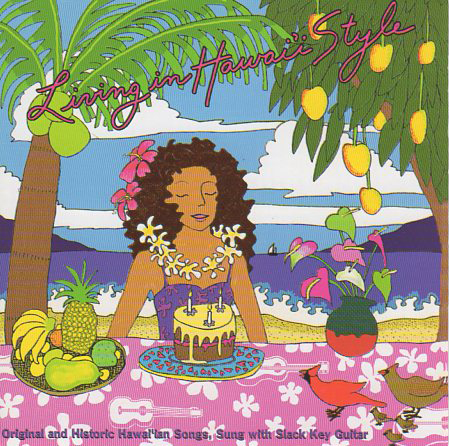
LIHS cover at 96 dpi

buy Living in Hawaii Syle

Review by Gerald Van Waes
Former radio producer and webmaster for radio show, Psyche Van Het Folk
Radio Centraal, Antwerp, Belgium
November 2005

Alicia started to live and breathe the essences of the island of Hawaii with its own special ‘heart’ energy. Like she expressed the hippie life book and album, this album expresses original and historic Hawaiian songs, accompanied by a slack key guitar with the help of Lei’ohu Ryder, singer and spiritualist with roots in Hawaiian culture, Sam Ahia, vocalist and jazz guitarist and Rick Asher Keefer, with some ukulele and percussion and vocals. Different from the previous album that seemed to have been an expression of immediate life energy, here a few song experiences have a kind of nostalgic souljazz in them even as if something is lost but still remembered. Elsewhere I feel sadness as if being an ode to the original Hawaiian joyful soul, while the historical songs are the immediate reference, while guitar instrumentals like “Sassy / Manuela Boy / Livin’ On Easy” are performed with a blues feeling. Other tracks, like the titletrack have all the luck and sunshine of Hawaii most brightly in them.

Review by Chris Roth
Founding member of Lost Valley Ecovillage
Former Editor, Talking Leaves Magazine
Spring, 2002

Our friend Alicia Bay Laurel (author and illustrator of the 1971 bestselling book Living On The Earth) has put together an album of original and historic Hawai’ian songs, sung with slack key guitar. After more than twenty-five years living in Hawai’i, Alicia has obviously absorbed much of the spirit of her adopted home—a spirit she conveys with great respect and also an effervescent joy. Most of this is lovely music about what’s good in life on an island where native culture and nature are still respected and honored by such “adopted natives” as Alicia.

Just as important, several songs point to the threats and damage to Hawai’i’s people and land done by less respectful outsiders, and a call, gently and beautifully, for a return to balance and sovereignty.

Review by Stanton Swihart
for www.allmusic.com
September 23, 2001

It took Alicia Bay Laurel nearly half of a lifetime and years of concerted study in a variety of styles before completing her debut album, but, oh, was it worth the wait. A gorgeous amalgam of John Fahey-style fingerpicking, modal passages, and lovingly sacred sentiments, Music from Living on the Earth was a sparkling stream of music pure from the heart. It took but mere months for Laurel to back up those sentiments with a second album that is every bit as compelling and beautifully realized, although it is considerably different in both tone and purpose.

Living in Hawai’i Style is, instead, a collection of Hawaiian songs – some traditional, some native and, indeed, some from the pen of Laurel herself, a longtime resident of the 50th state. Although a few have (most notably jazz guitarist George Benson), ha’oles (or “gringos”) have not traditionally been accepted with ease into the wider Hawaiian musical community. But Laurel proves herself acutely in-tuned to the nuances, subtleties, and details of traditional island styles, and the gorgeous open-key melodies or her original tunes are tailor-made to Hawaii’s deep legacy of slack-key guitar. Without debating the notion of authenticity, it can be said, at the very least, that Living is a supremely humble and giving album, both towards the listener and towards the Hawaiian musical history that it upholds and extends. That it goes well beyond is the album’s most endearing grace. Far from playing shallow and dilettantish, Living is, in fact, a paradisiacal love letter to Hawaii’s musical lore and to the place the artist calls home, and it could not honor the tradition any more than it does.

Laurel studied Hawaiian musical culture for more than two decades before even attempting to put her learning on tape (although some of the original songs date to the mid 1970s), and the album benefits greatly from that level of sensitivity and deference, as it incorporates nearly every style endemic to the islands, from ancient chant and drinking songs to a birthday tune, wedding songs, wonderfully breezy hulas, environmental anthems and songs of welcome. With ample help from the widely respected Hawaiian jazz-guitar great Sam Ahia and ravishing vocal support from spiritualist, composer, and educator Lei’ohu Ryder, Living in Hawai’i Style is every bit the blissful oasis that Hawaii often seems itself.

Review on Amazon.com by Pam Hanna
November 21, 2001

O Hawai’i!

In her first CD, Alicia Bay Laurel wrote and performed all of the songs, and it was a wonderful musical tour de force. On “Living in Hawaii Style,” other performers, writers and musicians make an appearance to excellent advantage. Alicia’s liner notes are a virtual musical primer on Hawaii – its musical history, genres, culture, geography, flora and fauna, as well as some magical personal history on how she came to know these people and places and enter into their music and their lives.

Traditional Hawaiian songs are included here (Nanakuli, from the 1890’s) as well as steel and nylon string guitars in standard and open tunings (known as Ki ho’alu or slack key) and “hapa ha’ole” (meaning half-foreign, one of a genre of swing tunes with tropical lyrics) as in “Moonlight and Shadows” with the smooth-voiced Sam Ahia.

Koa ukeleles, an ipu (gourd drum), pu’ili (bamboo rattles), pu (large conch shell used as a wind instrument), ti leaf rattles, slack key, steel and nylon string guitars, and ki ho’alu (open-tuned guitar, Hawai’ian style) are heard. Several songs, such as “Kawailehua’a’alakahonua” and “Holua, Kapalaoa and Paliku,” are sung in Hawaiian. The second of these is introduced with an original chant in the ancient style created and sung by Lei’ohu Ryder. The liner notes define Hawaiian words such as “Waikaloa” – “fresh water that is endless,” “A’a” a sharp, jagged lava and “Laupaho’eho’e” a smooth, ropy lava.”

One of my favorites is written and performed by Alicia alone (harmonizing with herself), “Ukulele Hula” – a lilting sing-along kind of song that embodies the feeling and spirit of Hawai’i. Has the feel of a years-old traditional song. “In Paradise, everybody is a lover.” Balmy, swaying breezy, rolling, it’s a “breezy afternoon and a sunset on the ocean.”

But the song that tugs most at the heart, for me, is “Kanikau, O Hawaii!”, written by Ginni Clemmons and sung by Lei’ohu Ryder and Alicia. “Kanikau” means “a mournful cry.”

“Oh Hawai’i, you’ve lost your innocence/ How can we get it back?/ Have we claimed you? Have we shamed you?/Have we spoiled the prize we’ve won?/ By taking you against your will,/Like all greedy lovers do./ Oh Hawai’i… we’re sorry/ Those who care are crying tears of shame./ ….Teach us the ways of nature,/ So that peace can end this war. Oh Hawai’i.”/
Lilting, haunting and lovely, the melody opens the heart to Hawai’i as she is, as she was.

This CD is pure pleasure. Just listen!

Review on Aloha Plenty Hawaii
by Doug and Sandy McMaster
September 28, 2001

“Any woman who has a great deal to offer the world is in trouble.” ~ Hazel Scott

In 1970, she wrote Living on the Earth which hit the bestseller list in 1971. She published 8 more books during the 70’s, and moved to Maui. Last year she released a CD entitled “Music From Living On the Earth” including 16 songs she had written at the time of the first publication.

Living on Maui and visiting the other islands, Alicia was
influenced by the musical stylings of Hawaii. She learned
traditional and contemporary songs as well as writing her
own. Spring of 2001 took her to the Big Island and into
the recording studio once again to create “Living in Hawaii
Style”. On this recording she’s joined by the Hawaiian
jazz guitarist Sam Ahia, spiritualist Lei’ohu Ryder, Rick
Asher Keefer. The recording includes several of her
originals as well as contemporary and jazz favorites.
It includes slack and standard guitar, ukulele, chants, ipu
(gourd), ukulele, and more.

It’s good to hear more women playing slack key… hence the quote I included in this issue. Having spent time in Hana on Maui we understand Alicia’s sentiments. A magical place with very special people. Her folk/pop renditions are nice and catchy. Alicia will be touring in support of her CD so watch for her coming your way… she has some great stories from her time on Maui. We met Alicia and her friend Joe atsunset by the bay.* Hope to see you there again soon Alicia!

And hope life is good for you on Big Island.

*Doug and Sandy are often found performing slack key guitar and ukulele duets at sunset at one of the beachparks in Hanalei, Kaua’i. Their music is beautiful! Their CDs are available at their web site (link above), which is a wonderful resource on ki hoalu (slack key guitar). ~ABL

Review in Newsgroups: alt.music.hawaiian
A new CD by Alicia Bay Laurel… some slack key, some jazz, some vintage Hawaiian… beautiful songs honoring her teacher and places on Maui that touched her heart. And a happy birthday, Hawaiian style, song too!

Letters

From Judy Barrett, former music industry professional in Honolulu, August 1, 2002:

I asked Led [slack key legend Ledward Ka’apana] to keep an eye out for you at the Hilo festival [the Big Island Slack Key Guitar Festival]. “She one haole girl? Kinda hippie?” Yeah, that sounds about right, I said. Turned out he’d already met you at one of his workshops in Hilo a few months ago. Said you played some of your compositions for him. I asked, “So?” He said you were pretty good. Now, I know that sounds pretty dang low key, but, from him, it truly is high praise. Enjoy it!

Sounds like you had a great time. I love that little festival!

ALOHA!
Judy Barrett

——————————————-

September 4, 2001

Mahalo Alicia,

We just reviewed your charming release “Living In Hawai’i Style”. It is refreshing to know there are still some artists performing and recording in the islands who appreciate our magnificent musical roots.

You original compositions offer a compelling story of what is happening to beloved Hawai’i. Usually, most artists only record their complaints, not solutions. You are the difference. Even though you are not native to the islands, you have the feel of the land and people.

When I was involved with the original “Hawai’i Calls” radio program, and the newer version, I always looked forward the most to the more traditional and hapa-haole numbers.

This is a most enjoyable musical experience.

Aloha nui loa,
J Hal Hodgson
Executive Producer
Ports of Paradise

————————————————-

September 12, 2001

Aloha Alicia~

I am delighted to have shared in your CD project. The songs are clearly from your heart. You are a gift to our islands. The makana who has been called to service the vision of aloha and maluhia for the world.

Congratulations on such a fine job. May you continue to heal the people in your work.

Malama pono~

Lei’ohu Ryder

—————————————————–

“What a nice recording. You did a very good job.”

January 21, 2002

Auntie Nona Beamer
Composer/Musician/Educator
Mother of Keola and Kapono Beamer
And Hawaiian Music Legend in Her Own Right

———————————————–

“I’ve been listening to your Hawaiian album.  I love it.  Every single song!  I hardly ever listen to other people’s music because my brain is just so full of my own.  Right now I’m listening to Track 3.  I love your voice; it’s so perfect, so lovely and sensual!”

June 28, 2011

Gabrielle Silva
Jazz vocalist and visual artist
Creator of the Ragananda doll, books and videos

————————————————-

I Absolutely LOVED YOUR Hawaiian CD! I especially loved your stories, like that of Auntie Alice. For those of us who had lived there and loved Paradise yet saw firsthand the impact on the old Hawaiian culture, those stories mean a lot.

I think we both saw Hawaii thru the same set of eyes while we were living there – I like the way you succinctly articulated it both here and thru the songs and stories on the CD – It will always hold a very special place in my heart, but what happened to the lovely gentle native people there was very similar to other Native Americans — yet you captured their Joy and Aloha spirit with your sweet Music, Alicia!!!!

Aloha Nui Nui,

Linda Joy Lewis
Author of vegan cookbook classic Earth Angel Kitchen

We Go to Japanese Heaven


In the morning, after Sachiho and I folded up our sleeping mats at the home of Sachiho’s dear friend Ryoko Okuda, the owner of Planet Flower (“Fashion from Nature”), a natural fiber clothing store in Osaka (who I’d met first at the Rainbow Festival, and who came to our show at Chakra and then drove us to her home to spend the night), a Buddhist monk came over to lead us in prayer in front of Ryoko’s home altar.


Ryoko’s home, a one-story house in a quiet neighborhood on the outskirts of Osaka, has, in traditional Japanese style, windows that are also doors, and tatami covered floors that change from bedroom to living room to dining room to temple as needs dictate.


Her small bedroom is full of the beautiful clothes she sells in her store.


Even the bathroom wall is blessed by angels.


Ryoko feeds us a lovely breakfast of fruit and raisin bread toast and tea, and walks us to the train. We bid her a fond goodbye. She will meet us the next day in Nara and drive us to Fumon-ji Temple.


Across from us, three generations of Japanese women snooze to the rhythm of the train, and, above them, an advertising model grins.


Sachiho and I made friends with four little girls on a school field trip.


We got off the train at Yoshino, a mountain village famous for its hot spring resorts and temples, and took a taxi to this lovely place, where we would relax for the night.


Sachiho’s friend Yatchan, a ceramic sculptor, is the son of the owners of Sakoya, the most luxurious ryokan (traditional style Japanese hotel) in Yoshino, and, for a special family-and-friends price, he has gotten us the premier suite, and the price includes gourmet dinner and breakfast, served by our own personal hostess in kimono!


We had a suite of rooms, one large room where we would sleep and eat…


…plus this lovely sitting room…


…with this gorgeous view of the mountains, with bamboo and pine forests…


…and our own outdoor hot springs bath…


…and our own indoor hotsprings bath. Plus a two-sink bathroom with a huge mirror, loads of bath towels…


…a kimono with jacket each for our stay…


…and tea served upon our arrival…


…made from sakura (cherry blossoms) with a sauce made from kudzu (arrowroot starch), two products for which Yoshino is reknowned. Yoshino is lush with cherry blossoms each spring, and packages a famous, slightly salty tea, made of the dried blossoms.

Chakra in Osaka


Handmade sign above the entrance to Chakra, an import, craft and clothing store with cafe and performance space in back, in Osaka, Japan, where Sachiho and I performed the final show of our tour together, on May 10, 2007.


On the shinkansen (bullet train) from Yamaguchi to Osaka, I spotted this ad, reminding me that (at least in 2007) the largest number of solar panel manufacturers, as well as the largest manufacturer of solar panels, Sanyo, are in Japan.


As soon as we reached Osaka’s main train station, Sachiho and I took a cab to Chakra, where we would perform that night. I got out there, and Sachiho hurried off to lead a meditation workshop elsewhere in Osaka. The store is an oasis of calm and beauty on a small back street in a densely urban part of the city.


Atchan, one of the owners of the store, came out to greet me.


Her husband and co-owner, Tatchan, joined us. I’m not sure what their formal names are; “chan” is a suffix implying endearment usually following the first syllable of a person’s given name. “San” is a suffix implying respect, and usually follows the person’s entire first or last name. (Only, in Japan, you say the family name first.) Anyway, I can see why everyone calls them Atchan and Tatchan. They are adorable.


The poster for the event features the cover of Living on the Earth! Tatchan told me that all sixty seats were sold out several days ago.


The interior of the store: musical instruments, exotic and local artisan clothing, low lights, handmade crafts, incense, East Indian music and CDs of local bands – everything for a spiritual/hip clietele…


…with all the cool accessories to match…


…even macrame!


I went out for a walk around the neighborhood. Japan’s cities burgeon with bicycles (better get out of the way if you hear a ringing sound behind you!)


I saw bike riders of all ages. Since people don’t steal in Japan, you can ride your bike (or lighweight motorcycle) to the nearest bus stop or train station, leave it there, go where you are going by public transportation, come back and bike home. Green all the way!


To my delight and astonishment, Minehiko Tanaka, an excellent sitar player, joined us for our performance that evening.


He accompanied Sachiho while she chanted sacred songs with her lyre.


I had always dreamed that someday I would be able to play my song Vai Raga with a sitar player, and that night was my night. I did a set by myself (with a volunteer translator from the audience), followed by three songs with Sachiho and Minehiko, including Vai Raga (from Music From Living on the Earth, my first CD).


I think they liked us.


In fact, I think they liked us a lot. I sold out all of the books I’d ordered, again, and almost all of the CDs.


I told everyone in the audience they’d be on my home page, and here they are. This is why I come to Japan. It’s a love fest!

Organ’s Melody in Yamaguchi


We hustled into the train station, me with newly streamlined luggage, and purchased tickets for the Shinkansen, the famous Japanese bullet train, that gets you where you are going FAST. It doesn’t stop at all that many places, so it can reach a velocity of nearly 200 miles per hour. We had to take a bus from Karatsu to Fukuoka to get to its nearest stop.


Touring by train is a science. You have to be able to carry everything you need for the gig and to keep yourself together, up a set of stairs if necessary, since not all train stations in Japan have elevators or escalators.


I need two guitars for my gigs, because I play one in an open tuning and one in concert tuning. I carry my laptop for selling my products, setting up gigs and publicizing them, reading the news, doing vocal exercises, listening to music, broadcasting the karaoke version of my last CD onstage, political activism, research, correspondence, shopping, photo editing, writing this blog, and working on other writing projects. I also need performance costumes and other clothes, toiletries, and my bag of natural supplements and immune-enhancing herbs, because travel is the immune system Olympics. Everywhere you go, someone is sneezing. For an almost 58-year-old, 105-pound woman, carrying all this by train is a marathon. But I am a muse-driven specimen of my age group, and I will do whatever it takes to get my art where it needs to go.


The Shinkansen looks like a large, dangerous snake. Inside, it’s much more comfortable than the local trains. We ate rice crackers and peanuts from the station kiosk and chatted the time away amiably.


We took a local train from the nearest Shinkansen station to Yamaguchi, a town so blessed with hot springs (on-sen) that there are public foot baths in the parks. Right next the train station stood an on-sen with a giant white fox in front, exuding the advertising cachet resulting from the Japanese national passion for cute animals. The Grateful Dead dancing bear does lots of business here.


Eizo, the owner of Organ’s Melody, a small night club (in Japan it’s called a “live house”) picked us up at the station, and he and his wife Yuki made us comfortable with a room above the club with futons and a bathroom. Nowhere to wash up, though. No problem; Yamaguchi is hot springs heaven. We even strolled over to a nearby park and had a VERY hot foot bath before the show.


The poster for the evening (May 9, 2007) featured the cover of Living on the Earth and a photo that Yuko Tsukamoto took of me performing last year at her club Yukotopia in Tokyo. There’s my name again in Katakana, starting with the letter P. Next to the photo of Sachiho playing her lyre is her name written in Kanji, Chinese characters.


In typical urban hipster style, the entrance to the club was practically unnoticeable. You had to know it was there.


Inside the club, the walls were black, the bar was stocked, and a bunch of little tables and chairs welcomed the patrons.


Up a narrow, kinda scary staircase, the dressing room displayed Eizo’s wild poster collection. This was my fave.


It was a pleasure to soundcheck with Eizo. His system was fantastic.


The opening act, a local musician known as Sensei because his day job is teaching school. He sang original songs; his friend played drum, and you had to love his traditional old style Japanese clothes.


Sachiho and I both enjoyed ourselves playing at Organ’s Melody. It’s always fun to play and sing through good sound system with an excellent technician at the controls. Afterwards, one of the patrons, who was celebrating his girlfriend’s birthday, took us (me, Sachiho, Eizo and Yuki, plus his friends) out to an expensive and fabulous Mediterranean style dinner at the restaurant next door. It was all I could do to stay in my body, between the gourmet cuisine, the happy, flowing conversation that I couldn’t understand, and the overwhelming presence of a large screen TV playing a dreamlike performance by Cirque du Soleil. After that wild meal, Sachiho and I walked in the rain to a large, nearby on-sen, and soaked for an hour. We slept well that night in the room above the club.