Natural High Festival, Day One, Evening


As dusk settled upon the Doshi campground, I could hear rumblings in the forest from the main stage of the Natural High Festival.


Earlier I had watched them set up the instruments for the first band…


…and run a sound check.


At night, the stage glowed, and the bands set the people to swaying and dancing.


People were still coming by my booth. We were all bundled up against the cold mountain night.


Morio Takizawa, one of the organizers of the festival, and a close friend of my host in Tokyo, Koki Aso, came by with his wife and daughter.


Near the stage, a charmingly fractured English eco-poem on a huge banner.


After the last band on the main stage, the people gathered around a bonfire in a nearby clearing.


The first entertainer was a Nepalese Rastafarian singer-songwriter. The setting suited him perfectly; he didn’t need a sound system, and he just relaxed with the audience and sang his songs. They loved him.


By the time he was finished, the sound system was set up at the tent near the bonfire, and the band Dachambo played their folk/reggae/rock songs. They are friends and collaborators of Sachiho Kudomi’s.


The whole band sings!


I came on after Dachambo. That’s Nambei-san, the chief organizer and audio engineer of the festival next to me, talking to the audience. I needed a translator, and I got a great one, who simply volunteered at the last minute: Jun Hoshikawa, the Director of Greenpeace Japan. He had lived on a hippie commune in California and at an ashram in India in the 1970s, he knew my book, had translated dozens of books, and wrote quite a few as well. He is erudite and witty. It worked out perfectly.

Natural High Festival, Day One, Afternoon


Wandering along the forest path, the next booth I encountered was festooned with indigo tie-dyed clothing. This color has special meaning for me. I named my business Indigo With Stars, as this is my answer to the life path question What Color is Your Parachute? Indigo with stars is how I represent the night sky, which is our constant, visible evidence that we live in an infinite universe. I consider the infinite universe the source of my sustainance, so that is how I chose the name of my business.


So, here, at this booth, I could be clad in a hoodie of indigo with stars!


And henceforth tote my belongings in indigo with stars (and a lotus!)


So, I bought them from these four women (collectively called Toshka) who made these magical indigo garments and sachels.


Next Jun introduced me to his friends, who were selling musical instruments from their booth at the festival. Left to right: Masaomi Ito plays didgeridoo. Teppei Saito makes musical instruments, some of which strain one’s incredulity. Me, happy to meet them all. Aya Uegaki, bead worker.


For instance, here is Teppei’s three-person didgeridoo, being played by Teppei, Masaomi and Aya.


And here is Teppei’s community-sized kalimba with a huge open resonator.


By now, the good folk at Kurkku were wondering when I would ever come and open my booth. So, I borrowed a tie-dyed sheet from my friends at 88 Magazine and set everything up: the Soshisha editions of Living on the Earth and Being of the Sun, the EM Records releases of Music From Living on the Earth and Living in Hawaii Style, my own release of What Living’s All About and my Living on the Earth t-shirts, the catalog and posters for Aya Noguchi’s Living on the Earth clothing line (with the scarf as a sample), a copy of the October 2006 issue of 88 Magazine, open to the interview with me. I’m wearing a festival t-shirt from the Rainbow Festival at Aso Mountain, also printed with the cover of Living on the Earth. In Japan, my dancing goddess is the icon of the Evolution.


Across the road from my booth I could see the pond with its surrounding booths…


…and next to it, a large tent for lectures, where I would do a story and music show the next day. Today my fellow author Sherpa (who I met last year here at Doshi when I lead a weekend workshop) is being interviewed about his backpacking and hiking books. He lives in a homemade house in the woods.


On the side of the festival information booth (next to mine) hung an exhilarating poster for the Kodo Drummers tour.


On the other side of me, the Greenpeace booth offered informational DVDs and books.


Sakaya Matsukawa, the director of the television documentary Setsuko is producing about my work, visited me at my booth. Behind her, the Kurkku booth display of environmentally friendly products, below curtains emblazoned with their logo.


A lovely couple brought me a gift from their artist friend Tomoko Yamada, who had been unable to come to the festival.


She had made me a colorful mobile of satin scraps, felt and cardboard, with messages lettered in acrylic paint, and weighted with pieces of wrapped candy.


At the top, a heart with the greeting, Dear Alicia-san…


On one scrap, her appreciation, which I shamelessly replicate here.


On another, the date and place the piece was made.


And, on a sail at the bottom, more praise and her name. On the back of the sail she wrote Thank You, Alicia. So, I say, Thank You, Tomoko!! I hung it outside my booth as the rainbow of hope it is. I hope I meet you someday, Tomoko.

Natural High Festival, Day One


May 19 and 20, 2007, I attended the Natural High Festival (logo above), two hours drive from Tokyo at a campground in the forest, just outside the mountain village of Doshi. Last October 2008 I lead a weekend workshop here for Kurkku. This time, I would do two performances and sell my books and CDs at a booth. Kurkku sponsored my participation in the Festival and let me use part of their booth to sell my stuff.


Soon after Jun, Ren and I arrived, we spent our lunch tickets at the vegetarian curry booth, which Jun’s chefly nose discerned as a good choice. It was! I came back for dinner.


All around us, open-air booths, handmade clothing and drums, undulating banners, and relaxed people enlivened the forest.


An air of friendliness permeated everyone.


I could hear a tabla player drumming and chanting.


Nearby, I heard a musician playing a jew’s harp. Like the didgeridoo, another favorite instrument for drone-saturated trance music, and like Mongolian and Tibetan throat singing, the jew’s harp is an instrument whose melodies are overtones created by changing the shape of the mouth cavity.


There was, of course, the requisite tipi.


There was a booth with a banner that said “Slow Life,” perhaps from the Slow Life Cafe in Tokyo, where they serve Slow Food. Slowly.


I visited the Good News booth (on the left), where tie-dyes, batik and patchwork hung for sale.


There I met Michiyo and Takeo, the owner/operators of Good News, and signed their copy of Living on the Earth. They knew I’d be at the festival and brought it along.


They presented me with one of their peace sign wash cloths. I knew I would display it on my bedroom wall instead of wash with it. So sweet.


Next I visited the Go Hemp booth, representing the Go Hemp Store in Shibuya, Tokyo (motto: “Enjoy Life”), where they were selling hemp clothing.


To my astonishment, they, too had books for me to sign, and hugs to spare. They even had me sign a t-shirt.


They presented me with one of their adorable signature hemp t-shirts.

The Diggers and the Summer of Love

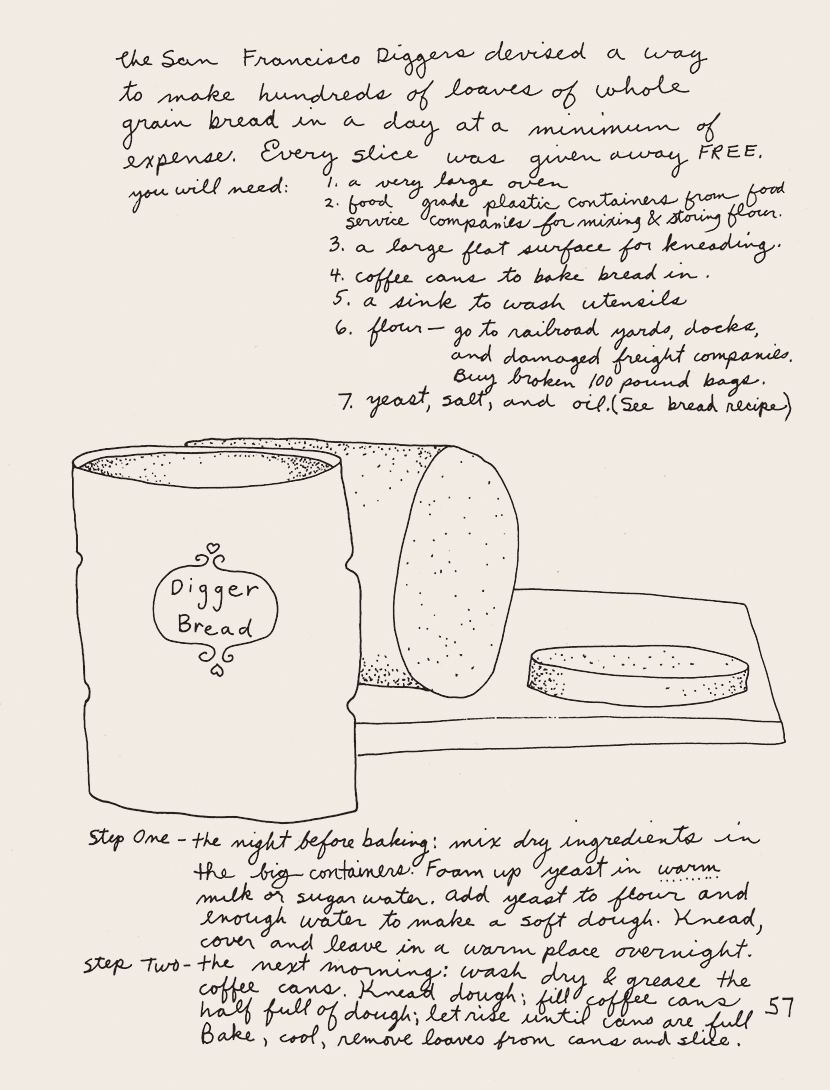
Living on the Earth-Digger bread-100 dpi
Page 57 of Living on the Earth, with the Diggers’ recipe for
mass quantities of bread baked in coffee cans to serve
for free at their 2 PM soup kitchen in the panhandle
of Golden Gate Park, San Francisco, in 1967.

Mmmm, the Summer of Love.

I was living in San Francisco the year before (1966), and, in my 17 year old eyes, it was all magic, artists and musicians, color and innovation.

I was visiting family in Ann Arbor, Michigan when the media created the Summer of Love. In March 1967, two articles about the hip scene in the Haight Ashbury appeared, one in Time Magazine and one in Esquire. Before that date, none of the freaks I met in Ann Arbor had heard of the Haight; after that date, all of the freaks I met were planning to go. Multiply that times everywhere freaks were.

When I came back after a winter of wandering, the Haight was crowded and sodden with hard drug users and dealers, winos, panhandlers, young runaways, and various religious orders trying to recruit converts. So, I settled in the houseboat haven at Gate 5, Sausalito, which, in 1967, was all magic, artists and musicians, color and innovation.  Soon I began working out of my own art studio there.

I met Peter Coyote in the Haight Ashbury Free Store one day and learned about what the Diggers were doing that summer. Now THAT was magical: The response of the resident artists and musicians to the wave of human misery that was the Summer of Love breaking over the Haight Ashbury. They fed people at 2 PM, daily, they opened “free stores” that gave away donated clothing and furnishings, they started a free clinic that still operates. It was compassion in action. May the Diggers be forever celebrated in the history of Bay Area counterculture.

Still Peace and Love,

Alicia Bay Laurel

Two Meals at Lotus House


When we returned to Lotus House, I noticed this drawing in the foyer, and was fascinated by the rows of images, which, to me, symbolized the continuity and changeable nature of experience. Rows of clocks displaying different times. Rows of musical notes. Rows of faces expressing a variety of feelings. Rows of eyes looking in different directions. Rows of hearts with pluses, minuses and question marks. Rows of I Ching hexagrams. Rows of trees and rows of cars. Rows of fish and rows of boats. Life.


Jun began to prepare the bamboo shoots to be part of our supper. First he cut them in half lengthwise.


Next he removed the inedible outer layers and upper point of the bamboo shoot, and cut the edible inner shoot into bite-sized pieces.


He also prepared pasta for lunch, and served it on (what else?) lily pad plates. I realized this was one of the very few times I’d been served food on a full-sized plate in Japan, and certainly one of the few times I was offered a fork. Usually food is served in many small dishes with chopsticks. But eating spaghetti with chopsticks is probably beyond my skill level right now. I’m not even all that graceful eating it with a fork.


Jun topped the pasta with sauteed vegetables and baby squid, brewed an intense onion soup, and tossed a green salad from his garden vegetables.


Setsuko and I enjoyed this superb meal at the table on their wonderful porch overlooking everything and God.


After lunch, Setsuko took her daily walk, and I sat down at the outdoor table to make some drawings for the television documentary. Sayaka, the director, had asked me for drawings from the animated show on which I am working now. I told her that my animation consultant, Jack Enyart, had suggested that I add myself as a character in the show, and she immediately wanted to see how I would portray myself as a cartoon character.


My character not only makes music; she plants trees.  She always has stars twinkling around her head.


The trees grow to be the centers of “guilds,” a permaculture term meaning groups of plants that benefit one another by growing in proximity. Usually a guild includes plants that not only feed humans, but, also, feed birds and beneficial insects, fix nitrogen in the surrounding soil, build biomass, provide shade and mulch, and create a moist subclimate in arid places. Many plants can grow in a small space if they are placed so that each can fill a different elevation according to their natural patterns of growth.


In the evening, all four of us gathered for a splendid meal featuring the bamboo shoots stewed with a melange of Jun’s garden vegetables. We each ate half of a small fish, perfectly sauteed. Homemade daikon pickles (from homegrown daikon) and homegrown rice completed this lovingly prepared, typically Japanese meal.


One cannot eat this rice without thinking of Jun and Setsuko’s beautiful rice paddies, which I visited the next day with their daughter Ren.

A Walk in Fujino with Jun


While Setsuko worked in her home office (preparing to send a television crew to Bangladesh), Jun gathered and prepared foods for lunch and dinner. I love taking walks and was eager to see the neighborhood, so I tagged along. First we walked to a bamboo grove just down the road where Jun would harvest bamboo shoots, which can only be accomplished in springtime.


He dug up two, enough, he explained to me, to make a meal for four people. Previous to this trip to Japan, I’d only eaten bamboo shoots from a can, and I was delighted with the delicate flavor of freshly harvested and cooked bamboo shoots. It’s like comparing canned peas to fresh peas picked from a garden.


Jun and Setsuko’s vegetable gardens, wheat and millet fields are on land about a mile from their home. Walking there, we passed a number of large abstract sculptures made by local artists. Above is an artist’s home and studio close to Lotus House, and below are some of the pieces situated along the road.

Not far from the sculpture, we passed a magnificent piece of sacred architecture:


A Zen Buddhist temple…


…with monuments in front…


…and gardens on one side.


Across the road from the temple I saw a tea farm…


…and, nearby, a pond with bamboo growing around it.


Of course, I didn’t miss the local man hole cover.


We walked into the valley where Jun and Setsuko’s gardens are.


Jun picked a variety of greens for our lunch and dinner, and then we headed back to Lotus House.

Lotus House


I left Tokyo by train the next day with Setsuko Miura, to be a guest in her home for five nights, while I did two performances at a (sort of) nearby music festival and participated with her in creating a TV documentary about my work. Setsuko, her husband Jun, and their daughter Ren (which means “Lotus”), live exemplary and extraordinary lives in Fujino (which means “covered with wisteria”), a mountain town an hour by train outside of Tokyo. There, they grow and prepare almost all of their own food (including rice), live in an energy efficient house they designed and built themselves from sustainable materials, and participate in the creation and maintainance of a local Waldorf school, a community natural farming rice field, and a permaculture center.


Setsuko and Jun both work hard to create their healthful, sustainable and elegant lifestyle and to raise a happy and broadly-educated daughter. They abandoned the traditional gender roles; Setsuko supports the family with her income as a television producer specializing in environmental issues, and Jun maintains the house, grows the food, and provides a large portion of the child care. Setsuko clearly derives inspiration and satisfaction from her career. Jun’s joy in gardening and cooking are palpable, and he is a master chef. Setsuko enjoys cooking and gardening, too, when she has time, and she adores her family. She radiates peace, joy and good health, quite unlike many of people I see commuting by train to jobs in Tokyo.


They call their home Lotus House. There’s a lotus on the front door…


…an old Chinese painting of lotus in the hallway..


…and a basket of lotus pods in Ren’s room…


…plus a pine cone collection on a window sill.


The great room looks out over a wooded canyon.


In one corner of the great room hangs a print of my painting Zephyr.


On cold days, the great room is warmed by a woodstove.


On warm days, the table on the porch outside the great room is the perch of choice.


From the other end of the porch, one can see the town of Fujino below in the valley.


Across the canyon from their home, on a wooded hillside, one of the many artists of Fujino set up a giant pair of blue eyes that seem to gaze into space.


The bedrooms and bathroom are downstairs.


I was particularly struck by the serene aesthetic of the bathroom…


…but I had to laugh when I noticed an Indonesian priapus near the ceiling in the corner above the toilet.


Every night before I slept (on an organic cotton futon in Ren’s room; she still sleeps in the same room with her parents), I took a long hot soak in the tub (gotta shower first!) It was divine.

Big Train Day in Tokyo


Tokyo man hole cover.
May 16, 2007, Tokyo. My first big change after turning 58 is that I begin to travel by train in Japan by myself, lack of language skills notwithstanding. Usually one of my friends studies the train schedules online, and hands me a paper telling me which trains to take and at what stations to change trains.

If I don’t know how to get to the next train I’m supposed to take (some stations have dozens of platforms at different levels and cover several acres), I ask the officials working in the station to help me. In one particularly large station, the friendly young man in the office actually walked me to the correct platform, which took quite a while, going up elevators and across shopping areas where hundreds of people walked purposefully in all directions. He was happy to practice his English. It was sweet, and by no means a singular occurance. I met friendly and helpful people everywhere I went.

Often I can find my own way by the signs (which are normally in both Japanese characters and in alphabetical letters), and just ask people standing near me for confirmation when needed by saying, “Seimasen (excuse me)” and stating my destination. If they start talking to me in Japanese, I say, “Gomenasai (I’m sorry). Scoshi scoshi Nihongo (very little Japanese).” After they help me, I say “Domo arigato gozaimas! (thanks so much for what you just did!)”


First stop today was in the Chiyoda section of Tokyo, to meet for the first time the literary agent with whom I’ve been doing business for years by email. Isn’t she gorgeous? This is Miko Yamanouchi, director of Japan Uni Agency.


We met for tea in the Koseto Cafe, where the walls are covered by dramatic murals painted by a famous actress. I discuss with Miko my current projects. Her English is perfect, and no wonder, she’s off to New York, or London, or Sydney, at the drop of a hat.


Next stop, I have a lunch date next with Setsuko Miura, my dear friend who produces television shows with an environmentalist viewpoint at TV Man Union. We dine at a very modern looking natural foods cafe in fashionable Shinjuku, near her office.


I have come to her office to discuss the interview-documentary that she and her crew will be filming of me the following Sunday, while I am performing at the Natural High music festival at Doshi, at a mountain campground two hours drive from Tokyo.


Colorful posters in the hall clue me to the wide variety of shows TV Man Union produces.


Sayaka Matsukawa, the director, (on the left, above) wants me to sing the songs from my first CD that have the most meaning to her: Hang Out and Breathe, and Pain and Love. I’m happy, of course, to oblige. She would like me to draw some line drawings typical of what I plan for the animated educational series for children on which I am working now. No problem. I always carry my pens. Mita Yutaka (center), the executive producer, mostly just listened as Sayaka and Setsuko unfolded the plans. Setsuko, who lived in California in the ‘70’s, and no doubt studied English mightily, translated for me.


Setsuko drew me a map so that I could walk to the Kurkku building from her office in about 45 minutes. I took this photograph from a bridge over Omotesando, an elegant shopping street on the border of Shibuya and Shinjuku. This part of Tokyo is full of trendy shops, and caters to young people especially.


I stopped into a natural foods market, and marvelled at the mix of imported, familiar products and typical Japanese foods, grown and prepared without chemicals. In the bins nearest me are organically grown mizuma (delicate salad greens), daikon (giant radishes), gobo (burdock root), and negi (green onions).


I passed a cute store selling “green” clothing (organic cotton, hemp, and other natural fibers). See the “Save the Earth” sign inside?


Here’s what Kurkku’s compound looks like from the street. There’s a garden store on the first floor, a natural foods cafe on the second floor, and a garden on the roof. Down the alley is their other building, with an elegant natural foods restaurant on the first floor, a bookstore and a “green” store selling sustainably produced clothing and gifts on the second floor, and the Artist Power Bank offices on the third floor. Both buildings were built from recycled and sustainably produced materials. Last October I performed a concert and storytelling show in the bookstore.  Next May I’ll do it again, as the opening of an art exhibit I’m having there. Artist Power Bank is an environmentalist arts notforprofit that runs Kurkku and funds community projects that raise awareness of sustainability and the environment.  They sponsored my tour last October.


When I arrived at the office, two Ainu tribespeople were visiting from Hokkaido. The woman is a fashion designer who makes clothes using traditional folkwear designs from her culture, including the beautiful robe she is wearing.


They insisted upon dressing me up in their clothing, and then instructed me in placing my hands in the proscribed mudra (hand position).


I had a productive meeting with the Artist Power Bank and Kurkku staff regarding the upcoming Natural High festival and my participation in it. Several of my friends from last October are working with me on this event, including Kaori, the translator (second from left), and Keisuke Era, the project director (third from left).


After the meeting, I walked to the Shibuya train station via Takeshita Street in Harajuku, the brightly lit shopping alley for college age and younger people. Varieties of pop music filled the air from each store, and the crowded street had a carnival vibe. Lotsa wild hair colors, costumes, tats, and piercings saunter by.


Besides the many shops selling punk clothes, sports clothes, and cutesie girlie fashion layers, there was a store with conservative shirtwaist dresses typical of the 1950’s. Is it really hip to be square, AGAIN? Although, God knows, these women have the waistlines for that style!


The only shop that lured me was an India import store. I guess I loved their handpainted staircase. But I continued to the train station, rode two trains for an hour and a half back to Zushi, took the bus from the Zushi train station to the bottom of the hill where Koki and Ayako live, and walked up to their house, well pleased that I am now able to get around on my own.

A Little Stroll in Hayama


The next day I awoke at Koki and Ayako’s house in Hayama (on the closest beach coast to Tokyo) to sunshine and soft breezes. My friends were both gone for the day, so I took a little walk by myself. I had new Turkish kilim shoes with Italian soles, and a new skirt (a birthday gift from Sachiho, made of ultra-comfortable hemp and cotton jersey by a company called Little Eagle), and I felt pretty spiffy, so off I went…


…down the steep street at the top of which Koki and Ayako live.


The coastline of Hayama, with its volcanic, green hills and luxurious homes.


I walked down to Standing Stone Park again. This time Mount Fuji was not visible on the horizon, but the Stone has an undeniable drama to it. A beach with an erection.


A plein air painter worked in the park that day. I turned to see what she was depicting.


Yes, I think I might choose this view, too, if I were into making oil paintings of landscapes.


However, for reasons I can’t fathom, when I go to Japan, I want to photograph the man hole covers.


All of them. One of each.


Even rusty ones.


But Hayama definitely has a sense of place. One homeowner painted the Standing Stone onto his garage door, including a full frontal of Mount Fuji, with snow.

Land of the Free


Here’s a free download of my matriotic anthem, “America the Blues,” the second cut from my most recent CD, What Living’s All About, featuring avant-garde guitar legend Nels Cline as the roar of the industrial-military complex (and Ron Grant, Jody Ashworth, and me as the Mormon Tabernacle Choir and Orchestra).

Happy Interdependence Day, to all people, animals, plants, planets, stars, universes and microbes.