Enchan’s Journal

What if Living on the Earth had been drawn by a young woman artist and gardener imbued with the divine Japanese sense of design? Here are some wonderful pages from En Ando’s notebook, that offer an idea of how that would look:


Solar heated shower


Hammock from a blanket


Water catchment


Keeping chickens for eggs


Centipedes. I wonder if she mentioned that chickens love to eat them?


Snorkeling!


Bathing with a hose


Hawaii and Hawaiian songs


Working with wood


Cats


Burning to recycle

Welcome to Ohshima


Map of Ohshima at the pier.


Dawn from the deck of the overnight ship; our first view of Ohshima.


We are thrilled to be here!


Magically, Hiro, a friend of Mana’s, has arrived on the same ship and is waiting for us at the pier with her car to take us to the hot springs and the top of Mount Mihara, Ohshima’s volcano. Good thing we missed the bus!


Beside the indoor hot springs pool are showers, where we clean ourselves before entering the pool.


The outdoor hot springs pool looks out upon the summit of the volcano.


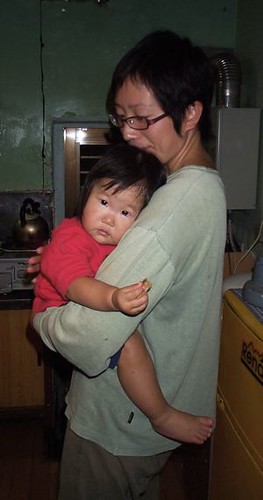
Hiro goes off to work (she’s a massage therapist), and Enchan, an artist friend of Mana’s, comes to pick us up and show us the views. Mayumi and I get up on the fence for a better look at Mount Mihara’s caldera. The last eruption occured only 20 years ago. The volcano is definitely still active.


Near the volcano visitors center, a sign showing the viewer where to look across the ocean for Mount Fuji. It’s the blue cone on the horizon, and a huge feature in the distant landscape.


The volcanic seacoast near the house where Enchan lives with her baby Mani, aged 15 months.


When we got to Enchan’s house, I took a long nap. I hadn’t slept much on the overnight ship. When I awoke, to my surprise, three people were waiting to interview and photograph me for a magazine article! Hiroshi, Maki and Takashi were good-natured about the communication mix-up, but they were also on a deadline. So, I pulled myself together, put on a lovely dress, and off we went, with Mana and Mayumi, for photos in the forest behind Mana’s house. After the magazine people left, Mana, Mayumi and I visited Junko at her very aesthetically advanced Oasis Cafe and Inn, and she served us a healing tea. Tomorrow night I will sing at the cafe.


Enchan and Mani. Mayumi and I are bedding down at their home tonight. Mayumi made pan breads with a whole wheat and raisin dough she brought from Yokohama; Enchan prepared a green salad and a pumpkin soup from her own organic garden produce and sashimi with cayenne pepper from a fish caught two hours earlier off Ohshima. Mana gave us freshly prepared brown rice, and excused herself to go teach a class. While I happily cleaned up after dinner and did the dishes, Mayumi played my guitar and sang for us.

The Night Ship to Ohshima


Last night in Yokohama Harbor, at 10 PM, Mayumi and I boarded an overnight ship bound for Ohshima, a small volcanic island close enough to Tokyo to be included in its city limits, but far enough away to be another world, like Martha’s Vineyard is to Boston, or Catalina is to Los Angeles. We will visit our mutual friend Mana, who introduced us.


What you get with an economy ticket is a tatami sized piece of the carpeted area onwhich to sleep and keep your things. Mayumi and I are amused.


For 100 yen, you can rent a blanket. The black foam filled headrests are free. Pretty soon everyone is tucked in, and at 11 PM, the ship’s crew turns the overhead lights off. You can still see your way around easily with the hall lights, which remain on.


I see recycling containers everywhere I go in Japan, and the ship has six different ones at each staircase.


Toilets are traditional Japanese style; you squat, which I think is much healthier than sitting on your thighs western style, since you can actually use your abdominal muscles in a squat, and avoid straining your rectum.


There is no way I can fall asleep to the immense growling of the ships engines, so, I don’t. No one else seems to have this problem, but, so what.  The hour until the lights go out seems like as good a time as any to practice guitar. My Pro Series Traveler Guitar is practically silent, and it comes with a stethiscope (the diaphragm is built into the guitar body and the tubes to the earphones detach) so that you can hear yourself play without using an amplifier.


It’s a pretty good sounding guitar; I’ve been using it professionally for a couple of years now. It’s got two pickups with separate volume controls, one that sounds more electric and one that sounds more acoustic, and you can blend them for a third sound. It has a full sized fretboard, but the tuning pegs are in the center of the guitar (where the sound hole would be on an acoustic guitar), and the lap-rest on the bottom of the guitar detaches and then reattaches so that the guitar is ultra-compact for traveling. No one has ever hassled me about bringing it on an airplane. It’s the size of a soprano ukulele and easily fits in any overhead compartment. And it’s not an expensive guitar.

With Mayumi in Tsurumi


Man hole cover on a Yokohama city street


I am visiting musician, dancer and bodyworker Mayumi Hirai in Tsurumi, the section of Yokohama closest to Tokyo. Today she took me on a magical walk around her neighborhood.


We walked along the Tsurumi River where it flows through an industrial landscape to the sea.


We passed a little karaoke bar with a bit of everything in its decor.


Mayumi showed me three beautiful old temples, and we silently prayed at the entrace of each one.


A trio of holy statues at the entrance to a temple garden.


Before we approach the temple, we clean our hands and souls with spring water from the mountain on which the temple stands.


Dragon fountain in the temple garden.


A shrine for children next to the temple.


A Shinto shrine.


Leaving the Shinto shrine through the torii.


Down the stairs below the torii.


The Buddhist temple where the Hirai family’s ancesters lie.


The magnificent interior of the Buddhist temple.


Funerary statues in the cemetery behind the Buddhist temple.


Mayumi brings water to refresh the spirits of her ancestors.


She tenderly pours water upon the tombs of her family members.


We return to Mayumi’s apartment on a quiet side street, downstairs from her parents’ home, to which she returned five years ago after decades of travel and learning. She prepared us a scrumptuous lunch of healthful traditional Japanese foods–lotus root, edamame, tofu, sea vegetables.  Now, while I am writing this blog, Mayumi plays her shamisen. Sometimes life is just SO good.

Performing at Yukotopia Again


Tonight at Yukotopia, we blissed out to four acts, including mine. Doing the What Living’s All About show two nights in a row freed me to take new risks, especially with my choreography. I am having the time of my life.


In an ultimate act of courtesy, the club posted signs requesting that patrons not smoke until after I had finished my set. I didn’t ask for this; it’s a perk from Sandy Rothman’s residence, since he requested this on the nights he played.


First up: Catch and Release, a very large group (nine people this time, but Yuko says the personnel varies from show to show, as the group has an open policy about friends sitting in. Yes, that’s a digiridoo player on the left.) The overriding feeling was Family; the woman singing up front also works at Yukotopia tending bar, and her parents play in the group. They played trance music, that is to say, mostly, instead of songs, they improvised over one and two chord drones, although they also performed the Grateful Dead classic Uncle John’s Band.


I was next. With a sizeable contingent of the audience comprised of the members of the other three bands, the support, if possible, was even more enthusiastic than the night before. God bless the deadheads of Tokyo; they do enjoy their musicians, and the musicians appreciate each other’s work.


After me came Strange Taste, which, like me, is a singer/songwriter driven act whose songs sizzle with political outrage, humor, sex and love. Wonderful blues, reggae, singing, instrumental solos. Good fun, altogether.


Last up was Pineapple Tom, another large trance band (seven players), but this group is all about focus and sophistication, with lots of cleverly arranged musical figures, at the same time as an almost free jazz quality to the improvisation. I say “almost” because the rhythm section churned forth danceable beats, of which the audience took advantage. Good free jazz will blow your brains, but only a modern dance troupe would dance to it.


On both nights some of the deadheads brought their kids, who danced, played, and generally enjoyed themselves in the night bar scene. These two kids danced plenty, and the baby came up to me and held my hand and laughed. Yuko and Roku have three kids, and I could tell they enjoy having little ones in the club. I sure did.

Performing at Yukotopia


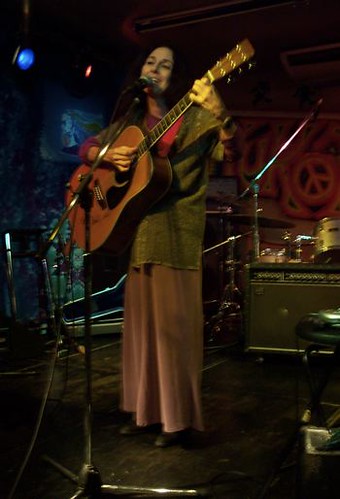
Tonight and tomorrow I perform at Yukotopia. I’m singing and playing guitar to a CD of ten of the twelve cuts from What Living’s All About, minus my voice and guitar tracks, prepared for me by Scott Fraser at the time he mixed and mastered the CD last spring.


What’s different about the What Living’s All About show from the shows I created for my first two CDs is that I perform them standing up, and on some of the songs I don’t play guitar. That leaves a space for a new performance realm for me: dance. I don’t leap about, but I definitely use my whole body and face to convey the song.


The first act onstage: Here’s to Theres, a bluegrass/rock/folk band celebrating its twentieth anniversary this year, and no wonder; each player astounds with virtuosity. Aki, the vocalist, has loads of personality and energy.


I played second, and the third and final act was Sandy Rothman’s Anniversary Band, with Ken and Tak on vocals and guitars. Sandy invited up the violinist from Here’s to Theres. Everyone fell into bliss listening to the string and vocal harmonies cascading from these prodigious players.


Mike Miller, brother of Tim Miller, who chaired the Communal Studies Conference, and his wife Val, live in Tokyo, where they write for Reuters News Service. At Tim’s recommendation, they atttended my show at Yukotopia. Sweet people! Val’s a folkie multi-instrumentalist, and Sandy’s band reminded her of old times when she played in a band of like mind.


The afterhours crowd at Yukotopia.

Dead Heads Land


Look for this sign above the door and you know you’re at Yukotopia.


Tonight I visited Yukotopia Dead Heads Land Night Club where its fifteenth anniversary party is in full swing, featuring Sandy Rothman, a masterful multi-instrumental player from Berkeley who had played at the grand opening and the tenth anniversary festivities as well. Sandy played in several bands with Jerry Garcia, and sings with the same kind of friendly, slightly sardonic, laid-back delivery for which the Dead are known. The three other players live in Tokyo. Lots of joy emanated from the stage during their sets and the audience loved them, too.


Meet Roku Uehara, the club manager and sound engineer, Yuko Tsukamoto, the club owner, and their friend, Masahiko, the official club photographer.


After Sandy and the Anniversary Band played their acoustic sets, the Warlocks played a couple of electric Grateful Dead sets and the audience danced.


Everyone in the room at least swayed in their seats to the band, but most were full on dancing.


Yuko’s got all kinds of Grateful Dead items for sale—books, DVDs, CDs, Jerry Garcia dolls, tie-dye t-shirts, and posters.


Dead head tie-dye on the ceiling.


Poster for this week’s events.


Yuko and I enjoyed our dinner at a sushi diner just down the street from the club, with this cool, super slow conveyer belt that circled three sushi chefs who constantly replenished it with dishes of sushi. Each dish cost $1. Not everything in Tokyo is expensive, it turns out.

Welcome to Japan


“Cat hope welcome you cat’s happy home!”

At the end of a thirty hour day that included crossing the International Date Line and being sidelined by a typhoon, which closed Tokyo’s Narita Airport for several hours while our plane waited at the airport in Osaka, I lay my weary bones upon a floor futon in a tatami room and breathed in gratitude for Toyko’s remarkable hospitality. Dear Koki Aso waited for me for EIGHT HOURS at Narita, sweetly and cheerfully, and delivered me to Yuko Tsukamoto in North Tokyo, who waited up for me until 1:30 AM, and stayed up with me another hour to make sure I was comfortable. I am fortunate indeed to have friends such as these.

I discovered the little box above on the bathroom shelf in Yuko’s family’s apartment where I am spending four nights.

After the Communal Studies Association Conference

October begins and the Communal Studies Association Conference ends. I bid a fond farewell to my friend Tim Miller, who chaired the conference and had invited me to perform and speak at it, and who wrote a wonderful foreword to the fourth edition of Living on the Earth, chairs the department of Religious Studies at University of Kansas at Lawrence, hosted my visit to Lawrence in 2000, when I did a concert and booksigning there, lived on a rural hippie commune himself in his younger days, and has published immense amounts of scholarly research on communes through the ages. And a dear heart as well.


I drive south along Tomales Bay.


I come to the end of the bay, where the Bolinas township begins.


View of Stinson Beach, Bolinas, and Bolinas Lagoon from the cliffs of Highway One.


View of San Francisco from the cliffs of Highway One, just before I pass Muir Beach.

Communal Studies Association Conference, Day Two


Today Ramon, Delia, Art and I shared our experiences and fielded questions as a panel on northern California communes. I think the point I am trying to make in this picture is about bonding.

My sister, a psychologist, taught me that physical closeness with emotional openness (which she calls bonding) is a human need on the level of food, air, and water; certainly babies die when they are deprived of it. She says that bonding is scarce in modern societies, and that lack of bonding is the source of much of what we call mental illness. I think that the hippie communes of the 1960’s grew out of a hunger for bonding and the deep relaxation derived from an abundance of it. The bonding that we offered one another created relationships far more deep and durable than those with our blood relations, indeed, here we sat, Ramon, Delia and I, as close as family members nearly forty years after we met, due to the immensely intimate experience of living outdoors together in an anarchistic society.


I found homes for a whole bunch of my books, CDs and t-shirts among the attendees of the conference.


In the late afternoon, Nicholas Alva presented his musical Morningstar Idyll, based on the story of Morningstar commune, with songs by Ramon Sender, Joe Dolce, me, and others. Steve Fowler, an actor formerly with the San Francisco Mime Troupe, and a neighbor and long time close friend of Lou Gottlieb’s played him so closely I felt he was channeling Lou’s spirit. Delia’s son Jeremy Sharp played Ramon Sender. Nick himself narrated, and a colorful cast of Gen X and Gen Y folks sang and danced the parts of the hippie folk. I was moved to tears when the full cast sang and danced my song “Thanksgiving Hymn” (the fifth song on Music From Living on the Earth). Afterwards, the cast presented me with a bouquet.


Boats on Tomales Bay as seen from the Marconi Conference Center.