Christmas in Noe Valley


The street sign at Noe and 24th Streets in San Francisco, decorated for the holidays.


I took at walk on 24th street, the shopping promenade of Noe Valley, an upscale bohemian neighborhood in the Mission District of San Francisco on December 1st. The famed San Francisco “painted ladies,” beautifully restored Victorian buildings with exterior details stylishly embellished to be more visible, house many of the shops.


The art supply store.


Corner of Castro Street and 24th Street.


Global Exchange, the Fair Trade Gift Store, features imported crafts and folk art from artisan coops in third world countries, often using recycled materials. As an alternative to supporting local artisans, these tasteful holiday tchatchas rest easy on the shopper’s conscience.


For example, here are colorful baskets made in Nepal of recycled food wrappers.


The Global Exchange policy posted at the front door. No sweat shop items here.


A glorious Victorian building with a Mayan restaurant on the first floor.


Moon over the roof of the Noe Valley Ministry, where concerts, lectures, yoga classes, bellydance classes and a pre-school share the space with a church congregation.


A mural on 24th Street in the Romantic style.


Noe Valley Music, a friendly place to buy a guitar, which used to be co-owned by my friend Dale Miller, a guitarist who, like me, was inspired by John Fahey.


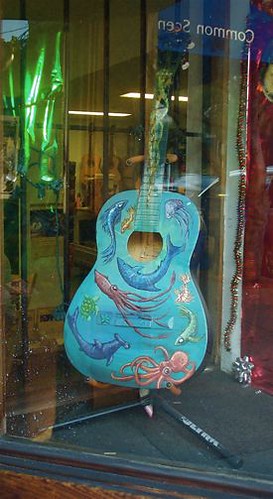
In the window of Noe Valley Music, a guitar painted with sea creatures.


A grouchy right-wing realtor wishes “all” a Merry Christmas from his storefront.


The oriental carpet dealer’s charming storefront.

The Interview in Hachi Hachi Magazine


So here’s the magazine interview with me that Takashi Kikuchi wrote for 88 (pronounced “hachi hachi” in Japanese) Magazine, a permaculture journal printed with soy inks on recycled paper. Kikuchi-san is the editor, and he was assisted by Maki Ozawa, who interpreted for us. They flew over to Ohshima (island) to interview me, and they also interviewed me at Koki Aso’s house in Hayama, since he and Kikuchi-san are friends. Every one of the 88 covers is a work of art. I recycled the cover of a May 2005 issue into the shoe box shrine I made at Doshi Camp in Yamanashi Prefecture at the Kurkku weekend workshop.


Page one of the November 2006 issue. This photo of me was taken in the forest in Ohshima, on the path to the ancient style rice straw hut. The way the embroidery on the dress echoes the curve of the ferns is a tribute to the superb designer’s eye of the photographer. His name is Hiroshi.


Page two. Behind the writing is an illustration from Living on the Earth of a girl awakening at dawn at her mountain encampment to the sound of a bird calling. She sits up nude in her sleeping bag, wherein her lover still snores. It’s got to be one of the most evocative drawings in the book.


Page three. Now here’s a wink from the Universe. In 2002, when Mana Koike and Sachiho Kojima came to Hawaii Island and recorded a CD of Tara songs onwhich I sang backup, Mana came to visit me at my home, and I gifted her with a Japanese language edition of Being of the Sun. The book had been out of print since the 1970’s, and Mana thought she might want to re-publish it herself. I was thrilled with her offer, but not counting on it, either. When Kikuchi-san and his crew came with me to Mana’s house in Ohshima, Mana showed him her copy of Being of the Sun, and he had Hiroshi, the photographer, take this picture of it next to the Japanese edition of Living on the Earth. Not long after the magazine came out, I received an email from Soshisha, Ltd., which had published both books in the 1970’s and still publishes Living on the Earth, to discuss publishing Being of the Sun again.


Page four. Again, the graphic designer for the article has chosen one of the other most evocative drawings from Living on the Earth – the title page image of a young man and woman dancing on a hilltop under a moonlit sky while a dog dances beside them. I’m looking very serious in the photo at Koki’s house. I’m probably discussing politics. I wish I could read the article! I wanted to get it translated for my blog, but, mercy, it’s 5 to 15 cents per character, which adds up to hundreds of dollars! Kikuchi-san (“Kick” is his screen name) sweetly featured my new jazz CD, What Living’s All About in a sidebar, with its cover art that echoes the image of ecstatic dancing in nature by moonlight.

Taxi Road Rally 2006, Day Four


The first two people in line for the Saturday Mentoring Luncheon were me and Vivi Chu, a feisty schoolteacher from Minnesota who plays an ancient Chinese instrument called the guzheng, from which the Japanese koto evolved. She recently released a CD of twelve original compositions with one thousand year old Chinese lyrics. “Why do performers care so much how about how they look?” she wondered aloud, “They are only there to make sound.” I thought about it and said, “Some listeners don’t really listen. They only know what they see.”


The mentoring luncheon: nine music biz aspirants and one rotating mentor per table. Maybe twenty tables in the banquet hall? It was vast. We had five mentors in total during our hour and half at the table, including Jai Josefs, Jason Blume, Liz Redwing, and Dan Kimpel. Our mentor in this photo is Ronan Chris Murphy (standing next to me).


After lunch I attended Bobby Borg’s talk “How to Market Your CD and Create a Buzz on a Limited Dollar Budget,” a standing room only event. I discovered that even note-taking has gone digital. It seemed like a good idea until I considered that I would probably make readable notes at home when I watched the class again, so why not just do it the first time?


I got to hang out and play some of my music with Jai Josefs later in the day. Turns out he produced a record of my friend Sophia Songhealer some years back, and he knows film composer, Ron Grant, who co-produced my CD What Living’s All About.


The 2006 Taxi Road Rally came to an end. I bid my new friends a fond farewell, got in my car, and flowed out onto Hollywood Boulevard, becoming one with the glowing Hollywood night.

Taxi Road Rally 2006, Day Three


Another bright blue November day on Sunset Boulevard on the way to the Taxi Rally. In LA, you don’t have to look in the newspaper to see what movie is opening soon. Gargantuan movie posters take up the entire sides of tall buildings, as well as enormous billboards, and the sides of buses and bus stops.


I could hardly wait to hear Nancy Moran’s lecture “Alternative Markets and Outlets for Songwriters and Artists Who Don’t Fit the Commercial Mold,” and I was not disappointed. I took six pages of notes, dense with information about alternative performance venues, radio stations, sales venues, and song markets.


I met Adam Rauf, mathematician, guitarist and percussion player, and Eric Belcastro, drummer, percussionist and guitarist, of the Pittsburgh instrumental group Kalon. Eric bought a copy of my book, Living on the Earth, which endeared him to me immediately. He said he wants to live off the grid someday.


Adam and Eric gave me their CD “Dark Sky, Bright Sun,” with a wonderful cover painted by Eric’s father Mario Belcastro, which amazed me because of its similarity to two of my CD covers: Music From Living on the Earth (a naked goddess smiling at the sun and the sun at her) and What Living’s All About (a girl waltzing with the moon over the ocean).


I cruised around the Music Biz Bookstore in the Silverlake Room, where the teachers and mentors offered their books, CDs, DVDs, and brochures. This lovely girl with rings through her upper and lower lips had devised a simple marketing strategy, which I know worked well for Lawrence Welk.


At the end of the day, I bought a Boss Dr. Rhythm DR-3 Drum Machine for one third off at West LA Music’s booth in the Grand Ballroom. My 1984 Roland TR 505 had exceeded its dotage, and a replacement had been on my shopping list a long time. It’s the second time in three years I’ve bought a piece of equipment from Noel Gould, their friendly and astute sales manager. And, yippee, he bought a copy of Living on the Earth, too. Those two books paid for my first three days of parking at the Hollywood and Highland mall.

Taxi Road Rally 2006, Day Two


I decided that the best use my time at the TAXI Road Rally would be taking “Driver’s Ed” classes on marketing songs and performances. It was a good choice; I came away with dozens of new options to explore.


My first class was “Indie Artist Marketing, Touring and Promotion,” with Gilli Moon, an Australian singer/songwriter with a lovely voice. She had just returned from a tour with John Cleese of Monty Python fame. “Think about what makes you and your act unique,” she advised. “For me, initially, it was my accent.”


When she said that she often has to reassure students who tell her that they are too old to go on the road as singer/songwriters at, say, 43, I raised my hand and said, “I’m 57 years old, and I just came back from touring a month in Japan.” The whole room erupted in applause. For the rest of the conference, people came up to me and said “I was there when you said…”


I met the adorable Pam Passmore, a singer/songwriter whose bread-and-butter job is entertaining at children’s parties.


My 15 minute individual mentoring session with Fuzzbee Morse (“Composer/Producer/Songwriter/Multi-instrumentalist who has played with Bono, Frank Zappa, Peter Gabriel, Lou Reed, Aaron Neville, and many more. Has had songs and scores in many films and TV shows with Paramount, ABC 20th Century Fox, Comedy Central and on labels such as A&M, Universal, Epic, Geffen and Warner Brothers”) consisted partly in his listening to Floozy Tune and America the Blues, and mostly in remembering our late, great friend in common, Steve Gursky, who was a famous recording engineer in the ‘70’s (Crosby, Stills, Nash and Young were among his clients) and who designed my first tour website in 2000.


I didn’t sign up to pitch my music to industry professionals, but lots of other people did. I’m content with self-producing and independently releasing my CDs and am not looking for a record deal. One thing I hear over and over again at this conference is that digital downloading is obsoleting the big record company/big record store/big hit record paradigm, and now what’s happening is that consumers are buying individual cuts over the internet and uploading them on their iPods, the more diverse in style, the better. That works for me.

Taxi Road Rally 2006, Day One


Five days after I flew back to Los Angeles from my month-long tour in Japan, I drove over to the Hollywood Renaissance Hotel in the Hollywood and Highland shopping and theatre complex (above), to attend the Taxi Road Rally, a four-day songwriters convention put on by Taxi, an independent A&R (“Artist & Repertoire”) company.


Taxi solicits performing artists, and compositions and songs from its members on behalf of record, television, and film producers, as well as for digital download companies and for libraries that sell music for advertising, video games, ring tones, and so forth. Taxi screens the submitted material and sends on what it considers appropriate. Because it performs this valuable function, it attracts many music buying entities, and, because it attracts many music buying entities, it attracts many songwriters and composers. Once a year, Taxi puts on a convention for its members, free of charge, offering classes, panel discussions, mentoring, and an open mic each night.


I joined Taxi last summer after releasing What Living’s All About, because I thought I could license my songs for performance by other artists. I realized quickly that the types of music I have created and the types commonly requested by the commercial music industry don’t overlap much, although occasionally I see a listing requesting something “quirky,” “like Tom Waits,” or “50’s style jazz” that the WLAA songs might fit. When they say “singer-songwriter,” what they mean is someone playing acoustic guitar rock and roll style, and singing about weird circumstances in a breathy voice. There’s a big market for that these days.


I don’t know how many thousands of songwriters attended the conference. It looked like at least two thousand to me. I loved being surrounded by other people who hear voices in their heads and actually do something about it. There was a sort of oximoronic quality to an event with a corporate format, attended by the very fringes of bohemian society, a convention of the unconventional.


Nonetheless, the hords of songsmiths and nightingales stood in long lines to register for the conference, receive badges, purchase luncheon tickets and carry away bags of advertising. We are a market, supporting magazines, professional organizations, music stores, equipment manufacturers, software writers, life coaches, career advisors, music and business teachers, authors and publishers. These were all present at the conference, fishing. And we were there, fishing, too. Everyone looked hopeful.


After we registered for admission, mentoring sessions, and luncheons, we gathered in the Grand Ballroom, where Michael Laskow, founder and CEO of Taxi offered a heartfelt welcome, and his thanks to the many who worked hard to make this event possible. “Every year,” he told us, “I swear I will never do another one of these again.” It was an endearing remark. Certainly none of us would have even done the first one.

Goodbye Wonderful Japan


Koki and Ayako with me at our farewell dinner
After our pottery district walk, Yoko and Tetsuya drove me and Koki to pick up our bags and catch our plane back to Tokyo. Kawashi and Hiromi came to see us off as well. Sachiho could not, and who could, after the marathon of festivals, performances and parties that she had just created? I could only imagine she was doing what I would have been doing: lying still and breathing.

A couple of days later, Koki took me to downtown Kamakura’s shopping district, where we paid our respects to Ayako’s grandmother in the cemetery of the gorgeous old Buddhist temple where she is interred, and bought the ingredients for a farewell dinner I would prepare for Koki and Ayako, Morio and his wife and daughter, for Miura-san and for Mayumi Hirai, who I hadn’t seen since we sailed back from Ohshima.


Miura-san, me, and Mayumi Hirai
I decided a Mediterranean menu would best suit the occasion, since it represents my heritage, and would consist of dishes my friends rarely were served. In the wok, I made a rich ratatouille, and I marinated chicken breasts overnight in a garlic vinaigrette to grill on the hibachi. I made a green salad with halved cherry tomatoes, chopped scallions, black olives, avocado, watercress and romaine, dressed with olive oil, balsamic vinegar, salt and pepper. Koki barbequed the chicken while I labored over the ratatouille. Of all the ingredients, the most exotic and intriguing to the Japanese palate is balsamic vinegar.  Ayako was amazed to discover she could buy it at her corner grocery store.


Morio, his wife and daughter, and me
Japanese people do not heap large helpings of food on big plates as we do in the USA. They serve very modest portions on a cluster of small plates and bowls. So, even though I served the Mediterranean dinner “family style” in the wok and large bowls at the floor table in Koki and Ayako’s main room, the meal ended up looking Japanese, portioned into their beautiful dishes. And, in typical Japanese style, lots of small gifts were exchanged. But, in California style, which evidently had invaded Japan since I last visited in 1974, lots of hugs were exchanged, too.

The next day Koki and Ayako drove me to Narita Airport, an astonishing place when I think about every other airport I’ve traversed. Friendly airline employees actually HELP YOU move your luggage. And it includes restaurants you’d actually patronize even if they weren’t at an airport (sorry, Wolfgang Puck). After I checked in my bags, we had some excellent sushi at one of these establishments, another one with a conveyor belt from which you could choose, or you could call out to the sushi chef for a custom order (which Koki did on our behalf).


After lunch, we hugged goodbye for a good ten minutes and then I proceeded through the security check, and even THAT was friendly. As I was about to go down the escalator to immigration, I saw Koki and Ayako on the other side of the glass wall, waving goodbye. I kissed them goodbye through the glass, we all laughed, and then I was on my way back to Los Angeles.

The Pottery District of Naha City


Yoko and Tetsuya Nema took us (me, Koki and Hiromi) on a walking tour of Naha City’s pottery district, which lies adjacent to the Peace Street Market. We were joined by Tetsuya’s cousin, Keiko, who works in a ceramics studio, and her friend, a photographer.


Nearly every Okinawan house has a pair of shisa figurines attached to it as protectors against evil spirits. The shisa is neither dragon nor dog, but has the features of both. In each pair, one has an open mouth and one a closed mouth . Some shisa look intimidating, but many are comical, even cartoon-like. Since both residents and tourists buy shisa, the pottery district of Naha City fairly bulges with wide-eyed, toothy specimens.


We visited a factory where shisa are formed in ceramic molds and the details carved by hand.


We discovered that the feline residents of the pottery district are not the slightest bit intimidated by the shisa, and maybe even a little bored with them.


One of Yoko’s friends owns and runs this lovely shop without shisa, just elegant ceramics and textiles. I bought four unique placemats batiked with floral designs on natural indigo by a reknown Okinawan artist. I gave them to my mother, who liked them so much she has decided to frame them.


We stopped for tea at a pottery school with a ceramic dragon set into an exterior wall.


The teacher at the pottery school expertly turned out one perfect cup after another on the potter’s wheel.


We walked past a very old traditional Okinawan house whose roof is secured with fishnet against the ravages of typhoons. The house is not liveable, nor can it be restored without destroying it, but it’s a historic site, so it is not disturbed.


The street entrance to the compound of which the very old traditional Okinawan house is part.


Across the road from the old house stands an intriguing curved wall, set with scale-shaped ceramic tiles, reminding me of the snakeskin sanshin and the sea snake remedies.


I almost got run over by a bicycle photographing the Naha City man hole cover design to add to my collection. Who said blogging is for couch potatoes?

Halloween on Peace Street


Koki and I checked out of our hotel rooms (but left our baggage with the front desk) and set off on the municipal railway to downtown Naha City and the immense, old, indoor southeast Asian style marketplace where we could visit Yoko Nema’s shop, Tata Bazaar. Over one of the market’s many entrances, a sign bearing the market’s name, Hewa Dori, which translates to “Peace Street.”


Illuminated by skylights, a labyrinth of hallways lined with shops goes on for several city blocks.


It’s Halloween, and wee Okinawan goblins campaign for candy from the shopkeepers and line up for group pictures in the hallways of the marketplace.


The meat market has a huge mask hanging even when it’s not Halloween. Up the escalator is a food court offering many Okinawan and Japanese dishes. It was there I first ate ika sumi soup (squid ink soup) and a rich tofu made from peanut milk.


Rainbow-colored parrotfish abound on Okinawa, a coral island. The parrotfish has a powerful jaw made for scraping algae and other small creatures off of coral, and possesses the ability to change gender. When the alpha male fish of a harem dies, the alpha female fish will become male and lead the school.


One of the pickle merchants kept plying us with samples, not only until we bought from her, but afterward as well. I tasted one I really liked and bought a small container of it. Later on, Koki asked me if I knew what it was made from. I did not. Koki told me it was made from jellyfish and pig’s ear. Okinawans particularly enjoy pig’s face, and many were displayed for sale in the meat market.


Next we stopped by a shop selling medicinal supplies. Black coils of dried sea snake, reputed to be excellent for healing problems with the eyes, hang above the packaged goods on the right.


A row of sanshin, the three-stringed Okinawan banjo, a descendant of the Chinese three-stringed lute, the sanxian. Like the sanxian, the sanchin has a snake skin covered resonator, in contrast with their larger Japanese descendant, the shamisen, which is traditionally covered with the skin of a cat or dog. All three instruments have three strings – and the names of all three instruments mean “three strings.”


Tata Bazaar’s colorful sign and merchandise welcome the passer-by. Yoko buys all of the merchandise herself, frequently traveling all over Southeast Asia and India. Some of it she designs and has manufactured by artisans in the countries she visits. This is definitely my kind of candy store!


Yoko and Tatsuya Nema welcome me and Koki Aso to their store. I had just gotten paid the night before for my festival gigs, and could hardly wait to spend some of my yen in their store, but that didn’t stop them from showering me with gifts!


Yoko drew a whole line of postcards featuring goya (bitter melons), the favorite vegetable of Okinawa. In this drawing, a trio of goya plays traditional Okinawan instruments (including a shansin), and a troupe of goya perform an Okinawan folk dance.


I am honored to report that at Tata Bazaar in Naha City, Okinawa, you can buy the Japanese edition of Living on the Earth, the Japanese releases of Music from Living on the Earth and Living in Hawaii Style, and my own release of What Living’s All About. And, as soon as Yoko can get the size XL organic cotton Living on the Earth t-shirts resized to more popular Asian sizes (like S, M and L), she’ll have some of them on the shelf, too. Now Hawaii, there’s a place you can sell t-shirts in size XXXL, but probably not with a naked lady on them.


(Three weeks later) Wow, Yoko just emailed me this photo. She made a scaled down t-shirt! And she models it gorgeously.


Goodbye Donto-in


The next day after the Soul of Donto concert, Sachiho threw an informal goodbye party at Donto-in for the musicians who came from Tokyo (and Aso Mountain in Kiushu) to play in the show (and who had played in a much larger Soul of Donto concert in Tokyo last summer). She began by arranging flowers for the altar, unwrapping all the packages of cookies and candy that had been amassing as house gifts on the altar and placing them on plates, and then arranging drinks and plates of sashimi and vegetable dishes on the dining table.


She lighted the sconces and unveiled the White Tara thanka.


At sunset, people gathered on the front porch, at the dining table, and in the altar room and passed around the various bottles and plates of food. Nonoa and Song Matsui played a singing and hand slapping game with some of the adults. Auta Matsui and Nala Kudomi hung out together and laughed a lot.


Considering that I don’t speak Japanese (YET!), I had a wonderful time with these new friends. I helped Kameya Matsui (next to me) with her English homework (Koki said not to tell her the answers so she’d have to figure them out, but I couldn’t help it). Toward the end of the evening, Kawashi drove Koki and me up to Naha City, where we each had a free hotel room that came with our round trip tickets from Tokyo, and, since we planned to sightsee in Naha City the next day until our evening flight back to Tokyo, this proved to be very convenient. On the top floor of this brand new hotel were bathhouses for men and for women, so, as soon as I got my luggage into my room, I threw on a robe and went up in the elevator to have a long, hot soak. The next morning, I soaked again. My inner monkey was happy.